
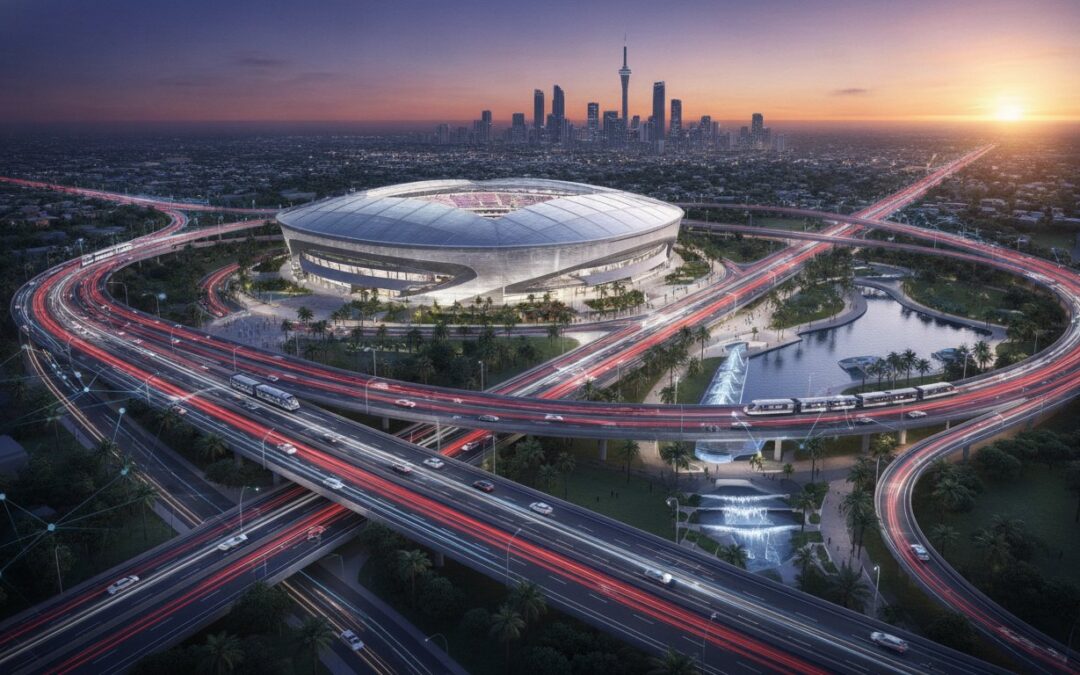
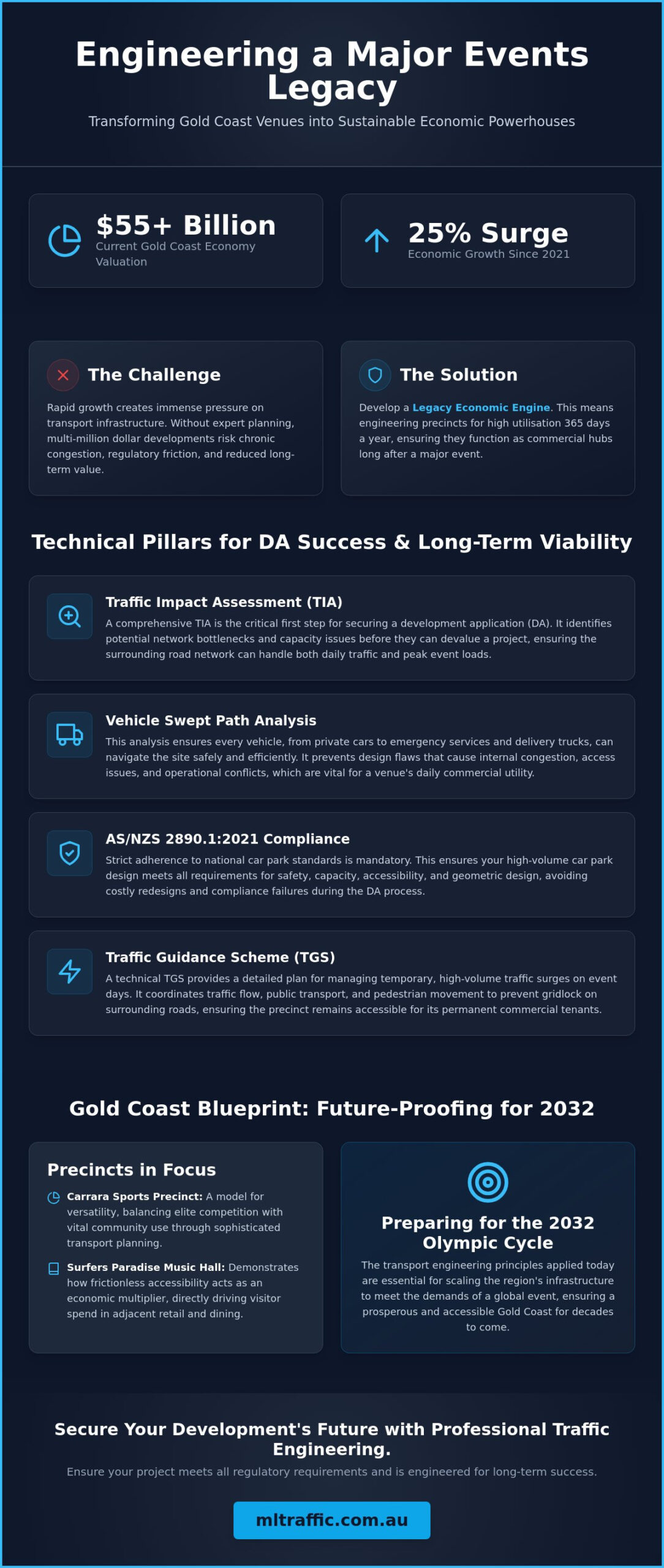
Did you know the Gold Coast economy has surged by 25% since 2021, now exceeding a $55 billion valuation? For developers and local authorities, this rapid growth presents a clear challenge: a major event precinct only becomes a sustainable economic engine when its transport infrastructure is engineered for both peak event loads and daily commercial utility. You likely recognise that a poorly planned transport network can devalue a multi-million dollar development through chronic congestion and complex regulatory friction during the application stage.
This article examines the Sport and Major Events Legacy Economic Engine Carrara Sports Precinct, Gold Coast Arena, Surfers Paradise Music Hall to demonstrate how technical traffic engineering and transport planning transform major event precincts into sustainable economic powerhouses for Australia. We will outline the specific steps required to secure successful DA approval for major event infrastructure while ensuring strict compliance with AS/NZS 2890.1:2021 for high-volume car parks. You’ll learn how detailed Traffic Impact Assessments and Vehicle Swept Path Analysis create precincts that remain profitable, safe, and accessible for decades to come.
Key Takeaways
- Understand how to engineer precinct infrastructure for long-term return on investment, ensuring major venues function as commercial hubs long after the final whistle.
- Learn why a comprehensive Traffic Impact Assessment and Vehicle Swept Path Analysis are critical for securing development application approval for complex, high-volume sites.
- Identify the mandatory requirements of AS/NZS 2890.1:2021 to ensure your car park design meets national safety, capacity, and accessibility standards.
- Discover the transport planning strategies that underpin the Sport and Major Events Legacy Economic Engine Carrara Sports Precinct, Gold Coast Arena, Surfers Paradise Music Hall as the region prepares for the 2032 Olympic cycle.
- Recognise the role of a technical Traffic Guidance Scheme in managing temporary event-day surges without compromising the precinct’s permanent commercial accessibility.
Defining the Sport and Major Events Legacy Economic Engine
A legacy economic engine is infrastructure engineered to yield a return on investment long after the final whistle. On the Gold Coast, this concept has evolved beyond simple stadium construction. It now focuses on creating high-utilisation precincts that support commercial, community, and elite sporting activities 365 days a year. The Gold Coast Sports Precinct serves as the primary case study for this approach, demonstrating how multi-use venues drive local employment and visitor spend. Without a robust transport network, however, these assets risk becoming stranded. Technical transport permeability is the hidden factor that dictates the long-term valuation of these precincts.
The Sport and Major Events Legacy Economic Engine Carrara Sports Precinct, Gold Coast Arena, Surfers Paradise Music Hall represents a strategic shift in how urban infrastructure is valued. We recognise that economic output is often capped by transport network capacity. If a precinct cannot efficiently manage the movement of people and vehicles, its commercial utility diminishes. Meticulous planning ensures that these venues remain accessible during both peak event loads and daily business operations. This requires a professional Traffic Impact Assessment (TIA) Report to identify potential bottlenecks before they devalue the development.
To visualise the scale of these entertainment precincts, watch this walking tour of the surrounding urban fabric:
The Carrara Sports Precinct: A Model for Versatility
The Carrara Sports Precinct provides a blueprint for multi-use sports hubs. It supports elite-level competition while remaining a vital community asset for local clubs and schools. Maintaining this balance requires a sophisticated understanding of mode share. We focus on reducing car dependency during sell-out events through integrated public transport planning. Effective traffic engineering prevents gridlock on surrounding arterial roads, preserving the precinct’s reputation as a reliable destination. Our senior principals oversee every assessment to ensure the technical work matches the high stakes of national infrastructure projects.
The Economic Multiplier of Accessible Entertainment
The Surfers Paradise Music Hall integrates into one of Australia’s most dense coastal transport fabrics. Accessibility directly correlates with visitor spend in adjacent retail and dining outlets. If patrons find site access difficult or parking unavailable, repeat visitation drops. Frictionless transport is the primary driver of sustained economic growth in these areas. We utilise Vehicle Swept Path Analysis and Car Parking Demand Assessments to ensure that every vehicle, from delivery trucks to private cars, can navigate the site without conflict. This hands-on approach ensures the expert who starts your project is the one who delivers the final technical report.
Essential Traffic Engineering for Major Infrastructure: TIA and Swept Path Analysis
Securing a successful development application (DA) for high-capacity venues requires more than a standard traffic report. The Sport and Major Events Legacy Economic Engine Carrara Sports Precinct, Gold Coast Arena, Surfers Paradise Music Hall necessitates a level of technical scrutiny that exceeds standard commercial developments. As highlighted in the 2018 Commonwealth Games Post-Games Report, the long-term utility of sports infrastructure depends heavily on how the surrounding network manages extreme surges. Without professional traffic engineering, these precincts can quickly become liabilities rather than economic drivers.
Site access for the Gold Coast Arena is a primary concern for council regulators. Standard driveway designs cannot accommodate the simultaneous arrival of thousands of patrons and dozens of logistics vehicles. We focus on creating a permeable site layout that separates pedestrian movements from high-volume vehicle throughput. This is particularly critical in Surfers Paradise, where high pedestrian density meets complex urban road grids. Our approach ensures that safety standards are met without compromising the operational efficiency of the venue.
The Mechanics of a Traffic Impact Assessment (TIA)
A professional Traffic Impact Assessment is the mandatory foundation for any major development application. When evaluating a venue like the Gold Coast Arena, we must account for the impact of 12,000 or more spectators on the local road network. This involves detailed intersection analysis to ensure the grid can handle “bump-in” and “bump-out” peaks. We examine:
- Existing traffic volumes and projected growth.
- Intersection degree of saturation and queue lengths.
- The effectiveness of proposed site access points.
- Integration with public transport and active travel networks.
These assessments provide the technical evidence required to satisfy council concerns regarding traffic congestion and precinct devaluation.
Vehicle Swept Path Analysis for Event Logistics
International touring acts and major sporting events bring significant logistical requirements. Broadcast trucks, stage equipment, and team coaches require specialised Swept Path Analysis to ensure they can navigate the site safely. We design loading docks and internal access roads that strictly adhere to AS 2890.2 standards for heavy vehicles. Failing to account for these dimensions during the design phase leads to costly construction errors and operational failures. By simulating vehicle movements early, we ensure that even the largest articulated vehicles can access the precinct without damaging infrastructure or creating safety hazards. If you are preparing a major infrastructure proposal, you should contact our senior principals to discuss your specific site requirements.
Infrastructure Compliance: Navigating AS 2890 and Event Parking Demand
Compliance with Australian Standards is a strict requirement for major infrastructure projects. The Sport and Major Events Legacy Economic Engine Carrara Sports Precinct, Gold Coast Arena, Surfers Paradise Music Hall must function under extreme pressure. Technical adherence to AS/NZS 2890.1:2021 ensures that off-street parking facilities are safe and efficient. The Gold Coast Commonwealth Games Legacy Report highlights that infrastructure longevity is tied to rigorous design standards. We provide the technical expertise to navigate these regulatory hurdles. Designing for high-capacity venues requires more than just meeting minimum requirements. We focus on risk mitigation through precise engineering. Accessible parking must be integrated into primary pedestrian flows to meet AS 2890.6 standards. Driveway ramp grades are another critical factor. They must comply with safety standards to prevent vehicle scraping and ensure smooth high-turnover use.
Mastering AS 2890.1 and AS 2890.6 Compliance
Professional AS 2890.1 compliance is essential for car park design. We ensure standard spaces meet the 2.4-metre by 5.4-metre minimum. This precision prevents congestion and accidents within the facility. Our senior principals perform every assessment to ensure your development application is robust. We prioritise:
- Minimum bay dimensions and aisle widths.
- Headroom clearances for service vehicles.
- Sight distance requirements at entry and exit points.
- Compliant ramp grades and transitions.
Parking Demand Assessment for Major Events
Standard council parking rates often fail to predict the needs of a multi-use arena. We use a Car Parking Demand Assessment to provide data-driven justifications for parking supply. Modern demand modelling must include active transport options like cycling and walking. This shift towards integrated transport hubs reduces the need for massive, underutilised car parks. We help developers strike a balance between sufficient event-day capacity and daily commercial utility. This approach ensures the precinct remains profitable and accessible for decades. Using data-driven assessments allows us to justify parking reductions or increases based on actual site requirements rather than generic estimates.
Future-Proofing for 2032: Scaling Transport Networks for Global Events
The 2032 Olympic and Paralympic Games represent a definitive deadline for Gold Coast infrastructure. The Sport and Major Events Legacy Economic Engine Carrara Sports Precinct, Gold Coast Arena, Surfers Paradise Music Hall must transition from regional assets to global venues. This transition requires more than just increased seating. It demands a transport circulatory system capable of scaling instantly. Professional Traffic Engineering provides the technical framework for this scalability. We use Smart City transport data to model how these precincts perform under global-event conditions. This ensures that the investment made today remains viable long after the 2032 closing ceremony.
Gold Coast’s population is expected to reach 1 million by 2040. This growth places immense pressure on the existing road network. We design infrastructure that accounts for this projected volume while maintaining precinct accessibility. The long-term viability of the Sport and Major Events Legacy Economic Engine Carrara Sports Precinct, Gold Coast Arena, Surfers Paradise Music Hall depends on this ability to scale without devaluing the surrounding urban fabric. Our senior principals ensure every report considers these multi-decade growth projections.
Developing Robust Traffic Guidance Schemes (TGS)
A permanent TIA establishes the baseline capacity for a development. However, global events require a temporary Traffic Guidance Scheme to manage extreme surges. A TGS outlines specific controls for pedestrian-vehicle conflict zones during international festivals. We focus on ensuring that temporary event overlays don’t disrupt existing precinct operations. Meticulous planning prevents the gridlock often associated with major festivals. Our senior engineers oversee the design of these schemes to ensure compliance with national safety standards.
Scalability: From Local Matches to Global Finals
Infrastructure must be right-sized for daily community use but scale-ready for international finals. This requires flexible car park design and multi-modal access points. We look at how the Gold Coast Light Rail extension and “The GC Surfer” metro service will integrate with these precincts. A precinct that’s over-engineered for daily use becomes a financial burden. Conversely, one that cannot scale fails during peak events. We provide the technical balance required to maintain profitability across all use cases. Our senior principals remain hands-on from the initial assessment through to final delivery. If you’re developing infrastructure for the 2032 cycle, contact our senior principals to discuss your transport strategy.
Professional Traffic Engineering for National Event Precincts
High-stakes national projects require more than just a consultant; they demand a technical partner with deep-seated expertise. The Sport and Major Events Legacy Economic Engine Carrara Sports Precinct, Gold Coast Arena, Surfers Paradise Music Hall is a complex environment where regulatory compliance and operational efficiency must coexist. Developers choose ML Traffic Engineers Australia because we eliminate the uncertainty inherent in major infrastructure approvals. Our authoritative approach is backed by over 15 years of experience in the Australian planning landscape. We understand that a successful DA approval is the first step in ensuring a precinct remains profitable and accessible for decades.
We operate on a “No-Gatekeepers” model. This means you have direct access to senior principals for every report and assessment. We don’t delegate technical work to junior staff once a contract is signed. The expert who initiates the client relationship and conducts the initial site visit is the same professional who performs the technical analysis and council submission. This personnel continuity promise ensures accountability and precision. It’s a hands-on philosophy that distinguishes ML Traffic Engineers Australia from larger, more impersonal consultancies. We focus on delivering results that withstand the scrutiny of local government and national regulatory bodies.
The ML Traffic Engineers Australia Advantage
Navigating complex Australian planning approvals requires meticulous attention to detail and a thorough understanding of current standards. We specialise in delivering Traffic and Parking Assessment reports that are specifically tailored to major infrastructure. Our expertise includes:
- Strict adherence to AS/NZS 2890.1:2021 for car park design and safety.
- Detailed Vehicle Swept Path Analysis for complex logistical requirements.
- Comprehensive Traffic Impact Assessments that justify site access and capacity.
- Data-driven Car Parking Demand Assessments to optimise site yield.
- Functional Waste Management Plans for high-volume venues.
Our proven track record across diverse project environments provides the assurance that your development application is based on sound engineering principles and qualified assessments.
Securing Your Precinct’s Future
Technical precision during the design and application phase prevents logistical failure during peak operations. A major event precinct only functions as a sustainable economic engine when its transport network is engineered for reliability. Whether you’re managing the daily needs of the Carrara Sports Precinct or preparing for the global stage at the Gold Coast Arena, we provide the technical evidence required for success. We dislike unnecessary bureaucracy and focus entirely on conveying expertise that builds confidence with all stakeholders. To discuss your major event infrastructure project and secure a comprehensive TIA or Swept Path Analysis, contact ML Traffic Engineers Australia to speak directly with our senior principals.
Securing the Long-Term Viability of Major Event Precincts
Engineering a major precinct for long-term success requires a shift from short-term event management to permanent transport permeability. The Sport and Major Events Legacy Economic Engine Carrara Sports Precinct, Gold Coast Arena, Surfers Paradise Music Hall represents a significant investment that relies on technical compliance and data-driven planning to thrive. By prioritising AS/NZS 2890.1 standards and rigorous modelling today, developers ensure these venues remain accessible and profitable through the 2032 Games and beyond.
ML Traffic Engineers Australia provides 15+ years of specialist traffic engineering experience to ensure your infrastructure meets every regulatory hurdle. We guarantee direct access to senior principals on every project and offer comprehensive national coverage for TIA and Swept Path Analysis. Our results-oriented approach removes the friction from development applications and secures the operational future of your site. Get a professional Traffic Impact Assessment for your major project and partner with qualified experts who understand the complexities of high-volume event logistics. Secure your project’s legacy today.
Frequently Asked Questions
What is the role of a traffic engineer in a major sports precinct development?
A traffic engineer designs the technical circulatory system of a precinct to ensure vehicles and pedestrians move safely and efficiently. This involves performing detailed Traffic Impact Assessments, Swept Path Analysis, and Car Parking Demand Assessments to mitigate chronic congestion. The engineer provides the technical evidence required for development applications, ensuring the precinct remains a functional Sport and Major Events Legacy Economic Engine Carrara Sports Precinct, Gold Coast Arena, Surfers Paradise Music Hall.
Why is Swept Path Analysis critical for venues like the Gold Coast Arena?
Swept Path Analysis is critical because it simulates the movement of heavy vehicles, such as broadcast trucks and equipment semi-trailers, through the site layout. Without this technical verification, loading docks and access roads may be under-sized, leading to logistical failure or property damage. We ensure all designs meet AS 2890.2 standards for heavy vehicle manoeuvrability to accommodate international touring acts and major sporting logistics.
How does a Traffic Impact Assessment (TIA) help in getting council approval for an event venue?
A TIA provides council regulators with empirical data showing how a venue will affect the local road network. It includes intersection analysis and queue length modelling to demonstrate that the development will not cause gridlock during peak event times. This professional report is a mandatory foundation for high-capacity venues, addressing council concerns regarding traffic safety, network capacity, and potential precinct devaluation.
What are the parking requirements for a 12,000-seat entertainment arena under AS 2890.1?
AS 2890.1:2021 dictates the technical dimensions and design of parking spaces, but the total number of bays is determined by a Car Parking Demand Assessment. For a 12,000-seat arena, we calculate requirements based on event-day mode share and local government planning schemes. Standard bays must meet the 2.4-metre by 5.4-metre minimum to ensure compliance with national safety and accessibility standards.
How do major venues like Carrara Sports Precinct manage traffic during sell-out events?
Major venues manage sell-out crowds through a combination of high-capacity public transport and a site-specific Traffic Guidance Scheme. This includes prioritising bus movements and managing pedestrian-vehicle conflict zones at primary entry points. Engineering the precinct for these peak loads ensures that the Sport and Major Events Legacy Economic Engine Carrara Sports Precinct, Gold Coast Arena, Surfers Paradise Music Hall remains safe and accessible for all patrons.
Can a Traffic Guidance Scheme (TGS) be used for construction and event days?
A TGS is used to manage temporary changes to traffic flow for both construction activities and event-day surges. While a TIA covers permanent infrastructure, a TGS provides specific instructions for signage, lane closures, and traffic control. This ensures that construction traffic does not disrupt existing precinct operations and that event crowds are managed safely according to national transport standards.
What is the “Legacy Economic Engine” concept in transport planning?
The legacy economic engine concept refers to infrastructure designed to provide sustained ROI long after a major event concludes. In transport planning, this means designing networks that can handle 2032 Olympic peaks while remaining efficient for daily community and commercial use. Technical permeability and scalability are the primary drivers that ensure a precinct remains a profitable and accessible asset for decades.
How does AS 2890.2 impact the design of loading docks for music halls?
AS 2890.2 governs the design of off-street commercial vehicle facilities, including loading docks for venues like the Surfers Paradise Music Hall. It sets mandatory standards for headroom, ramp grades, and turning circles for heavy vehicles. Compliance ensures that touring equipment trucks and waste management vehicles can access the site without obstructing public traffic or creating safety hazards for pedestrians.

Disclaimer
The content on www.mltraffic.com.au, including all technical articles, guides, and resources, is provided for general informational and educational purposes only. It is not intended to constitute professional advice in traffic engineering, transportation planning, development approvals, or any other technical or legal field.While ML Traffic Engineers makes every reasonable effort to ensure the accuracy, completeness, and timeliness of the information published, we do not provide any warranties or representations (express or implied) regarding its reliability, suitability, or availability for any particular purpose. Any reliance you place on the content is strictly at your own risk.In no event shall ML Traffic Engineers, its directors, employees, authors, or affiliates be liable for any direct, indirect, incidental, special, consequential, or punitive damages (including, without limitation, loss of profits, data, or business opportunities) arising out of or in connection with the use of, or inability to use, any information provided on this website.The articles and guides on this site are not a substitute for engaging a qualified, registered professional traffic engineer (such as an NPER or RPEQ engineer) to assess your specific project requirements. For tailored advice, compliance assessments, or traffic engineering services, please contact a competent professional.This disclaimer may be updated from time to time without notice. By accessing or using this website, you agree to be bound by the most current version of this disclaimer.
