

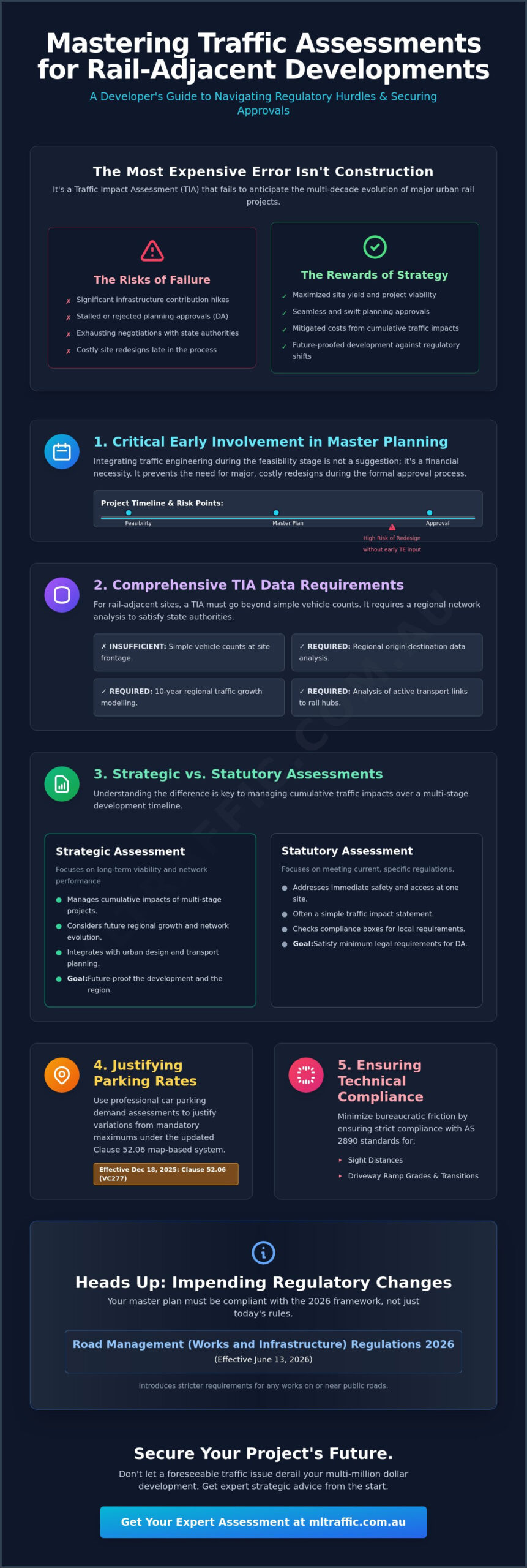
The most expensive error in a major precinct development isn’t the construction cost; it’s a Traffic Impact Assessment that fails to account for the multi-decade evolution of major urban rail developments. Securing a compliant traffic impact assessment for developments near such major rail stations requires more than just a snapshot of current road volumes. It demands a strategic framework that integrates evolving national planning regulations and impending road management legislation. Failing to anticipate these regulatory shifts can result in significant infrastructure contribution hikes and stalled planning approvals.
As ML Traffic Engineers Australia, we understand that navigating the friction between mandatory parking maximums and site yield goals often leads to costly DA delays and exhausting negotiations with state authorities. This article provides the technical clarity you need to align your master plan with the nation’s shifting regulatory landscape and secure seamless approvals. You’ll learn how to structure your TIA to satisfy council requirements while mitigating the costs associated with cumulative traffic impacts. We will compare the short-term, medium-term, and long-term cost-benefit profiles of developments within these high-growth rail corridors to ensure your project remains viable through every phase of these major rail infrastructure rollouts.
Key Takeaways
- Understand why early traffic engineering involvement in the master planning phase is critical to prevent costly site redesigns and ensure long-term project viability.
- Learn the specific data requirements for a traffic impact assessment for developments near suburban rail loop corridors to satisfy regional transport authorities and state road regulations.
- Master the technical differences between strategic and statutory assessments to effectively manage cumulative traffic impacts over a multi-stage development timeline.
- Discover how to justify parking rate variations using professional car parking demand assessments that align with the updated Clause 52.06 map-based system.
- Ensure technical compliance with AS 2890 standards for sight distance and driveway ramp grades to minimize bureaucratic friction during the planning approval process.
Table of Contents
-
The Strategic Role of Traffic Engineering for Master Planning Near Rail Infrastructure
-
Core Components of a Traffic Impact Assessment (TIA) for Rail-Adjacent Sites
-
Strategic vs. Statutory Assessments: Managing Multi-Stage Rail Developments
-
Expert Traffic Engineering for National Large-Scale Projects
The Strategic Role of Traffic Engineering for Master Planning Near Rail Infrastructure
Traffic engineering for major precincts differs fundamentally from standard site assessments. A typical project focuses on local driveway safety. However, a large-scale development near the Suburban Rail Loop (SRL) requires a regional network analysis. State authorities apply rigorous scrutiny to these sites because they influence the performance of Melbourne’s future transit hubs. Integrating core traffic engineering principles during the feasibility stage allows developers to maximize site yield while maintaining compliance. Early involvement prevents the financial burden of major redesigns during the formal approval stage. Developers should review our technical services to identify which assessments apply to their specific precinct.
To better understand the complexities of infrastructure-adjacent assessments, watch this video:
Effective master planning near rail hubs requires a synthesis of transport planning, urban design, and civil engineering. The goal is to create a functional interface between private land use and public infrastructure. This process involves complex negotiations regarding infrastructure contributions and access points. Authorities prioritize the integrity of the rail corridor. Consequently, developers must demonstrate that their project does not degrade the efficiency of the surrounding arterial road network.
Defining Large-Scale Development Triggers
Developments trigger full assessments when they meet specific density thresholds or sit within Transit-Oriented Development (TOD) zones. A simple Traffic Impact Statement is insufficient for precincts that affect state-controlled roads or regional transport corridors. For these sites, a comprehensive traffic impact assessment for developments near suburban rail loop stations is mandatory. This ensures the proposed density aligns with the capacity of the road network and the 2026 regulatory framework. The Road Management (Works and Infrastructure) Regulations 2026, effective June 13, 2026, introduce stricter requirements for works conducted on or near public roads.
Objectives of a Master Plan Traffic Assessment
The primary objective is to balance high-volume vehicle access with the safety of pedestrians and cyclists. Master plans must prioritize active transport links that connect to rail hubs. Assessments also future-proof the site against projected 2026 regional traffic growth. Advanced modelling ensures the development remains functional as the surrounding precinct matures over a ten-year horizon. This includes adhering to the map-based parking requirements introduced on December 18, 2025, under Clause 52.06 (VC277). These regulations categorize land based on public transport access, often imposing maximum parking limits to encourage sustainable mode shifts.
Core Components of a Traffic Impact Assessment (TIA) for Rail-Adjacent Sites
A Traffic Impact Assessment (TIA) is a technical analysis of how a proposed development modifies the safety and efficiency of the surrounding transport network. For precincts near major infrastructure, data collection must extend beyond simple vehicle counts at the site frontage. We analyze regional origin-destination data to understand how new transport patterns will emerge as the network evolves. A comprehensive traffic impact assessment for developments near suburban rail loop stations identifies potential bottlenecks before they become costly liabilities. This level of technical scrutiny is required to satisfy the high evidentiary standards of state transport authorities and local councils.
Modern assessments require advanced trip generation modelling to reflect the diverse land-use categories planned for 2026. This includes calculating precise impacts on arterial road performance and the integration of multi-modal transport links. Securing a professional Traffic Impact Assessment (TIA) Report ensures that all technical components, from swept path analysis to intersection capacity, meet national regulatory benchmarks.
Traffic Generation and Trip Distribution Modelling
Accurate modelling begins with utilizing Austroads guidelines to establish baseline trip rate estimates. For innovative land uses or unique mixed-use precincts, we apply ‘First Principles’ assessments. This method uses empirical data from comparable sites to provide a more realistic forecast than standard generic rates. We specifically model peak hour impacts on critical intersections near rail stations to ensure the proposed development doesn’t compromise commuter access or bus priority lanes.
Intersection and Network Performance Analysis
We use SIDRA Solutions to evaluate isolated intersection capacity and determine the Level of Service (LoS). This software allows us to calculate the ‘Degree of Saturation,’ which is a primary metric for DA approval viability. For complex precinct-wide flows, micro-simulation modelling using Vissim or Aimsun provides a dynamic view of how traffic interacts across the broader network. These tools are essential for demonstrating that a development can handle high-volume residential and commercial traffic without creating regional gridlock.
Parking demand remains a critical component of any TIA. We navigate the friction between Australian Standards (AS 2890) and local council variations by performing detailed car parking demand assessments. Under the December 2025 updates to Clause 52.06, parking requirements are now determined by public transport accessibility. Our reports provide the technical justification needed if a development proposes to vary from these mandatory rates, ensuring the car park design remains functional while maximizing site yield.
Strategic vs. Statutory Assessments: Managing Multi-Stage Rail Developments
Strategic assessments and statutory assessments serve distinct functions in the planning lifecycle. A Strategic TIA establishes the overarching traffic framework for a master plan, covering the entire project footprint and a multi-decade horizon. In contrast, a Statutory TIA accompanies a specific stage Development Application (DA), focusing on immediate local impacts. For projects adjacent to the Suburban Rail Loop, maintaining consistency between these two tiers is essential. Discrepancies between the long-term vision and stage-specific reports often lead to costly delays and rework during the council referral process.
Managing ‘cumulative impact’ assessments is a primary challenge for large-scale developments with 10-year timelines. Authorities require developers to account for the traffic generated by their own future stages and other planned developments in the precinct. This necessitates negotiating specific infrastructure trigger points with state road authorities. We identify the exact development yield that necessitates external road upgrades, allowing developers to align capital expenditure with project revenue. For industrial or mixed-use precincts, integrating Swept Path Analysis early in the master plan ensures that heavy vehicle access requirements don’t compromise future residential stages.
A professional traffic impact assessment for developments near suburban rail loop corridors must provide a clear roadmap for infrastructure delivery. This prevents the ‘front-loading’ of expensive intersection upgrades that can cripple a project’s early-stage feasibility. By providing technical evidence of current network capacity, we help clients defer infrastructure contributions until they are functionally necessary.
Staging and Threshold Analysis
Determining the maximum yield before a major intersection upgrade is required is a critical commercial milestone. We perform cost-benefit analyses to compare the impact of early infrastructure provision against deferred staging. Our technical strategies focus on justifying deferred contributions through rigorous gap analysis and performance-based modelling. This ensures that the development remains compliant with the Road Management (Works and Infrastructure) Regulations 2026 while protecting the project’s bottom line.
Integrating Active and Public Transport
Large-scale urban developments near rail hubs must now meet ambitious ‘Mode Share’ targets. This shift moves the focus from private vehicle throughput to pedestrian permeability and end-of-trip facilities. We coordinate directly with transport authorities to integrate bus routes and stop placements into the site layout. Designing for seamless public transport links is no longer optional; it’s a mandatory requirement for securing master plan approval in high-density transit zones. This approach aligns with the performance-based parking requirements of Clause 52.06, which prioritize sites with superior public transport accessibility.
Mitigating Risks and Overcoming Traffic Engineering Hurdles
Addressing the primary objections from council and state authorities requires a data-driven approach to risk mitigation. The most frequent hurdle in precinct developments is justifying parking shortfalls. A professional traffic impact assessment for developments near suburban rail loop stations must provide empirical evidence to support departures from standard parking rates. We use site-specific car parking demand assessments to demonstrate that high public transport accessibility reduces the need for traditional parking volumes. This technical justification is essential for maintaining site yield while satisfying the map-based requirements of Clause 52.06.
Technical compliance with AS 2890 remains a non-negotiable requirement for planning approval. We perform rigorous sight distance assessments and access safety evaluations to ensure every entry point meets national safety standards. Mitigating community concerns regarding increased local traffic volumes involves presenting clear, transparent modelling that shows the actual net impact on the road network. During the construction phase, a comprehensive Traffic Management Plan is required to manage heavy vehicle movements and maintain local precinct safety. For expert assistance with your project’s technical requirements, contact our senior engineering team directly.
Parking Demand and Car Park Design Compliance
Designing multi-level and basement parking structures requires strict adherence to AS 2890.1 standards. We focus on ensuring compliant driveway ramp grades and efficient internal circulation to prevent queuing on public roads. For transit-oriented developments, we use first-principles data to argue for reduced parking rates based on the December 2025 regulatory updates. This process involves a detailed car park design review to identify potential bottlenecks in high-turnover residential or commercial sites before they trigger a council RFI.
Negotiating Voluntary Planning Agreements (VPA)
Negotiating infrastructure contributions requires a clear understanding of the ‘nexus’ between a development’s traffic impact and the required road upgrades. We provide the technical analysis needed to ensure infrastructure cost-sharing is fair and equitable. If a project moves to a planning tribunal or court, our senior principals provide expert witness representation to defend the technical integrity of the traffic impact assessment for developments near suburban rail loop corridors. This authoritative presence ensures that developers are not burdened with infrastructure costs that are disproportionate to their actual network impact.
Expert Traffic Engineering for National Large-Scale Projects
ML Traffic Engineers Australia is the preferred technical partner for complex master plan TIAs because we prioritize direct accountability and senior-level expertise. Our Principal Continuity promise ensures that the senior engineer who initiates the project performs all technical work, from modelling to final reporting. This prevents the loss of critical project knowledge often seen in larger firms where work is delegated to junior staff. For a professional traffic impact assessment for developments near suburban rail loop corridors, this continuity is essential for maintaining a consistent technical narrative throughout the multi-year approval lifecycle.
Our firm maintains a broad national footprint, delivering specialized assessments across residential, retail, industrial, and institutional sectors. We focus on streamlining the path to council approval by providing reports that satisfy the technical requirements of both local government and state road authorities. You can view our complete range of traffic engineering services to see how we support large-scale precinct developments through every stage of the planning process. By providing a direct line to our senior leadership, we ensure that technical queries are resolved with authority and precision.
Our Technical Capabilities for Master Planning
Precinct-wide network analysis requires a level of technical authority that goes beyond basic compliance. ML Traffic Engineers Australia provides advanced intersection analysis and certification for complex parking structures that meet the rigorous standards of state transport bodies. We act as the primary technical liaison during the referral process, resolving complex objections regarding access safety and network capacity. This authoritative representation minimizes the risk of costly RFIs and ensures the traffic impact assessment for developments near suburban rail loop stations withstands intense regulatory scrutiny.
Get Started with a Preliminary Feasibility Assessment
Early technical advice is a critical commercial tool that can maximize site efficiency before the master plan is finalized. A preliminary feasibility assessment identifies the infrastructure triggers and parking constraints that will impact the project’s bottom line. This proactive approach allows developers to align their staging plans with actual network capacity and avoids the need for late-stage redesigns. Learn more about ML Traffic Engineers Australia and our 15-year history of delivering successful planning outcomes for complex projects. Contact our senior principals directly to discuss the specific technical requirements of your next precinct development.
Securing Technical Approval for Rail Corridor Precincts
Master planning near major rail hubs requires a transition from static reporting to dynamic strategic frameworks. Successful developers prioritize early traffic engineering to resolve infrastructure triggers and parking constraints before they lead to costly redesigns. A robust traffic impact assessment for developments near suburban rail loop stations serves as the technical foundation for these approvals. It ensures compliance with the 2026 regulatory updates while protecting your project’s commercial site yield.
ML Traffic Engineers Australia provides 30+ years of specialist experience across all development types nationwide. Our senior principals maintain direct involvement in every TIA report to ensure technical authority and accountability. We eliminate the gatekeepers found in larger firms by providing a direct line to the experts performing your technical work. Consult with our Senior Traffic Engineers on your Master Plan to ensure your project remains viable as Melbourne’s transport network matures. We’re ready to help you navigate the complexities of rail-adjacent planning with precision.
Frequently Asked Questions
What is the difference between a Traffic Impact Statement and a Traffic Impact Assessment?
A Traffic Impact Statement is a concise report typically reserved for small-scale developments with negligible effects on the broader road network. In contrast, a Traffic Impact Assessment (TIA) is a comprehensive technical analysis required for larger projects that significantly alter local or regional traffic patterns. TIAs include advanced intersection modelling, regional network performance data, and detailed assessments of multi-modal transport integration.
When is a traffic report mandatory for developments near the Suburban Rail Loop?
A traffic report becomes mandatory when a project meets specific floor area or dwelling thresholds defined under the Victoria Planning Provisions. For precincts adjacent to the Suburban Rail Loop, authorities require a full TIA if the development affects arterial road performance or sits within a designated transit-oriented development zone. These requirements ensure that new high-density precincts don’t compromise the efficiency of the emerging rail infrastructure.
How do traffic engineers calculate trip generation for mixed-use master plans?
Engineers utilize Austroads guidelines and empirical data from comparable sites to establish accurate trip rate estimates. For complex mixed-use master plans, we apply "First Principles" assessments to account for internal trip capture. This method recognizes that residents may visit on-site retail or commercial facilities without using the external road network, providing a more realistic forecast of vehicle movements than generic rates.
Can a development be approved if it exceeds local intersection capacity?
Approval is possible if the developer proposes physical infrastructure upgrades or demonstrates that the impact can be managed through a Voluntary Planning Agreement (VPA). A professional traffic impact assessment for developments near suburban rail loop corridors identifies the specific capacity triggers where upgrades become necessary. These reports provide the technical evidence needed to negotiate fair infrastructure contributions with state road authorities and local councils.
What software is used for traffic modelling in large-scale developments?
SIDRA Solutions is the primary industry standard for analyzing isolated intersection capacity, delay, and Level of Service. For large-scale precincts with complex interactions, we use micro-simulation software such as Vissim or Aimsun. These tools model dynamic traffic flows across multiple intersections and public transport interchanges, ensuring the proposed development functions correctly within the broader regional network.
How does AS 2890.1 impact the design of large commercial car parks?
AS 2890.1 establishes the mandatory technical standards for parking space dimensions, aisle widths, and driveway ramp grades. Compliance is essential for ensuring that high-turnover commercial sites maintain safe internal circulation and prevent vehicle queuing from spilling onto public roads. Our car park design services ensure that every basement or multi-level structure meets these national safety and efficiency benchmarks.
What is a cumulative traffic impact assessment and why is it required for staged projects?
A cumulative traffic impact assessment evaluates the combined traffic generated by all project stages alongside other planned developments in the immediate precinct. This is a standard requirement for large-scale projects near the Suburban Rail Loop to ensure that infrastructure trigger points are identified early. It prevents the network from reaching a point of failure as the precinct matures over a ten-year development horizon.
How can a developer reduce the required number of parking spaces for a large site?
Developers can justify reduced parking volumes by submitting a professional Car Parking Demand Assessment that leverages the site’s public transport accessibility. Under the December 2025 updates to Clause 52.06 (VC277), proximity to major rail hubs allows for significant variations from standard parking rates. We use empirical data to demonstrate that the actual demand is lower than mandatory minimums, allowing for increased site yield.

Disclaimer
The content on www.mltraffic.com.au, including all technical articles, guides, and resources, is provided for general informational and educational purposes only. It is not intended to constitute professional advice in traffic engineering, transportation planning, development approvals, or any other technical or legal field.
While ML Traffic Engineers makes every reasonable effort to ensure the accuracy, completeness, and timeliness of the information published, we do not provide any warranties or representations (express or implied) regarding its reliability, suitability, or availability for any particular purpose. Any reliance you place on the content is strictly at your own risk.
In no event shall ML Traffic Engineers, its directors, employees, authors, or affiliates be liable for any direct, indirect, incidental, special, consequential, or punitive damages (including, without limitation, loss of profits, data, or business opportunities) arising out of or in connection with the use of, or inability to use, any information provided on this website.
The articles and guides on this site are not a substitute for engaging a qualified, registered professional traffic engineer (such as an NPER or RPEQ engineer) to assess your specific project requirements. For tailored advice, compliance assessments, or traffic engineering services, please contact a competent professional.
This disclaimer may be updated from time to time without notice. By accessing or using this website, you agree to be bound by the most current version of this disclaimer.
