

We are traffic engineers operating in Perth and surrounding regions.
The upcoming 12-month closure of the Fremantle Traffic Bridge is more than a mere inconvenience; for local businesses and developers, it represents a significant operational risk. As traffic shifts toward an already strained Stirling Bridge, the potential for “carmageddon” and escalating transport costs is a legitimate concern. Navigating the Swan River Crossing Fremantle traffic impacts requires more than just patience-it demands a strategic, engineering-led approach to ensure your deliveries stay on schedule and your projects remain viable.
In this 2026 survival guide, we leverage our decades of transport planning expertise to help you stay ahead of the disruption. You will gain a professional understanding of the planned traffic diversions, specific truck restrictions, and site access strategies designed to mitigate delays. We also address the complexities of securing Development Application (DA) approvals during this construction phase, providing the technical clarity you need to maintain site accessibility. By applying these engineering insights, you can transform a period of regional congestion into a manageable and predictable phase of your project’s lifecycle.
Key Takeaways
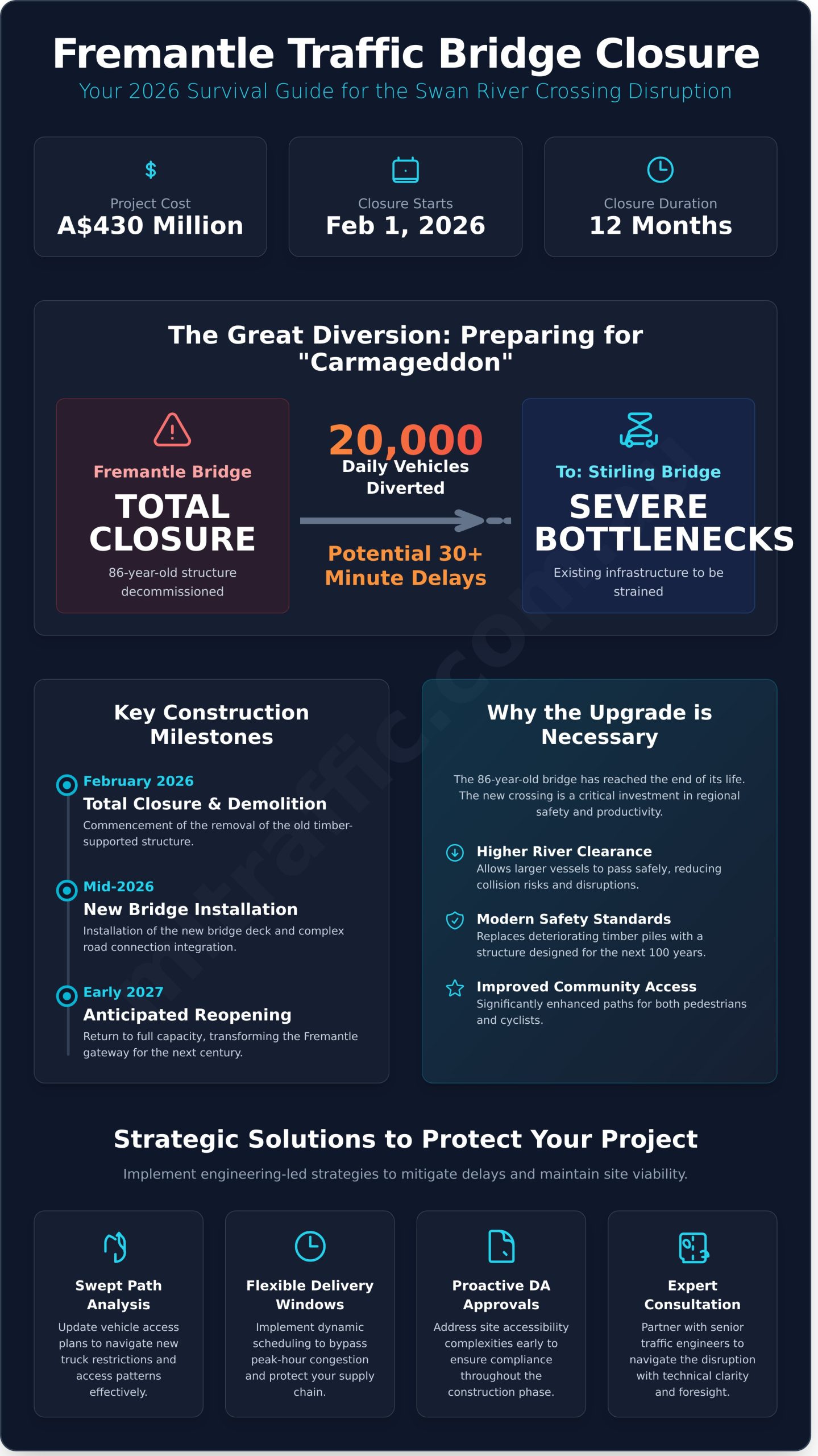
- Prepare for the total closure starting February 1, 2026, and learn how this A$430 million project will reshape the local transport network for a full year.
- Analyze the Swan River Crossing Fremantle traffic impacts to see how diverting 20,000 daily vehicles to Stirling Bridge will create severe bottlenecks for your logistics.
- Avoid “carmageddon” by implementing strategic engineering solutions like updated Swept Path Analysis and flexible delivery windows to bypass peak-hour congestion.
- Protect your supply chain from 30-minute delays by understanding the new truck restrictions and access patterns before they affect your business footfall.
- Discover the advantage of working directly with senior consultants who manage your project personally, ensuring your site remains accessible and compliant throughout 2026.
Table of Contents
- The 2026 Swan River Crossing Project: A Network in Transition
- Analyzing the Stirling Bridge Bottleneck: Beyond the Detour
- Commercial Impact: Why Developers Can’t Ignore the Closure
- Strategic Engineering Solutions for Impacted Sites
- Partnering with ML Traffic Engineers for a Seamless 2026
The 2026 Swan River Crossing Project: A Network in Transition
The A$430 million Swan River Crossing project represents one of the most significant infrastructure shifts in Western Australia’s recent history. For commuters, local businesses, and logistics planners, understanding the Swan River Crossing Fremantle traffic impacts begins with a single, non-negotiable date: February 1, 2026. On this day, the existing bridge will close completely to facilitate a 12-month intensive rebuild, marking a period of transition for the entire regional road network.
This isn’t just a routine maintenance job; it is a total transformation of the Fremantle gateway. The project aims to replace an asset that has long been a bottleneck for both road and river users. By examining the Fremantle Traffic Bridge history, it becomes clear why this timber-supported relic-originally built as a temporary structure in the 1930s-is no longer fit for a modern transport corridor. The new design will offer higher clearance for river vessels and significantly improved paths for pedestrians and cyclists, ensuring the bridge serves the community for the next century.
To better understand the scale and design of this transformation, watch this helpful animation from Main Roads WA:
Why the 86-Year-Old Bridge is Closing Now
The decision to close the bridge is driven by structural necessity and modern safety requirements. The current 86-year-old structure has reached the end of its functional life, with timber piles that require constant, costly maintenance to meet Australian Standards. Main Roads WA has opted for an expedited 12-month construction schedule to minimize the long-term duration of the Swan River Crossing Fremantle traffic impacts. Beyond road safety, the new bridge’s higher clearance is a critical upgrade for river navigation, allowing larger vessels to pass safely and reducing the risk of vessel-bridge collisions that have historically disrupted traffic.
Key Milestones for the 2026 Construction Phase
The 2026 rebuild is a high-intensity program designed to return the network to full capacity as quickly as possible. We anticipate the following critical milestones during the construction window:
- February 2026: Total closure of the existing bridge and commencement of the removal of the timber-supported structure.
- Mid-2026: Installation of the new bridge deck and the complex integration of modern road connections on both the North Fremantle and Fremantle sides.
- Early 2027: Anticipated reopening to traffic, with the potential for program acceleration if site conditions remain favourable.
While the 12-month closure presents a significant logistical challenge, the transition to a modern, high-clearance crossing is a necessary investment in the region’s future productivity and safety.
Analyzing the Stirling Bridge Bottleneck: Beyond the Detour
The diversion of over 20,000 daily vehicles from the decommissioned Fremantle Traffic Bridge to Stirling Bridge represents a significant logistical challenge for the region. Traffic modeling consistently predicts a “severe impact” on local transit times, as the existing infrastructure was not originally configured to absorb this concentrated volume. While a detour map provides a simple visual route, it fails to account for “network friction”-the cumulative delays caused by merging turbulence, altered signal timings, and the interaction between heavy freight and passenger vehicles.
Our analysis of the Swan River Crossing Fremantle traffic impacts suggests that peak hour congestion patterns will shift dramatically. The morning peak will see intensified queuing on the northern approach, while the afternoon flow will likely result in significant tailbacks reaching into the Fremantle CBD. According to official Swan River Crossings Project Details, these changes require a highly coordinated management plan to prevent total gridlock during the construction phase.
The Morning Peak Truck Restriction Explained
To mitigate congestion, the Transport Minister has implemented a plan to restrict heavy vehicles on Stirling Bridge during the morning peak (6:00 AM to 9:00 AM). This strategy aims to free up lane capacity for commuters but creates a complex hurdle for port-related logistics and freight companies. To maintain supply chain efficiency, there is an industry-wide push for the adoption of High Productivity Freight Vehicles (HPFV). These vehicles carry larger payloads, effectively reducing the total number of truck movements required to service the Inner Harbour, thereby easing the pressure on the bridge deck.
Secondary Road Network Pressure Points
The displacement of traffic will inevitably saturate the secondary road network. We anticipate the following pressure points will experience the highest levels of “rat-running” and congestion:
- Canning Highway & Queen Victoria Street: These corridors will face increased load as motorists seek alternative routes to the Stirling Highway.
- North Fremantle Intersections: Local junctions will struggle with higher turn-in volumes, impacting residential amenity and commercial access.
- East Fremantle Residential Streets: Significant “rat-running” is expected through minor roads, which may necessitate temporary local traffic management (TMT) measures to protect pedestrian safety.
Understanding these Swan River Crossing Fremantle traffic impacts is essential for local businesses and residents to prepare for extended travel times and altered access routes throughout the project duration.
Commercial Impact: Why Developers Can’t Ignore the Closure
The upcoming Fremantle bridge replacement is more than a civil engineering project; it is a significant commercial disruptor. For developers and business owners, the risk of ‘carmageddon’ is real, with the potential to shift consumer behavior and reduce local footfall. As congestion increases, the Swan River Crossing Fremantle traffic impacts will likely force a redistribution of where people shop, work, and invest.
Supply chain reliability is also under threat. When ‘just-in-time’ delivery models encounter 30-minute delays at the river crossing, the ripple effect reaches every stage of construction and retail operations. Consequently, local councils are increasing their scrutiny of Development Applications (DAs) within the construction zone. You should expect Council to mandate comprehensive temporary traffic management plans to ensure that new projects do not exacerbate the existing bottleneck.
- Footfall Erosion: Commuters may bypass North Fremantle entirely to avoid delays.
- Operational Delays: Construction schedules are at risk if materials cannot arrive on site predictably.
- Increased Compliance: Stricter requirements for site access and egress during the 12-month closure window.
The Hidden Costs of Transport Delays
Industry warnings suggest that transport costs could surge by up to 30% as logistics providers price in the uncertainty of the Fremantle gridlock. For trades and mobile service providers, these delays represent direct labor productivity losses that cannot easily be recovered. Beyond logistics, the economic risk for local retailers is defined by a potential sharp decline in spontaneous consumer visits as the perceived “hassle” of navigating the bridge outweighs the incentive to shop locally.
Planning Approval Challenges in 2026
The 2026 construction window changes the baseline for every Traffic Impact Assessment (TIA) in the region. If you are submitting a DA, your assessment must account for the temporary closure rather than relying on historical traffic data. Council will focus heavily on how your project manages site access without further choking the remaining arterial routes. To ensure your project remains compliant and viable, you may need to engage specialized ML Traffic services to update your TIA with current Swan River Crossing Fremantle traffic impacts and mitigation strategies. Proactive planning is the only way to avoid costly RFI (Request for Further Information) cycles during the approval process.
Strategic Engineering Solutions for Impacted Sites
Mitigating the Swan River Crossing Fremantle traffic impacts requires more than general oversight; it demands technical precision and proactive site management. As construction progresses, local businesses and developers must adapt to a fluid road environment. At ML Traffic Engineers, we specialise in developing site-specific Traffic Guidance Schemes (TGS) that ensure your operations remain viable while adhering to rigorous safety standards.
To maintain site accessibility, we recommend a multi-pronged engineering approach:
- Flexible Delivery Windows: Implementing internal policies to avoid the 7:00 AM – 9:00 AM morning peak, reducing conflict with construction-related congestion.
- Data-Driven Modeling: Using SIDRA intersection analysis to provide the empirical evidence required by the City of Fremantle and Main Roads WA to justify continued access arrangements.
- RPEQ/Qualified Oversight: Ensuring all assessments are performed by senior consultants who understand the specific bureaucratic requirements of Western Australian transport authorities.
Swept Path Analysis for Construction Detours
As road alignments shift to accommodate the new bridge infrastructure, standard entry and exit points often become compromised. We use advanced Vehicle Swept Path Assessment software to model new turning circles at modified intersections. This ensures that Heavy Rigid Vehicles (HRV) and Articulated Vehicles can still navigate your site safely without encroaching on temporary barriers or pedestrian zones.
Case Study: We recently assisted a commercial site near Queen Victoria Street where a temporary median strip reduced the effective turning radius for delivery trucks. By modeling a revised entry angle and adjusting internal loading bay markings, we prevented a total delivery blockage, saving the client thousands in potential logistical delays.
Updating Your Traffic Impact Statement (TIS)
An outdated TIS can lead to costly compliance issues. It is essential to recalculate trip generation based on projected 2026 network conditions, accounting for the redistributed volumes caused by the Swan River Crossing project. Our team focuses on proposing mitigation measures that satisfy Main Roads WA requirements while protecting your development’s operational efficiency.
For further technical deep-dives into how we handle complex transport planning, you can learn more about our previous projects and traffic modeling methodologies in our older articles. At ML Traffic Engineers, the consultant who provides your quote is the expert who does the work. Contact us at mltraffic.com.au to secure your site’s accessibility during this transition.
Partnering with ML Traffic Engineers for a Seamless 2026
Navigating the Swan River Crossing Fremantle traffic impacts requires more than just data; it requires a partner who understands the local landscape and the technicalities of Western Australian road networks. At ML Traffic Engineers Pty Ltd, we operate on a simple, transparent promise: the consultant who provides the quote is the one who does the work. This accountability ensures that your project is never handed off to a junior staff member, but remains in the hands of seasoned experts.
Clients benefit from direct access to our senior principals, Michael Lee and Benny Chen. With over 15 years of experience navigating complex Australian road networks and a portfolio of over 10,000 successful sites, we provide the reliability and deep-seated expertise necessary for high-stakes Fremantle projects. Our local knowledge is critical for ensuring your development application remains compliant with Australian Standards (AS 2890.1) while addressing the specific congestion challenges of the 2026 bridge works.
Hands-on Traffic Engineering for Private Clients
Large engineering firms are often bogged down by bureaucracy, leading to delays that private developers simply cannot afford during a traffic crisis. We prioritise a no-nonsense, results-oriented approach designed for rapid turnaround. Our services are focused on getting your project through the approval process without unnecessary friction. We provide:
- Rapid Swept Path Analysis: Ensuring vehicle access and manoeuvrability meet stringent council requirements.
- Technical TIA and TIS Reports: Comprehensive Traffic Impact Assessments tailored to the evolving Fremantle road network.
- Direct Communication: You will have direct mobile contact for urgent advice, allowing for immediate adjustments to project plans.
Get Your Project Moving Today
With the major bridge closure scheduled for February 1, early engagement is the only way to safeguard your development from the anticipated Swan River Crossing Fremantle traffic impacts. We assist our clients through every stage of council negotiations and planning approvals, leveraging our reputation for meticulous, fact-based reporting.
Whether your project involves apartments, retail centres, warehouses, or medical facilities, our team is ready to provide the professional assurance you need. Do not wait for the congestion to peak before securing your traffic strategy. Contact us today for a project quote and ensure your development stays on track through 2026 and beyond.
Navigating the 2026 Fremantle Transition
The upcoming Swan River Crossing project represents more than just a bridge replacement; it is a fundamental shift in Fremantle’s local transport network. Understanding the Swan River Crossing Fremantle traffic impacts is essential for developers and business owners who need to maintain site accessibility and project viability during the Stirling Bridge bottleneck. Proactive planning-from detailed Traffic Impact Assessments (TIA) to strategic swept path analysis-will be the difference between a stalled development and a successful 2026 delivery.
At ML Traffic Engineers, we remove the bureaucracy. We offer direct access to principals with over 15 years of Australian traffic engineering experience and a proven track record of over 10,000 sites assessed across the country. Our “no-gatekeepers” philosophy ensures that the engineer who quotes your project is the same expert performing the technical work. Don’t let construction delays or complex compliance requirements compromise your commercial outcomes.
Speak directly to a Senior Traffic Engineer about your Fremantle project today. We are ready to help you navigate these network changes with confidence, ensuring your development remains on track and fully compliant.
Frequently Asked Questions
When exactly does the Fremantle Traffic Bridge close?
The existing Fremantle Traffic Bridge is scheduled for permanent closure in late 2024. This closure is a critical phase of the Swan River Crossing project, allowing for the construction of the new road and rail bridges. Motorists and local residents should prepare for significant detours and increased travel times as traffic is redirected to Stirling Bridge and surrounding arterial routes during the demolition and rebuild.
Will Stirling Bridge be able to handle all the diverted traffic?
Stirling Bridge will become the primary detour route, absorbing approximately 25,000 additional vehicles daily. While Main Roads WA is implementing essential intersection upgrades at Canning Highway and Marmion Street to improve capacity, some congestion is inevitable. For developers, a professional Traffic Impact Statement (TIS) is vital to model how these shifted volumes will specifically affect your site access and local road safety.
Are there specific restrictions for trucks during the bridge closure?
Yes, heavy vehicle movement will be strictly managed. Trucks will be redirected primarily via Stirling Highway and Stock Road to maintain freight efficiency while protecting local residential streets. Logistics managers must review their transport routes now to ensure compliance with the updated Traffic Management Plans (TMP). We recommend a formal route assessment to prevent delays and ensure your fleet adheres to new height and weight restrictions.
How will the Swan River Crossing project affect local business deliveries?
Local businesses may experience significant delivery delays due to the Swan River Crossing Fremantle traffic impacts. Delivery windows should be adjusted to avoid peak congestion periods on Stirling Highway. We strongly advise conducting a site-specific assessment to ensure that your delivery vehicles can still safely access loading bays without obstructing the increased traffic flow on secondary roads during the construction period.
Do I need to update my Traffic Impact Assessment for a 2026 development?
Absolutely. If your development is slated for 2026 or beyond, any previous Traffic Impact Assessment (TIA) is likely obsolete. The permanent closure of the old bridge and the introduction of new infrastructure will fundamentally change baseline traffic volumes and distribution patterns. Updating your TIA now ensures your project remains compliant with Australian Standards and local planning requirements under the new road network configuration.
What public transport alternatives are available during the construction?
The Fremantle Line will remain operational for the majority of the project, though periodic shutdowns are planned for rail bridge works. Transperth will provide high-frequency replacement bus services during these intervals. For commuters, the Principal Shared Path (PSP) will be maintained or realigned, offering a reliable cycling and walking alternative to avoid the road congestion on Stirling Highway and North Fremantle routes.
What is a Swept Path Analysis and why do I need it now?
A Swept Path Analysis uses specialized software to simulate the movement of specific vehicles through a site. With the Swan River Crossing Fremantle traffic impacts altering road layouts and narrowing certain access points, you need this analysis to prove your development can safely accommodate vehicle turning circles. This is essential for waste management and delivery vehicles to ensure they comply with AS 2890.1 safety standards.
How long will the new Fremantle bridge construction take?
The construction of the new Swan River Crossing is expected to take approximately three years, with a projected completion date in 2027. This timeline encompasses the demolition of the old timber bridge and the phased opening of the new road and rail structures. Stakeholders and developers should prepare for a prolonged period of modified traffic conditions and engage professional consultants to manage long-term access strategies.
Which suburbs do you service?
We operate in Alexander Heights, Alfred Cove, Alkimos, Anketell, Applecross, Ardross, Armadale, Ascot, Ashby, Ashendon, Ashfield, Attadale, Atwell, Aubin Grove, Aveley, Balcatta, Baldivis, Balga, Ballajura, Banksia Grove, Bassendean, Bateman, Bayswater, Beaconsfield, Beckenham, Bedford, Beechboro, Beeliar, Beldon, Bellevue, Belmont, Bentley, Bertram, Bibra Lake, Bicton, Booragoon, Brentwood, Brigadoon, Brookdale, Bull Creek, Bullsbrook, Burns Beach, Burswood, Butler, Byford, Canning Vale, Cannington, Carine, Carlisle, Carramar, Casuarina, Caversham, Champion Lakes, Chidlow, Churchlands, City Beach, Claremont, Clarkson, Cloverdale, Cockburn Central, Connolly, Coogee, Coolbellup, Coolbinia, Cottesloe, Craigie, Crawley, Currambine, Dalkeith, Darch, Doubleview, East Perth, Edgewater, Ellenbrook, Floreat, Fremantle, Girrawheen, Greenwood, Guildford, Hamilton Hill, Heathridge, Hillarys, Inglewood, Joondalup, Kallaroo, Kingsley, Leeming, Mandurah, Maylands, Melville, Midland, Mindarie, Morley, Mosman Park, Mount Hawthorn, Mount Lawley, Mullaloo, Nedlands, North Perth, Northbridge, Ocean Reef, Osborne Park, Padbury, Perth, Piara Waters, Rockingham, Scarborough, South Perth, Subiaco, Swanbourne, Thornlie, Tuart Hill, Victoria Park, Wangara, Wanneroo, Warwick, Wembley, West Perth, Willetton, Woodvale, Yokine.
