

A request from council for a swept path analysis can be a significant hurdle in the planning application / development application (DA) process. For developers, architects, and project managers, this technical requirement is non-negotiable for proving the safety and functionality of vehicle access points, car parks, and loading docks. Failure to provide a compliant assessment can result in costly project delays, mandated redesigns, and ultimately, the rejection of your DA. Ensuring your design accommodates the required vehicle movements from the outset is critical for project success.
This guide provides a complete overview of swept path analysis for Australian developments. We will explain precisely what the assessment involves, why it is essential for satisfying council requirements and Australian Standards (such as AS 2890.1), and how to ensure your design is compliant. By understanding this process, you can confidently demonstrate compliance, prevent costly rework, and secure timely approval for your project.
What is Swept Path Analysis? A Plain English Explanation
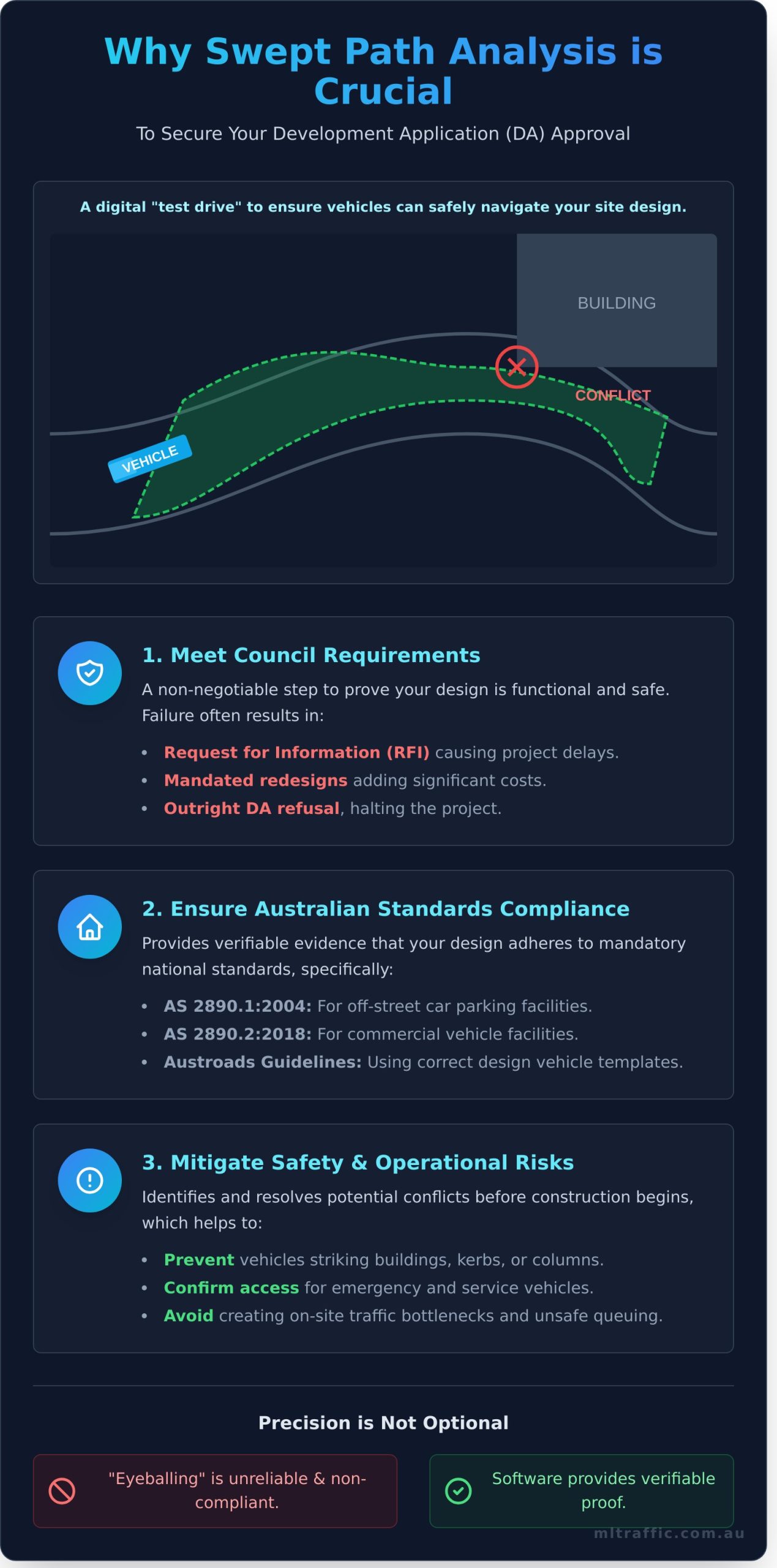
In simple terms, swept path analysis is a technical simulation used by traffic engineers to model the precise movements of a vehicle. It is a critical assessment that verifies whether a specific vehicle can manoeuvre through a proposed site layout-such as a car park, loading dock, or new intersection-safely and efficiently. Think of it as a digital test drive for your architectural or civil plans before any construction begins.
To better understand this concept, this video provides a helpful visual demonstration:
The core purpose is to prevent costly design flaws. A swept path analysis can identify potential conflicts where a vehicle might strike a kerb, building, or another vehicle. It is essential to distinguish between the ‘swept path’-the total physical space a vehicle’s body occupies as it turns-and the ‘analysis’. The analysis is the professional process of using specialised software to model this path, ensuring the design complies with Australian Standards. Accuracy is paramount, which is why engineers rely on industry-standard Swept Path Analysis Software like AutoTURN to produce verifiable results for development applications.
Key Terminology You Need to Know
Understanding the following terms is fundamental to swept path assessments:
-
Design Vehicle: The specific vehicle type chosen for the analysis, based on the site’s intended use (e.g., a 10m council garbage truck or smaller truck for a residential unit block, a 19m semi-trailer or 12.5m heavy rigid vehicle for a warehouse).
-
Turning Radius: The tightest turn a vehicle can make. This is a critical geometric constraint for designing intersections, roundabouts, and car park ramps.
-
Body Overhang: The portion of the vehicle’s body that swings out beyond the path of the wheels during a turn, such as the front bumper or rear corner. This can create conflicts with bollards, signs, or pedestrians if not accounted for.
-
Path & Envelope: The ‘path’ refers to the line traced by the wheels, while the ‘envelope’ is the entire two-dimensional space the vehicle body occupies throughout the manoeuvre.
Why You Can’t Just ‘Eyeball’ It
Attempting to estimate a vehicle’s path by eye is unreliable and will not meet regulatory standards. The dynamic movements of large vehicles are far too complex to predict without specialised tools. Professional software accurately calculates numerous variables, including vehicle speed, steering lock angles, and transition times between turns. Most importantly, local councils and road authorities across Australia require these software-generated diagrams as objective, verifiable evidence that a development’s design is safe, functional, and compliant with key standards such as AS 2890.1 and AS 2890.2.
Why Swept Path Analysis is Crucial for Your Planning Application / Development Application (DA)
Submitting a Planning Application / Development Application (DA) without a professional swept path analysis is a significant risk. Far from being a procedural formality, it is a non-negotiable step for gaining council approval in Australia. This analysis provides objective proof that your architectural plans are functional in the real world, demonstrating due diligence and proactive risk management to assessment authorities. Failure to include a comprehensive assessment often results in council issuing a Request for Information (RFI), causing costly delays, or can even lead to an outright refusal of your DA.
Ultimately, a thorough swept path analysis de-risks your project by identifying and resolving access issues before construction begins, saving you from expensive and disruptive post-approval design changes.
Meeting Local Council Requirements
Most local councils across Australia mandate swept path diagrams as a standard component of a planning submission. They are required to assess the traffic impact of a development, particularly where new vehicle access points are proposed. This is especially critical for projects involving:
-
New driveways or access points to public roads.
-
Commercial loading docks and service bays.
-
Underground or multi-level car parks.
-
Sites with constrained or complex internal circulation routes.
Ensuring Compliance with Australian Standards
A key function of swept path analysis is to verify that a design complies with mandatory national standards. The assessment uses precise vehicle templates, based on publications like the Austroads Design Vehicle Guidelines, to simulate vehicle movements. This process provides concrete evidence that your layout adheres to the geometric requirements of AS 2890.1:2004 (Off-street car parking) and AS 2890.2:2018 (Commercial vehicle facilities), ensuring ramps, aisle widths, and bay dimensions are safe and practical.
Mitigating Safety and Operational Risks
Beyond compliance, the analysis is a critical tool for identifying and mitigating physical risks on-site. It ensures that vehicles can navigate the proposed layout without conflict, preventing costly property damage and enhancing safety for all users. A correctly performed analysis will:
-
Prevent vehicles from striking buildings, structural columns, kerbs, and other parked cars.
-
Confirm that emergency vehicles (e.g., fire trucks) and service vehicles (e.g., garbage trucks) can access and exit the site efficiently.
-
Avoid the creation of internal traffic bottlenecks or unsafe queuing conditions that could impact public roads.
The Swept Path Analysis Process: What to Expect
A professional swept path analysis is a structured, collaborative process between the project architect, the developer, and the traffic engineering consultant. The objective is straightforward: to test vehicle access and circulation against the proposed site plans to achieve a definitive ‘pass’ for council submission. If conflicts are identified, the process provides the precise data needed to revise the design for compliance.
From the client’s perspective, the workflow is designed for clarity and efficiency, moving from initial data provision to a final, actionable report.
Step 1: Information Gathering & Defining the Scope
The process begins with providing the necessary project information to your traffic consultant. To ensure an accurate assessment, you will need to supply:
-
Architectural Drawings: Current site plans, floor plans, and elevations, preferably in a CAD format (.dwg or .dxf).
-
Design Vehicle Selection: In consultation with the engineer, the correct ‘design vehicle’ is confirmed. This is determined by the development’s intended use and council requirements, such as a B85 car (as per AS 2890.1) for a residential building or a truck (19m semi-trailer 12.5m heavy rigid vehicle) for a warehouse.
-
Manoeuvre Confirmation: The specific vehicle movements that require testing are defined, such as entering the site from the street, navigating internal ramps, or reversing into a loading bay.
Step 2: The Simulation and Analysis
Once the scope is defined, the traffic engineer undertakes the technical analysis. Your architectural plans are imported into specialised software, most commonly AutoTURN. The engineer then simulates the design vehicle moving along the predefined paths at low, realistic speeds. The software generates a ‘swept path envelope’-a visual representation of the entire area the vehicle’s body and overhangs will occupy during the manoeuvre. This allows for a precise assessment of clearances against structures like walls, columns, and kerbs.
Step 3: The Report and Recommendations
The final deliverable is a formal report and set of diagrams suitable for inclusion in your Planning Application / Development Application (DA). This package typically includes scaled drawings showing the vehicle’s path overlaid on your plans, clearly demonstrating compliance or highlighting problem areas. An accompanying report outlines the methodology, assumptions, and results. If the swept path analysis identifies issues, our consultants provide specific, actionable recommendations for design modifications to resolve the conflicts. The goal is to provide a clear path to approval.
Ensure your plans pass the test. Contact us for an analysis.
Common Applications: Where Swept Path Analysis is Essential
A vehicle swept path analysis is not a theoretical exercise; it is a critical due diligence step for a wide range of development projects. Ensuring vehicles can safely and efficiently navigate a site is fundamental to obtaining council approval and guaranteeing long-term functionality. Below are common scenarios where this assessment is indispensable.
Car Parks and Basements
Designing compliant and user-friendly car parks, particularly in underground basements, presents significant geometric challenges. A swept path assessment is essential for verifying that all vehicles can navigate the proposed layout. Key checks include:
-
Access Ramps: Confirming vehicles can negotiate ramp gradients and turns without scraping or encroaching on opposing lanes.
-
Circulation Aisles: Testing tight corners and intersections to prevent collisions with columns, walls, or other vehicles.
-
Parking Bays: Ensuring the nominated design vehicle, typically the B85 vehicle as per Australian Standard AS 2890.1, can enter and exit a parking space in a single, acceptable manoeuvre.
Loading Docks and Service Bays
For commercial, industrial, and retail developments, safe and efficient access for service vehicles is paramount. These sites require analysis using larger design vehicles, such as a Medium Rigid Vehicle (MRV), Heavy Rigid Vehicle (HRV) or articulated vehicles such as semi-trailers. The assessment validates that trucks can manoeuvre into position-often by reversing-without blocking public roads or internal circulation routes. This process also verifies critical vertical and horizontal clearances, preventing costly clashes with building awnings, services, or other infrastructure.
Drive-Throughs, Service Stations, and Fast Food Outlets
The success of these facilities depends entirely on smooth, uninterrupted vehicle flow. A detailed swept path analysis is crucial to model the movement of various vehicles, from standard passenger cars to delivery trucks and, for service stations, large fuel tankers. The analysis confirms that the layout can accommodate vehicle queues without spilling onto the main road, and that adequate clearance is maintained around critical points like ordering screens, payment windows, fuel bowsers, and bypass lanes. This prevents operational bottlenecks and enhances customer safety.
Ensuring your design accommodates these vehicle movements is critical. A professional traffic engineering assessment can identify and resolve potential issues before they lead to costly redesigns or council rejection.
How to Choose the Right Traffic Consultant for Your Analysis
The quality of your swept path analysis is directly proportional to the expertise of the engineer performing it. A low-cost report from an inexperienced practitioner may seem economical, but a submission rejected by council due to errors or non-compliance results in significant project delays and resubmission costs measured in thousands of dollars. Selecting the right consultant is not an expense; it is an investment in a smooth and successful Development Application (DA) process. A professional consultant acts as a vital partner in your development team, ensuring the traffic components of your DA are robust and defensible.
Expertise in Relevant Software and Standards
Technical proficiency is non-negotiable. Your consultant must utilise industry-standard software like AutoTURN and demonstrate a comprehensive understanding of Australian Standards, particularly AS 2890.1:2004 (Off-street car parking) and AS 2890.2:2018 (Off-street commercial vehicle facilities). Do not hesitate to request examples of similar projects they have successfully completed to verify their competence in delivering compliant assessments.
Experience with Local Council Requirements
An experienced traffic consultant possesses invaluable local knowledge. They understand the specific requirements, preferences, and common points of contention for different local councils across Australia. This foresight allows them to anticipate and resolve potential issues before your plans are even lodged, preventing costly Requests for Information (RFIs) and significantly accelerating your approval timeline. This localised expertise is often the difference between a swift approval and a protracted negotiation with council planners.
A Focus on Practical Solutions
The objective of a swept path analysis is not merely to produce a compliant diagram; it is to verify and inform a workable, efficient, and safe vehicle access design. A superior consultant provides more than just a pass/fail assessment. They deliver clear, actionable feedback and collaborate with your architect or designer to refine layouts, ensuring the final design is both practical and compliant. The report should function as a constructive tool that finalises your design.
When selecting a consultant, ensure they meet these key criteria:
-
Verified Technical Skills: Proficiency in AutoTURN and deep knowledge of AS 2890.
-
Local Council Insight: A proven track record of successful applications within the relevant council area.
-
Solution-Oriented Approach: A focus on providing practical advice to improve your design, not just identify problems.
Engaging an experienced consultant for your vehicle access design is critical for project success. For expert advice and assessments that meet all council requirements, contact a senior traffic engineer at ML Traffic to discuss your project’s specific needs.
Finalise Your DA with a Compliant Swept Path Report
Ultimately, a professional swept path analysis is not merely a technical drawing; it is a critical tool for demonstrating the safety, functionality, and compliance of your site’s vehicle access. For any Australian development, getting this right is essential for securing a smooth Development Application (DA) approval and avoiding costly post-submission design changes.
At ML Traffic Engineers, every assessment is performed by a senior traffic engineer with over 15 years of experience navigating local council requirements. We ensure every report rigorously adheres to Australian Standards AS 2890.1 & AS 2890.2, providing the technical authority and assurance your application requires to succeed.
Ensure your project proceeds without delay. Partner with the experts who deliver compliant, robust reports designed for council approval. Get a quote for a compliant Swept Path Analysis Report. Let our expertise clear the path for your development’s success.
Frequently Asked Questions About Swept Path Analysis
What does a swept path analysis cost in Australia?
In Australia, a standard swept path analysis for a small-scale residential or commercial development typically costs between A$600 and A$1,800 + GST. The final fee is determined by project complexity, including the number of different design vehicles to be assessed (e.g., passenger cars, delivery vans, waste collection trucks) and the intricacy of the access ways and parking layout. Larger sites with multiple vehicle simulations will command a higher fee to ensure a thorough and compliant assessment.
What is the standard design vehicle for car parks in Australia?
The standard design vehicle for most Australian car parks is the B85 vehicle, as specified in Australian Standard AS 2890.1. This vehicle profile represents the 85th percentile of vehicles on the road, encompassing the majority of passenger cars, SUVs, and utes. Using the B85 vehicle for analysis ensures that car park aisles, ramps, and parking bays are designed to safely and efficiently accommodate the most common vehicles, preventing access issues and vehicle conflicts.
Can my architect perform a swept path analysis?
While architects design the physical space, a formal swept path analysis must be performed by a qualified traffic engineer. Traffic engineers utilise specialised software (such as AutoTURN) and possess an in-depth understanding of Australian Standards and specific council requirements for vehicle access. This expertise is critical for producing an accurate, compliant assessment that will be accepted by planning authorities. An incorrect assessment can lead to design rejections and significant project delays.
How long does a typical swept path analysis take?
A typical swept path analysis can be completed within 3 to 5 business days from the receipt of final architectural drawings in a suitable CAD or PDF format. This timeframe allows for setting up the design vehicle templates, running the turning simulations on the proposed layout, and preparing the formal drawings and report for submission. Projects that are more complex or require the assessment of multiple vehicle types may require additional time to ensure a comprehensive evaluation.
What’s the difference between a Swept Path Analysis and a full Traffic Impact Assessment?
A Swept Path Analysis is a technical check of on-site vehicle manoeuvrability. It confirms whether a specific vehicle can physically navigate a driveway, loading dock, or car park without colliding with structures. In contrast, a Traffic Impact Assessment (TIA) is a much broader study. A TIA analyses the effect of the development’s generated traffic on the surrounding external road network, assessing factors like road capacity, intersection performance, and public transport impacts.
What happens if my design fails the swept path analysis?
A design failure is a common part of the iterative design process and is not a final roadblock. If the analysis identifies areas where a vehicle cannot manoeuvre correctly, the traffic engineer will provide specific, actionable recommendations for design modifications. These may include widening a corner, adjusting a ramp grade, or relocating a structural column. We work with your architect to implement these changes to ensure the revised design achieves full compliance with council and Australian Standards.
Which areas do you service?
We are traffic engineers covering Melbourne, Sydney, Brisbane, Gold Coast, Hobart, Perth, Adelaide, Darwin and surrounding areas.
