

With SUVs and light commercial vehicles now representing over 75% of new car sales in Australia, a standard parking bay is no longer a one-size-fits-all solution. Designing a functional layout requires more than just meeting a minimum quota of spaces; it demands proof that the modern Australian fleet can actually navigate the environment. Implementing a rigorous swept path analysis for car park design is the only way to verify that your project won’t face immediate rejection due to poor manoeuvrability or non-compliance.
We understand the frustration of receiving a council RFI because a B99 vehicle cannot clear a tight turn or a driveway ramp grade is slightly off. It’s a costly delay that often leads to wasted space and expensive redesigns. This guide provides a clear path through the technicalities of AS 2890.1:2021 and AS 2890.2:2018. You’ll learn how to use industry-standard tools like AutoTURN 2026 to create a car park that maximises efficiency while remaining fully compliant with national standards. We’ll cover everything from design vehicle dimensions to the specific documentation required for a smooth council approval process.
Key Takeaways
- Understand why theoretical dimensions fail and how swept path analysis for car park design provides the necessary proof of vehicle manoeuvrability.
- Master the application of AS 2890.1:2021 and AS 2890.2:2018 using precise AutoTURN simulations for B85 and B99 vehicles.
- Learn to optimise complex basement layouts by identifying conflict points and resolving tight aisle constraints before construction begins.
- Streamline the council approval process by providing the exact technical diagrams required to satisfy regulatory assessments.
- Benefit from senior-led expertise that ensures your traffic engineering documentation is accurate, compliant, and ready for submission.
Understanding Swept Path Analysis for Car Park Design
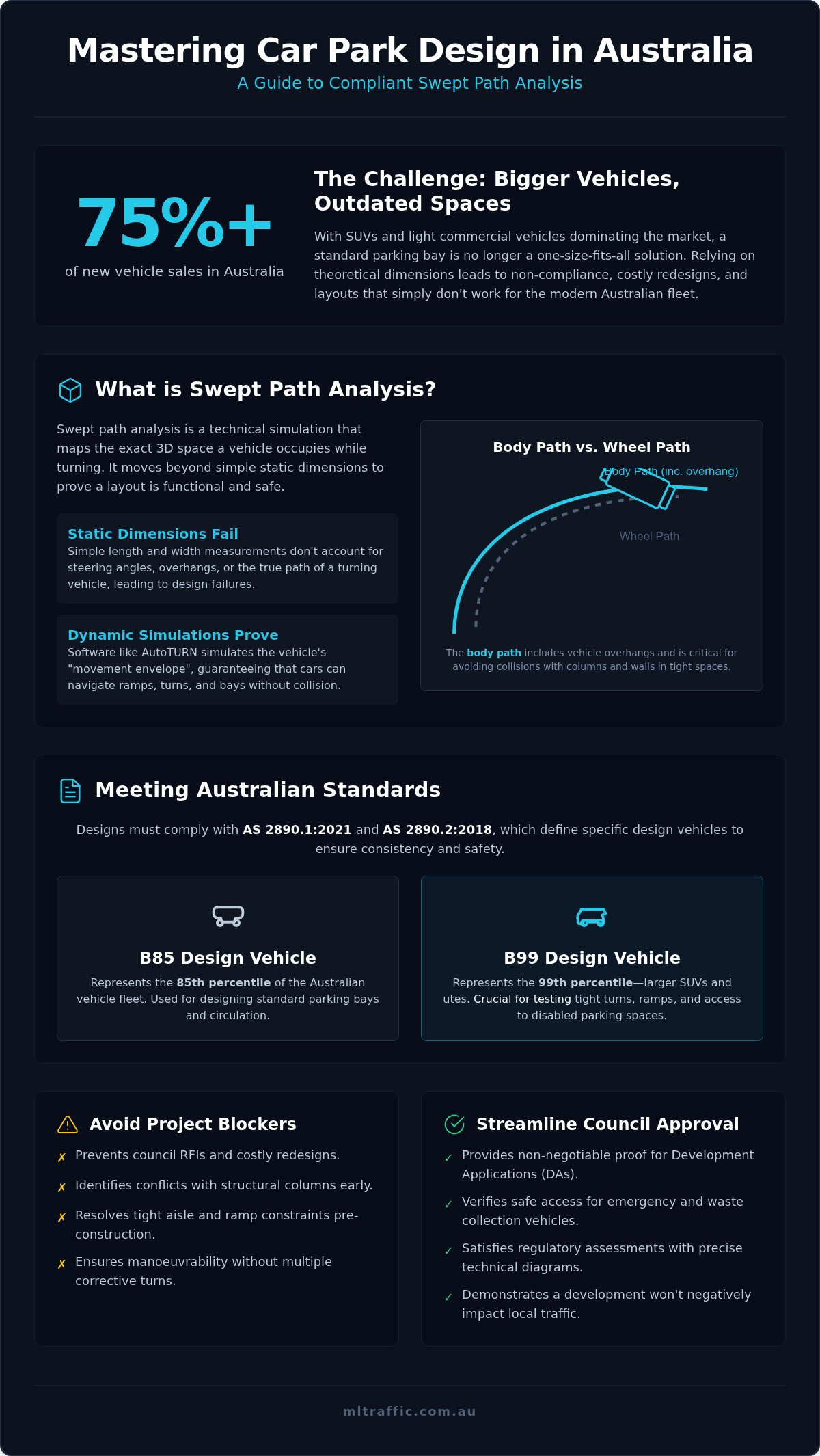
Swept path analysis for car park design is a technical simulation that maps the dynamic space a vehicle occupies while in motion. These movement envelopes account for the steering geometry, physical footprint, and turning capabilities of specific vehicles. Relying on simple, static vehicle dimensions is insufficient for professional design because a car’s path is not a simple rectangle moving in a straight line. Factors such as steering lock and wheelbase determine the exact curve of a turn, making theoretical measurements unreliable for precise planning.
To better understand how these simulations function in a multistorey environment, watch this helpful video:
A critical distinction in any assessment is the difference between the body path and the wheel path. The wheel path tracks the trajectory of the tyres, which is essential for determining kerb heights and pavement widths. However, the body path includes the front and rear overhangs. In tight basement car parks, the body path is what prevents collisions with structural columns or walls. Engineers often utilise industry-standard tools like AutoTURN or AutoTrack swept path analysis software to validate designs against Australian Standards.
The Critical Importance of Manoeuvrability
Professional car park design must facilitate safe vehicle passage without requiring multiple corrective manoeuvres. If a layout forces a driver to reverse and adjust several times to enter a bay, it creates operational bottlenecks and increases the risk of property damage. Structural columns often present the greatest challenge. Designers must ensure that columns are placed outside the swept path envelope to maintain clear lines of sight. Using “standard” dimensions often leads to failure because the B99 design vehicle requires significantly more clearance than an average sedan or hatchback.
Regulatory Context in Australia
In the Australian planning system, swept path analysis supports the Statement of Environmental Effects by proving that a development won’t negatively impact local traffic safety. This technical data is a non-negotiable requirement for Development Applications (DAs) in constrained urban sites. Local councils use these diagrams to verify that waste collection trucks and emergency vehicles can access the property without obstructing public roads. Providing a professional Vehicle Swept Path Analysis ensures every design complies with the rigorous specifications of AS 2890.1:2021 and AS 2890.2:2018.
The Technical Mechanism: AutoTURN Software and AS 2890
Modern traffic engineering relies on high-fidelity simulations to predict vehicle behaviour with absolute certainty. AutoTURN 2026 is the industry-standard software used to conduct swept path analysis for car park design. It moves beyond static geometry by calculating the precise movement of a vehicle based on its steering lock, wheelbase, and operational speed. This level of precision is mandatory for modern developments, as it accounts for the front and rear overhangs that often collide with structural elements in poorly designed spaces.
Using the latest software version is critical because the Australian vehicle fleet has changed significantly. SUVs and light commercial vehicles now dominate the market, representing over 75% of new sales. Older software versions or manual “turning circle” templates often fail to capture the increased dimensions of these modern vehicles. By integrating current vehicle profiles, engineers ensure that a design works for the cars people actually drive today, rather than those from decades ago.
Vehicle Templates and Design Standards
The Australian Standards define specific vehicle templates to ensure consistency across all developments. The Australian Standard AS 2890.1:2004 established the groundwork for off-street parking, though the current AS/NZS 2890.1:2021 update now governs new projects. The most common templates are the B85 vehicle, representing the 85th percentile of the fleet, and the B99 vehicle, representing the 99th percentile. While B85 is used for standard bays, the B99 template is often required for high-stakes access points and narrow ramps where the margin for error is minimal.
For commercial facilities, AS 2890.2:2018 dictates the requirements for heavy rigid vehicles (HRVs) and articulated vehicles. Simulating these larger envelopes is essential for loading docks and waste collection areas. A professional Vehicle Swept Path Analysis maps these complex movements to ensure that a 12.5-metre HRV can enter, load, and exit the site safely without blocking public traffic or damaging infrastructure.
Simulation Accuracy and Software Reliability
Manual calculations are no longer accepted by most local councils. They lack the dynamic detail required to prove safety in constrained sites. AutoTURN simulations account for steering lock angles and the speed of the vehicle, which directly impacts the width of the swept path. A vehicle turning at 5 km/h requires a different envelope than one navigating a tight corner at a crawl. Accurate simulations also consider driveway ramp grades, ensuring that the vehicle’s underside does not scrape when transitioning between levels. This technical rigour is why senior-led analysis is vital for securing council approval without costly RFIs.
Solving Manoeuvrability Challenges in Complex Layouts
Complex site constraints often force compromises in car park geometry. Narrow aisles and tight turning radii in basement levels are frequent points of failure in Development Applications. Using swept path analysis for car park design allows engineers to identify these issues during the preliminary layout phase. We work through an iterative process where structural columns and kerb alignments are adjusted based on real-time simulation results. This ensures every square metre of the site is utilised effectively while maintaining safe vehicle movements.
Identifying and Fixing Design Bottlenecks
A common mistake in urban developments is the use of 90-degree parking in dead-end aisles without providing adequate turnaround space. If a driver enters a full aisle and cannot turn around, they’re forced to reverse back into a main thoroughfare, creating a significant safety risk. Professional analysis identifies these “dead zones” where vehicle paths don’t overlap, allowing architects to repurpose that space for bicycle parking, storage, or landscaping. According to best practices supported by the Institute of Transportation Engineers Australia & New Zealand, driveway widths must also be tailored to the specific design vehicle. A width that works for a B85 car might cause a B99 vehicle to clip a structural pillar or encroach on the opposing lane.
Heavy Vehicle and Service Access
Councils increasingly require on-site waste collection for medium and high-density projects. This necessitates a layout that can accommodate heavy rigid vehicles (HRVs) without obstructing resident traffic. Swept path diagrams must prove that a waste truck can enter, reach the collection point, and exit in a forward direction as per AS 2890.2:2018. We also simulate emergency vehicle access to verify that fire trucks and ambulances have sufficient clearance heights and turning radii. For more detailed information on managing these larger envelopes, refer to our guide on Truck Turning Paths: Planning for Loading Docks. Managing these “conflict points” between service vehicles and private cars is essential for operational safety and long-term site functionality.
Securing Council Approval with Swept Path Diagrams
Local councils in Australia treat swept path analysis for car park design as a mandatory validation tool rather than an optional service. A professional diagram must provide more than just a visual trace; it requires precise annotations showing clearances to every structural column, wall, and kerb. Most rejections occur because the submission lacks clarity in its scale or fails to account for the 300mm clearance buffer required by AS 2890.1. A certified traffic engineer’s signature serves as a technical guarantee that the simulation follows correct steering lock and speed parameters, providing the council with the necessary assurance of site functionality.
The DA Submission Checklist
A successful Development Application (DA) requires comprehensive traffic documentation that explicitly proves a design vehicle can access all parking bays and service areas. This proof must show the vehicle can move without encroaching on opposing lanes or striking infrastructure. Essential items for your submission include:
- Verification of clearance to all structural elements, including overhead obstructions and basement pillars.
- Demonstration of “three-point turn” limitations to ensure drivers aren’t forced into excessive or dangerous manoeuvres.
- Detailed scale drawings, typically at 1:100 or 1:200, showing both the wheel path and body path envelopes.
For larger developments, this analysis forms a critical component of a broader Traffic Impact Assessment: The Definitive Guide for Australian Developers. Clear documentation at this stage prevents the 2025/2026 NSW fee unit costs from escalating due to repeated redesigns and resubmissions.
Expert Witness and RFI Responses
Council planners frequently issue a Request for Information (RFI) if they doubt the manoeuvrability of a proposed layout. We use swept path data to provide evidence-based justifications for design variations, acting as technical advocates during the planning process. This involvement is crucial when a site is particularly constrained and requires a professional to defend a specific turning angle as safe, even if it deviates from standard recommendations. Having the same expert who performed the initial analysis manage the RFI response ensures continuity and accountability. This direct access to senior leadership allows for rapid adjustments that satisfy council requirements without compromising the project’s commercial viability.
Ensure your project stays on track by engaging experts who understand the nuances of local government requirements. Contact us to book a professional Vehicle Swept Path Analysis for your next submission.
ML Traffic Engineers Australia: Expert Analysis for Your Car Park Design
ML Traffic Engineers Australia provides rigorous swept path analysis for car park design to ensure every project meets the demanding requirements of Australian Standards. With over 15 years of experience in traffic and transport planning, we’ve developed a reputation for technical precision and reliability. Our approach eliminates the uncertainty of the Development Application process by providing evidence-based designs that satisfy council planners and optimise site functionality. We understand that a car park is a significant capital investment; our simulations serve as a digital stress test to protect that investment from design failure.
Our consultancy offers a comprehensive suite of technical services designed for the Australian development sector:
- Vehicle Swept Path Analysis using industry-standard AutoTURN software.
- Traffic Impact Assessment (TIA) Reports for all land-use categories.
- Car Parking Demand Assessments to justify parking provision variations.
- Driveway Ramp Grade Assessments to prevent vehicle scraping.
- Waste Management Plans and loading dock optimisation.
- Intersection Analysis and Sight Distance Assessments.
Why Developers Trust Our Technical Expertise
We maintain a strict commitment to senior-led analysis on every project. Unlike larger, impersonal firms that often delegate technical work to junior staff, we ensure that our clients have direct access to senior principals at ML Traffic Engineers Australia. This “no-gatekeepers” approach guarantees that the professional who initiates your project is the one performing the technical simulation and signing the final report. This personnel continuity promise is a core pillar of our philosophy. It ensures that the expert who understands your site constraints is the one defending the design during council negotiations.
Our experience spans a vast range of project environments, including high-density residential towers, commercial shopping centres, industrial warehouses, and mixed-use developments. We focus on practical, cost-effective solutions that pass council on the first submission. By identifying potential manoeuvrability issues early in the design phase, we help developers avoid the wasted space and expensive structural retrofitting that results from poor planning. Our meticulous attention to detail ensures that structural columns and aisle widths are positioned for maximum efficiency.
Get Started with Your Assessment
Securing a professional assessment is a straightforward process. To receive a rapid and competitive quote, simply provide our team with your current site plans in PDF or CAD format. ML Traffic Engineers Australia maintains national service coverage, ensuring that developers across Australia can access high-level traffic engineering expertise regardless of their project’s location. Every report we produce is meticulously checked for compliance with AS 2890.1, AS 2890.2, and AS 2890.6 where required. This rigorous quality control process minimises the risk of costly RFIs and keeps your project timelines on track.
Take the first step toward a compliant and functional design by engaging a seasoned expert. Contact ML Traffic Engineers Australia today to discuss your project requirements directly with a senior traffic consultant.
Optimise Your Car Park Layout for Compliance and Approval
A functional car park design requires more than meeting minimum bay counts. It demands technical proof that the modern vehicle fleet can navigate the site safely and efficiently. By implementing a professional swept path analysis for car park design, you address potential manoeuvrability issues before they become permanent structural errors. Adhering to the latest updates in AS 2890.1 and AS 2890.2 is essential for securing council approval and avoiding the delays associated with Requests for Information.
ML Traffic Engineers brings over 15 years of industry experience to every assessment. We ensure your documentation is accurate, compliant, and ready for submission. Our clients benefit from direct contact with senior principals throughout the project lifecycle, ensuring technical accountability and personnel continuity from start to finish. Don’t leave your Development Application to chance with manual calculations or outdated templates.
Take the next step in your project’s success. Request a Professional Swept Path Analysis from ML Traffic Engineers to ensure your design is functional and ready for council approval. We’re here to help you bridge the gap between architectural vision and regulatory reality.
Frequently Asked Questions
What is swept path analysis in car park design?
Swept path analysis for car park design is a technical simulation that maps the dynamic envelope of a vehicle while it’s in motion. It calculates the space required for a vehicle’s body and wheels to navigate turns, aisles, and parking bays. Unlike static measurements, this analysis accounts for steering geometry and front or rear overhangs. It ensures that the proposed layout accommodates the turning capabilities of specific design vehicles without colliding with structural columns.
Is swept path analysis required for all Australian car park designs?
Most local councils in Australia require swept path analysis as a mandatory component of a Development Application (DA). It’s particularly critical for sites with constrained access, basement levels, or complex loading requirements. While small residential driveways might occasionally be exempt, any multi-unit or commercial development must provide technical proof of manoeuvrability. If you don’t include these diagrams, it often results in an immediate Request for Information (RFI) or application rejection.
What software is used for swept path analysis in Australia?
AutoTURN 2026 is the industry-standard software utilised by traffic engineers across Australia. This technical tool allows for millimetre-precise simulations of vehicle movements based on steering lock angles and operational speeds. It contains an extensive library of Australian Standard vehicle templates, ranging from small cars to heavy rigid vehicles. Using the latest software version is essential to ensure the simulations reflect the dimensions of the modern Australian vehicle fleet.
Can an architect perform swept path analysis instead of a traffic engineer?
While some architects have access to basic simulation tools, most councils require these assessments to be performed or certified by a qualified traffic engineer. ML Traffic Engineers Australia provides the technical depth required to interpret AS 2890.1 and AS 2890.2 accurately. We ensure that steering parameters and clearance buffers are correctly applied. Engaging a specialist provides a higher level of professional accountability, which is vital if a design needs to be defended during a planning appeal.
What are the AS 2890 requirements for swept paths?
The primary requirements are detailed in AS/NZS 2890.1:2021 for off-street parking and AS 2890.2:2018 for commercial facilities. These standards specify the design vehicles that must be used, such as the B85 and B99 templates. A critical requirement is the provision of adequate clearance buffers from the vehicle body to any structural obstruction. The analysis must demonstrate that vehicles can enter and exit bays safely while maintaining these buffers throughout the entire manoeuvre.
How much does a swept path analysis report cost for a DA?
The cost of a swept path analysis report varies depending on the complexity of the site and the number of vehicle movements required. Industry data suggests that standard assessments for Australian developments typically range from $500 to $1,800 plus GST. Factors such as the number of basement levels, the variety of vehicle types simulated, and the need for intersection analysis will influence the final fee. Developers should seek a site-specific quote based on their architectural plans.
What vehicle types are used in swept path simulations?
Simulations typically utilise standard design vehicles defined by Australian Standards. The B85 vehicle represents the 85th percentile of the car fleet, while the B99 represents the 99th percentile, covering larger SUVs and utes. For commercial sites, ML Traffic Engineers Australia simulates heavy rigid vehicles (HRVs), small rigid vehicles (SRVs), or articulated vehicles for loading docks. Waste collection trucks and emergency vehicles, such as fire engines, are also modelled to ensure they can access the property safely.
How long does it take to complete a swept path assessment?
A standard assessment can generally be completed within three to five business days once the final CAD plans are provided. More complex projects involving multiple basement levels or large-scale commercial loading facilities may require additional time for detailed modelling and conflict point analysis. Providing clear, up-to-date architectural drawings is the best way to ensure a rapid turnaround. Early engagement allows for design adjustments before the final council submission deadline.

Disclaimer
The content on www.mltraffic.com.au, including all technical articles, guides, and resources, is provided for general informational and educational purposes only. It is not intended to constitute professional advice in traffic engineering, transportation planning, development approvals, or any other technical or legal field.
While ML Traffic Engineers makes every reasonable effort to ensure the accuracy, completeness, and timeliness of the information published, we do not provide any warranties or representations (express or implied) regarding its reliability, suitability, or availability for any particular purpose. Any reliance you place on the content is strictly at your own risk.
In no event shall ML Traffic Engineers, its directors, employees, authors, or affiliates be liable for any direct, indirect, incidental, special, consequential, or punitive damages (including, without limitation, loss of profits, data, or business opportunities) arising out of or in connection with the use of, or inability to use, any information provided on this website.
The articles and guides on this site are not a substitute for engaging a qualified, registered professional traffic engineer (such as an NPER or RPEQ engineer) to assess your specific project requirements. For tailored advice, compliance assessments, or traffic engineering services, please contact a competent professional.
This disclaimer may be updated from time to time without notice. By accessing or using this website, you agree to be bound by the most current version of this disclaimer.
