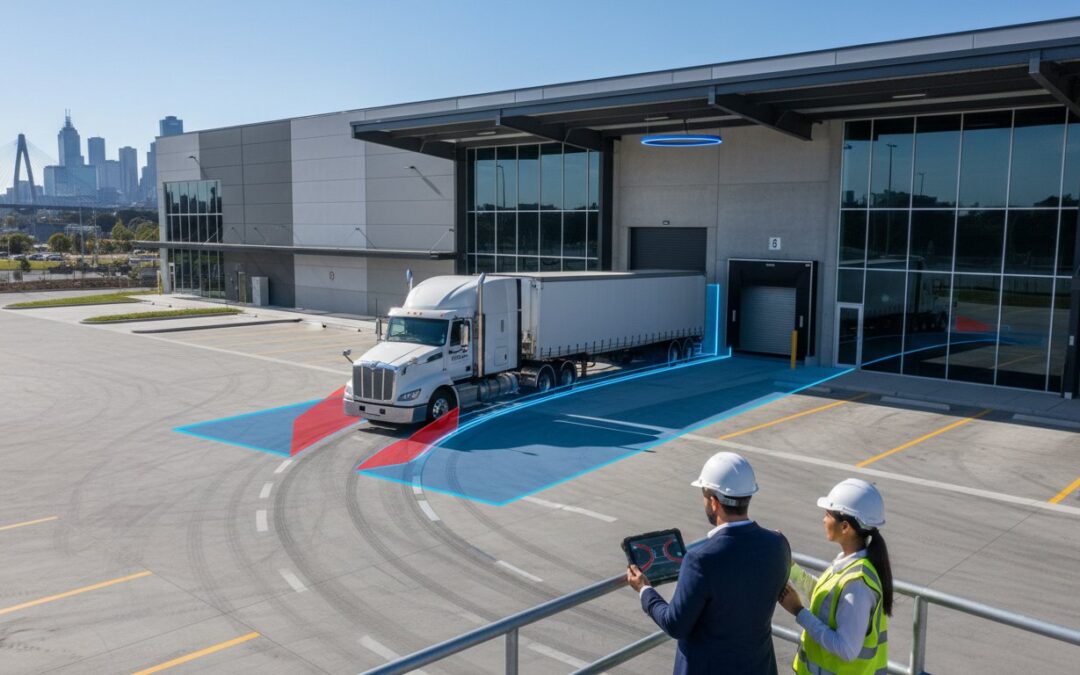
What if your multi-million dollar industrial project is stalled because a single vehicle cannot clear the entry gate? At ML Traffic Engineers, we have seen this scenario play out across more than 10,000 sites since 2005, where a developer’s DA is rejected simply because turning circles do not meet strict Australian Standards. You likely already know that every square metre of your site is valuable. Losing space to oversized or poorly planned driveways directly impacts your potential yield and project timelines.
This guide demonstrates how a professional swept path analysis for B-double truck access ensures your site layout remains both safe and compliant with AS 2890.2. We’ll show you how to navigate complex Austroads templates to secure council approval without the need for expensive site retrofitting later. You will discover how to maximize your usable building footprint while gaining the certainty that heavy vehicles won’t clip curbs or structural pillars. We’re going to break down the technical requirements you need to move from a risky layout to a council-ready site plan.
Key Takeaways
-
Understand the technical complexities of B-double maneuvering, including how dual articulation points and off-tracking dictate your site’s spatial requirements.
-
Learn why professional swept path analysis for B-double truck movements using AutoTURN software is essential for meeting Australian Standards and avoiding the limitations of manual templates.
-
Identify common design pitfalls, such as cabin overhangs and insufficient run-up distances, to prevent vehicle damage and ensure safe loading dock access.
-
Discover how early involvement from a traffic consultant streamlines your Traffic Impact Assessment (TIA) and helps secure council approval for your development.
Table of Contents
What is Swept Path Analysis for B-Double Trucks?
A swept path analysis for B-double truck is a technical simulation that calculates the exact envelope of space a multi-combination vehicle requires to complete a maneuver. It is a mandatory requirement for industrial and commercial developments across Australia. Unlike a standard rigid vehicle, a B-double consists of a prime mover and two trailers connected by two separate articulation points. This configuration creates a complex footprint that changes based on steering angle, vehicle length, and speed.
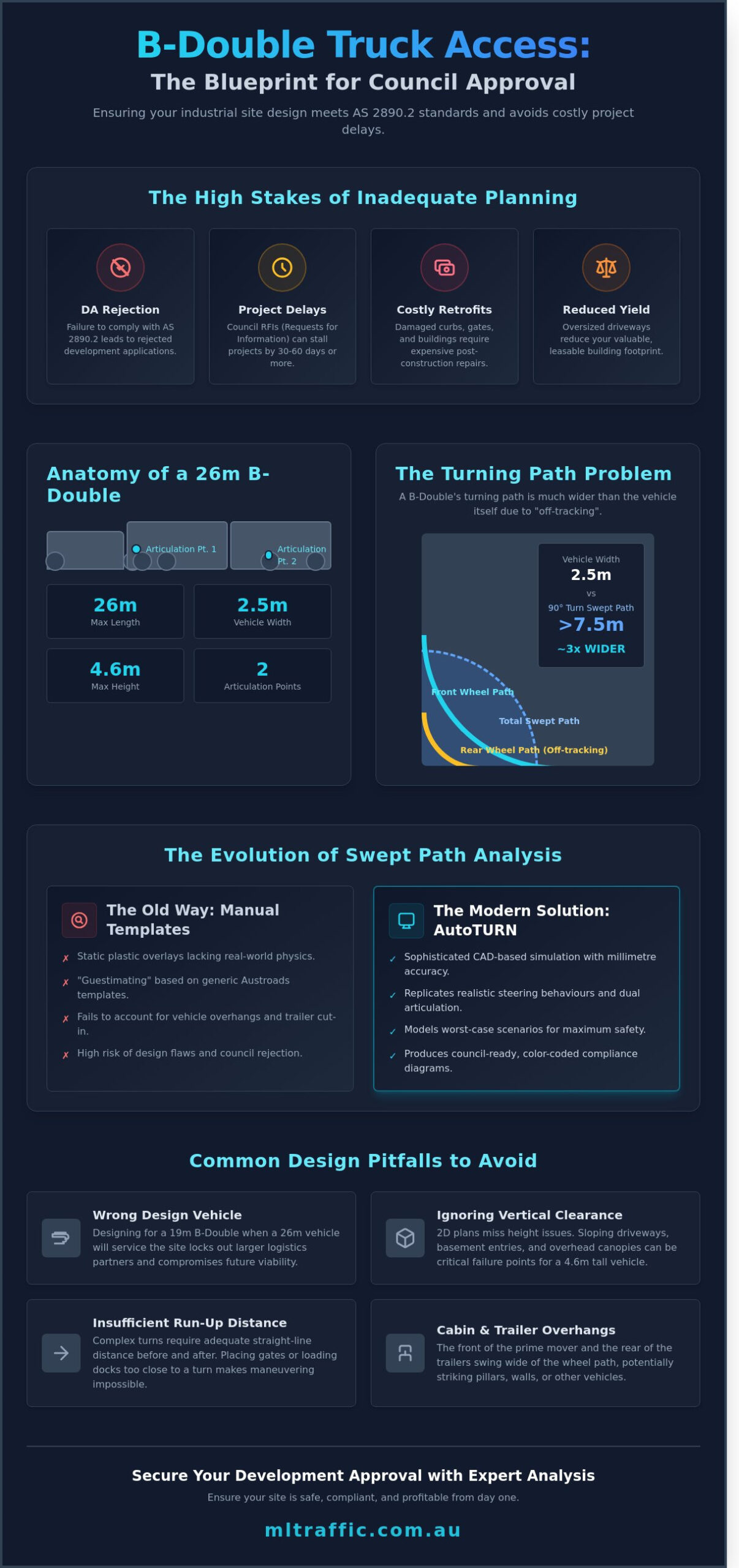
Developers cannot rely on "guestimating" these turns. A 26-metre B-double does not follow the path of its front wheels. If the design fails to account for the dynamic movement of the rear trailer, the result is often structural damage. Curb strikes, destroyed gate posts, and damaged loading docks lead to expensive retrofits. More importantly, failing to provide an accurate simulation during the planning phase usually results in a rejected permit or a costly Request for Further Information (RFI) from the council.
The Anatomy of a B-Double Turning Path
Understanding the difference between physical width and swept path width is critical for site design. While a B-double is typically 2.5 metres wide, its swept path in a 90-degree turn can exceed 7.5 metres. This occurs due to "off-tracking," where the rear wheels follow a significantly tighter path than the front steering axle. Our engineers use specialized software to model these movements, accounting for the maximum steering lock and the specific dimensions of the vehicle. This ensures your site layout accommodates the actual space needed for safe operation without encroaching on pedestrian zones or landscaping.
Why Councils Demand Professional Swept Path Diagrams
Australian local councils and road authorities require professional diagrams to verify compliance with AS 2890.2 (Off-street commercial vehicle facilities). These assessments are not just paperwork; they are safety benchmarks used to protect public assets. Professional diagrams provide:
-
Regulatory Compliance: Proof that the site meets the rigid standards of AS 2890.2 for heavy vehicle access and egress.
-
Infrastructure Protection: Assurance that the vehicle won’t mount curbs, strike power poles, or overhang into oncoming traffic lanes.
-
Risk Mitigation: A reduction in the likelihood of council issuing an RFI, which can delay a project by 30 to 60 days.
At ML Traffic Engineers, we provide the technical certainty needed to move your DA forward. You can view our full range of traffic engineering services to see how we assist with complex site access and heavy vehicle requirements.
How Engineers Simulate B-Double Movements
Traffic engineering has moved far beyond the era of manual plastic overlays. In the past, consultants relied on static Austroads templates to guess how a heavy vehicle might navigate a corner. This method lacked the precision required for modern, high-density developments. Today, we use sophisticated CAD-based simulations to perform a swept path analysis for B-double truck maneuvers with millimetre accuracy.
These digital tools allow us to account for the complex physics of multi-part articulation. We don’t just look at where the wheels go; we track the "overhang" of the chassis and the "cut-in" of the trailers. This level of detail is vital when designing loading docks or tight intersections where a few centimetres of error can result in structural damage or operational failure.
The Role of AutoTURN in Modern Engineering
AutoTURN is the industry standard for Australian traffic engineering because it replicates realistic steering behaviours. It simulates how a 26m B-double actually pivots across its two separate kingpins. We use it to test "worst-case" scenarios, such as a driver navigating a 12.5m radius curve at a slow crawl. The software generates the color-coded diagrams required for technical reports, clearly distinguishing between the tyre path and the body clearance. If you’re unsure which vehicle your site needs to accommodate, reviewing our detailed traffic services can help clarify the compliance path.
Selecting the Right Design Vehicle
Choosing the wrong vehicle size is a common mistake that leads to costly retrofits later. A 19m B-double has a significantly tighter turning circle than a 26m high-productivity vehicle. If your warehouse development only accounts for the 19m variant, you’ll permanently lock out larger logistics partners. We use Austroads Vehicle Turning Templates as the baseline, but we customize the simulation based on the specific fleet expected on-site. Designing for the largest possible vehicle future-proofs the development and ensures site resilience as transport demands grow.
While 2D footprints are the standard, we also use 3D modeling to identify vertical clearance issues. This is critical for basement entries or overhead canopies where a B-double’s 4.6m height meets a sloping driveway. By simulating the vertical swept path, we prevent "grounding" issues on steep 1:20 grade transitions, ensuring the truck doesn’t bottom out or strike the ceiling during entry.
Austroads Templates vs. Real-World Maneuvering
Standard Austroads turning templates provide a basic baseline for vehicle movement, but they often lack the nuance required for a successful Development Application. These static models assume a perfectly level surface. In reality, a 25-metre B-double faces physical challenges that a 2D drawing simply cannot predict. Relying solely on a generic template without a site-specific swept path analysis for B-double truck configurations often leads to costly construction errors or immediate council rejections. We see many projects stall because the initial design didn’t account for the physical reality of heavy vehicle dynamics.
The Limitations of Static Turning Templates
Most templates ignore vertical geometry. When a B-double enters a site with a 1:20 cross-fall or a steep driveway grade, the vehicle’s body tilts. This tilt shifts the swept path outward, which can cause the trailer to clip gate posts or structural columns. Standard templates also frequently overlook the "tail swing" of the rear trailer. During a sharp turn, the rear of a B-double can swing up to 1.0 metre outside the tracked path of the wheels. Custom digital simulations are the only way to verify these movements on non-standard intersections or constrained loading docks. It’s a mistake to assume a flat-land template works on a 1:8 ramp.
Human Error and Operational Reality
Designers must account for the average driver rather than a precision expert. A driver maneuvering a heavy vehicle into a tight industrial unit at 5km/h won’t hit the exact same line every single time. We recommend building "forgiveness" into the site layout to prevent operational bottlenecks and constant property repairs. Clearance is the 300mm minimum buffer required by most Australian councils between the vehicle’s swept path and any fixed vertical obstruction. If your design requires a "perfect" maneuver with zero room for error, it’s a failed design. Real-world logistics require a swept path analysis for B-double truck access that allows for minor steering adjustments without hitting a kerb or a wall. Professional assessments ensure these low-speed maneuvers remain safe and functional for everyday logistics staff, not just on paper.
Common B-Double Design Pitfalls (and How to Avoid Them)
Designing for a 26-metre B-double requires more than just following a standard template. Small oversights in the planning phase lead to expensive retrofits or operational gridlock. Performing a detailed swept path analysis for B-double truck access ensures the combination fits within the site boundaries without damaging infrastructure. One frequent error is providing insufficient run-up distance before a major turn. A B-double needs a straight approach to align its trailers before entering a loading dock. Without this, the rear trailer off-tracks aggressively, often mounting kerbs or striking bollards.
Developers also overlook the cabin overhang. While the wheels follow one path, the front corners of the prime mover swing wide during a turn. This results in gate posts being clipped during tight entries. A professional swept path analysis for B-double truck movements identifies these collision points before construction begins. We’ve seen projects where a 200mm shift in a gate pier saved a developer A$15,000 in future repairs and maintenance costs.
Loading Dock and Driveway Disasters
Tight crossovers are a primary cause of damaged tyres and destroyed landscaping. If the driveway throat is too narrow, drivers must swing into oncoming traffic lanes to complete the turn. Site layouts must also avoid the "blind side" reverse. In Australia, drivers need to see the rear of their trailer out of the right-hand window. Forcing a passenger-side reverse increases accident risks by 40%. Integrating a Vehicle Swept Path Assessment early in your design phase prevents these operational bottlenecks and safety hazards.
The Conflict Between Parking and Access
Car parking spots often encroach on the 15.4-metre turning radius required for heavy vehicles. When a B-double is forced to wait for a car to exit, it blocks the street, leading to council complaints and traffic fines. While drive-through layouts are 30% more efficient for logistics, they require more land. If you choose a reversing design, ensure your Car Park Design doesn’t place small vehicle bays within the truck’s swing zone. Failure to account for simultaneous movements, such as a truck entering while a visitor exits, remains a top reason for DA refusals in high-density industrial zones.
Avoid costly redesigns by booking your compliance assessment today.
Securing Approval: Your Next Steps for a Compliant Site
Transitioning from a design concept to a certified Traffic Impact Assessment (TIA) is the most critical phase of your development application. You’ve designed a functional warehouse or industrial hub, but without a certified swept path analysis for B-double truck movements, your proposal won’t survive the initial council review. Planners require technical certainty that your site can handle heavy vehicle maneuvers without compromising public safety or damaging infrastructure.
Engaging a traffic consultant during the early site planning phase prevents the "design-fail-redesign" loop that drains project budgets. We’ve seen developers lose upwards of A$35,000 in architectural revisions because a loading dock was positioned just two metres too close to a boundary for a 26-metre B-double to clear. By involving us early, you’ll identify these constraints before the plans are locked in. It’s a proactive approach that saves time and capital.
Our "Principal-led" philosophy sets us apart from larger, impersonal firms. The engineer who provides your initial quote is the same expert who performs the technical calculations and signs the final report. You won’t be handed off to a junior graduate. Since 2005, we’ve completed assessments for over 10,000 sites across Australia, providing the "done-for-you" documentation that local councils and state road authorities demand.
What to Include in Your Swept Path Report
Council planners look for specific technical triggers in your documentation. Your report must feature clear, scaled diagrams that illustrate the full vehicle envelope, including the mandatory 600mm clearance margins. We ensure every swept path analysis for B-double truck compliance references AS 2890.2 and relevant state guidelines, such as those from Transport for NSW or VicRoads. A signed statement of compliance from a qualified traffic engineer is the final piece that transforms a simple drawing into a valid legal document for your DA.
Partnering with ML Traffic Engineers
Don’t let bureaucratic hurdles delay your construction timeline. We leverage over 15 years of experience in Traffic Impact Assessments to deliver reports that satisfy even the most stringent council requirements. You’ll have direct access to our senior experts, Michael Lee and Benny Chen, ensuring you get answers quickly without dealing with administrative gatekeepers. Contact us today for a Vehicle Swept Path Analysis quote to move your DA forward and secure your site’s operational future.
Secure Your Site Approval with Precise Engineering
Navigating heavy vehicle access doesn’t have to be a roadblock for your development. Generic templates often fail to account for site-specific constraints, leading to council refusals and expensive redesigns. A detailed swept path analysis for B-double truck movements is the only way to guarantee your project meets Australian Standards while maximizing usable space. At ML Traffic Engineers, we’ve assessed over 10,000 sites across Australia, ensuring every driveway and loading dock functions exactly as intended.
You’ll work directly with our senior principals, Michael Lee and Benny Chen, who lead every assessment from start to finish. We don’t pass work to juniors; the consultant who quotes your project is the one who delivers the technical engineering report. This hands-on approach provides the certainty you need for a successful development application while avoiding common design pitfalls.
Get a professional Swept Path Analysis for your B-double project today
Your path to a compliant, high-functioning site starts with accurate data and seasoned expertise. We look forward to helping you move your project forward.
Frequently Asked Questions
What is the difference between a 19m and 26m B-double for swept path analysis?
A 19m B-double is generally classified as a "General Access" vehicle, while a 26m B-double requires specific route permits under the Performance Based Standards (PBS) framework. In a swept path analysis for B-double truck compliance, the 26m variant demonstrates significantly more "off-tracking." This means the rear trailers cut inward by up to 3.5 metres more than the 19m version on tight 90 degree turns. We model these differences precisely to ensure your site layout accommodates the specific vehicle size your tenants require.
Does every commercial development application require a swept path analysis?
Not every application needs one, but 85% of commercial projects involving loading areas or heavy vehicle access will face this council requirement. If your site plan involves any vehicle larger than an 8.8 metre Medium Rigid Vehicle (MRV), you’ll likely need a formal assessment. Providing this data upfront prevents the council from issuing a Request for Further Information (RFI), which can delay your approval by 30 days or more.
Can I use a standard truck template for a B-double turn?
You can’t use a single-unit template because B-doubles have two distinct articulation points. This "double pivot" creates a complex path that a standard semi-trailer template cannot replicate. Using the wrong template often results in a 100% rejection rate from council engineers. We use specialized software like AutoTURN to simulate the exact wheel paths and body overhangs of Australian Standard B-doubles to ensure accuracy.
What are the Australian Standards for heavy vehicle access?
The primary regulation is AS 2890.2:2018, which provides the design parameters for off-street commercial vehicle facilities. This standard dictates the minimum clearances and turning radii required for various truck classes. We also cross-reference the Austroads Guide to Road Design Part 4 to ensure your site’s entry and exit points interact safely with public infrastructure and meet local government requirements.
How much does a professional swept path analysis for a B-double cost?
A professional swept path analysis for B-double truck maneuvers typically costs between A$600 and A$1,500 per site plan. The final price depends on the number of maneuvers required and the complexity of your site’s geometry. Investing in this assessment early is a cost-effective move. It’s much cheaper than spending A$40,000 later to relocate structural columns or widen driveways that were built too narrow for heavy vehicle access.
How long does it take to get a swept path report for a council application?
We typically deliver completed swept path reports within 3 to 5 business days after receiving your CAD files. If you’re facing a strict council deadline, we can often provide a priority 24 hour turnaround. Our RPEQ-certified engineers ensure every report is technically sound and formatted for immediate submission with your Development Application (DA) or Construction Certificate (CC) paperwork.
What happens if a B-double cannot safely maneuver on my proposed site plan?
If the simulation shows a failure, we don’t just hand you a "no" and walk away. We provide practical design solutions, such as splaying a loading dock corner or widening a driveway gate by 1.2 metres. About 30% of our projects involve these types of layout adjustments. Our goal is to find a balance where the truck fits safely while you retain the maximum possible floor area for your development.
Do I need swept path analysis for reversing maneuvers or just forward motion?
You need to demonstrate both to satisfy council planners and AS 2890.2:2018 requirements. Most councils mandate that trucks enter and exit the site in a forward direction to maintain road safety. This means your report must show the full sequence: entering from the street, reversing into the designated loading bay, and then driving forward to exit the site. We model the entire movement to prove the site is functional and safe.
Which areas do you cover?
We are traffic engineers servicing Melbourne, Sydney, Brisbane, Gold Coast, Hobart, Perth, Adelaide, Darwin, Canberra and surrounding areas.
Disclaimer
The content on www.mltraffic.com.au, including all technical articles, guides, and resources, is provided for general informational and educational purposes only. It is not intended to constitute professional advice in traffic engineering, transportation planning, development approvals, or any other technical or legal field.
While ML Traffic Engineers makes every reasonable effort to ensure the accuracy, completeness, and timeliness of the information published, we do not provide any warranties or representations (express or implied) regarding its reliability, suitability, or availability for any particular purpose. Any reliance you place on the content is strictly at your own risk.
In no event shall ML Traffic Engineers, its directors, employees, authors, or affiliates be liable for any direct, indirect, incidental, special, consequential, or punitive damages (including, without limitation, loss of profits, data, or business opportunities) arising out of or in connection with the use of, or inability to use, any information provided on this website.
The articles and guides on this site are not a substitute for engaging a qualified, registered professional traffic engineer (such as an NPER or RPEQ engineer) to assess your specific project requirements. For tailored advice, compliance assessments, or traffic engineering services, please contact a competent professional.
This disclaimer may be updated from time to time without notice. By accessing or using this website, you agree to be bound by the most current version of this disclaimer.
