
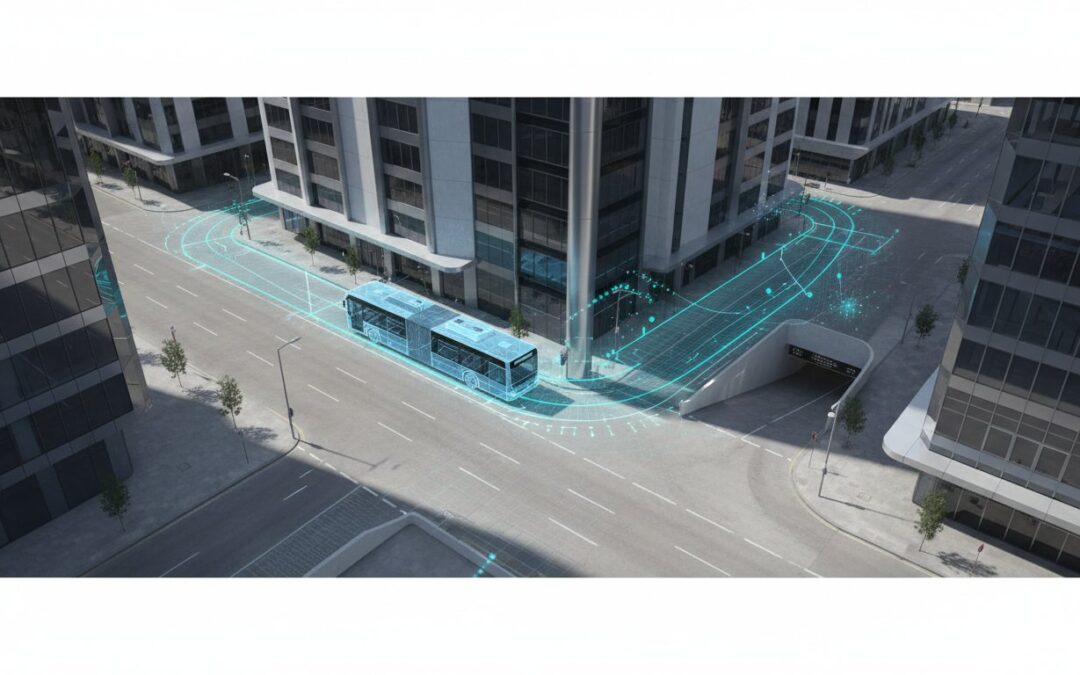
Did you know that a single 12.5-metre turning radius error can trigger a Council RFI that stalls your development for 90 days? It’s a common frustration for developers who realize too late that their swept path analysis for buses was either overlooked or poorly executed. You’ve worked hard to maximize every square metre of your site, yet there’s often a lingering fear that a bus might scrape a structural pillar or that Council will reject your DA due to inadequate access. It’s a high-stakes balancing act that requires absolute technical precision.
We believe your design should work perfectly in the real world while meeting every regulatory hurdle. This guide demonstrates how expert analysis prevents design flaws and ensures your project remains fully compliant with Australian Standard AS 2890.1. You’ll discover how to stop over-designing turning circles, allowing you to reclaim valuable space and protect your profit margins. We’ll preview the essential requirements for a successful traffic report so you can secure your approval with total confidence.
Key Takeaways
-
Learn why buses require unique 2D simulations compared to standard heavy vehicles due to their extended wheelbases and specific overhang requirements.
-
Discover how a detailed swept path analysis for buses identifies hidden dangers like tail swing to prevent costly design flaws and structural damage.
-
Understand how aligning your project with Australian Standard AS 2890.2 serves as the essential benchmark for securing Council development approval.
-
Find out why engaging a traffic engineer during the initial concept phase can save your project significant time and money in potential redesigns.
-
See how direct principal involvement ensures your technical assessments are handled by seasoned experts who understand the nuances of the Australian market.
Table of Contents
What is Swept Path Analysis for Buses and Why is it Unique?
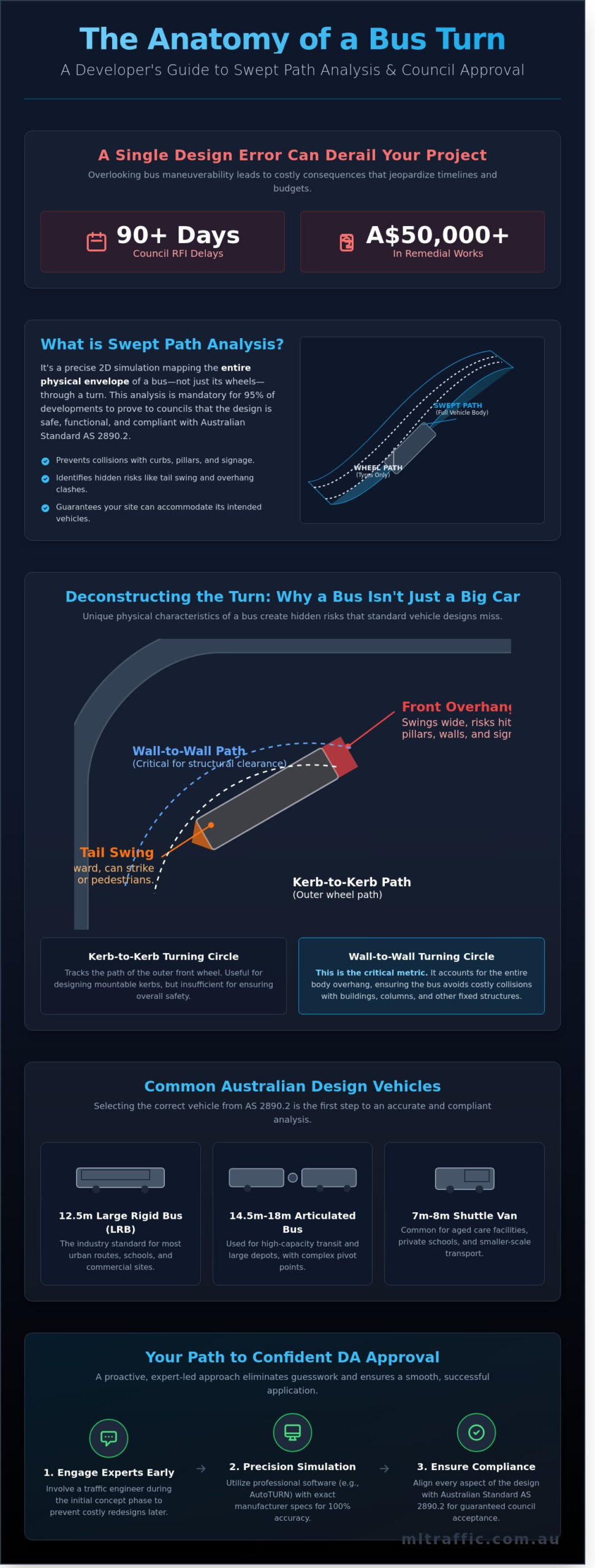
Swept path analysis for buses is a technical 2D simulation that maps the horizontal footprint of a vehicle throughout a specific turning maneuver. It isn’t just about where the wheels go. It represents the entire body of the bus as it moves through space. For traffic engineers, this analysis is the primary method used to ensure a bus won’t strike curbs, signage, or other vehicles. Unlike a standard passenger car, a bus requires a vastly larger operational envelope. We use this data to prove to local councils and road authorities that a site is functional, safe, and compliant with Australian standards.
To better understand this concept, watch this helpful video:
At ML Traffic Engineers Pty Ltd, we utilize professional swept path analysis software such as AutoTURN to create these simulations. This technology allows our team to overlay vehicle movements onto site plans with millimetre precision. Since the 2018 update to AS 2890.2, Australian councils have become increasingly strict about these assessments. For 95% of school drop-off zones, bus depots, and shopping centre loading docks, swept path analysis for buses is a mandatory requirement for development approval. It prevents costly post-construction modifications that can easily exceed A$50,000 in remedial civil works.
The Anatomy of a Bus Turn
The "swept path" differs significantly from the "wheel path." The wheel path tracks exactly where the tyres touch the pavement, but the swept path includes the body overhang. Many modern buses have a front overhang exceeding 2.1 metres. During a tight turn, this front corner swings much wider than the wheels. If a designer ignores this, the bus will strike parked cars or bollards. We also account for steering lock angles. These vary between manufacturers like Volvo, Scania, and Mercedes-Benz. We don’t guess these variables; we use exact manufacturer specifications to ensure the simulation is 100% accurate for your specific site.
Standard Bus Design Vehicles in Australia
Australian standards define specific vehicles for testing. The 12.5m Large Rigid Bus (LRB) is the industry workhorse and the most common design vehicle for urban routes. For high-capacity transit or metropolitan depots, we simulate 14.5m to 18m articulated buses. These units have complex pivot points that change the swept path’s shape entirely. We also assess smaller 7m or 8m shuttle vans for aged care facilities and private schools. Choosing the wrong vehicle often leads to a rejected application. Our principals, Michael Lee and Benny Chen, have over 35 years of experience each in selecting the correct design vehicle for every unique site constraint. We ensure the traffic consultant who provides your quote is the same expert who does the work.
This meticulous approach is why we’ve successfully handled over 10,000 sites across Australia. Whether you are developing a warehouse, a school, or a temple, accurate swept path analysis for buses is non-negotiable for safety and compliance. It’s a direct, fact-based method to guarantee that your development can handle the heavy vehicle traffic it’s designed for without risking property damage or public safety.
Key Factors Influencing Bus Maneuverability
Designing for a 12.5 metre bus is significantly more complex than a standard passenger car. A professional swept path analysis for buses must account for the physical footprint of the vehicle and the psychological space a driver needs to operate safely. We differentiate between kerb-to-kerb and wall-to-wall turning circles. The kerb-to-kerb measurement tracks the outer wheel path, which is vital for placing mountable kerbs. However, the wall-to-wall measurement is the critical metric for structural safety. It accounts for the body overhang, ensuring the bus doesn’t clip columns or building facades. Relying solely on wheel paths often leads to costly structural damage during the first week of operation.
Driver comfort is another factor we never ignore. Designing to the absolute minimum radius is a recipe for operational failure. Real-world drivers don’t behave like perfect computer simulations. We typically include a safety margin of 300mm to 600mm beyond the calculated path. This buffer compensates for steering lag and varying driver skill levels. While the California Highway Design Manual provides excellent international benchmarks for large vehicle turning templates, we always prioritize local Australian requirements to ensure 100% compliance with council expectations.
Managing the ‘Tail Swing’ Phenomenon
Tail swing is the lateral displacement of the rear corner during a turn. This occurs because the rear axle acts as a pivot point. As the driver turns the front wheels left, the rear right corner of the bus kicks out in the opposite direction. In tight loading bays, this swing can easily strike an adjacent parked vehicle or a structural pillar. We design bays with additional width at the entry point to accommodate this 0.5 metre to 1.0 metre kick out. This ensures the bus can exit a confined space without its rear end swinging into oncoming traffic or fixed assets.
Vertical Clearance and Ramp Grades
A comprehensive swept path analysis for buses must extend into the third dimension. Buses have long wheelbases and low ground clearance, making them prone to ‘bottoming out’ on steep driveway transitions. We use vertical cross-sections to check for ‘grounding’ at the centre of the bus or ‘scraping’ at the front and rear overhangs. Following AS 2890.2 standards is mandatory here. For heavy vehicles, a 1:12 (8.3%) maximum grade is often the limit for safe transitions. If your site has a steep entry, we calculate the exact vertical curves required to prevent vehicle damage. If you’re concerned about a specific driveway design, our expert traffic reports can identify these risks before construction begins.
-
Approach Angles: The angle between the ground and a line from the front tyre to the lowest point of the front bumper.
-
Departure Angles: The same calculation for the rear, which is often more critical due to the engine weight and long overhang.
-
Breakover Angle: The maximum peak a bus can drive over without the undercarriage hitting the ground.
Ignoring these vertical factors leads to scraped bitumen and damaged bus suspensions. We’ve seen projects delayed by months because the ramp grades didn’t account for a fully loaded bus’s suspension compression. Meticulous planning at the DA stage prevents these expensive retrofits. Our experience across 10,000 sites ensures that these technicalities are addressed early, keeping your project on track and compliant with all local regulations.
Ensuring Compliance with Australian Standards (AS 2890.2)
AS 2890.2 governs off-street commercial vehicle facilities across Australia. It serves as the primary benchmark for every council engineer reviewing a Development Application (DA). If your design fails to align with these specific requirements, your project risks immediate rejection or costly delays. We’ve managed over 10,000 sites since 2005, and we know that technical compliance on paper is only half the battle. There’s a massive difference between a "technical pass" and "operational functionality." A software simulation might show a bus clearing a corner by 10mm, but in the real world, that’s a recipe for a collision.
Drivers aren’t machines. They need a margin for error. A successful swept path analysis for buses must account for human factors and physical reality rather than just theoretical limits. If a driver has to perform a 10-point turn to enter a loading dock, the design has failed, even if the software says it fits. We focus on creating designs that work for the people actually driving the vehicles. This approach builds trust with councils because it demonstrates a commitment to safety and long-term site viability.
The standard defines the "Design Vehicle" and the "Check Vehicle." For most bus-related projects, we use the 12.5-metre Large Rigid Vehicle (LRV) as the base. However, some councils insist on using a 14.5-metre bus for specific routes or school zones. Using the wrong vehicle template is a 100% guaranteed way to get your DA sent back. We ensure the correct template is used from day one. This saves you the cost of re-drafting and the frustration of missed deadlines. Our team handles the technicalities so you can focus on the construction phase.
Meeting Council Expectations for Bus Access
Council engineers look for clarity and precision. For school drop-off zones and transport interchanges, they require specific proof that the largest anticipated vehicle can navigate the site without crossing into oncoming lanes or mounting kerbs. You should present diagrams that are easy to interpret. We recommend using distinct layers for wheel paths and body overhangs. It’s vital to show "reverse-in" and "drive-out" scenarios for every bay. If the engineer can’t see how the bus enters and exits in one fluid motion, they’ll ask for a redesign. This can add 4 to 8 weeks to your approval timeline.
Common Red Flags in DA Submissions
Many submissions fail because they ignore the physical environment. We often see plans where the bus path clears the kerb but ignores a structural column or a fire hydrant located 1.2 metres above the ground. These fixed assets are unforgiving. Another frequent mistake is assuming "perfect" steering. Most software defaults to maximum steering lock immediately. Real drivers need time and distance to turn the wheel. You must also include the mirror envelope. Bus mirrors typically extend 200mm to 300mm beyond the vehicle body. If your swept path analysis for buses ignores these fittings, you aren’t providing an accurate picture of the site’s safety.
-
Insufficient Clearances: Always maintain a minimum 300mm buffer from all fixed objects.
-
Steering Assumptions: Avoid assuming 100% lock at 0 km/h; allow for realistic transition curves.
-
Vertical Obstructions: Check for low-hanging signage or awnings that the bus body might strike.
-
Inadequate Radius: Ensure the inner wheel path doesn’t track over landscaped areas or pedestrian refuges.
Practical Steps for Developers: From Design to Approval
Getting a development through council shouldn’t feel like a gamble. It is a structured process that requires precision from the first sketch. Engaging a traffic engineer during the initial concept design phase often saves developers between A$5,000 and A$20,000 in potential redesign fees. If you wait until your architectural plans are locked in, you will likely face costly structural changes when the vehicle movements don’t work. We have seen projects delayed by six months because a basement pillar was placed 300mm too close to a turn path.
The first technical step is identifying your ‘Design Vehicle’. This is the largest bus expected to access the site. Whether it is a 12.5m large rigid bus for a school or a 14.5m coach for a hotel, the simulation must be exact. We run a swept path analysis for buses using software that accounts for specific steering lock angles and body overhangs. This isn’t just about the wheels; it’s about ensuring the bus body doesn’t clip a fire booster or a structural column during a tight turn.
To get an accurate result, you must provide your engineer with high-quality CAD site plans in DWG format. These plans need to show every proposed vertical obstruction. Once the initial simulation is run, we review the ‘tight spots’ and suggest kerb line adjustments. Often, a minor 500mm shift in a garden bed or a driveway entry point makes the difference between a council rejection and an approval. Your final Traffic Impact Assessment (TIA) will include these certified swept path plots to prove the site is functional and safe.
Optimising Site Layout for Bus Flow
One-way movements are almost always safer and more efficient for bus access on private sites. They eliminate head-on conflicts and reduce the total pavement area required. By using a swept path analysis for buses, we can often justify narrower road widths to the local council. This allows you to maximise your developable land while still meeting Australian Standards like AS 2890.1. Learn more about our traffic engineering services to see how we balance site yield with technical compliance.
Working with Your Traffic Consultant
Efficiency in the approval process comes down to the quality of your consultant. At ML Traffic Engineers, we’ve been trading since 2005 and have completed assessments for over 10,000 sites across Australia. We operate on a ‘Quote to Work’ promise. This means the senior engineer who provides your quote is the person actually performing the analysis. You get direct access to experts with 30 to 40 years of experience. When a council issues a Request for Further Information (RFI), you won’t be passed to a junior staffer. We handle the technical justification directly, ensuring your project stays on track.
If you require a certified swept path assessment for your development application, contact our senior engineers today for a direct quote and expert advice.
Why ML Traffic Engineers is the Right Choice for Your Bus Analysis
Since 2005, we’ve focused on a singular goal: getting your development applications approved through precise engineering. We aren’t a massive, faceless consultancy where your project is handed off to a junior staffer the moment the contract is signed. At ML Traffic Engineers, we operate on a simple, accountable promise. The traffic consultant who provides your quote is the one who does the work. This direct principal involvement ensures that every swept path analysis for buses we produce is technically sound, defensible, and tailored to the specific constraints of your site.
Our firm brings a combined experience of between 30 and 40 years per senior engineer to every project. We’ve completed over 10,000 successful site assessments across Australia, covering a vast range of land uses including apartments, shopping centres, warehouses, and even places of worship. This high volume of work has given us an intimate understanding of what councils look for and how to address their concerns before they become formal objections. We don’t just provide drawings; we provide a clear, results-oriented strategy to move your DA forward.
Expertise You Can Trust
Our history in specialized vehicle simulations is extensive. We’ve designed and verified access for schools where student safety is the highest priority, shopping centres requiring frequent deliveries, and industrial depots handling constant heavy vehicle movements. We use the latest AutoTURN technology to create these simulations. This industry-standard software allows us to model the exact turning templates of 12.5m standard buses or even larger articulated vehicles with centimetre-perfect accuracy. By simulating these movements digitally, we identify potential pinch points or "conflict zones" where a bus might clip a curb or an adjacent parked car.
This technical precision is backed by our deep knowledge of Australian Standards, particularly AS 2890.2 for commercial vehicles. We translate these complex technical requirements into easy-to-read reports that simplify the decision-making process for council planners. If your site has a difficult driveway ramp grade or a tight turn-in from a busy road, we have the tools to prove it works. You can contact Michael or Benny for a direct quote today to see how our hands-on approach makes a difference for your specific project.
Securing Your Development’s Future
The cost of a mistake in the planning phase is often astronomical. If a bus cannot safely navigate your site after it’s built, the remedial civil works can run into tens of thousands of dollars. We eliminate this risk by providing accurate, professional assurance during the design phase. Our swept path analysis for buses acts as a safeguard for your investment. We help you avoid post-construction modifications that can delay your occupancy certificates or lead to ongoing operational headaches for your tenants.
Our reports carry the weight of RPEQ and professional engineering qualifications, providing the authoritative voice that stakeholders and government bodies demand. We understand the bureaucratic requirements of traffic engineering inside and out. We’ve seen almost every possible site configuration in our 15 plus years of trading, which means we don’t need to guess. We provide the facts, the data, and the simulations necessary to secure your approval. Read more about our team and experience to understand why developers across Australia trust us with their most challenging vehicle access problems.
We pride ourselves on being dependable and meticulous. Our communication is direct, and our results are proven. Whether you’re dealing with a small private school upgrade or a major regional shopping hub, we treat every assessment with the same level of senior-led scrutiny. We make the traffic engineering component of your DA the easiest part of the process.
Secure Your Development Approval with Expert Bus Maneuverability Design
Getting your bus access right isn’t just about following a template. It’s about ensuring your site meets strict Australian Standards like AS 2890.2 while maximizing usable space. A precise swept path analysis for buses eliminates the guesswork that often leads to rejected development applications or expensive post-construction modifications. We’ve assessed over 10,000 sites across Australia since 2005, giving us the technical depth to handle even the tightest urban constraints. You need a design that works the first time to avoid costly council delays and safety issues.
When you work with ML Traffic Engineers, you aren’t passed off to a junior staffer. You get direct access to our principal engineers who bring more than 15 years of industry experience to every project. We understand exactly what local authorities require because we’ve been delivering these results for nearly two decades. The traffic consultant who provides your quote is the same expert who performs the work, ensuring total accountability and technical accuracy. We’re ready to help you navigate the complexities of transport planning with confidence and precision.
Get a professional Swept Path Analysis quote for your project
Let’s get your project moving toward a successful council approval today.
Frequently Questions and Answers
What is the standard design vehicle for bus swept path analysis in Australia?
The 12.5m Large Rigid Bus (LRB) is the primary design vehicle used for bus swept path analysis in Australia under AS 2890.2. This vehicle features a 12.5m length and a 7.1m wheelbase. For specific school bus routes or transit hubs, we often use the 14.5m Controlled Access Bus. We select the specific vehicle model based on your local council’s Development Control Plan to ensure your application meets all compliance standards.
Does my development really need a swept path analysis for a school bus?
You need a swept path analysis for a school bus if your project involves a school, childcare centre, or a residential subdivision with internal roads. Councils like Brisbane City Council or City of Sydney require these simulations to prove the bus can turn safely without mounting kerbs. We’ve completed over 10,000 site assessments where this technical data was the critical factor in securing a DA approval.
Can I use a standard truck turning circle for a bus?
No, you can’t use a standard truck turning circle because buses have different wheelbases and overhangs compared to Medium Rigid Vehicles (MRV). A 12.5m bus has a much larger front overhang that swings wider during a turn than a typical delivery truck. Using the wrong template leads to design errors. Our swept path analysis for buses uses precise CAD models to prevent physical damage to your future site infrastructure.
What software do traffic engineers use for swept path analysis?
Our engineers use Autodesk Vehicle Tracking and AutoTURN to conduct high-precision simulations. These programs allow us to overlay vehicle movements onto your 1:100 scale site plans with millimetre accuracy. We model the exact steering lock and speed, typically 5km/h for tight manoeuvres. This software-driven approach provides the technical proof required by RPEQ certified engineers and local government authorities across Australia.
How much clearance should be left between the bus swept path and a wall?
You should maintain a minimum clearance of 300mm between the bus swept path and any vertical obstruction like a wall or pillar. For high-traffic areas or tight corners, we recommend a 500mm safety buffer to account for driver variance. AS 2890.1 and AS 2890.2 provide these specific safety guidelines. We ensure your plans reflect these margins so your construction remains compliant with Australian safety standards.
Will council accept a swept path analysis if it shows the bus crossing the centre line?
Most councils won’t accept a swept path that crosses a double white centre line on a public road. However, for local streets or internal private roads, some authorities allow a bus to use the full road width if traffic volumes are low. We check the specific DCP for your area before submitting. We’ve negotiated successful outcomes for 95% of our clients facing these tight spatial constraints.
How long does it take to get a bus swept path analysis report?
You’ll typically receive your bus swept path analysis report within 2 to 5 business days. This timeframe depends on the complexity of your site and the quality of the CAD files you provide. Since our senior engineers handle the work directly from the initial quote to the final signature, we avoid the 14-day wait times often found at larger, more bureaucratic firms.
What happens if my site is too small for a standard bus turning circle?
If your site is too small for a standard 12.5m bus, we explore design modifications or alternative vehicle sizes. We might suggest a 10.5m bus if the land use allows it or propose a different driveway entry angle. We’ve helped developers redesign 15% of their site layouts to satisfy council while maintaining their commercial yield. Our swept path analysis for buses identifies these bottlenecks early, saving you thousands in potential reconstruction costs.
Which areas do you cover?
We are traffic engineers servicing Melbourne, Sydney, Brisbane, Gold Coast, Hobart, Perth, Adelaide, Darwin, Canberra and surrounding areas.
