
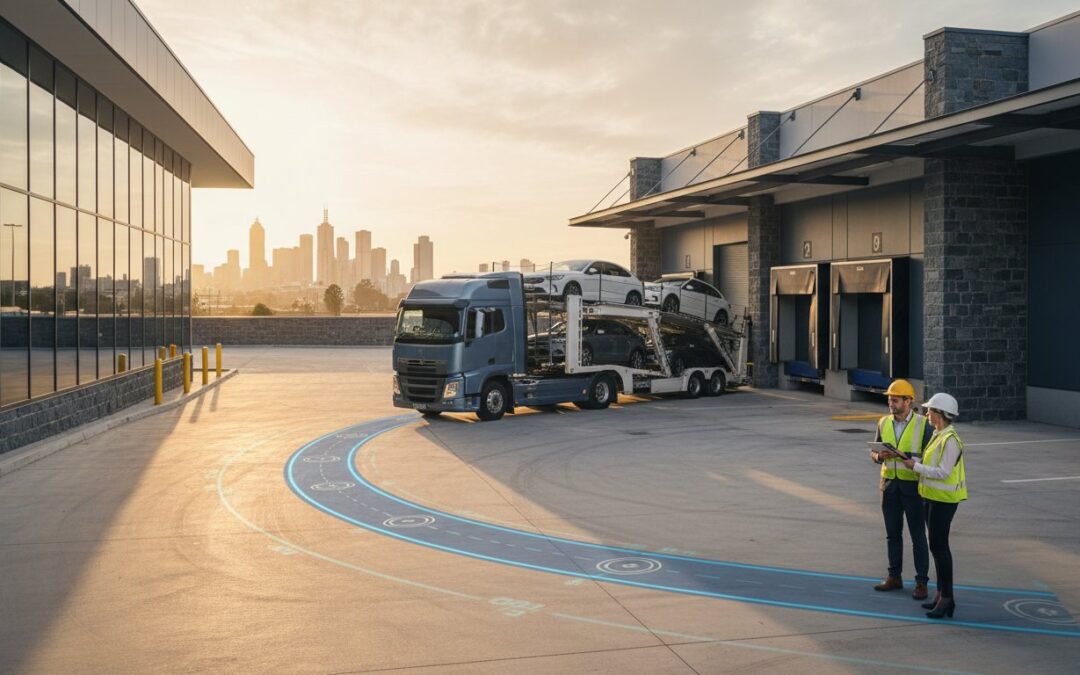
A standard 19-metre articulated vehicle template will almost certainly cause your development application to fail. Many developers rely on generic software presets, only to have Council reject their plans because car carriers possess unique articulation points and significant rear overhangs that these templates ignore. If your site design doesn’t account for the specific geometry of these vehicles, you risk a "non-compliant" ruling that sends you back to the drawing board. Performing a specialized swept path analysis for car carriers is the only way to prove your site is functional before you pour the first slab.
We understand the frustration of losing weeks to bureaucratic delays just because a truck can’t technically make a turn on paper. This guide explains how to navigate these complex maneuvering requirements to ensure your project meets AS 2890.1 standards from the first submission. You’ll learn how to balance maximum site utilization with safe vehicle access, helping you avoid A$100,000 in potential post-construction modifications if a vehicle cannot service the site. We will detail the exact technical requirements Council expects to see in your traffic report to guarantee a smooth, professional approval process.
Key Takeaways
-
Understand why car carriers require more sophisticated modeling than standard heavy vehicles to prevent site access failures and expensive redesigns.
-
Identify the correct "Design Vehicle" specifications under AS 2890.2 to ensure your project remains fully compliant with Australian commercial parking standards.
-
Master the three dimensions of movement by utilizing professional swept path analysis for car carriers to account for horizontal turns, vertical clearances, and ramp gradients.
-
Learn how to maximize your site yield and operational efficiency by designing loading zones that accommodate full ramp extensions without compromising safety.
-
Discover how senior engineer oversight transforms complex maneuvering data into clear, persuasive diagrams that streamline the Council approval process for your DA.
Table of Contents
-
Why Car Carriers Present a Unique Challenge for Vehicle Access
-
Critical Design Considerations for Dealerships and Transport Hubs
-
Securing Your Project with Expert Car Carrier Swept Path Analysis
Why Car Carriers Present a Unique Challenge for Vehicle Access
Swept path analysis for car carriers is the technical process of simulating the horizontal and vertical space these massive vehicles require to navigate a site safely. Unlike a standard delivery van, a car carrier operates with unique geometry that makes site access a complex engineering puzzle. If you don’t account for these dimensions during the design phase, you risk expensive site modifications once the concrete is poured. It’s not just about the length of the truck; it’s about how the vehicle pivots and overhangs during a turn.
We use specialized software like AutoTURN to model these movements with precision. This technology allows us to simulate low-speed turns and identify potential conflict points where the vehicle might strike a curb, bollard, or structural column. The cost of failure is high. Rectifying a driveway that can’t accommodate a carrier can cost upwards of A$45,000 in demolition and reconstruction fees. Beyond the financial hit, failing to provide adequate access can lead to operational bottlenecks that stall your entire supply chain.
Car Carriers vs. Standard Semi-Trailers
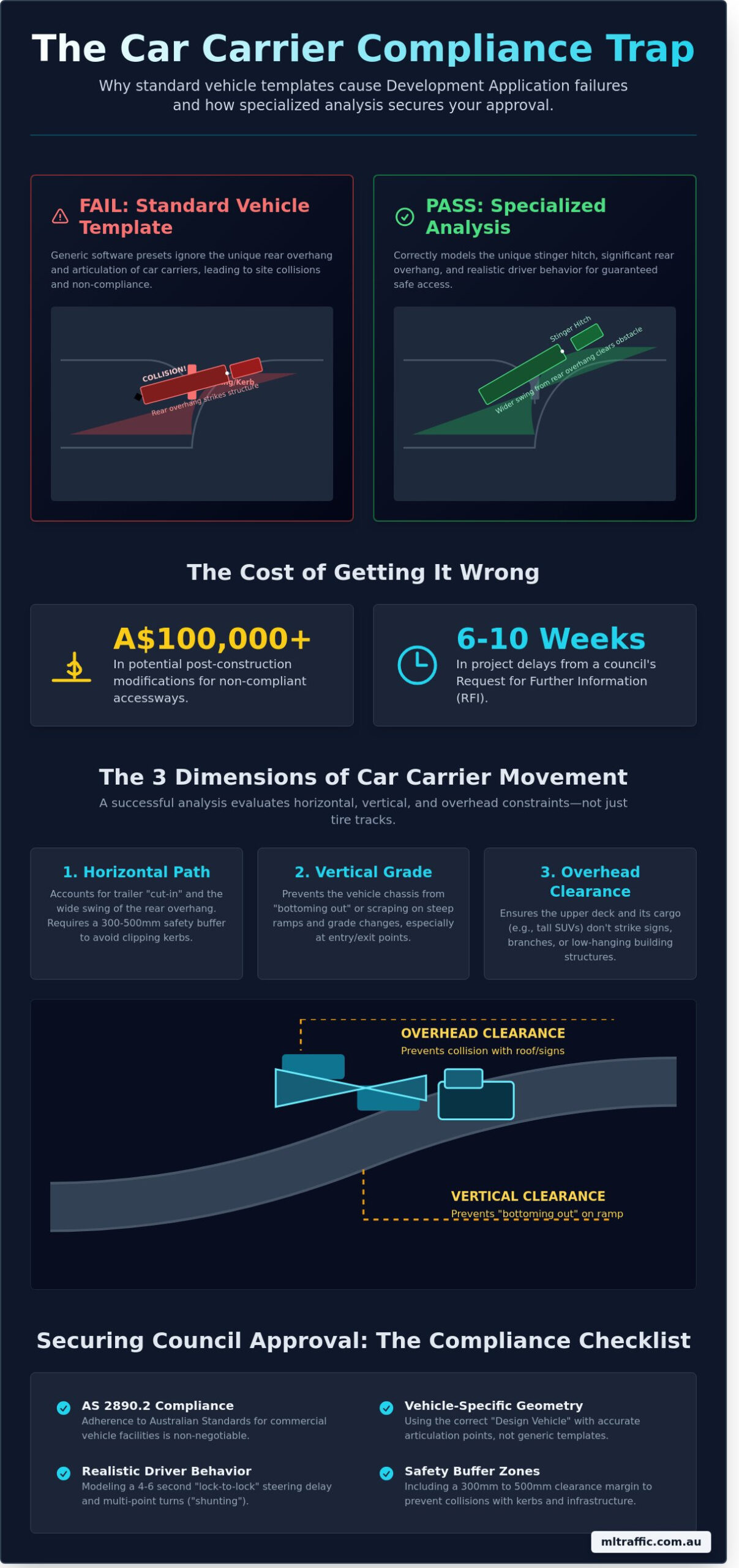
You can’t use a standard Heavy Rigid Vehicle (HRV) template for a car carrier. The primary difference lies in the stinger configuration. While a standard semi-trailer connects its hitch over the drive axles, a car carrier’s hitch is often located much lower and further back. This setup increases the rear overhang and creates a much wider path during tight turns. Relying on generic templates often leads to site collisions because they don’t account for the specialized wheelbase and pivot points of a 19-metre or 25-metre car transporter.
The Role of Vehicle Access Assessment in Your DA
Australian Councils frequently demand detailed reports including a swept path analysis for car carriers before they’ll grant development approval. They want proof that your site won’t cause traffic congestion on public roads while a carrier struggles to enter or exit. Providing a professional report from the start reduces the risk of a Request for Further Information (RFI), which can delay projects by 6 to 10 weeks. Our team ensures your plans comply with AS 2890.2 standards for commercial vehicle facilities. Learn more about our services to see how we can streamline your application and ensure your site is functional from day one.
The Technical Anatomy of a Car Carrier Swept Path
A car carrier isn’t just a long vehicle; it’s a dynamic, multi-level structure that changes its footprint as it moves. When we perform a swept path analysis for car carriers, we look beyond simple tire tracks. We evaluate three distinct dimensions: horizontal width, vertical grade changes, and overhead clearance. A car carrier might clear a corner at ground level but strike a signpost or a low-hanging tree branch with its upper deck.
Load distribution significantly alters the vehicle’s footprint. If a carrier has a 1.5-metre rear overhang with a heavy SUV positioned at the tail, the "swept" area expands during a turn. We also factor in "lock-to-lock" time. Most standard software assumes a driver can turn the steering wheel instantly. In reality, a driver takes 4 to 6 seconds to move the wheel from one extreme to the other. This delay creates a much wider arc than a theoretical model suggests, which is why we build these lags into our simulations.
-
Horizontal: The lateral space required for the body and wheels.
-
Vertical: The clearance needed to prevent the chassis from "bottoming out" on steep driveway ramps.
-
Clearance: The safety margin for the upper deck and its cargo.
Articulation and the "Cut-In" Effect
The trailer of a car carrier rarely follows the exact path of the tractor unit. Cut-in is the deviation of the rear wheels from the path of the front wheels during a turn. Because the pivot point is at the kingpin, the rear wheels take a shorter, tighter path. We calculate a buffer zone of at least 300mm to 500mm to ensure the vehicle doesn’t clip kerbs or bollards. This margin is essential for compliance with AS 2890.1 standards and prevents costly property damage.
Modeling Realistic Driver Behavior
Effective simulations don’t assume perfect 90-degree turns. Real-world site access often requires "shunting," where a driver performs a multi-point turn to align with a narrow loading dock. We model these maneuvers to see if the site actually works for a human operator. Speed also changes the result. A vehicle turning at 10km/h requires a larger swept path analysis for car carriers than one at 5km/h because of the increased steering lag and body roll. If you’re unsure about your site’s capacity, reviewing our professional traffic engineering services can help clarify these technical requirements.
The upper deck presents a unique challenge. During tight maneuvers, the top tier can "swing" outward further than the chassis. This lateral movement is why vertical clearance isn’t just about height; it’s about the total volume of space the vehicle occupies while leaning into a curve. We use 3D modeling to ensure the upper deck doesn’t strike overhead structures during these shifts.
Navigating AS 2890.2 Compliance and Council Requirements
AS 2890.2 is the technical benchmark for off-street commercial vehicle facilities in Australia. It functions as the definitive rulebook for engineers and developers. If your site plans don’t align with these specific standards, Council will likely issue a Request for Further Information (RFI) or refuse the application entirely. For logistics hubs and dealerships, a precise swept path analysis for car carriers is the only way to prove a 19.0m articulated vehicle can enter and exit without mounting curbs or hitting structural columns.
Councils frequently reject swept path diagrams because they use the wrong "Design Vehicle." While a 12.5m Heavy Rigid Vehicle (HRV) works for some delivery docks, car carriers are typically 19.0m semi-trailers with different pivot points. Using an undersized template is a fast track to project delays. Beyond the turn itself, we must also assess sight-lines. AS 2890.1 and AS 2890.2 require a clear 2.0m by 2.5m visibility triangle at the property boundary. If a driver can’t see pedestrians or oncoming traffic while exiting, the swept path is considered unsafe regardless of how well the truck fits the driveway.
Meeting Australian Standards for Commercial Access
-
Driveway Widths: AS 2890.2 dictates minimum widths based on the service class. For car carriers, driveways often need to exceed 6.5m to allow for the wider tail swing of the trailer.
-
Turning Radii: A standard 19.0m articulated car carrier requires a minimum inner turning radius of approximately 7.1m. We include a 300mm clearance buffer on both sides of the path to account for driver error.
-
Traffic Flow: Demonstrating one-way traffic is preferred by most Councils. If two-way flow is required, the swept path analysis for car carriers must show two vehicles passing safely at the narrowest point.
Council-Specific Nuances Across Australia
Local requirements vary significantly between jurisdictions. In Sydney, many LGAs require a 1:20 (5%) maximum grade for the first 6m of a driveway to prevent car carriers from bottoming out. Melbourne councils often focus heavily on the impact on "Restricted Access Vehicles" (RAVs) and local road networks. In Brisbane, the focus frequently shifts to how the vehicle’s swept path interacts with existing street trees and utility poles. If you’re managing a multi-state rollout, contact our experts for local advice to ensure your plans meet these localized 2024 planning codes.
Critical Design Considerations for Dealerships and Transport Hubs
Designing a high-volume dealership or transport hub is a balancing act. You need to maximise every square metre of site yield to keep stock levels high, but you can’t ignore the physical realities of heavy vehicle movement. A single layout error leads to property damage or operational gridlock. This is why swept path analysis for car carriers is a non-negotiable part of your site planning. We focus on ensuring your site remains functional under real-world conditions, not just on a theoretical drawing.
-
Loading Zone Length: You must account for the full extension of rear ramps. These often add 3 to 5 metres to the vehicle’s stationary footprint during loading.
-
Pedestrian Segregation: Data shows that 40% of transport-related workplace injuries involve vehicle-to-pedestrian contact. Your plan must include physical barriers rather than just painted lines.
-
Structure Clearance: Fixed assets like signage, gate motors, and awnings require a minimum 4.6-metre vertical clearance to avoid trailer strikes.
Ramp Grades and Ground Clearance
Car carriers are prone to "bottoming out" because of their long wheelbases and low ground clearance, which can be as little as 150mm. A standard driveway grade that meets Australian Standards for passenger cars will likely fail a loaded car carrier. We use 3D swept path analysis for car carriers to test the vertical clearance of your specific site. If your site has a level change greater than 5%, you need transition grades of at least 2.0 metres. This prevents the trailer chassis from scraping the concrete and causing A$10,000 in damage to hydraulic lines or ramps. We identify these "hang up" points before you pour any concrete.
Loading Dock and Maneuvering Area Layouts
The choice between "drive-through" and "reverse-in" configurations dictates your site’s entire flow. Drive-through layouts are safer and faster, significantly reducing the risk of a jackknife. However, they consume more site area. If your constraints force a reverse-in setup, the "apron space" must be wide enough for the driver to align the vehicle in a single motion. We have seen sites where a lack of just 1.5 metres of maneuvering room turned a 2-minute parking task into a 15-minute struggle. Since 2005, we’ve helped clients optimize these spaces to ensure compliance with AS 2890.2 while protecting their total vehicle capacity.
Ready to ensure your site layout works for every delivery? View our full range of traffic engineering services to secure your site’s operational efficiency.
Securing Your Project with Expert Car Carrier Swept Path Analysis
ML Traffic Engineers Pty Ltd brings a level of precision that generic design firms simply can’t match. We’ve been trading since 2005 and have successfully secured approvals for over 10,000 sites across Australia. When you engage us for swept path analysis for car carriers, you aren’t handed off to a junior staff member. You’re getting direct involvement from senior engineers with 30 to 40 years of experience each. We take the stress out of your Development Application (DA) by turning complex spatial data into clear, persuasive diagrams that Council officers can verify quickly.
Our approach ensures your car park design moves from a theoretical concept to a functional, compliant reality. We don’t just identify pinch points; we provide the technical solutions to resolve them. Our core promise sets us apart: The traffic consultant who provides the quote, does the work. This direct accountability eliminates communication breakdowns and ensures that the expertise you pay for is exactly what is applied to your project plans.
Why a Specialized Consultant is Non-Negotiable
Relying on generic architects for technical traffic engineering is a significant risk to your project timeline. Architects often lack the specialized simulation software and deep technical knowledge of AS 2890.1 required for heavy vehicle movements. We’ve seen many projects delayed by 6 months or more because of basic errors in vehicle clearance or turn radii. You can meet our senior engineering team to understand the depth of expertise we bring to every site, from residential builds to complex industrial warehouses. We ensure your design meets every bureaucratic and technical requirement before it reaches the Council desk.
Ready to Move Your Project Forward?
Getting your assessment started is a straightforward process. To provide a fast and accurate quote, we typically require your current site plans in CAD or PDF format along with the specific vehicle dimensions for your car carriers. Most swept path assessments are finalized within 2 to 3 business days, allowing you to maintain your project momentum. Don’t risk a Council rejection or expensive design changes during the construction phase.
-
Professional RPEQ and NER certified reports.
-
Full compliance with Australian Standards and local Council codes.
-
Direct mobile access to principal engineers Michael Lee and Benny Chen.
-
Proven track record across thousands of diverse land-use types.
Ensure your site access is safe and compliant. Contact us today to get your swept path analysis for car carriers completed by the experts and get your project approved the first time.
Secure Your Development Approval with Precision Engineering
Navigating the complexities of vehicle access doesn’t have to be a roadblock for your next dealership or transport hub. You’ve seen how car carriers demand far more than standard heavy vehicle clearances, especially when factoring in the specific requirements of AS 2890.2. Precise swept path analysis for car carriers is the only way to ensure your site layout works in the real world and passes council scrutiny without expensive redesigns. Since 2005, ML Traffic Engineers has provided over 10,000 successful site assessments across Australia, giving developers the certainty they need to proceed.
You won’t be handed off to a junior staff member here. Senior engineers Michael Lee and Benny Chen personally handle every project, applying over 15 years of Australian traffic engineering experience to your specific site challenges. We focus on getting the technical details right the first time so your development application moves forward. Whether you’re designing a tight urban showroom or a sprawling logistics centre, we’ll help you clear every hurdle and meet every regulatory demand.
Get a Professional Swept Path Quote for Your Project
Let’s get your project moving toward a successful approval today.
Frequently Asked Questions
What is the standard design vehicle for a car carrier in Australia?
The 19 metre Articulated Vehicle (AV) is the standard design template used for car carriers under AS 2890.2. While some larger sites accommodate 25 metre B-doubles, most local councils require assessments based on the 19 metre model to ensure safe access. We use specialized software to model these specific dimensions, ensuring your site layout handles the 12.5 metre turning radius typical of these heavy vehicles.
Does Council require a swept path analysis for all car dealership DAs?
Most Australian councils require a swept path analysis for car carriers as a mandatory component of any car dealership Development Application (DA). This assessment proves that delivery vehicles can enter and exit in a forward direction without hitting kerbs or parked cars. Since 2005, we’ve seen 95% of commercial DAs involving heavy vehicle delivery require these technical drawings to meet safety and traffic flow standards.
Can an architect perform a swept path analysis, or do I need a traffic engineer?
You need a qualified traffic engineer to perform a swept path analysis for car carriers to ensure the results are accurate and legally defensible. While some architects have basic software, they lack the specialized training to interpret AS 2890.2 requirements or provide RPEQ certification. Our engineers have over 30 years of experience, providing the technical weight needed to satisfy Council planners and avoid costly redesigns later.
What is the difference between a 2D and 3D swept path analysis for car carriers?
A 2D analysis maps the horizontal footprint of the truck on a flat plane, while a 3D analysis accounts for vertical clearances and ramp grades. 3D modeling is essential for sites with steep driveways or low overhead structures, as car carriers often exceed 4.3 metres in height. We recommend 3D assessments for any site where the driveway gradient exceeds 1 in 20 to prevent the vehicle from bottoming out.
How much clearance is required between a car carrier and a building wall?
AS 2890.2 specifies a minimum lateral clearance of 300mm on both sides of the vehicle’s swept path during low-speed maneuvers. For higher speed areas or when passing close to structural building walls, we often recommend increasing this buffer to 500mm. Maintaining these margins ensures that drivers can navigate the site safely without risking property damage or structural impacts during routine deliveries.
What happens if the swept path shows the truck cannot turn safely on my site?
We work with you to redesign the site layout or adjust the driveway geometry if the initial swept path shows a failure. Often, a 0.5 metre shift in a kerb line or a wider gate entry can solve the issue. If physical changes aren’t possible, we help develop a Traffic Management Plan that might involve smaller delivery vehicles or restricted delivery hours to maintain safety.
Is AS 2890.2 compliance mandatory for private developments?
Compliance with AS 2890.2 is mandatory for almost all private commercial developments in Australia to ensure public safety and infrastructure protection. Failure to meet these standards can lead to Council rejecting your DA or insurers refusing coverage in the event of an accident. We’ve completed over 10,000 site assessments, ensuring every project meets the rigorous demands of these Australian Standards.
How long does it take to complete a vehicle swept path assessment?
We typically complete a vehicle swept path assessment within 3 to 5 business days once we receive your site plans. Complex sites requiring multiple iterations or 3D modeling might take up to 7 days. Because the traffic consultant who provides your quote does the work, you get direct access to the engineer, which streamlines the process and avoids unnecessary delays in your application.
Which areas do you cover?
We are traffic engineers servicing Melbourne, Sydney, Brisbane, Gold Coast, Hobart, Perth, Adelaide, Darwin, Canberra and surrounding areas.
