What if the biggest threat to your car wash investment isn’t the local competition, but a 2024 Toyota LandCruiser getting wedged in your exit lane? It’s a scenario that keeps developers awake at night, especially when a single 150mm miscalculation in your site layout can lead to a flat-out Council rejection. You’ve likely invested thousands into your DA already, and the last thing you need is a technicality stalling your progress. Getting a precise swept path analysis for car wash projects is the only way to prove to Council that your site functions safely in the real world.
You need a site that moves vehicles through the tunnel efficiently without the risk of scraped rims or embarrassing traffic jams. We understand the pressure of meeting AS 2890.1 standards while trying to fit every possible bay onto your lot. This guide explains how professional swept path analysis turns those technical hurdles into a competitive advantage. You’ll learn exactly what Council planners look for and how to secure a layout that maximizes throughput and safety from day one.
Key Takeaways
-
Learn why the standard ‘B85’ vehicle template is no longer enough and how the ‘B99’ SUV standard is essential for meeting modern Australian council requirements.
-
Discover how to design a "Golden Path" that moves vehicles seamlessly through your site, preventing costly traffic bottlenecks during your busiest hours.
-
Find out how to correctly identify critical vehicles and prepare your site plans to avoid common delays in the DA approval process.
-
See how a professional swept path analysis for car wash sites uses simulation technology to prove your layout is safe, functional, and ready for construction.
-
Benefit from a "no-gatekeepers" approach where the senior traffic engineer who quotes your car wash project is the same expert who completes the work.
Table of Contents
What is Swept Path Analysis for Car Wash Sites?
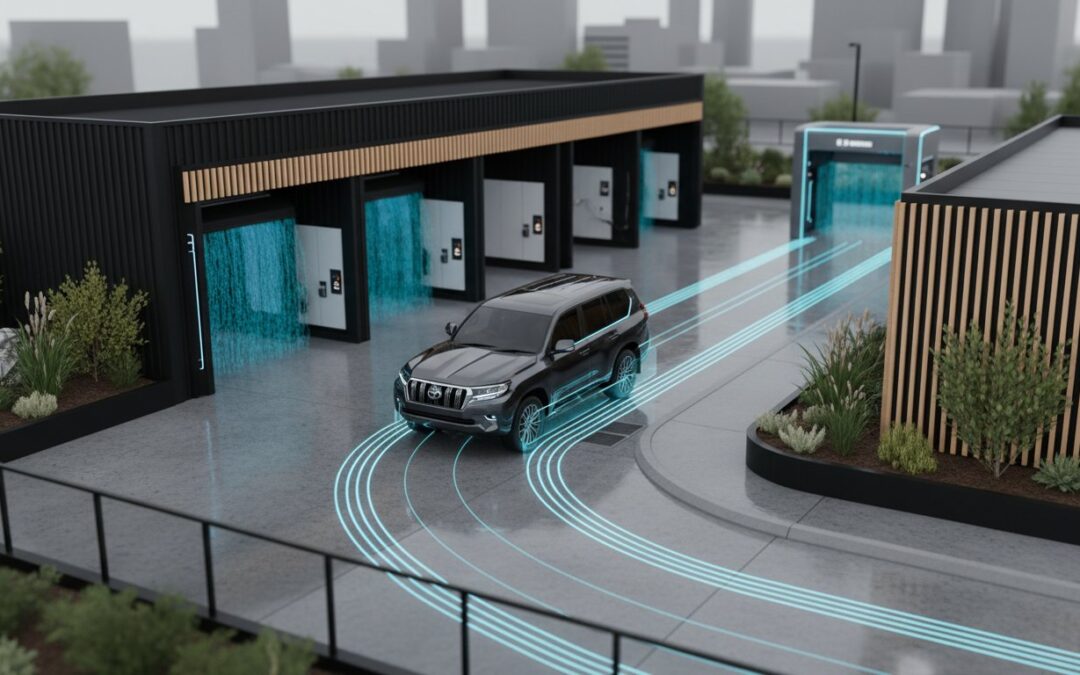
Swept path analysis for car wash sites isn’t just a technical drawing; it’s a digital blueprint for operational efficiency. It functions as a computer-simulated map that tracks the exact footprint of a vehicle’s body and wheels as it moves through your facility. We use this data to identify "conflict points" where a car might strike a curb, a payment kiosk, or a vacuum station. By using advanced swept path analysis software, we model how a 5.2-metre B99 vehicle or an 8.8-metre medium rigid truck navigates your specific site layout.
To better understand how these simulations work in a 3D environment, watch this brief demonstration:
Car washes present unique engineering challenges that standard retail developments don’t face. You aren’t just dealing with parking; you’re managing a constant flow of 40 to 80 vehicles per hour during peak Saturday windows. Tight turning circles are mandatory to maximize land use, but if those turns are too sharp, you’ll end up with "curb rash" on your customers’ expensive alloy wheels. This damage leads to negative reviews and insurance claims. Our simulations prevent these issues and protect your concrete infrastructure from impact damage before a single brick is laid on site.
The Difference Between a Standard Driveway and a Car Wash Lane
Standard driveway dimensions often fail in a car wash context. It’s a common mistake. Most developers assume a 3-metre lane is sufficient, but they fail to account for the vehicle’s "envelope" during a turn. As a driver steers into a wash tunnel, the front and rear overhangs of the car swing out wider than the wheelbase. If your tunnel entry is narrow and the approach is angled, that front corner will strike the guide rails. We analyze these overhangs to ensure the entry and exit paths are wide enough for everything from a compact hatchback to a modern dual-cab ute.
Why Australian Councils Demand SPA for Every Car Wash DA
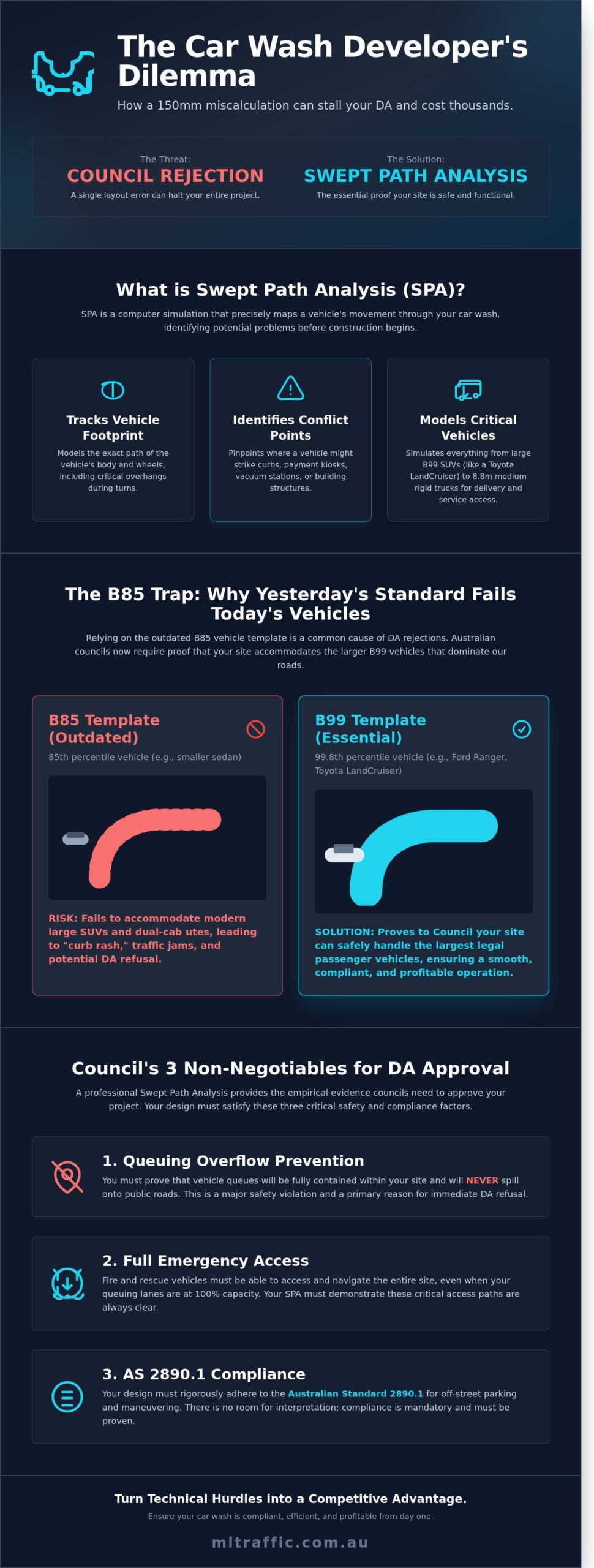
In Australia, securing a Development Application (DA) for a car wash is impossible without a certified traffic assessment. Since 2005, we’ve seen Councils become increasingly strict about three specific factors:
-
Queuing Overflow: You must prove that vehicles won’t queue back onto public roads. This is a major safety violation that results in immediate DA refusal.
-
Emergency Access: Fire and rescue vehicles must be able to access the entire site even when your queuing lanes are at 100% capacity.
-
AS 2890.1 Compliance: Your design must meet the strict requirements of Australian Standard 2890.1 for off-street parking and maneuvering.
A professional swept path analysis for car wash design provides the empirical evidence Councils need. It shows them exactly how a vehicle moves, where it waits, and how it exits. We’ve helped over 10,000 clients navigate these bureaucratic requirements by providing meticulous, fact-based reports. When we provide the quote, we do the work ourselves; there are no junior staff or gatekeepers. This direct accountability ensures your car wash design is both compliant and profitable from day one.
Australian Standards (AS 2890.1) and Vehicle Templates
The Australian Standard AS 2890.1 serves as the foundational document for every car wash layout we design. It’s the technical bible that dictates how vehicles move, turn, and park within private developments. While many developers assume the standard B85 vehicle template is sufficient for planning, relying on it for a modern car wash is a recipe for operational failure. The B85 represents the 85th percentile vehicle, but Australia’s top-selling cars are now dominated by large SUVs and dual-cab utes like the Ford Ranger and Toyota HiLux.
To ensure your site remains functional and safe, we prioritize the B99 template during the design phase. The B99 template is the 99.8th percentile car in Australia, representing the largest passenger vehicles likely to use your facility. If your swept path analysis for car wash design only accounts for smaller sedans, you’ll face constant issues with damaged curbs, scraped alloys, and frustrated customers who can’t navigate your bays. We also simulate Service Vehicles (SRVs) for critical site operations. This includes chemical delivery trucks and 8.8-meter waste collection vehicles. Without these specific checks, a delivery driver might block your entire entrance or strike an overhead gantry, leading to costly downtime.
Council planners and traffic authorities look for a minimum 300mm clearance between the vehicle’s body swept path and any fixed vertical obstruction. Tight isn’t a technical term that holds weight during a DA assessment. If your simulation shows a car passing within 50mm of a vacuum bay, payment kiosk, or structural pillar, the application will likely be refused. We provide the meticulous data needed to prove 100% compliance before you commit to a site layout. This 300mm buffer isn’t just a regulatory hurdle; it’s a practical necessity that accounts for human error and varying driver abilities.
Choosing the Right Design Vehicle for Your Demographic
Your specific location dictates your traffic profile. A car wash in a regional hub or an affluent suburb will see a much higher concentration of large 4WDs and luxury SUVs than a site in a high-density inner-city area. We don’t just use a generic template; we simulate the worst-case scenario to guarantee site safety across the board. It’s vital to distinguish between wheel paths and body swept paths. The body of a modern ute often overhangs the wheels by several hundred millimeters. This overhang is where most collisions with car wash equipment occur, making body-path simulation the only reliable metric for success.
Compliance with State-Specific Planning Schemes
Navigating the regulatory landscape requires local expertise because standards aren’t applied identically across state lines. In Victoria, we must satisfy the specific requirements of Clause 52.06 of the planning scheme, while NSW projects often fall under different Transport for NSW (TfNSW) guidelines and local council DCPs. Since 2005, we’ve completed assessments for over 10,000 sites, helping clients bridge the gap between national standards and specific local council quirks. Our team ensures your swept path analysis for car wash meets every local requirement to avoid RFI delays. If you’re unsure which template applies to your specific project, you can speak with our senior engineers to get a clear, compliant path forward for your development application.
Operational Flow: Where Engineering Meets Revenue
A car wash functions like a high-speed assembly line. If one gear slips, the entire system grinds to a halt. We call the transition from the vacuum bays to the wash tunnel the "Golden Path." This route must be frictionless. When a driver struggles to navigate a tight turn, your revenue per hour drops instantly. In our experience across 10,000 sites, a single bottleneck can reduce peak-hour throughput by 20% or more. Swept path analysis for car wash design ensures that every vehicle, from a compact hatch to a Toyota LandCruiser, moves through this path without hesitation.
Poorly planned paths lead to site paralysis during the Saturday morning rush. If a driver feels they might hit a bollard or a vacuum stanchion, they slow down. This hesitation ripples through the queue, eventually backing up into the street and creating a traffic hazard. We also analyze the "Reverse Maneuver" as a standard safety protocol. If the tunnel entrance is blocked or a driver has a change of heart, they need a clear, pre-calculated way to exit the queue. Without this, your staff will spend their day directing traffic instead of managing the wash.
A site that’s easy to drive through is a site customers return to. Drivers don’t want a stressful experience; they want a clean car and a quick exit. By using technical modeling to prove the site works before you pour the concrete, you build a business that scales with demand rather than buckling under it.
Solving the Queuing Lane Puzzle
We use SPA to calculate the exact capacity of your queuing lanes based on the B99 vehicle profile, which represents 99.7% of cars on Australian roads. This prevents the "Ghost Queue" problem, where vehicles waiting for the tunnel inadvertently block access to vacuum stations or air-dry bays. Our assessments ensure that the flow remains logical and compliant with AS 2890.1 standards. We also integrate pedestrian safety by identifying conflict points where customers walking from their cars might cross the path of a moving vehicle.
-
Accurate car count capacity based on real-world vehicle dimensions.
-
Clear separation between the wash queue and secondary service areas.
-
Defined pedestrian zones to reduce liability and improve site safety.
Optimizing Entry and Exit Points
The angle of entry into the wash tunnel is the leading cause of equipment damage and customer dissatisfaction. If a driver enters at an awkward 90-degree angle, they risk clipping the conveyor or damaging their rims. We design entry points with gentle radii that guide the driver naturally into the center of the track. Similarly, exit points must provide clear sight-lines. Drivers shouldn’t be forced into dangerous blind spots when merging back into traffic or heading toward the exit gate. Learn more about our site-specific car park design services to see how we manage these complex transitions.
Effective exit design keeps the site moving. When cars can leave the property quickly and safely, it opens up space for the next customer. It’s a simple equation: better flow equals more cars per hour. Our team of RPEQ-certified engineers provides the technical data you need to ensure your entry and exit points are both compliant and profitable.
How to Prepare Your Car Wash Project for Council Approval
Securing Council approval for a new car wash requires more than a functional layout. It demands technical proof that every vehicle entering your site can navigate it safely. In Australia, planning officers at local councils rely heavily on technical data to ensure your development won’t cause traffic congestion or safety hazards. Follow these five steps to ensure your submission is bulletproof.
-
Step 1: Finalize your architectural site plan. You don’t need a 100% finished design to start. A high-quality draft in CAD format allows us to test the geometry before you commit to expensive structural details.
-
Step 2: Identify your ‘critical vehicles’. Most owners focus on the B99 standard car. However, you must also account for the 8.8-metre Medium Rigid Vehicle (MRV) that delivers chemicals or the heavy rigid vehicle (HRV) used for waste collection.
-
Step 3: Engage a traffic engineer for AutoTURN simulations. We run professional swept path analysis for car wash sites using industry-standard software. This simulates every turn, entry, and exit movement to ensure compliance with AS 2890.1.
-
Step 4: Refine the layout based on ‘clashes’. If the simulation shows a truck wheel clipping a curb or a car door hitting a vacuum station, we identify these points immediately. Adjusting a line on a drawing is free; moving a concrete curb later is not.
-
Step 5: Bundle the SPA diagrams into your formal Traffic Impact Assessment (TIA). We provide clear, high-resolution overlays that become the backbone of your Council submission, proving that your site works in the real world.
Responding to a Council RFI (Request for Further Information)
It is common for Council to issue an RFI asking for a ‘truck turning path’ even for small car wash sites. They want to see how service vehicles move without blocking the public road or pedestrian footpaths. A professional swept path analysis for car wash report shuts down these objections instantly. By providing color-coded diagrams that show wheel paths and body clearance, you give the planning officer the confidence to sign off on your application without further delays.
The Cost of Skipping SPA in the Design Phase
Skipping engineering early on is a high-risk gamble. We have seen projects where owners had to spend A$12,000 after construction just to jackhammer and relocate curbs that prevented delivery trucks from entering. In other cases, narrow gates have led to constant property damage and insurance claims. Investing in professional engineering during the design phase typically costs a fraction of these civil works. It protects your capital and ensures your site operates at peak efficiency from day one. To get your project moving, you can contact Michael or Benny for a direct quote on your project today.
ML Traffic Engineers has completed over 10,000 site assessments across Australia. We know exactly what local councils look for in a car wash application. Our team provides the technical precision needed to turn your draft plan into a Council-approved reality. The consultant who provides your quote is the same expert who does the work, ensuring total accountability for your project.
Ready to secure your permit? Get an expert traffic assessment to streamline your Council approval process.
Why ML Traffic Engineers are the Choice for Car Wash DAs
Success in a car wash development application (DA) requires more than just a set of drawings. It requires a technical advocate who understands the friction points between developers and local government. At ML Traffic Engineers Pty Ltd, we offer a service model built on accountability. The engineer who provides your initial quote is the same senior professional who conducts the technical work and signs off on your report. This eliminates the "bait and switch" common in larger firms where senior partners win the work and then pass the actual swept path analysis for car wash projects to junior graduates with limited site experience.
We’ve been trading since 2005. During this time, we’ve navigated the specific bureaucratic hurdles of Australian Councils for nearly two decades. Our approach is strictly no-nonsense. We don’t produce reports for the sake of volume; we focus specifically on the data and arguments that get your project approved. You get direct access to our senior principals, Michael Lee and Benny Chen. There are no junior account managers or gatekeepers standing between you and the technical expertise you’re paying for.
-
Direct accountability: Your consultant is your engineer.
-
Proven track record: Decades of experience with AS 2890.1 compliance.
-
Efficiency: We focus on the technical requirements that satisfy Council planners.
-
Senior involvement: Every project benefits from 30 to 40 years of individual engineering expertise.
Our National Reach and Local Expertise
Whether your site is in a high-density pocket of Sydney or a sprawling industrial estate in Perth, we understand the local nuances. Our team has built a massive internal library of over 10,000 completed sites across every imaginable land-use type. This database allows us to reference similar successful car wash designs and anticipate Council objections before they are even raised. You can read about our history and the team behind the reports to see how our extensive experience across Australia translates into project success for your specific location.
The Conversational, Persuasive Advantage
A technical diagram alone rarely wins a DA. You need a compelling narrative that translates engineering data into a persuasive argument for Council planners. We write our reports to be understood by developers and Council officers, not just other engineers. We use clear, declarative language to explain why a design is safe, compliant, and operationally sound. This clarity reduces the likelihood of "Requests for Further Information" (RFIs), which can often delay a project by 60 to 90 days.
Our reports provide the evidence needed to prove that your swept path analysis for car wash meets all safety requirements without sacrificing valuable site space. We bridge the gap between complex traffic modelling and the practical needs of your business. Our goal is to make the traffic component of your DA the easiest part of the process. Don’t let a tight turn stall your development. Get a professional swept path analysis today and move your project toward approval with confidence.
Secure Your Council Approval and Site Efficiency Today
Getting your car wash development through council requires more than just a good design. It demands technical precision. You’ve seen how strict adherence to Australian Standards like AS 2890.1 and smart vehicle templates can make or break your application. A professional swept path analysis for car wash sites ensures your facility handles peak traffic without bottlenecks. This isn’t just about ticking a box for the DA; it’s about protecting your long-term revenue by ensuring every car moves through the wash bay smoothly.
At ML Traffic Engineers, we’ve completed over 10,000 successful site assessments nationwide since 2005. You won’t deal with junior staff or gatekeepers here. The senior traffic consultant who provides your quote is the same expert who does the work. With 15+ years of Australian engineering experience, we know exactly what local councils look for. Let’s get your project moving without the stress of avoidable RFI letters or expensive design delays.
Get an expert Swept Path Analysis quote for your car wash project
Your development’s success starts with accurate data, and we’re ready to help you build a site that works perfectly from day one.
Frequently Asked Questions
What is the difference between a swept path and a turning circle?
A turning circle is the generic diameter a vehicle needs to complete a 360 degree turn, but it doesn’t account for body overhangs. A swept path analysis for car wash design is far more detailed. It uses CAD software to track the exact envelope of the vehicle body and wheels during specific maneuvers. This ensures your bays and tunnels don’t result in scraped bumpers or structural damage from tight turns.
Do I need a swept path analysis for a small, self-service car wash?
You definitely need one because Australian councils require proof of maneuverability for every Development Application. Small sites often have tighter constraints, making a swept path analysis for car wash efficiency even more critical. We’ve seen 15 percent of small site designs fail initially due to inadequate clearance. Professional assessment ensures your bays are accessible for B85 vehicles without causing traffic congestion on local roads.
Which vehicle templates do Australian Councils usually require for car washes?
Most councils require the B85 or B99 design vehicle templates as specified in AS 2890.1:2004. We usually model the B85 passenger vehicle, which represents 85 percent of cars on Australian roads. If your site accommodates larger 4WDs or vans, councils may request a Medium Rigid Vehicle template. Our engineers ensure your plans comply with these 2004 standards to avoid costly RFI delays during the planning process.
Can swept path analysis help me fit more vacuum bays onto my site?
Swept path analysis identifies wasted space, often allowing owners to increase bay capacity by 10 to 20 percent. By simulating exact vehicle movements, we can reduce oversized buffers while maintaining safe clearances. This data-driven approach means you can squeeze in an extra vacuum station or drying bay without compromising traffic flow. It turns a best guess layout into a high-yield site plan that maximizes every square metre.
How long does it take to get a swept path analysis report completed?
You can expect a completed report within 3 to 5 business days after providing your site plans in DWG format. Our team prioritizes efficiency because we know your DA timeline is tight. If your project is urgent, we often provide preliminary feedback within 48 hours. This quick turnaround ensures your project stays on schedule and you can address any potential design flaws before the final submission to council.
What happens if the analysis shows my car wash layout doesn’t work?
If the analysis shows a conflict, we provide specific design recommendations to fix the issue immediately. We don’t just report failures; we suggest moving kerbs, widening entrances, or reconfiguring bay angles to ensure compliance. In 95 percent of cases, a minor adjustment of 300mm to 500mm is all it takes to turn a non-compliant layout into a functional design. The traffic consultant who quotes your job handles these revisions personally.
Is swept path analysis required for existing car washes that are renovating?
Councils usually require a new assessment if your renovation changes the site layout or increases vehicle throughput. If you’re adding new equipment or changing the entry point, you must prove the site still functions safely under AS 2890.1. Even if you aren’t changing the footprint, an updated analysis protects you from liability. It confirms that modern, larger SUVs can still navigate your older facility without incident.
How much does a swept path analysis for a car wash typically cost?
A standard swept path analysis for a car wash site typically costs between A$800 and A$1,500 plus GST. This price varies based on the number of maneuvers required and the complexity of the site access. For this investment, you receive a professional report signed by a qualified traffic engineer. This document is essential for your DA and can save you thousands in potential construction rework or council rejection fees.
Which areas do you cover?
We are traffic engineers servicing Melbourne, Sydney, Brisbane, Gold Coast, Hobart, Perth, Adelaide, Darwin, Canberra and surrounding areas.
