
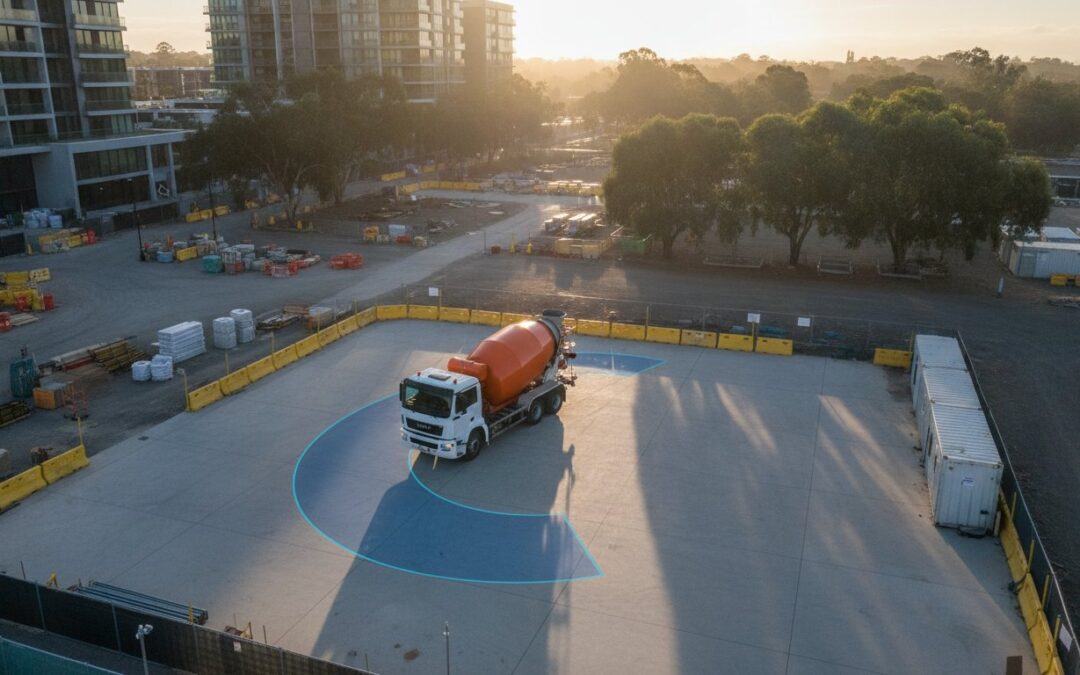
A single miscalculation in your site’s heavy vehicle access doesn’t just delay a project. It can render an entire development application useless and lead to structural failures that are impossible to rectify once the concrete is poured. You already know that local councils have intensified their scrutiny of vehicle movements, particularly for high-impact machinery. A precise swept path analysis for concrete truck access is no longer a luxury. It’s a mandatory technical baseline for AS 2890.2:2018 compliance.
We understand the frustration of facing a council rejection due to inadequate turning circles or height clearances. This guide provides the technical certainty you need to master these requirements and ensure your site layout is fully functional for heavy rigid vehicles. We will examine the specific dimensions of Australian 6, 8, and 10-wheeler trucks, the rigorous demands of the current 2018 standards, and how to produce a compliant diagram that avoids costly on-site accidents. Following these protocols will help you secure your DA and prevent the unexpected redesign costs that are currently impacting the Australian construction industry.
Key Takeaways
- Understand the mandatory requirements of AS 2890.2:2018 to ensure your development application satisfies council safety and functionality standards.
- Learn how a professional swept path analysis for concrete truck access identifies potential conflicts between heavy rigid vehicles and site infrastructure before construction begins.
- Identify the critical turning dynamics and weight considerations of 3-axle and 4-axle agitators that necessitate specific buffer zones and road surface grades.
- Discover how to design site entrances and internal manoeuvring areas, such as hammerhead reversals, to prevent vehicles from mounting kerbs or causing structural damage.
- Gain certainty in your project timeline by using software-driven AutoTURN modelling to secure a certified traffic engineering report for your DA submission.
What is Swept Path Analysis for a Concrete Truck?
A swept path analysis for concrete truck access is a technical simulation that maps the horizontal and vertical space a concrete agitator requires to navigate a site safely. This process uses advanced swept path analysis software to trace the “envelope” of the vehicle as it performs specific manoeuvres, such as entering a construction gate or reversing into a discharge point. Unlike standard delivery vans, concrete trucks possess unique physical characteristics that make these simulations essential for any development application (DA) involving construction activity.
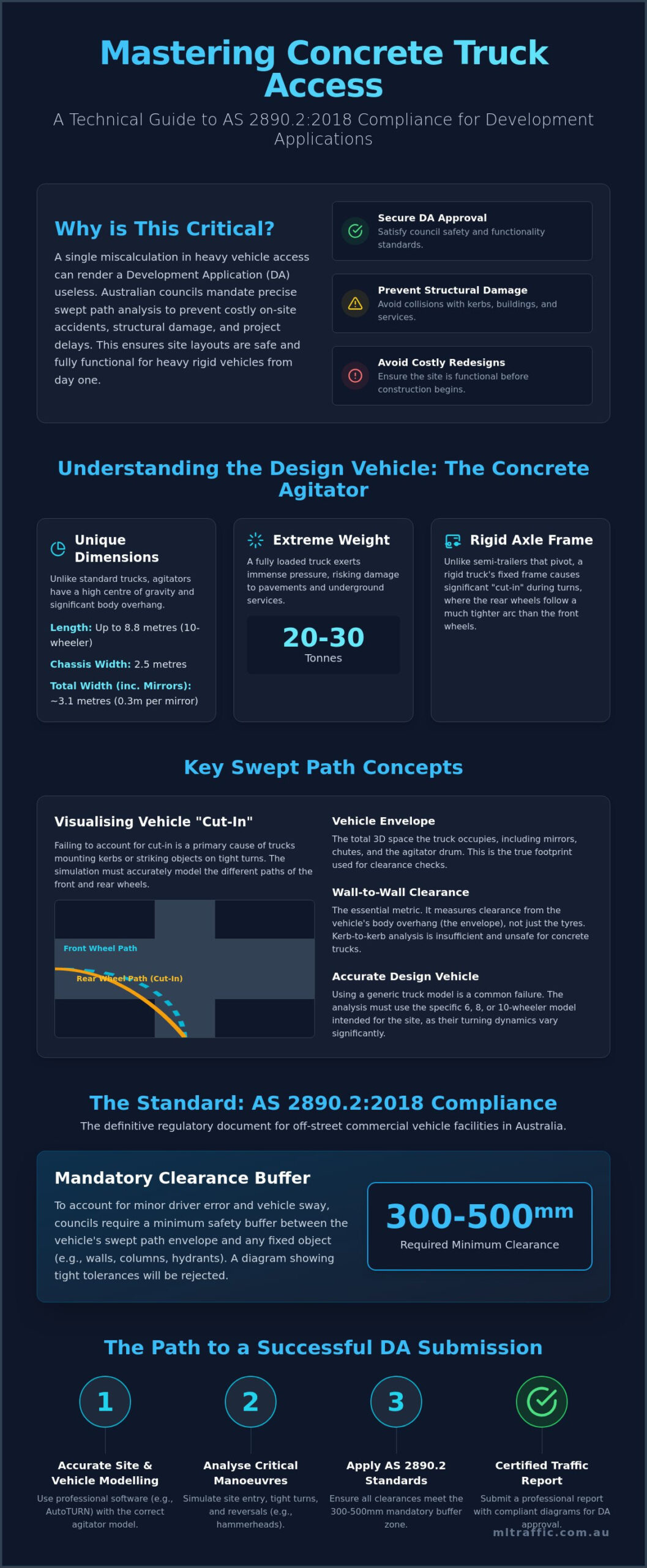
Councils across Australia mandate these diagrams to ensure that heavy rigid vehicles don’t mount kerbs, strike overhead structures, or collide with existing buildings. Because a loaded concrete truck can weigh between 20 and 30 tonnes, any deviation from the planned path can cause immediate structural damage to pavements or underground services. These simulations provide the empirical proof needed to satisfy AS 2890.2:2018 requirements before a single cubic metre of concrete is ordered.
To better understand this concept, watch this helpful video:
Concrete trucks differ from other heavy vehicles due to their high weight distribution and rigid axle configurations. While a semi-trailer pivots at the fifth wheel, a 3-axle or 4-axle concrete agitator has a fixed, rigid frame. This setup creates significant “cut-in,” where the rear wheels follow a much tighter arc than the front wheels during a turn. A professional analysis must account for the wheel path and the vehicle body overhang, including the side mirrors which typically add 0.3 metres of width to each side of the 2.5-metre wide chassis.
Key Terminology for Heavy Vehicle Simulations
- Vehicle Envelope: This is the total three-dimensional space occupied by the truck, including its mirrors, the agitator drum, and rear chutes.
- Kerb-to-kerb vs. Wall-to-wall: Kerb-to-kerb measurements track the tyres only, while wall-to-wall analysis accounts for the body overhang. For concrete trucks, wall-to-wall clearance is the only safe metric for site planning.
- Cut-in: The phenomenon where the rear tyres track toward the inside of a turn. In tight site access scenarios, failing to account for cut-in leads to trucks “clipping” gate posts or internal bollards.
The Importance of Accurate Design Vehicle Selection
Using a generic heavy vehicle model is a common error in site planning. An 8.8-metre long 10-wheeler agitator has vastly different turning dynamics than a standard delivery truck of the same length. The wheelbase length, which can exceed 5 metres on larger units, dictates the minimum turning radius required for the site. If the design vehicle is undersized, the real truck won’t fit. Accurate modelling must reflect the specific fleet intended for the project to avoid the costly redesigns that occur when a site is found to be non-functional during the construction phase.
Australian Standards and AS 2890.2 Compliance
AS 2890.2:2018 is the definitive regulatory document for off-street commercial vehicle facilities in Australia. It sets the technical parameters for everything from loading dock dimensions to the turning requirements of heavy rigid vehicles. For developers and civil engineers, adhering to this standard is the only way to ensure a site can legally and safely accommodate heavy plant equipment. When performing a swept path analysis for concrete truck access, compliance hinges on using the correct design vehicle templates and applying the mandatory clearance buffers specified within the standard.
Most Australian councils require a minimum clearance of 300mm to 500mm between the vehicle’s swept path envelope and any fixed object, such as a building wall, power pole, or hydrant. This buffer space accounts for minor driver error, vehicle sway, and the physical variations in truck models. If your diagram shows a concrete agitator passing within 50mm of a structural column, the council will likely reject the DA immediately. They view these tight tolerances as a high risk for future property damage or site blockages. Ensuring your design respects these margins is a non-negotiable part of the planning process.
Classifying the Concrete Agitator under AS 2890.2
Concrete trucks are typically classified as either a Medium Rigid Vehicle (MRV) or, more commonly for modern 8 and 10-wheeler fleets, a Heavy Rigid Vehicle (HRV). While an 8.8-metre MRV template might seem sufficient for smaller sites, using the 12.5-metre HRV template often provides the necessary future-proofing for the development. Selecting the most conservative design vehicle ensures that larger agitators can access the site without operational constraints. The simulation must precisely match real-world Australian axle spacings; these specific dimensions dictate the severity of the cut-in effect during tight manoeuvres.
Council Requirements for Swept Path Documentation
Councils no longer accept approximate or hand-drawn path indicators. Your documentation must be a precise, software-generated simulation that includes several critical data points for verification. These include the specific design vehicle model used, a realistic turn speed (typically calibrated between 5km/h and 10km/h), and the steering lock angle. The diagram must also be presented on a clear 1:200 or 1:500 scale site plan that shows all existing and proposed infrastructure.
In many instances, councils will require this data as part of a broader Traffic Impact Assessment to prove that the construction traffic won’t disrupt the local road network. If you are unsure which vehicle classification applies to your specific project, seeking a professional Vehicle Swept Path Analysis can prevent the need for expensive redesigns after the DA is lodged. This level of technical certainty is essential for meeting the rigorous demands of modern Australian planning authorities.
Technical Challenges: Modelling the Concrete Agitator
Modelling a concrete agitator requires more than just plotting a vehicle’s length and width. Unlike dry freight trucks, these vehicles carry a rotating, liquid-state cargo that shifts the centre of gravity constantly. A fully loaded 10-wheeler can reach 30 tonnes, which places extreme stress on pavements and affects the truck’s ability to navigate steep driveway ramps. This is why a precise Driveway Ramp Grade Assessment is often performed alongside the swept path to ensure the vehicle doesn’t bottom out or lose traction. When conducting a swept path analysis for concrete truck access, engineers must account for this weight, as it dictates the maximum allowable grades and the structural integrity of the turning surface.
The physical profile of the agitator also presents unique overhang hazards. The rear discharge chute and the collection hopper often extend beyond the rear axle, creating a “tail swing” that can strike walls or site hoardings during a sharp turn. Generic swept path analysis software often underestimates these protrusions unless the vehicle model is custom-calibrated to Australian fleet specifications. Site designs must also incorporate wider margins in areas where a driver’s blind spots are most vulnerable to ensure safety for on-site personnel. Because the drum blocks the rear-view, these trucks rely heavily on side mirrors, which must be given an additional 0.3 metres of clearance on both sides of the vehicle envelope.
3-Axle vs. 4-Axle Agitators: Turning Radius Differences
Most Australian concrete fleets consist of 6-wheeler (3-axle) and 10-wheeler (4-axle) units. A 6-wheeler typically has an overall length of 8.0 metres and a tighter turning circle, making it suitable for residential infill sites. However, a 10-wheeler is 8.8 metres long and requires a significantly larger radius to complete a 90-degree turn. If a site is designed solely around the smaller 3-axle model, a larger 4-axle unit will inevitably fail to negotiate the access points. We also account for “lazy axles” in our simulations; while these axles improve load distribution, they can increase the effective wheelbase and widen the swept path during low-speed manoeuvres.
Vertical Clearances and High-Centre-of-Gravity Risks
Height clearance is a critical failure point in many DA submissions. Concrete trucks require a minimum clearance of 4.0 metres, but 4.5 metres is the preferred industry standard to account for vehicle bounce and site-specific gradients. Under AS 2890.2, the vertical clearance for heavy rigid vehicle access areas is defined as 4.5 metres to accommodate vehicle bounce and variations in agitator drum height. Designing to the absolute minimum increases the risk of the vehicle toppling on steep, tight turns where the centrifugal force of the rotating drum can destabilise the chassis. Our simulations verify that the proposed site levels and overhead obstructions provide a safe margin for these high-centre-of-gravity vehicles.
Site Access Design: Avoiding Common DA Rejections
Inadequate entrance and exit widths are a primary cause of Development Application (DA) rejections across Australian jurisdictions. For a concrete agitator, the design must ensure the vehicle can enter and leave the site in a forward direction without mounting the kerb or encroaching on opposing traffic lanes. A standard driveway width often fails to accommodate the significant “cut-in” that occurs when a 10-wheeler HRV turns from a narrow local road. If the simulation shows the vehicle envelope crossing a property boundary or striking a proposed gate post, the design is fundamentally non-compliant.
Internal site manoeuvring requires equal precision. Councils typically expect developers to demonstrate that heavy vehicles can turn around within the site to avoid reversing onto public roads. This often necessitates the design of “hammerhead” or T-shaped reversal areas. The swept path must prove that the agitator can reach the designated discharge point or concrete pump while maintaining the mandatory 300mm to 500mm clearance from all structural elements. Failure to provide this evidence suggests a high risk of operational failure once construction begins.
Integrating Swept Paths with Driveway Ramp Grades
A frequent technical oversight is the failure to link horizontal swept paths with vertical site topography. Steep driveway ramps present a “grounding” trap; the chassis of a loaded 30-tonne agitator can strike the pavement at the crest or sag of a ramp. When the truck is on an incline, its effective swept path width also changes due to the tilt of the vehicle body. A comprehensive Driveway Ramp Grade Assessment must be performed in conjunction with the horizontal analysis to ensure total site compliance. If the ramp is too steep, the swept path analysis for concrete truck access will be invalid because the vehicle cannot physically navigate the grade without damage.
Conflict Points with Pedestrians and Other Vehicles
Identifying “squeeze points” is essential for site safety and regulatory approval. These are areas where the truck’s body overhang encroaches on pedestrian footpaths or designated parking bays. The design must provide adequate sight lines for drivers exiting the site to ensure they can see oncoming cyclists and pedestrians. These technical insights are often used to inform broader Traffic Management Plans, which detail how construction traffic will be controlled. By resolving these conflicts during the design phase, you avoid the need for expensive structural modifications during the construction process. To ensure your site layout is fully functional and council-ready, you should commission a professional Vehicle Swept Path Analysis before finalising your architectural plans.
Professional Swept Path Services by ML Traffic Engineers Australia
ML Traffic Engineers Australia provides rigorous technical assessments for construction and commercial access. We utilise industry-standard AutoTURN modelling to create high-precision simulations for every concrete agitator configuration in the Australian fleet. Our focus is on absolute technical accuracy. We ensure that every swept path analysis for concrete truck requirements meets the strict criteria of AS 2890.2:2018. This level of detail is necessary to secure council approval and avoid the structural failures that occur when site access is poorly planned.
Every report we produce is signed by a seasoned traffic engineer. These documents serve as certified evidence for council submission. We provide our Swept Path Analysis services for diverse projects across Australia, from high-density urban residential blocks to heavy industrial facilities. You work directly with our senior technical team. We don’t use gatekeepers or junior intermediaries. This direct access to principals ensures that complex technical challenges are resolved quickly and correctly.
Our Meticulous 3-Step Assessment Process
Our assessment begins with a comprehensive review of your site plans and architectural drawings. We identify the specific design vehicle required based on the project’s construction needs and local council mandates. This information gathering phase is critical for establishing the correct parameters for the simulation.
The second stage involves the technical simulation. We run multiple iterations within our software to find the most efficient and safe path for the vehicle. We look for potential conflict points with existing infrastructure and propose design refinements where necessary. This iterative process ensures the final layout is functional and safe.
The final stage is the delivery of a comprehensive report. This document includes high-resolution turning diagrams, a detailed methodology, and a compliance statement. Our reports are designed to be easily interpreted by council planning officers, which helps to expedite the approval process.
Why Developers Trust ML Traffic Engineers Australia
We have over 15 years of experience in securing DA approvals for complex developments. Our no-nonsense approach identifies design flaws before they become expensive problems on-site. We don’t just provide a diagram; we provide a functional solution for heavy vehicle access. We also offer a personnel continuity promise. The senior engineer who initiates your project is the one who performs the technical work and completes the report. This accountability is a core part of our professional philosophy. If you require technical certainty for your development application, Contact our senior engineers for a swept path assessment today.
Securing Technical Certainty for Your Site Access Approval
Achieving a compliant site layout requires a precise understanding of heavy vehicle dynamics and regulatory standards. By prioritising a detailed swept path analysis for concrete truck access, you eliminate the guesswork that often leads to council rejections and structural damage. This technical foresight prevents expensive redesigns after construction has commenced, ensuring your project stays on schedule and within budget.
ML Traffic Engineers Australia provides the meticulous documentation needed to satisfy planning authorities across the country. By providing direct access to senior principals, we ensure that your specific site challenges are addressed with professional status and regulatory certification. Our reports translate complex technical data into clear, actionable diagrams that secure your DA and future-proof your construction logistics. We provide the certainty you need to move your development forward with confidence.
Request a Professional Swept Path Analysis for Your Project
Frequently Asked Questions
What is the standard width of a concrete truck for swept path analysis?
A standard concrete agitator has a chassis width of 2.5 metres, but a swept path analysis for concrete truck access must account for a total width of 3.1 metres to include side mirrors. We use this expanded vehicle envelope to ensure the truck can navigate site gates and internal laneways without striking fixed infrastructure. Failing to account for these mirror clearances is a common cause of operational failure on tight construction sites.
Do I need a swept path analysis for a temporary construction site access?
Yes, most Australian councils require a swept path simulation for temporary access points as part of a Construction Traffic Management Plan (CTMP). This ensures that heavy agitators can enter and leave the site in a forward direction without mounting kerbs or disrupting local traffic flow. Providing this technical evidence early prevents delays in securing your construction certificates.
What software do traffic engineers use for concrete truck simulations?
Traffic engineers utilise AutoTURN, which is the recognised industry standard for vehicle movement simulations. This software allows us to model the specific turning radii, wheelbase lengths, and axle configurations of the Australian concrete fleet. Using these precise digital templates ensures that our reports meet the rigorous evidence requirements of local planning authorities.
Can a concrete truck handle a standard residential driveway grade?
Concrete trucks often cannot navigate standard residential driveway grades because their heavy loads and rigid chassis increase the risk of grounding on crests or sags. A Driveway Ramp Grade Assessment is typically required alongside the swept path to verify that the vehicle can physically enter the site. We check these vertical clearances to prevent the truck from bottoming out and damaging the pavement.
What happens if the swept path shows the truck hitting a kerb?
If the simulation shows the vehicle mounting a kerb, the design is non-compliant and will likely result in a council rejection. In these cases, we provide direct consultation to identify necessary site refinements, such as widening the entrance or adjusting the internal turning area. Resolving these “squeeze points” during the design phase is far more cost-effective than modifying a site after construction has begun.
Is a swept path analysis required for all Council DAs in Australia?
While not every application requires one, a swept path analysis for concrete truck movements is mandatory for most commercial, industrial, and multi-residential developments. Any site that requires on-site concrete pouring or heavy vehicle deliveries must demonstrate that these vehicles can manoeuvre safely. You should check your local council’s specific DCP (Development Control Plan) for their heavy vehicle access requirements.
How much clearance is required between the truck body and a structural wall?
AS 2890.2:2018 mandates a clearance buffer of 300mm to 500mm between the swept path envelope and any structural wall or fixed object. This safety margin accounts for minor driver variances and vehicle sway during low-speed manoeuvres. If your site plans do not respect these minimum buffers, the council will consider the access route unsafe for heavy rigid vehicles.
Can you model a concrete truck with a trailer (dog trailer)?
Yes, we can model complex vehicle combinations including concrete trucks with dog trailers for large-scale infrastructure projects. These combinations have vastly different turning dynamics compared to a single-unit agitator, requiring a much larger swept path area. Accurate modelling of the trailer’s tracking is essential for ensuring that the site can accommodate high-volume concrete deliveries safely.

Disclaimer
The content on www.mltraffic.com.au, including all technical articles, guides, and resources, is provided for general informational and educational purposes only. It is not intended to constitute professional advice in traffic engineering, transportation planning, development approvals, or any other technical or legal field.While ML Traffic Engineers makes every reasonable effort to ensure the accuracy, completeness, and timeliness of the information published, we do not provide any warranties or representations (express or implied) regarding its reliability, suitability, or availability for any particular purpose. Any reliance you place on the content is strictly at your own risk.In no event shall ML Traffic Engineers, its directors, employees, authors, or affiliates be liable for any direct, indirect, incidental, special, consequential, or punitive damages (including, without limitation, loss of profits, data, or business opportunities) arising out of or in connection with the use of, or inability to use, any information provided on this website.The articles and guides on this site are not a substitute for engaging a qualified, registered professional traffic engineer (such as an NPER or RPEQ engineer) to assess your specific project requirements. For tailored advice, compliance assessments, or traffic engineering services, please contact a competent professional.This disclaimer may be updated from time to time without notice. By accessing or using this website, you agree to be bound by the most current version of this disclaimer.
