
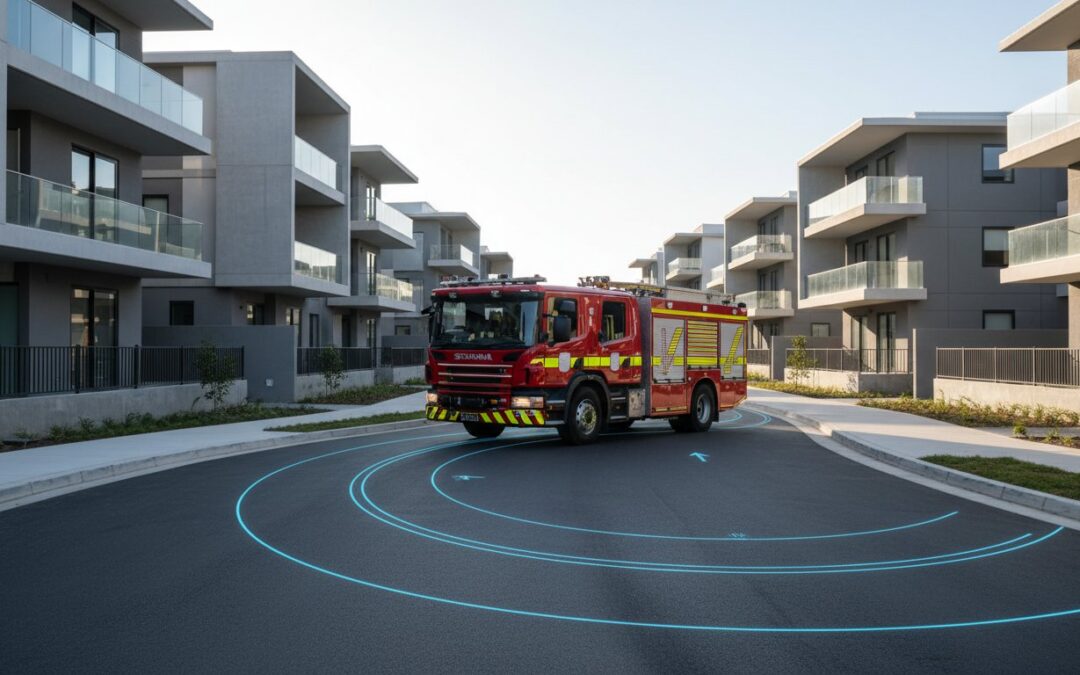
Last Tuesday, a developer in Parramatta discovered that a single overlooked turning radius could trigger a A$32,000 redesign fee. It’s a common story that often leads to months of unnecessary council delays and missed milestones. You likely feel that meeting the shifting requirements of different state fire brigades, such as the CFA or FRNSW, is like trying to hit a moving target while your project budget hangs in the balance. It’s a significant stressor when you’re already managing tight timelines and high stakes.
We’re here to give you total certainty over your site’s accessibility. You’ll learn how to secure immediate council approval by mastering swept path analysis for emergency vehicles for both fire trucks and ambulances. This article provides a clear technical roadmap to ensure your designs are compliant from the very first submission. We’ll examine the specific vehicle dimensions required for Australian Standards and show you how to avoid the 15% increase in construction costs that typically follows a late-stage site redesign.
Key Takeaways
-
Understand why standard truck simulations aren’t enough and how specialized modeling ensures your site meets the high-stakes requirements for fire and ambulance access.
-
Learn to navigate the critical differences between MRV and HRV templates to align your project design with Australian Standards AS 2890.2 and AS 2419.1.
-
Identify the common site design flaws, such as inadequate three-point turns, that frequently lead to DA objections and learn how to rectify them before submission.
-
Discover how professional swept path analysis for emergency vehicles using AutoTURN simulation can secure your council approval while guaranteeing life-saving site accessibility.
-
See why working with a senior consultant who manages your project from quote to completion is the key to navigating complex emergency access requirements across Australia.
Table of Contents
What is Swept Path Analysis for Emergency Vehicles?
Swept path analysis for emergency vehicles is a precise computer-simulated model that maps the exact footprint of a vehicle as it moves through a site. At ML Traffic Engineers, we use AutoTURN software to plot these movements against your architectural site plans. This process ensures that a fire truck or ambulance can navigate turns, ramps, and narrow corridors without striking physical obstructions. Unlike standard delivery van assessments, this analysis focuses on the specific vehicle turning radius of heavy rigid vehicles used by Australian emergency services.
To better understand this concept, watch this helpful video:
This simulation differs significantly from standard truck analysis because the stakes are much higher. While a delivery driver might have the luxury of a three-point turn, an emergency responder does not. These vehicles operate under extreme time pressure and possess unique dimensions, such as front and rear overhangs that swing wider than the wheel path. Our swept path analysis for emergency vehicles accounts for these specialized dynamics to prevent life-threatening bottlenecks.
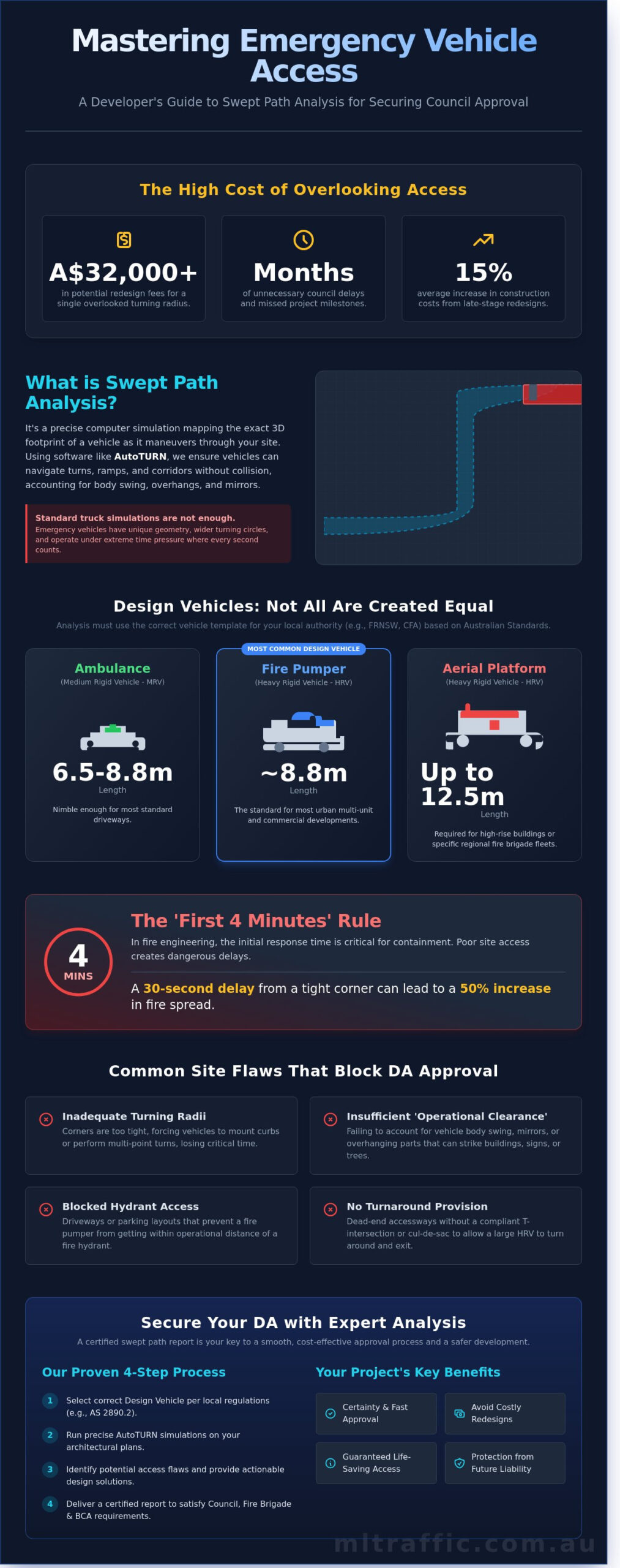
Australian planning regulations require us to identify specific "Design Vehicles" based on the largest likely appliance to attend a site. In most urban jurisdictions, this is an 8.8-metre Heavy Rigid Vehicle (HRV) fire pumper, though some regions require analysis for 10.2-metre aerial platforms. We select the vehicle profile that matches your local fire brigade’s fleet to ensure the simulation reflects real-world conditions. This isn’t a generic test; it’s a tailored engineering check for your specific location.
Every local council in Australia now mandates these reports for multi-unit residential or commercial development applications (DA). Without a certified swept path analysis for emergency vehicles, your application will likely face a Request for Information (RFI) or an outright refusal. Councils prioritize fire safety above almost all other traffic considerations, making this a non-negotiable component of your submission package.
The ‘First 4 Minutes’ Rule and Site Access
In fire engineering, the first four minutes of an incident are critical for containment. Efficiency in site access directly correlates with these response times. If a driver must slow down to crawl speed to navigate a poorly designed tight corner, you lose precious seconds. A 30-second delay caused by difficult maneuvering can lead to a 50% increase in fire spread within a residential structure. ‘Operational clearance’ is the buffer required beyond the physical tire path to account for vehicle body swing and mirrors.
Legal and Insurance Implications for Developers
Developers face significant liability risks if a site prevents emergency vehicle entry during a real-world event. If an appliance cannot reach a hydrant because the driveway radius is too tight, the developer may be held liable for property damage or loss of life. A certified swept path report from an experienced traffic engineer protects you from future negligence claims by proving the design met all Australian Standards (AS 2890.1) at the time of construction. This report bridges the gap between the Building Code of Australia (BCA) requirements and practical traffic engineering.
Technical Specifications: Fire Trucks vs. Ambulances
Designing for emergency access requires a clear understanding of vehicle geometry. An ambulance typically fits within the Medium Rigid Vehicle (MRV) template, which usually spans 6.5m to 8.8m in length. These vehicles are relatively nimble and can often navigate standard residential driveways with ease. In contrast, fire trucks are classified as Heavy Rigid Vehicles (HRV) and present a much greater challenge for site designers. These appliances vary significantly; urban pumpers measure around 8.8m, while heavy aerial platforms reach up to 12.5m. When we perform a swept path analysis for emergency vehicles, we use these specific HRV dimensions to ensure the site layout can accommodate the largest possible vehicle that might respond to a 000 call.
Fire trucks require significantly more space than a standard HRV garbage truck. While both might share a similar chassis length, the fire truck’s wheelbase and body overhang create a much wider swing. The front overhang can extend up to 2.5m beyond the front axle, while the rear overhang can exceed 3.5m depending on the equipment carried. This means the nose and tail of the truck swing out further than the wheels during a tight turn. If your design doesn’t account for this "body swing," the truck might clear the kerb but strike a structural pillar, a signpost, or a parked car. This is why we simulate the "envelope" of the vehicle, not just the wheel tracks.
Turning Radii and Kerb-to-Kerb Requirements
For an Australian HRV fire appliance, the standard outer turning radius is typically 12.5m. We distinguish between kerb-to-kerb and wall-to-wall paths. A kerb-to-kerb path only tracks where the wheels go. A wall-to-wall path tracks the outermost point of the vehicle body, including mirrors and ladders. Council assessors look for wall-to-wall clearance to ensure the vehicle doesn’t hit buildings. Mounting the kerb is not an acceptable solution for a Development Application (DA). Emergency vehicles carry heavy water loads; driving over kerbs can damage the vehicle or underground utilities. While international standards like the UK fire appliance access requirements provide a global benchmark for safety, Australian engineers must adhere strictly to AS 2890.1 and local fire brigade specifications.
The Role of AutoTURN Software in Simulation
Traffic engineers use AutoTURN software to eliminate guesswork. We overlay digital vehicle templates directly onto your architectural CAD files. This allows us to see exactly where the vehicle body travels at every degree of a turn. Using an outdated or generic vehicle library is a common reason for council rejection. Each Australian state has specific requirements, such as the NSW Fire & Rescue or Victoria’s CFA templates. Manual "eyeballing" of a driveway turn often leads to expensive site accidents or forced redesigns after construction begins. Our team at ML Traffic Engineers ensures every swept path analysis for emergency vehicles uses the most current data to keep your project compliant. If you need a technical review of your site layout, you can request a professional swept path assessment to avoid these common pitfalls.
Common Site Design Flaws That Block Emergency Access
"We have plenty of room" is the most common phrase we hear from developers before a formal review. The reality of vehicle physics usually tells a different story. A standard fire appliance in Australia is often modelled on a 12.5m Heavy Rigid Vehicle (HRV) template. This vehicle doesn’t just need a wide road; it requires a specific geometry to pivot safely. When we conduct a swept path analysis for emergency vehicles, we frequently find that a 6m wide driveway is useless if the entry angle is too sharp or the internal radius is below 10.5m. Our experience over 10,000 sites shows that geometric reality often contradicts architectural intent.
Dead-end courts are a recurring nightmare for emergency services. Without a compliant hammerhead or a cul-de-sac with a minimum 25m kerb-to-kerb diameter, a fire truck cannot turn around in a single flow. This forces a 20-tonne vehicle to reverse out of a narrow street, often for 50 metres or more. This manual reversing maneuver adds 45 to 60 seconds to a response time. In a fire emergency, those seconds are the difference between containment and total loss.
Street furniture and landscaping are the silent killers of site compliance. Designers often place bollards, trees, or signage right on the edge of the kerb to maximize aesthetic appeal. They forget that the body of the truck overhangs the wheels significantly during a turn. While the tyres might stay on the bitumen, the front bumper or the side mirrors often strike these obstacles. Referencing the Metrolinx swept path analysis standards helps illustrate how these horizontal clearances must be maintained throughout the entire movement to ensure safety.
High-density parking creates another layer of operational risk. If a 7m wide road allows cars to park on both sides, the effective width drops to approximately 3.2m. This is insufficient for a fire truck to deploy outriggers for ladder operations. We’ve seen projects where 20% of the required access lane was obstructed by "visitor" parking bays that were poorly positioned relative to the turning arc of a swept path analysis for emergency vehicles.
Vertical Clearance: The Forgotten Obstacle
Fire trucks require a minimum 4.5m vertical clearance under AS 2419.1. We often see architectural plans with overhanging balconies or signage at 3.5m or 3.8m. These heights work for delivery vans but stop emergency access entirely. A compliant swept path must account for 3D clearance, not just 2D ground movement. Basement entries and porte-cochères are the most common areas where these height restrictions fail to meet Australian Standards.
Hydrant Access and Hardstand Requirements
Emergency vehicles must park within reach of hydrants and booster assemblies. A fire appliance weighing up to 20 tonnes cannot park on standard residential turf or thin 100mm concrete. The driveway must be engineered as a hardstand to prevent the vehicle from sinking or cracking the pavement during operation. We also analyze the "Reverse-In" vs. "Drive-In" debate for every site. Most fire authorities prefer drive-in access to loading docks and emergency bays to minimize the risk of collisions during high-stress arrivals. Our principals, Michael Lee and Benny Chen, ensure these technicalities are addressed at the quote stage, not after the concrete is poured.
Navigating Australian Standards and Authority Guidelines
Compliance starts with AS 2890.2, the baseline standard for off-street commercial vehicle facilities. It provides the foundational geometry for heavy vehicles, but fire trucks are unique assets that require more than just standard commercial clearances. AS 2419.1:2021 serves as the primary standard for fire hydrant installations, and it dictates the specific access requirements for fire brigade vehicles. If your design doesn’t meet these criteria, your development application will likely stall at the referral stage.
State-specific variations add another layer of complexity. NSW, VIC, and QLD authorities utilize different vehicle templates for their assessments. A pumper in Sydney might have a different turning circle than a heavy aerial appliance in Brisbane. We’ve seen projects where a 12.5m radius was sufficient in one council area, while a neighboring jurisdiction demanded a 15m clearance for the same vehicle type. Early consultation with fire authorities is the only way to avoid expensive redesigns on complex or constrained sites.
Professional swept path analysis for emergency vehicles ensures that your site layout respects these technical boundaries. It isn’t just about drawing circles; it’s about proving to a certifying authority that a 20-tonne vehicle can reach every hydrant without hitting a kerb or getting wedged in a dead-end. We use the latest software to simulate these movements, providing the data-backed assurance that councils demand.
CFA (VIC) vs. FRNSW (NSW) Requirements
The Country Fire Authority (CFA) in Victoria typically mandates a minimum trafficable road width of 4m for fire access. However, Fire and Rescue NSW (FRNSW) often requires 6m for heavy appliances in urban developments to allow for outrigger deployment. Turnaround areas also differ; Victoria often accepts a T-head or Y-head with specific dimensions, while NSW may insist on a 12m radius cul-de-sac. You can find these specifics in the CFA "Requirements for Water Supplies and Access" or the FRNSW "Fire Safety Guideline – Access" documents.
Council RFI Responses: How to Fix a Non-Compliant Path
Receiving a Request for Further Information (RFI) doesn’t mean you have to scrap your entire floor plan. We focus on swept path optimization to find the minimum required road widening, which can save 15% to 20% of Gross Floor Area (GFA) that might otherwise be lost to oversized driveways. By adjusting corner radii by as little as 500mm or repositioning a single structural column, we can often achieve compliance. Our revised reports address council concerns directly with clear, color-coded overlays that prove the vehicle clears all obstacles with a 300mm safety margin.
Don’t let compliance issues delay your project. Contact our experienced team for a certified swept path analysis that meets all Australian standards.
Secure Your DA with Expert Swept Path Analysis from ML Traffic
Your development application represents a significant investment of time and capital. It shouldn’t be derailed by an overlooked access requirement for a fire truck or ambulance. At ML Traffic Engineers, we understand that the stakes are high. That’s why we operate on a transparent, accountable principle: the consultant who quotes your project is the one who does the work. We don’t hand your critical simulations off to junior staff or offshore teams. When you hire us, you’re getting senior-level expertise applied directly to your site plan.
Since 2005, we’ve successfully handled over 10,000 sites across Australia. Our portfolio covers everything from high-density residential towers to complex industrial warehouses and sensitive community hubs. This depth of experience is vital when conducting swept path analysis for emergency vehicles, as these larger vehicles have unique turning circles and clearance needs that standard passenger cars simply don’t. We’ve seen every possible site constraint and know how to find compliant solutions where others see dead ends.
Negotiating with local councils and fire authorities requires a specific technical vocabulary. We speak that language fluently. Our team understands the nuances of state-specific requirements, whether you’re dealing with Fire and Rescue NSW, the CFA in Victoria, or the QFES in Queensland. We don’t just provide a set of drawings; we provide a robust technical defense of your project’s accessibility. This no-nonsense approach helps bridge the gap between architectural vision and the rigid safety requirements of planners and fire marshals.
Our senior engineers ensure every simulation is strictly compliant with Australian Standards. We focus heavily on AS 2890.1 for off-street parking and AS 2419 for fire protection installations. By ensuring your swept path analysis for emergency vehicles is accurate from the start, we help you avoid the costly "Request for Further Information" (RFI) cycles that can delay a project for months. We provide the certainty you need to move your development forward with confidence.
Our Process: From CAD to Council Approval
We’ve refined a three-step workflow designed for speed and technical accuracy. We know that in the development world, time is money.
-
Step 1: Rapid Review. We perform an immediate assessment of your site plan to identify red flags like tight turn radii, steep driveway grades, or insufficient overhead clearance.
-
Step 2: Technical Simulation. Using the latest AutoTURN Pro software, we run precise simulations for the specific emergency vehicle classes required by your local authority.
-
Step 3: Authoritative Reporting. You receive a clear, professional report that is ready for immediate submission with your DA.
Explore our full range of Vehicle Swept Path services to see how we accommodate various vehicle classes and site types.
Get a Direct Quote from Our Principals
When you call ML Traffic, you get direct access to our principals, Michael Lee or Benny Chen. Both Michael and Benny bring between 30 and 40 years of individual experience to every project. This senior involvement ensures that your traffic engineering needs are met with precision and a deep understanding of the regulatory landscape. We pride ourselves on fast turnaround times, often delivering results much faster than larger, more bureaucratic firms. We’re here to keep your project on track and ensure your access design is both functional and compliant.
Contact ML Traffic Engineers today for a no-obligation quote and let our experts secure the access component of your development application.
Secure Your DA with Precise Emergency Access Planning
Getting your Development Application approved requires more than just a functional layout; it demands proof that life-saving vehicles can navigate your site without delay. A failed swept path analysis for emergency vehicles can stall your project or lead to expensive retrofits. You must account for specific fire truck dimensions and turning radii while adhering strictly to Australian Standards like AS 2890.1. It’s about ensuring site safety and meeting the rigorous demands of local authorities.
ML Traffic Engineers brings 15+ years of specialist experience to your project. We’ve successfully assessed 10,000+ sites nationwide, ensuring every driveway and turning circle meets strict compliance guidelines. You’ll have direct access to our senior engineers throughout the process. The consultant who quotes your job is the one who completes the technical work. Don’t leave your compliance to chance or junior staff when your project timeline is on the line.
Get a compliant Swept Path Analysis from the experts at ML Traffic Engineers. We’re ready to help you clear the final hurdle for your DA approval with confidence.
Frequently Asked Questions
Is swept path analysis mandatory for all residential developments?
Swept path analysis isn’t mandatory for every single-family home, but it’s essential for 90% of multi-unit residential developments. Councils require it whenever a fire truck must enter a private road to stay within 45 metres of a building’s furthest point. If your project involves more than 3 dwellings or a complex driveway, expect this to be a non-negotiable part of your DA submission to ensure safety compliance.
What is the standard size of a fire truck for swept path analysis in Australia?
Standard fire trucks in Australia generally follow the 8.8-metre Medium Rigid Vehicle (MRV) or 12.5-metre Heavy Rigid Vehicle (HRV) dimensions. We use these specific templates from AS 2890.2 to ensure the 12.5-metre turning radius is met. Most state fire authorities, such as FRNSW, demand that we simulate the largest vehicle in their fleet to guarantee access during a life-threatening emergency event on your property.
Can an ambulance navigate a tighter turn than a fire truck?
Ambulances can definitely navigate tighter turns than fire trucks because they’re built on smaller chassis like the 6.5-metre Mercedes-Benz Sprinter. While an ambulance fits within a B99 vehicle template, a fire truck is a different beast entirely. We perform a swept path analysis for emergency vehicles primarily to accommodate the fire truck’s 12.5-metre length, which is the most restrictive vehicle likely to enter your site during an incident.
What happens if my site plan fails the swept path simulation?
You’ll need to revise your site layout or driveway geometry to accommodate the vehicle’s turning arc. Failure means the Council won’t approve your Development Application because it poses a significant safety risk. Our engineers typically suggest widening the driveway throat by 500mm or increasing the inner kerb radius to resolve these clearance issues quickly. We provide practical design advice to fix these failures before you resubmit your plans.
Do I need a new swept path if I change my driveway design slightly?
Yes, even a 200mm change to a kerb or a 5-degree shift in a driveway’s angle requires a new simulation. Fire trucks have tight tolerances, and a design that worked yesterday might fail today with a minor tweak. We re-run the assessment to confirm the 12.5-metre HRV still clears all structures. This prevents the high risk of a Council rejection during the final construction certificate or inspection phase.
What is the difference between a swept path and a turning circle?
A turning circle only measures the path of the outer tyres, while a swept path accounts for the body overhang of the entire vehicle. A fire truck’s front bumper often swings 1.2 metres beyond the wheel path during a sharp turn. Swept path analysis for emergency vehicles is more comprehensive because it tracks every corner of the vehicle to prevent collisions with walls, carports, or landscaping during a turn.
How much does a professional swept path analysis report cost?
A professional swept path analysis report typically costs between A$450 and A$900 for a standard residential development. If your project is a large commercial site requiring multiple vehicle types, the fee may increase to A$1,800. Our team provides these reports with a 48-hour turnaround, ensuring your DA stays on track without expensive delays. You’re paying for RPEQ-certified expertise that satisfies strict Council engineering departments across Australia.
Can I use standard AS 2890.1 templates for emergency vehicles?
You can’t use AS 2890.1 templates because they only cover passenger cars and light vans. Emergency vehicles require the Heavy Rigid Vehicle (HRV) templates found in AS 2890.2 or specific fire brigade specifications. Most Australian councils will reject a report that uses car templates for fire access. It’s critical to use the 12.5-metre radius standard to ensure a pumper can actually reach your building’s hydrants without getting stuck.
Which areas do you cover?
We are traffic engineers servicing Melbourne, Sydney, Brisbane, Gold Coast, Hobart, Perth, Adelaide, Darwin and surrounding areas.
