
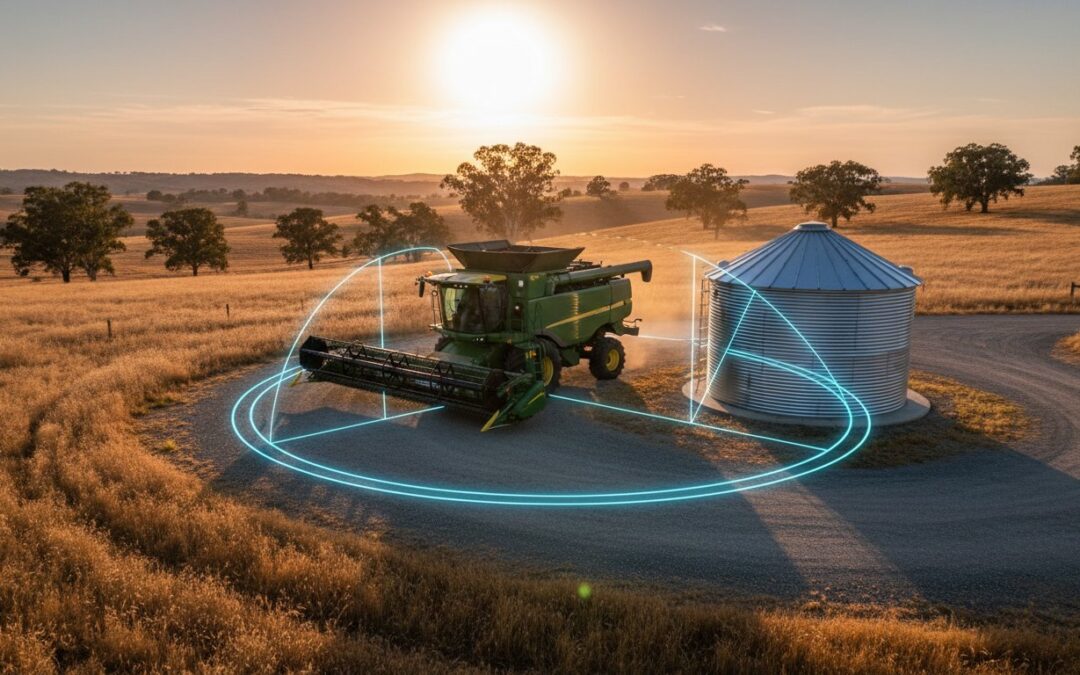
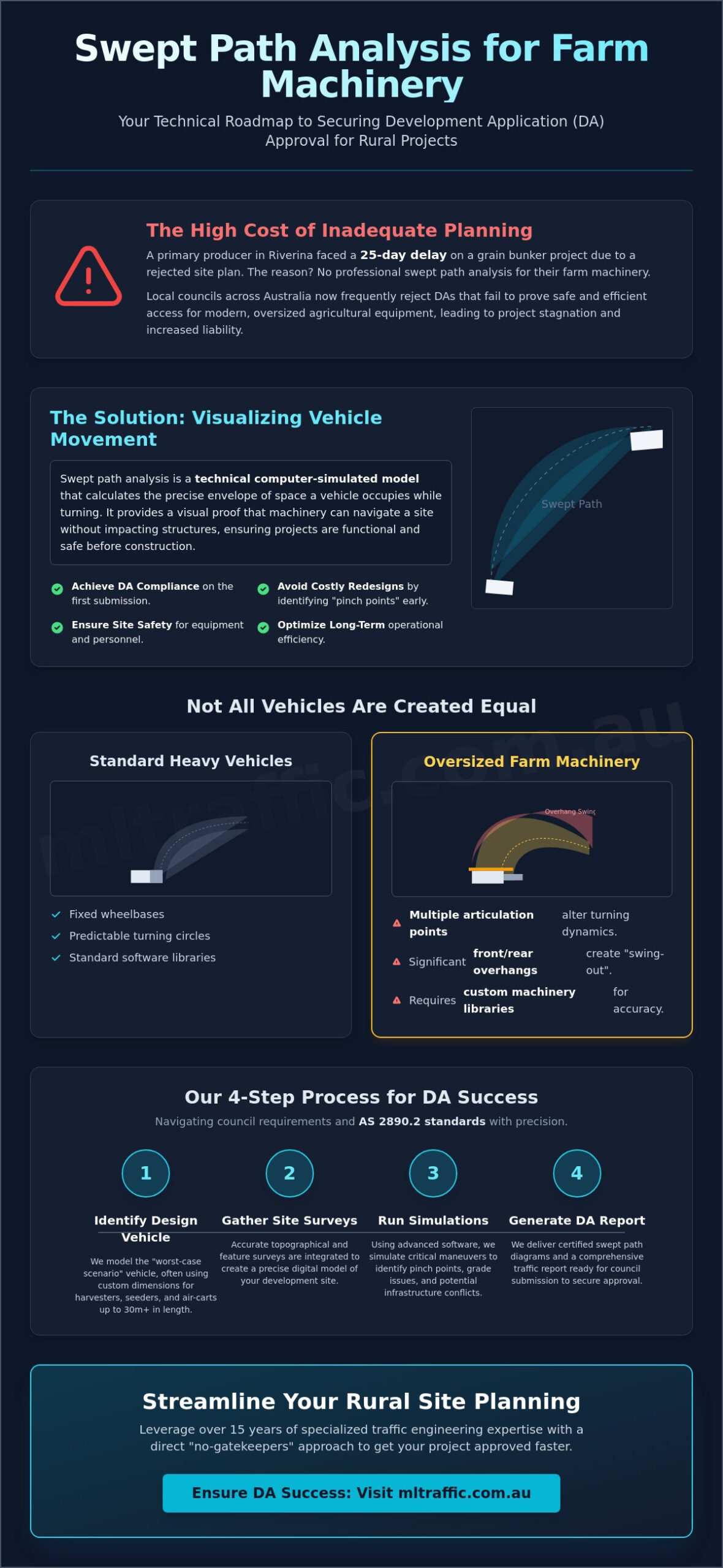
A primary producer in the Riverina recently faced a 25 day delay on a new grain bunker project because the site plan lacked a professional swept path analysis for farm machinery. Local councils across Australia now frequently reject Development Applications (DAs) that fail to demonstrate safe access for modern, oversized agricultural equipment. Maneuvering a 12 metre header or a dual-axle chaser bin requires precise spatial planning to prevent property damage and ensure site efficiency. You recognise that inadequate access plans are a leading cause of project stagnation and increased liability.
This guide explains how a detailed swept path assessment ensures your site layout meets AS 2890.2 standards and satisfies council requirements on the first submission. We’ll provide a technical roadmap for achieving DA compliance, optimising driveway grades, and avoiding the common design errors that stall rural developments. The following sections break down the specific requirements for heavy vehicle movements and the importance of expert certification in the planning process.
Key Takeaways
- Understand how computer-simulated models verify that oversized agricultural equipment can safely maneuver within your rural development site.
- Ensure your project meets Australian Standard AS 2890.2 by performing a professional swept path analysis for farm machinery as part of a comprehensive Traffic Impact Assessment.
- Learn how to identify the correct “design vehicle” parameters, accounting for the unique widths and turning circles of harvesters, seeders, and sprayers.
- Discover the step-by-step process of gathering site surveys and using custom machinery libraries to secure Development Application (DA) approval.
- Leverage over 15 years of specialized traffic engineering expertise and a direct “no-gatekeepers” approach to streamline your rural site planning.
Table of Contents
What is Swept Path Analysis for Farm Machinery?
Swept path analysis for farm machinery is a technical computer-simulated model that calculates the envelope of space a vehicle occupies while performing a turn or maneuver. Unlike standard road vehicles, agricultural equipment often features irregular dimensions and complex movement patterns. This analysis provides a precise visual representation of the vehicle’s path, ensuring it can navigate a site without impacting physical structures, vegetation, or other infrastructure. At ML Traffic Engineers, we use this data to validate that proposed rural developments are functional and safe before construction begins.
To better understand this concept, watch this helpful video:
For rural Development Applications (DAs) in Australia, these simulations are a mandatory component of a comprehensive traffic report. They prove to local government authorities that the site layout accommodates the specific heavy machinery intended for use. By identifying potential "pinch points" early, developers avoid costly mid-construction redesigns and ensure long-term operational efficiency. Our team relies on advanced Swept Path Analysis Software to generate these diagrams, providing the high level of accuracy required by Australian councils and state road authorities.
The Difference Between Standard Trucks and Farm Equipment
Standard heavy vehicles usually have fixed wheelbases and predictable turning circles. Agricultural machinery is significantly more complex. A tractor paired with a trailing implement, such as a multi-axle seeder or a large grain cart, creates multiple articulation points that drastically alter the vehicle’s footprint during a turn. These implements often have wide wheelbases and low ground clearance, which limits their ability to clear kerbs or navigate steep driveway grades.
Front-mounted attachments, like headers on combine harvesters, introduce significant front and rear overhangs. These overhangs can "swing out" much further than the wheels themselves, posing a risk to gateposts and utility poles. Accurate swept path analysis for farm machinery must account for these specific attachments to prevent infrastructure damage. You can view our full range of assessment capabilities on our services page.
Why Councils Require Swept Path Diagrams for Rural DAs
Australian councils require these diagrams to ensure compliance with local planning schemes and Australian Standards, specifically AS 2890.1 for off-street parking and access. The primary concern is safety and the preservation of public assets. If a farm vehicle cannot turn safely, it may be forced to reverse onto a public road or block emergency vehicle access, which creates an unacceptable liability. Council Compliance in 2026 requires traffic engineering reports to demonstrate that proposed rural access points accommodate the specific turn radii of modern, oversized agricultural plant equipment.
-
Ensures fire trucks and ambulances have clear passage alongside active machinery.
-
Protects public assets like roadside drainage and telecommunications pits.
-
Validates that internal site roads are wide enough for the largest intended vehicle.
-
Reduces the risk of traffic congestion at property entrances.
Critical Vehicle Parameters for Agricultural Simulations
Accurate swept path analysis for farm machinery begins with identifying the correct design vehicle. For rural developments, this isn’t a standard truck. It’s often the largest harvester, seeder, or air-cart combination expected to access the site. Standard vehicle libraries in software like AutoTURN provide a baseline, but agricultural equipment frequently requires custom dimensioning. Our engineers model the "worst-case scenario" to ensure maximum safety margins, accounting for the extreme dimensions of modern broadacre machinery. Accuracy is non-negotiable for DA approval.
Designers must accommodate long trucks or combinations of farm machinery that may exceed 30 metres in total length. Unlike standard logistics vehicles, agricultural implements have variable widths. A harvester with a front attached can exceed 12 metres in width, while a folded seeder might be 6 metres. Our simulations use the maximum operational width to prevent collisions with gate posts, power poles, or vegetation. We don’t rely on generic templates; we build custom profiles based on manufacturer specifications.
Modelling Tractors, Harvesters, and Chaser Bins
Articulated tractors present unique challenges due to their central pivot points. This creates a different turning footprint compared to front-steer vehicles. When performing swept path analysis for farm machinery, we calculate the swept width by measuring the outermost points of the machinery, including protruding mirrors, augers, and ladders. It’s vital to simulate "reverse-in" and "drive-out" manoeuvres. Most rural accidents or property damage occur during reversing, so we verify that these movements fit within the available pavement area without encroaching on table drains or embankments.
The Role of Ground Clearance and Vertical Swept Paths
Horizontal clearance is only half of the requirement. Vertical swept paths are critical for machinery with low ground clearance or high cabs. We perform a driveway ramp grade assessment to ensure that long-wheelbase equipment won’t "bottom out" on crests or scrape on entries. This assessment complies with AS 2890.1 standards while adjusting for the specific clearances of agricultural tyres and frames. We also verify overhead clearance for grain augers and exhaust stacks, which often require at least 5.0 metres of unobstructed vertical space. If you’re unsure if your site layout meets these technical requirements, contact our senior engineers for a direct review of your plans.
Navigating Australian Standards and Compliance Requirements
Rural Development Applications (DA) require more than a basic site plan. Council planners and state road authorities demand technical proof that proposed access points function safely under heavy load conditions. While AS 2890.2 (Off-street commercial vehicle facilities) provides the foundation for heavy vehicle movements, it doesn’t always account for the unique geometry of modern agricultural equipment. A precise swept path analysis for farm machinery bridges the gap between standard engineering templates and the practical realities of a working farm.
AS 2890.2 and Rural Development Access
The Australian Standard AS 2890.2 classifies vehicles into specific categories like Service Vehicles (SRV) and Heavy Rigid Vehicles (HRV). These categories work for standard delivery trucks, but they’re often insufficient for rural sites. A standard 12.5 metre HRV template doesn’t reflect the pivot points of an articulated tractor or the wide swing of a chaser bin. A swept path needed for common agriculture vehicles must be customized to the specific machinery used on-site to avoid gatepost damage or road shoulder erosion.
On mixed-use rural sites, we integrate AS 2890.1 car park design principles for staff and visitor parking. This ensures that light vehicle movements don’t interfere with heavy machinery corridors. We focus on:
-
Separating passenger vehicle parking from heavy machinery maneuvering areas.
-
Verifying that driveway widths accommodate the widest possible implement.
-
Ensuring that turning circles don’t encroach on neighboring properties or sensitive environmental zones.
The Importance of RPEQ and Senior Engineer Certification
Council planners trust reports backed by decades of experience. At ML Traffic Engineers, we’ve completed assessments for over 10,000 sites since 2005. Our principals, Michael Lee and Benny Chen, each bring between 30 and 40 years of experience to every project. We operate on a direct-access model: the traffic consultant who provides the quote, does the work. This hands-on approach ensures that your swept path analysis for farm machinery is technically sound and ready for scrutiny by authorities like TfNSW, VicRoads, or TMR.
Professional certification by an RPEQ or senior engineer reduces the risk of costly post-construction modifications. We assess sight distance compliance by measuring Safe Intersection Sight Distance (SISD) at property entry points. We don’t just rely on posted speed limits; we look at actual approach speeds and topography. This meticulous data collection ensures your entry point meets safety standards, preventing delays in the DA process and protecting the long-term viability of your rural operations.
The Step-by-Step Process of a Rural Swept Path Assessment
A professional swept path assessment follows a rigorous technical workflow to ensure compliance with council requirements and Australian Standards like AS 2890.1. Our engineers use specialized software to model how heavy equipment moves through your specific site layout. This process eliminates guesswork and provides the empirical evidence needed for a successful Development Application (DA).
-
Step 1: Data Collection. We gather site surveys in CAD format and precise machinery specifications. This includes the total length, width, and turning radius of your largest combinations, such as B-Doubles or wide-axle harvesters.
-
Step 2: Vehicle Selection. We select the appropriate design vehicle from standard Australian libraries. For unique or modified equipment, we build custom vehicle profiles to ensure the simulation is 100% accurate to your fleet.
-
Step 3: Movement Simulation. We simulate the most difficult manoeuvres. This typically involves testing 90-degree turns at property entrances and complex movements within loading areas.
-
Step 4: Conflict Identification. We locate "pinch points" where the vehicle path overlaps with proposed buildings, existing fences, or vegetation. Identifying these issues early through swept path analysis for farm machinery prevents costly construction errors.
-
Step 5: Final Reporting. We produce a comprehensive report with clear, high-resolution diagrams. These documents prove to the council that your farm can operate safely without impacting public infrastructure.
Designing Property Gates and Setbacks
The "throat length" of your entrance is a critical safety factor. It’s the distance between the road edge and the property gate. For a standard B-Double, this length must be at least 26 metres. This ensures the vehicle doesn’t idle on a public road while waiting for a gate to open, which is a major safety concern for regional councils. Swept path analysis for farm machinery also determines the required gate width. Wider gates are often necessary to allow for "off-tracking," where the rear wheels follow a tighter path than the front wheels during a turn.
Optimising Shed Access and Loading Docks
Effective internal circulation reduces the risk of accidents and equipment damage. We design paths that minimize reversing, as backing up a multi-trailer unit is a high-risk manoeuvre. By using swept path analysis, we ensure there is sufficient clearance around grain silos, fertilizer bunkers, and machinery sheds. This technical approach maximizes your usable site area while maintaining safety margins for large-scale operations. It’s about making sure your infrastructure works for your equipment, not against it.
Contact ML Traffic Engineers today to discuss your rural swept path requirements with an experienced consultant.
Ensuring DA Success with ML Traffic Engineers
ML Traffic Engineers has operated as a specialized consultancy since 2005. With over 15 years of experience in traffic engineering and transport planning across Australia, our team understands the specific requirements of rural development applications. We’ve supported over 10,000 sites with successful planning approvals. This track record stems from a commitment to technical accuracy and a deep understanding of council expectations.
Our firm utilizes a "No Gatekeepers" approach. Clients gain direct access to senior engineers Michael Lee and Benny Chen. You won’t be passed off to junior staff or administrative intermediaries. This direct line of communication ensures that the technical nuances of your swept path analysis for farm machinery are addressed by experts with decades of experience. Our hands-on methodology results in reports that are accurate, compliant, and ready for council submission.
Comprehensive Traffic Engineering for Rural Projects
Rural developments often require a suite of technical assessments beyond basic swept paths. We provide a full range of services to ensure your project meets all regulatory hurdles. Our expertise includes:
-
Traffic Impact Assessments (TIA) and Traffic Impact Statements (TIS).
-
Sight distance checks to ensure safe property access.
-
Detailed car park design and driveway ramp grade assessments.
-
Swept path analysis for farm machinery, including harvesters and B-doubles.
All our work adheres strictly to Australian Standards, including AS 2890.1. We maintain national coverage, applying local knowledge to every project. You can review our expert credentials to see how our senior-led team handles complex traffic requirements.
Get a Quote for Your Agricultural Project
Obtaining a quote is a straightforward process. We require your current site plans and details regarding the specific vehicles used on your property. This data allows us to provide a fast and accurate fee proposal tailored to your DA requirements. We operate on a transparent principle: the traffic consultant who provides your quote is the person who does the work. This ensures accountability and eliminates the risk of information loss between the sales and engineering phases.
Our reports focus on practical outcomes. We help you avoid costly design errors before they reach the council desk. Contact our team today for professional traffic engineering services. We provide the technical documentation you need to move your agricultural project forward without unnecessary delays.
Secure Your Rural DA Approval with Precise Engineering
Navigating rural development applications requires strict adherence to Australian Standards, particularly AS 2890.1. Accurate swept path analysis for farm machinery ensures that oversized agricultural vehicles safely navigate site access points and internal roads without compromising safety or infrastructure. Failure to account for specific vehicle parameters like wheelbase and turning circles often leads to costly delays in the planning process. Technical precision at the design stage isn’t just a requirement; it’s a safeguard for your project’s timeline.
ML Traffic Engineers provides the technical certainty required by local councils. We’ve completed over 10,000 projects nationwide. Our senior staff bring between 30 and 40 years of experience to every assessment. You won’t deal with junior gatekeepers. The traffic consultant who provides your quote is the one who does the work. You’ll have direct mobile access to our principals to discuss your site’s specific requirements. We focus on delivering results that meet bureaucratic demands while supporting your operational goals.
Request a Swept Path Analysis Quote from our Senior Engineers
We’re ready to help you secure your rural development approval with confidence.
Frequently Asked Questions
What is the most common design vehicle for farm machinery swept paths?
The 19 metre articulated semi-trailer is the most common design vehicle for large-scale rural operations, while the 12.5 metre Heavy Rigid Vehicle (HRV) serves smaller sites. We often use custom dimensions for specific equipment like a Case IH Steiger or John Deere 9RX. These simulations ensure your site accommodates the exact turning circle of your specific fleet.
Does my rural shed expansion really need a swept path analysis?
You need a swept path analysis if your shed expansion requires a Development Application (DA) and changes how heavy vehicles move on-site. Local councils in New South Wales and Queensland require proof that machinery won’t impact public road safety or damage internal infrastructure. Providing a professional simulation prevents costly redesigns during the construction phase.
Can I use a standard semi-trailer template for my harvester simulation?
You shouldn’t use a standard semi-trailer template for harvesters because their wheelbase and steering geometry differ significantly. Harvesters often feature rear-wheel steering or specific header attachments that exceed 3.5 metres in width. Our team uses specialized software to create a custom swept path analysis for farm machinery that accurately reflects your harvester’s unique footprint.
How much space does a tractor with a chaser bin need to turn?
A tractor with a 30 tonne chaser bin typically requires a turning radius between 18 and 24 metres. This distance depends on the hitch type and the total length of the combination, which can exceed 15 metres. We calculate these requirements based on the manufacturer’s minimum turning circle to ensure your hardstand areas are sized correctly.
What happens if my swept path analysis shows the machinery won’t fit?
We identify the specific conflict points and recommend geometric adjustments to your site plan. This might involve widening a gate by 1.5 metres or increasing a turning radius by 3 metres. Correcting these issues on paper during the DA process is significantly cheaper than rebuilding a concrete driveway that fails a council inspection.
Is swept path analysis required for both forward and reverse movements?
Most Australian councils require simulations for both forward and reverse movements to ensure operational safety. We demonstrate that a vehicle can enter, turn around, and exit the site in a forward direction as per AS 2890.2 standards. This assessment is critical for loading docks and shed entries where reversing is a daily requirement.
How does swept path analysis impact my driveway design for council approval?
Swept path analysis for farm machinery determines the minimum width and entry radii of your driveway to prevent vehicles from crossing into oncoming traffic lanes. Councils use these reports to verify that heavy machinery won’t damage road shoulders or kerbs. A compliant design speeds up the approval process for rural developments.
Can ML Traffic Engineers help with rural projects outside of major cities?
We provide traffic engineering services for rural projects across all Australian states, including remote regions in Western Australia and the Northern Territory. Our engineers have completed over 10,000 site assessments since 2005. You’ll deal directly with our principals, Michael Lee or Benny Chen, regardless of your project’s location.
Which areas do you cover?
We are traffic engineers servicing Melbourne, Sydney, Brisbane, Gold Coast, Hobart, Perth, Adelaide, Darwin, Canberra and surrounding areas.

Disclaimer
The content on www.mltraffic.com.au, including all technical articles, guides, and resources, is provided for general informational and educational purposes only. It is not intended to constitute professional advice in traffic engineering, transportation planning, development approvals, or any other technical or legal field.
While ML Traffic Engineers makes every reasonable effort to ensure the accuracy, completeness, and timeliness of the information published, we do not provide any warranties or representations (express or implied) regarding its reliability, suitability, or availability for any particular purpose. Any reliance you place on the content is strictly at your own risk.
In no event shall ML Traffic Engineers, its directors, employees, authors, or affiliates be liable for any direct, indirect, incidental, special, consequential, or punitive damages (including, without limitation, loss of profits, data, or business opportunities) arising out of or in connection with the use of, or inability to use, any information provided on this website.
The articles and guides on this site are not a substitute for engaging a qualified, registered professional traffic engineer (such as an NPER or RPEQ engineer) to assess your specific project requirements. For tailored advice, compliance assessments, or traffic engineering services, please contact a competent professional.
This disclaimer may be updated from time to time without notice. By accessing or using this website, you agree to be bound by the most current version of this disclaimer.
