
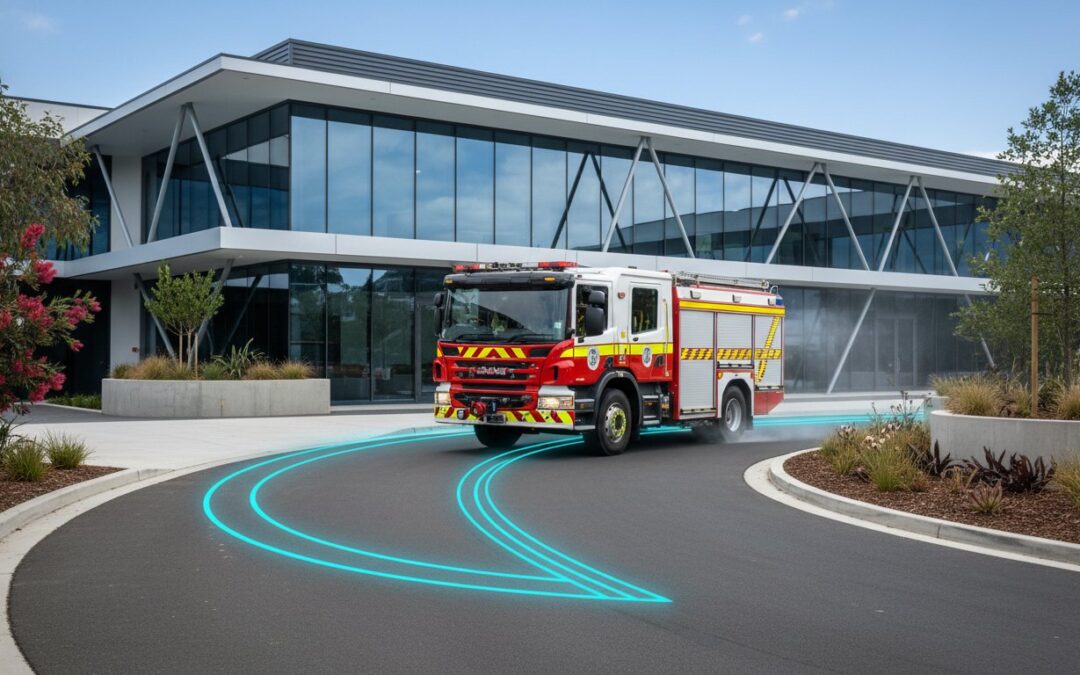
A single Request for Information regarding fire truck access can stall a multi-million dollar development for months or force a costly site redesign that eats into your saleable area. You’re likely aware that navigating the friction between AS 2419.1:2021 and the specific mandates of state authorities like FRNSW, CFA, or QFES is one of the most complex aspects of a planning submission. Failing to account for the physical footprint of an emergency vehicle often results in non-compliant driveway grades or inadequate turning circles that councils simply won’t overlook.
This technical guide ensures you master the requirements for a swept path analysis for fire pumper access to secure immediate council approval. By applying the latest AutoTURN 2026 modeling standards, you’ll learn how to balance the 11.5m outer turning radius and 4.5m vertical clearance requirements with your project’s density goals. We provide a definitive breakdown of the 40-metre hose-reach rule and the 15-tonne GVM hardstand specifications you need to maintain site viability and fire service compliance across all Australian jurisdictions.
Key Takeaways
- Identify the specific dimensions and turning radii of Heavy Rigid Vehicles to ensure your site layout accommodates standard Australian fire appliances.
- Learn how to integrate AS 2419.1 and AS 2890.2 requirements into a compliant swept path analysis for fire pumper access.
- Understand the critical hardstand requirements necessary to support the 20-tonne operating weight of modern fire pumpers during emergency scenarios.
- Discover why manual turning templates are no longer accepted by councils and how AutoTURN modelling eliminates the risk of unreplicable vehicle paths.
- Streamline your development application by integrating certified access designs into a comprehensive Traffic Impact Assessment.
Table of Contents
-
The Critical Role of Fire Pumper Swept Path Analysis in Site Design
-
Technical Specifications: Understanding Fire Pumper Dimensions and Radii
-
Compliance with Australian Standards: AS 2419.1 and AS 2890.2
The Critical Role of Fire Pumper Swept Path Analysis in Site Design
A swept path analysis for fire pumper access is a technical simulation that maps the dynamic envelope a vehicle occupies while in motion. It calculates the precise path of the chassis, wheels, and specialized equipment overhangs during complex maneuvers. This assessment isn’t a mere suggestion; it’s a fundamental requirement for site viability. Most Australian local government authorities mandate these simulations for all multi-residential and commercial developments to ensure emergency responders aren’t obstructed by physical site constraints.
The geometric complexity of a fire truck requires a deep understanding of a vehicle’s turning radius and its swept width. Unlike standard passenger cars, fire pumpers have significant front and rear overhangs that can strike bollards, walls, or parked cars if the path isn’t modeled correctly. Developers who overlook these simulations often face expensive redesigns after the building footprint has already been finalized.
To better understand this concept, watch this helpful video:
Design decisions directly impact the "First 4 Minutes" rule. This industry benchmark dictates that fire services must be able to access, set up, and begin suppression within four minutes of arrival to prevent total structure loss. Every second lost to a difficult three-point turn or a tight driveway reduces the likelihood of a successful rescue. If a site design prevents access, the developer may face severe legal liabilities or find the property uninsurable due to non-compliance with fire brigade access requirements.
DA Compliance and Regulatory Necessity
Councils frequently issue Requests for Information (RFIs) when a development application lacks clear evidence of emergency vehicle access. Providing a certified swept path analysis for fire pumper movements at the outset accelerates the approval timeline. There’s a clear shift toward performance-based design in Australian safety codes. This means designers must prove a vehicle can navigate the specific site layout rather than just meeting generic minimum widths. Engaging an expert for Vehicle Swept Path Analysis ensures your submission meets these rigorous regulatory expectations.
Fire Pumper vs. Standard Heavy Vehicles
Relying on standard Medium Rigid Vehicle (MRV) or Heavy Rigid Vehicle (HRV) templates is a common mistake. Fire pumpers carry specialized ladders and pumping gear that extend beyond the standard chassis dimensions. These overhangs create a wider "swept" area during turns than a typical delivery truck. Furthermore, fire authorities have a strict "no-reverse" preference. They require designs that allow vehicles to enter and exit in a forward direction. This necessitates dedicated turn-around areas or through-roads that go beyond standard site circulation requirements for delivery or waste vehicles.
Technical Specifications: Understanding Fire Pumper Dimensions and Radii
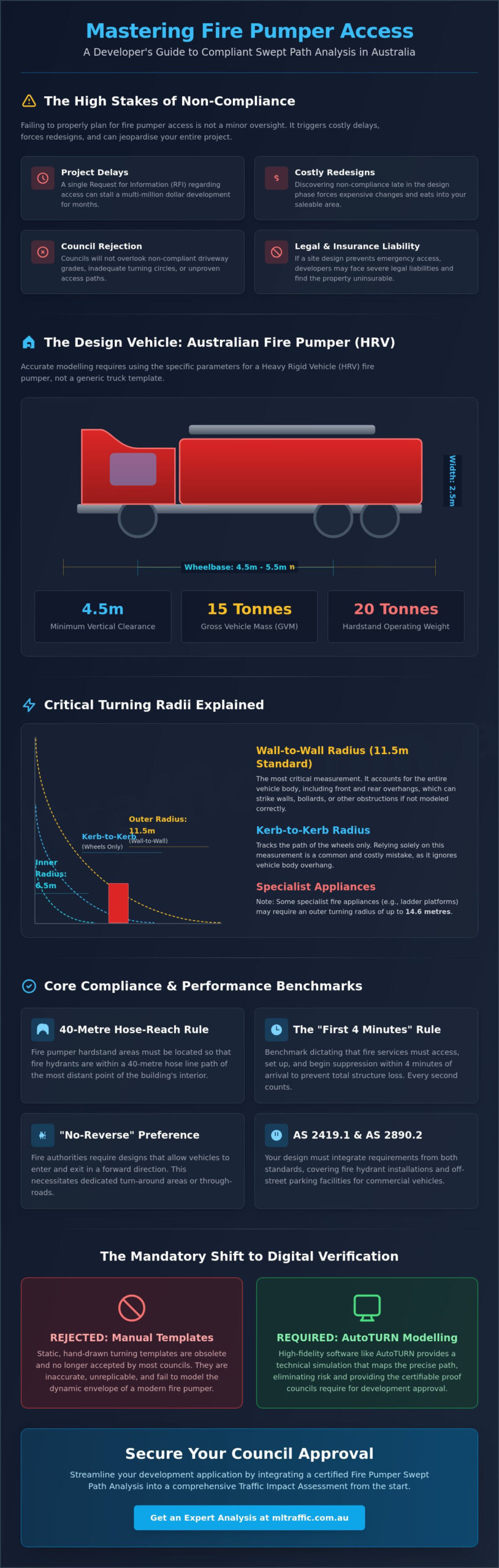
Accurate modeling begins with the correct design vehicle. In Australia, the standard fire pumper is categorized as a Heavy Rigid Vehicle (HRV). While generic HRV templates exist, fire authorities require specific parameters that account for the unique chassis of emergency appliances. A typical pumper measures between 8.8 and 10.5 metres in length and 2.5 metres in width. The wheelbase, often ranging from 4.5 to 5.5 metres, serves as the critical pivot point during a turn.
A professional swept path analysis for fire pumper access must distinguish between kerb-to-kerb and wall-to-wall turning circles. The kerb-to-kerb measurement tracks the path of the wheels alone. However, the wall-to-wall radius accounts for the body of the vehicle, including front and rear overhangs. For a standard appliance, an inner radius of 6.5 metres and an outer radius of 11.5 metres are common benchmarks. Specialist fire appliances may require an outer radius of up to 14.6 metres. Failure to account for these dimensions leads to body strikes against walls or site infrastructure.
Front and rear overhangs present the greatest risk during maximum lock turns. The front overhang typically extends 1.5 metres beyond the front axle, while the rear can extend up to 2.5 metres. As the driver turns the steering wheel, the rear of the pumper kicks out in the opposite direction. This tail swing can easily clip parked vehicles or fence lines if the access road is too narrow. Ensuring your Compliance with Australian Standards requires precise modeling of these geometric realities.
HRV vs. MRV: Which Template Should You Use?
Choosing the wrong template is a frequent cause of council RFIs. While some rural or low-density residential sites might permit Medium Rigid Vehicle (MRV) modeling, most high-density developments mandate HRV pumper templates. The HRV pumper requires wider internal access roads, typically a minimum of 4.0 metres unobstructed width. In two-way traffic zones or areas with passing bays, this width often increases to 6.0 metres to ensure the pumper doesn’t become trapped behind other site traffic.
The Clearance Envelope: Beyond the Wheel Path
A compliant design includes a 500mm safety margin between the vehicle’s swept path and any fixed obstacles. This clearance envelope protects both the building and the emergency vehicle. Vertical clearance is equally vital. Australian standards generally require a minimum clear height of 4.5 metres along the entire access route. This must remain clear of eaves, signage, and mature tree canopies. If your site features complex grades or overhead structures, a professional Vehicle Swept Path Analysis can verify that these clearances are maintained throughout the maneuver.
Compliance with Australian Standards: AS 2419.1 and AS 2890.2
A successful development application relies on the seamless integration of vehicle movement and fire suppression infrastructure. While many consultants treat AS 2419.1 and AS 2890.2 as separate entities, they’re inextricably linked. A swept path analysis for fire pumper access must do more than prove a vehicle can drive through a site; it must prove the vehicle can reach and operate from specific hardstand positions adjacent to hydrants and booster assemblies. If the pumper cannot park within the required distance of the booster, the entire hydrant system may be deemed non-compliant.
Structural integrity of the access route is a primary concern. Under AS 2419.1:2021, fire authorities require hardstands capable of supporting the heavy operating weight of modern appliances. In New South Wales, FRNSW mandates that driveways longer than 15 metres support a 15-tonne Gross Vehicle Mass (GVM). In Victoria, Fire Rescue Victoria (FRV) requires hardstand surfaces to withstand a point load of 150kN to accommodate specialized aerial appliances. Failure to specify these structural requirements in your traffic engineering plans can lead to immediate council rejection during the planning phase.
Dead-end access roads are another common failure point in site design. Fire authorities generally prohibit reversing maneuvers over long distances due to safety risks for personnel and the public. If an access road exceeds 15 metres, a dedicated turning head is required. These are typically designed as T-junctions or hammerheads that allow the pumper to turn around using a maximum three-point turn. Your swept path analysis for fire pumper must demonstrate this turn is achievable within the property boundaries while maintaining the mandatory 500mm clearance from all permanent structures.
AS 2419.1: Fire Hydrant Proximity
AS 2419.1:2021 distinguishes between "hose lay" and "pumper reach" distances. While firefighters can drag hoses across a site, the pumper itself must be positioned within a specific distance of the booster assembly to ensure effective pressure. FRNSW enforces a 40-metre hose-reach rule, meaning every ground-floor point of a building must be within 40 metres of a pumper parked on a compliant hardstand. The simulation must show the pumper in its "deployed" state, accounting for the space needed for personnel to access side-mounted lockers and equipment without obstructing the fire-fighting effort.
AS 2890.2: Off-Street Commercial Vehicle Facilities
AS 2890.2:2018 provides the framework for driveway and parking geometry. For fire pumper access, gradient and cross-fall limits are strictly enforced. Hardstands where the pumper must park to operate should ideally have a gradient no steeper than 1 in 50, with a maximum limit of 1 in 20 in some jurisdictions. We also perform a Driveway Ramp Grade Assessment to ensure the vehicle’s approach and departure angles don’t cause it to scrape or bottom out on steep transitions. These vertical clearances and grade changes are just as critical as the horizontal turning path for securing approval.
Common Design Pitfalls and High-Fidelity AutoTURN Modelling
Manual turning templates are now largely insufficient for modern development applications. Most Australian councils require digital evidence that an emergency vehicle can navigate a site without striking infrastructure. Relying on static plastic overlays or basic CAD blocks often leads to "idealised" paths. These simulations assume a driver can achieve a 100% steering lock instantly while stationary, which is impossible in a real-world emergency. A professional swept path analysis for fire pumper access must account for realistic steering lock rates and transition distances to be considered valid by assessing officers.
Pinch points frequently occur at gated entries and the start of basement ramps. Designers often forget that the body of the pumper swings wide before the wheels begin their turn. If a gate is positioned too close to a corner, the front overhang may strike the gate post even if the wheels clear the kerb. Similarly, vertical clearance isn’t just about the height of the vehicle. Exhaust stacks and rear-mounted ladders require a minimum clear height of 4.5 metres. On steep ramp transitions, this clearance can be further compromised as the vehicle’s angle changes, potentially leading to a "clash" with overhead services or structural beams.
The Three-Point Turn Constraint
Fire authorities maintain a strict operational preference for forward-entry and forward-exit maneuvers. When a dead-end road is unavoidable, any proposed turn-around must be achievable in no more than three points. If a swept path analysis for fire pumper shows a five-point turn is required, the design will likely be rejected. We design compliant T-Heads or Hammerheads that allow the driver to reverse once into a dedicated bay and then exit forward. Circular driveways remain the gold standard, as they eliminate reversing entirely and significantly reduce response times.
Software Precision: AutoTURN for Fire Access
We utilise AutoTURN 2026 to provide the high-fidelity modelling councils now demand. This software allows us to simulate variable speeds and realistic steering lock rates. It’s essential to model the "worst-case" vehicle in the local fire brigade’s fleet, rather than a generic truck. In high-density urban environments, 3D swept path analysis is often necessary to identify potential clashes with building balconies or cantilevered eaves that hang over the access route. This level of precision eliminates the guesswork that leads to costly council RFIs.
For projects with complex site constraints, securing a professional Vehicle Swept Path Analysis is the only way to guarantee your design is physically achievable for emergency responders and compliant with all local regulations.
Securing Council Approval with Expert Traffic Engineering
A compliant swept path analysis for fire pumper access is not a standalone document. For most medium to high-density developments, councils require these results to be integrated into a comprehensive Traffic Impact Assessment (TIA) Report. This integration ensures that emergency access doesn’t conflict with other essential site functions such as waste collection routes, resident parking, or pedestrian sightlines. A fragmented approach often leads to contradictory data that triggers immediate council scrutiny and project delays.
Accountability is paramount in the planning process. Having an RPEQ or NER certified engineer sign off on your access designs provides the technical weight necessary for a successful Statement of Environmental Effects. Councils prioritize reports from registered professionals because they carry professional indemnity and adhere to national regulatory standards. This certification serves as a guarantee that the vehicle movements modeled are physically possible and meet the specific safety requirements of state fire authorities.
Responding to council RFIs regarding emergency vehicle "dead spots" requires a data-driven strategy. If an assessing officer identifies a hydrant or building corner they believe is inaccessible, a high-fidelity simulation is your only defense. We provide detailed technical responses that demonstrate compliance without requiring expensive site redesigns or the loss of valuable developable area. By using precise modeling, we often resolve these disputes by proving the physical capability of the design vehicle.
The ML Traffic Engineers Australia Advantage: Senior Expertise
Our firm operates on a principal-led model. This means you have direct access to senior principals who perform the technical swept path analysis for fire pumper movements themselves. We don’t outsource critical compliance work to junior staff. With over 15 years of experience negotiating with councils and fire authorities nationwide, we understand the specific nuances of local planning schemes. This "no-gatekeepers" approach ensures your project benefits from deep-seated expertise and avoids the common errors that delay planning approvals.
Next Steps for Your Development
Engage a traffic engineer during the initial site planning phase to maximize your developable area. Waiting until after the building footprint is locked in often results in non-compliant driveway grades or inadequate turning heads. To provide an accurate quote for a Vehicle Swept Path Analysis, we typically require architectural site plans in CAD format and proposed hydrant locations. Ensuring fire services can access your property is a non-negotiable safety requirement. Contact ML Traffic Engineers Australia to secure a compliant swept path assessment that meets Australian Standards and secures your council approval.
Streamline Your DA Approval with Certified Fire Access Design
Achieving compliance for emergency vehicle access requires more than meeting minimum driveway widths. It demands the precise integration of vehicle geometry, hydrant proximity, and structural hardstand capacity. By moving beyond manual templates and adopting high-fidelity digital modeling, you eliminate the "idealised" paths that lead to council RFIs and expensive site redesigns. A professional swept path analysis for fire pumper access ensures that every maneuver, from the three-point turn to the clearance of front overhangs, is physically achievable and compliant with AS 2890.2 and AS 2419.1.
ML Traffic Engineers Australia provides over 15 years of experience to help you navigate these technical hurdles. You’ll receive direct access to senior principals who perform the technical modeling themselves, ensuring your project avoids the errors common in junior-led consultancies. We specialize in AS 2890 and AS 2419 compliance to help you maximize developable area while maintaining absolute safety. Get a professional Swept Path Analysis for your DA today and move your project toward a successful planning outcome. We look forward to securing your council approval.
Frequently Asked Questions
What is the standard turning radius for an Australian fire pumper?
The standard minimum turning radius for a general fire appliance on a curved carriageway is 6.5 metres for the inner radius and 11.5 metres for the outer radius. Specialist fire appliances require larger clearances of 7.5 metres for the inner radius and 14.6 metres for the outer radius. These dimensions ensure the vehicle chassis and specialized equipment overhangs don’t strike fixed objects during a turn.
Do I need a swept path analysis for a single-dwelling residential build?
A swept path analysis is typically not required for standard urban single-dwelling residential builds. However, requirements change if the property is subject to a Bushfire Management Overlay or has a driveway exceeding 15 metres in length. In these cases, councils mandate evidence that a pumper can access the building or specific hydrant points without reversing over long distances or damaging site infrastructure.
Can I use a standard garbage truck template for fire pumper access?
You cannot substitute a garbage truck template for a fire pumper template. While both are Heavy Rigid Vehicles, fire pumpers have unique front and rear overhangs and specialized chassis lengths that differ from waste collection vehicles. Using the wrong vehicle model in your swept path analysis for fire pumper access will likely result in a council Request for Information or an unusable site design.
What is the minimum vertical clearance required for fire brigade access?
The standard minimum vertical clearance for fire brigade access across Australia is 4.5 metres. This height must be maintained along the entire access route, including under eaves, signage, and tree canopies. This clearance accounts for the vehicle’s height plus top-mounted equipment like ladders and exhaust stacks. Maintaining this clear envelope prevents damage to the appliance and ensures rapid response times during an emergency.
How many points are allowed in a fire pumper turnaround maneuver?
Fire authorities generally permit a maximum of a three-point turn for turnaround maneuvers on private property. Maneuvers requiring five or more points are rejected due to the time delay and safety risks to ground personnel. Designs should prioritize forward-entry and forward-exit through-roads. If a dead-end is unavoidable, a compliant T-head or hammerhead must be modeled to demonstrate the vehicle can turn within three movements.
What happens if my site cannot accommodate a full fire pumper turn?
If a site cannot accommodate a full turnaround, you may be forced to redesign the building footprint or internal road network. Some authorities allow performance-based solutions if you can prove alternate access to hydrants via longer hose lays, but this often requires a specialized fire engineering report. It’s more cost-effective to identify these constraints early through a swept path analysis for fire pumper before finalising the architectural design.
Is a swept path analysis required for fire hydrants located on the street?
Analysis is often required even for street hydrants if the building’s distance from the street exceeds mandatory hose-lay limits. Fire and Rescue NSW requires every point on the ground floor to be within 40 metres of a pumper parked on a compliant hardstand. If the street-side hydrant doesn’t allow the pumper to reach the entire building within this limit, internal access and modeling become mandatory for your DA.
How long does a professional swept path analysis report take to complete?
A professional swept path analysis report typically takes three to five business days to complete once all architectural site plans are provided. Complex sites with multiple grade changes or restricted entries may require additional time for detailed 3D modeling. Engaging an expert early in the design phase prevents the analysis from becoming a bottleneck during the final preparation of your planning submission.
Which areas do you cover?
We are traffic engineers servicing Melbourne, Sydney, Brisbane, Gold Coast, Hobart, Perth, Adelaide, Darwin, Canberra and surrounding areas.

Disclaimer
The content on www.mltraffic.com.au, including all technical articles, guides, and resources, is provided for general informational and educational purposes only. It is not intended to constitute professional advice in traffic engineering, transportation planning, development approvals, or any other technical or legal field.
While ML Traffic Engineers makes every reasonable effort to ensure the accuracy, completeness, and timeliness of the information published, we do not provide any warranties or representations (express or implied) regarding its reliability, suitability, or availability for any particular purpose. Any reliance you place on the content is strictly at your own risk.
In no event shall ML Traffic Engineers, its directors, employees, authors, or affiliates be liable for any direct, indirect, incidental, special, consequential, or punitive damages (including, without limitation, loss of profits, data, or business opportunities) arising out of or in connection with the use of, or inability to use, any information provided on this website.
The articles and guides on this site are not a substitute for engaging a qualified, registered professional traffic engineer (such as an NPER or RPEQ engineer) to assess your specific project requirements. For tailored advice, compliance assessments, or traffic engineering services, please contact a competent professional.
This disclaimer may be updated from time to time without notice. By accessing or using this website, you agree to be bound by the most current version of this disclaimer.
