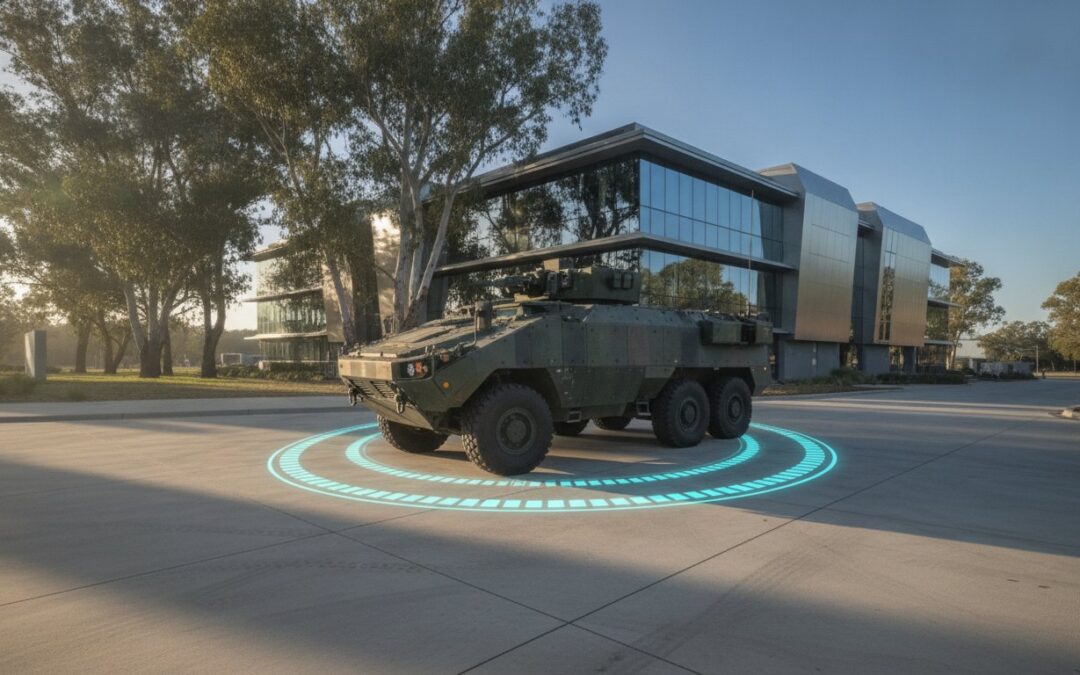
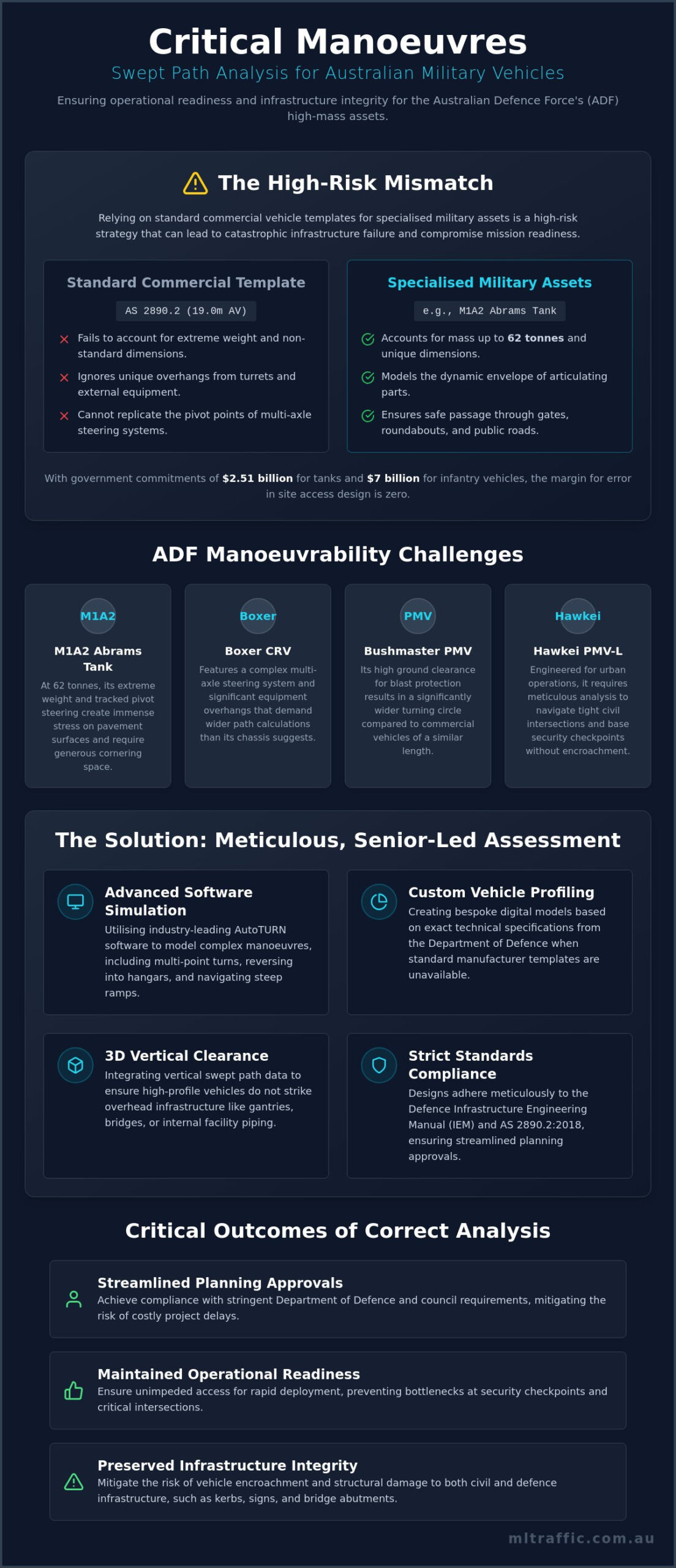
Relying on standard commercial vehicle templates to model the movements of a 62-tonne M1A2 Abrams tank or a Boxer Combat Reconnaissance Vehicle is a high-risk strategy that can lead to significant infrastructure failure. You recognise that defence-related developments demand a level of technical precision far beyond typical logistics planning. With the Australian Government recently committing 2.51 billion dollars to upgrade the tank fleet and 7 billion dollars for the Hanwha Redback infantry fighting vehicles, the margin for error in site access design has effectively vanished. Standard software libraries frequently lack the specific dimensions and articulating characteristics of these specialised assets, leaving engineers to grapple with stringent Department of Defence and council approval requirements.
This technical guide details how rigorous swept path analysis for military vehicles ensures these heavy assets navigate civil and defence infrastructure safely and within legal frameworks. You will learn how to achieve compliant site access designs that mitigate the risk of vehicle encroachment and structural damage. We provide a professional overview of integrating ADF-specific data into AutoTURN modelling, adhering to the Defence Infrastructure Engineering Manual (IEM) and AS 2890.2:2018 standards, and streamlining the planning approval process for complex defence projects through meticulous, senior-led assessment.
Key Takeaways
- Understand why specialised swept path analysis for military vehicles is critical for maintaining infrastructure integrity and ensuring the operational readiness of the Australian Defence Force.
- Identify the specific manoeuvrability challenges posed by ADF assets, including the wide turning circles of the Bushmaster PMV and the urban navigation requirements of the Hawkei.
- Recognise the limitations of standard AS 2890.2 templates and why additional safety buffers are mandatory for vehicles with significant equipment overhangs or turrets.
- Learn how to optimise site geometry for roundabouts and security checkpoints to prevent bottlenecks during heavy vehicle transit and special forces deployments.
- Discover how direct access to senior principals and 15 years of technical expertise can streamline planning approvals for complex defence-related developments.
What is Swept Path Analysis for Military and Special Forces Vehicles?
Swept path analysis (SPA) is the technical calculation of the horizontal and vertical space required by a vehicle as it performs a turn. For the Australian Defence Force (ADF), this isn’t a routine assessment of a standard delivery van. It involves high-mass, multi-axle assets with non-standard dimensions. Military SPA defines the dynamic envelope of vehicles like the 62-tonne M1A2 Abrams or the Boxer Combat Reconnaissance Vehicle. These assets present unique Technical Manoeuvrability Challenges that standard commercial software templates simply cannot replicate.
Precision in swept path analysis for military vehicles is the baseline for operational readiness. If a vehicle can’t clear a gatehouse or navigate a public roundabout during a convoy, the mission is compromised before it begins. Standard commercial templates, such as the 19.0m Articulated Vehicle (AV) defined in AS 2890.2, are dangerous proxies for military transporters. They fail to account for the extreme overhangs of turrets, external equipment racks, or the specific pivot points of multi-axle steering systems used in Special Forces assets.
To better understand the mechanics of vehicle tracking, watch this overview of the concept:
The Role of SPA in Defence Infrastructure
The primary objective of SPA in a defence context is the preservation of infrastructure and the facilitation of rapid deployment. Special Forces units require unimpeded access to and from base locations. Any bottleneck at a security checkpoint or a poorly designed intersection can delay critical response times. Beyond base gates, SPA calculates the clearance required for “abnormal loads,” including heavy recovery vehicles and tank transporters. These assessments are vital for mitigating risk to civil infrastructure, such as power poles, traffic signals, and bridge abutments, during transit on the public road network.
Software and Methodology: Beyond Standard Calculations
We utilise industry-leading AutoTURN software to simulate the complex movements of military assets. This includes multi-point turns, reversing manoeuvres into tight hangars, and navigating steep driveway ramps. When official manufacturer templates are unavailable, we perform custom vehicle profiling based on exact technical specifications provided by the Department of Defence. This methodology extends to 3D swept path analysis. We integrate vertical clearance data to ensure that high-profile vehicles don’t strike low-hanging infrastructure, such as overhead gantries or internal facility piping. This level of meticulous detail ensures that every site design is both compliant and functional for the ADF’s diverse fleet.
Technical Manoeuvrability Challenges of ADF and Special Forces Assets
The Australian Defence Force (ADF) operates a fleet where vehicle dimensions are dictated by protection levels and payload capacity rather than civil road compliance. Academic research into Military Vehicles Swept Path Analysis confirms that the physical footprint of these assets creates unique spatial requirements. Conducting a precise swept path analysis for military vehicles is the only way to guarantee that protection-focused designs don’t fail in civil environments. The Bushmaster Protected Mobility Vehicle (PMV), for instance, features high ground clearance for blast protection, yet this design results in a significantly wider turning radius than commercial vehicles of similar length. Conversely, the Hawkei PMV-L is engineered for Special Forces urban navigation, requiring tight tracking despite its wide armoured stance.
Logistics assets like the HX range of MAN trucks present different hurdles. These heavy vehicles often operate in confined loading docks or temporary field depots where standard clearances don’t apply. For the M1A2 Abrams, the challenge shifts to tracking width and the immense ground pressure exerted during neutral turns. Tracked assets don’t follow the same steering geometry as wheeled vehicles; they require a wider safety corridor to prevent damage to kerbs and pavement edges. Ensuring these movements are accurately modelled requires a Vehicle Swept Path Analysis that accounts for non-standard pivot points and the specific operational footprint of the asset.
Pivot Points and Articulation in Military Transport
Military trailer geometry differs substantially from standard Australian B-Double or semi-trailer configurations. Kingpin offsets and drawbar lengths are often customised for off-road capability, which directly affects how the trailer tracks behind the prime mover. Independent multi-wheel steering on certain heavy transporters can reduce the overall swept path width, but it introduces complex pivot variables that standard templates ignore. The “cut-in” effect for long-wheelbase military trucks occurs when the rear wheels follow a significantly tighter path than the front wheels during a turn, potentially striking inner-radius obstacles.
Special Forces Operational Requirements
Special Forces deployments demand infrastructure that supports high-speed ingress and egress. Site designs must allow for rapid movement without compromising vehicle safety or structural integrity. We simulate “worst-case” manoeuvre scenarios for emergency responses to ensure that security gate designs accommodate the physical footprint of armoured vehicles under duress. Balancing the need for tight security with the requirement for fluid vehicle movement is a core component of swept path analysis for military vehicles. Meticulous planning ensures that bollards, gatehouses, and barriers are positioned to allow for the necessary clearance while maintaining defensive postures.
Why Standard Australian Templates (AS 2890.2) Are Often Insufficient
Most civil site designs rely on the standard vehicle templates provided in AS 2890.2:2018. While these templates are sufficient for commercial logistics, they are inadequate for the specialised requirements of the Australian Defence Force. The 19.0m Articulated Vehicle (AV) is the common benchmark for industrial developments, yet it fails to represent the physical footprint of a heavy tank transporter or an armoured recovery vehicle. Using these commercial proxies creates a high risk of infrastructure damage. Precise swept path analysis for military vehicles must account for assets that exist well outside the parameters of the National Heavy Vehicle Regulator (NHVR) standard templates.
A primary failure point in standard designs is the “overhang” problem. Commercial trucks have predictable front and rear overhangs. Military assets often feature turrets, external equipment racks, and front-mounted recovery gear that extend far beyond the wheelbase. These components require significantly larger safety buffers during a turn. If an engineer uses a standard design vehicle proxy, they will likely underestimate the real-world swept path, leading to collisions with gatehouses, bollards, or parked assets. Accurate modelling requires custom vehicle profiles that reflect the true dynamic envelope of the specific ADF asset in use.
Dimensions: Military vs. Commercial Heavy Vehicles
- Width Discrepancies: Standard commercial vehicles are capped at 2.5 metres. An M1A2 Abrams or a Boxer CRV can exceed 3.5 metres in width, requiring wider lanes and larger turning pockets.
- Tail-swing: Armoured recovery vehicles often have massive rear overhangs that swing wide during tight manoeuvres, a factor not captured by standard logistics templates.
- Ground Clearance: Low-slung heavy transporters require a specific Driveway Ramp Grade Assessment to prevent grounding. Standard 1:20 or 1:8 ramp grades often prove too steep for loaded military trailers.
Compliance with Australian Standards
In defence projects, AS 2890.2 serves as a baseline for compliance, not a ceiling. While local councils may only require adherence to these national standards, the Defence Infrastructure Engineering Manual (IEM) mandates higher thresholds for operational readiness. Navigating the gap between these two sets of requirements is a core technical challenge. A qualified traffic engineer must certify non-standard vehicle access by providing detailed simulations that prove the site can accommodate the Defence Road Transport Exemption Framework (Version 8) allowances. This certification ensures that the design is both legally compliant and operationally functional for the life of the infrastructure.
Site Design for Military Base Access and Public Road Transit
Designing infrastructure for defence requires a shift in perspective from static dimensions to dynamic envelopes. While previous sections detailed vehicle characteristics, the physical layout of intersections and access points must facilitate these movements without fail. Effective swept path analysis for military vehicles identifies where public road geometry needs modification to support oversized transit. This is particularly critical for roundabouts and tight urban intersections where the “cut-in” effect can lead to total road blockage or infrastructure strikes. Our assessments ensure that the transition from a secure base to the public road network is seamless and safe.
Intersection and Roundabout Design
Calculating the correct curb return radii is essential to prevent tyre scrub and damage to kerbs or pavement edges. For heavy military convoys, we determine whether the site requires mountable aprons or full-width travel lanes. Mountable aprons allow occasional oversized loads to track over a reinforced section of the roundabout while maintaining standard lane widths for civil traffic. Our simulations also account for multi-lane turns. This ensures that convoys can move in formation without encroaching on adjacent lanes or creating safety hazards for civilian motorists during transit.
Gateways and Security Checkpoints
Security checkpoints often utilise “Z-gate” or “S-gate” configurations to prevent forced entry. These designs are effective for security but can become bottlenecks if they don’t account for the turning capabilities of a Bushmaster or a heavy logistics truck. We ensure that the queuing space before and after the checkpoint is sufficient for the total vehicle length. This prevents convoys from spilling out onto public roads and creating traffic hazards. Integrating SPA with driveway ramp grade assessments is a mandatory step in this process. It prevents low-slung transporters from grounding on the vertical transitions common at security barriers and weighbridges.
Sight distance is another critical factor in site design. Operators in armoured cabs often have significantly restricted visibility compared to commercial truck drivers. Our assessments ensure that the site layout provides clear lines of sight at all conflict points, reducing the risk of accidents during high-pressure Special Forces deployments. If your project requires technical certification for complex access designs, you should contact our senior principals to discuss your specific site requirements and ensure total compliance with Australian Standards.
Expert Swept Path Analysis for Defence and Government Infrastructure
Technical precision in swept path analysis for military vehicles is a prerequisite for the successful delivery of defence-related infrastructure. ML Traffic Engineers Australia brings over 15 years of specialised experience to this discipline, ensuring that complex site layouts accommodate the unique dynamic envelopes of ADF assets. We understand that a generic approach to vehicle tracking is insufficient for high-stakes government projects. Our methodology prioritises accuracy and compliance, providing a reliable foundation for civil and military engineering teams. We manage the full service lifecycle, moving from initial site assessments to detailed access certification for non-standard vehicle movements.
Direct involvement of senior principals is a core tenet of our professional practice. In the sensitive context of defence projects, accountability matters. We don’t delegate critical technical work to junior staff; the expert who initiates the client relationship is the one performing the analysis. This ensures that the specific requirements of the Defence Infrastructure Engineering Manual (IEM) and relevant Australian Standards are met with meticulous attention to detail. Our reports are designed to bridge the gap between local Council expectations and Federal Defence requirements, facilitating a smoother approval process for developers and contractors.
Why Choose ML Traffic Engineers Australia for Military SPA?
- Specialised Technical Knowledge: We maintain deep expertise in both AS 2890.2:2018 and the bespoke manoeuvrability requirements of armoured and logistics vehicles.
- Rigorous Planning Scrutiny: Our track record includes delivering technical reports that successfully withstand the most stringent assessments from road authorities and planning departments.
- Direct Professional Access: We operate with a “no-gatekeepers” approach. Clients have direct lines to our senior traffic consultants for immediate technical advice and project updates.
- Personnel Continuity: The same expert oversees your project from the initial briefing through to the final certification, ensuring consistency in technical data and communication.
The Path to Approval
Our Traffic Impact Assessments integrate swept path analysis for military vehicles to create a seamless Development Application (DA) process. We prepare documentation that communicates technical engineering data clearly to all stakeholders, including non-engineers in planning roles. This clarity reduces the likelihood of requests for further information (RFIs) and prevents project delays. Whether you are designing a new base access point or assessing public road transit routes, our team provides the qualified oversight necessary for compliance. Contact us today to discuss your national defence infrastructure project and secure a senior-led technical assessment.
Securing Operational Access for Future Defence Infrastructure
Ensuring that specialised assets can navigate the transition between secure bases and public road networks is a critical engineering requirement. Standard commercial templates often fail to account for the extreme width, overhangs, and specific articulation of modern ADF vehicles. Precise swept path analysis for military vehicles is the only method to guarantee that site designs accommodate these non-standard loads while maintaining full compliance with AS 2890.1 and AS 2890.2. By prioritising technical accuracy, you mitigate the risk of structural damage and operational bottlenecks during high-pressure deployments.
ML Traffic Engineers provides the rigorous oversight needed for complex defence projects. With over 15 years of specialised experience, we ensure that every technical report benefits from direct senior principal involvement. This hands-on approach guarantees that your site access designs are both functional and compliant with stringent Department of Defence standards. Consult our senior principals for expert military swept path analysis to discuss your project requirements. We look forward to helping you achieve streamlined approvals and robust infrastructure designs for your next development.
Frequently Asked Questions
Is swept path analysis mandatory for military developments in Australia?
Swept path analysis is mandatory for most military developments under the Defence Infrastructure Engineering Manual (IEM). This manual requires all infrastructure to comply with Australian Standards and the National Construction Code. Site access designs must be certified to ensure that specific ADF assets can enter and exit without compromising safety or structural integrity.
Can I use standard commercial vehicle templates for military vehicle tracking?
Standard commercial templates are usually insufficient for military vehicle tracking. Military assets often feature turrets, equipment racks, and non-standard wheelbases that exceed the dimensions of the 19.0m Articulated Vehicle (AV) template found in AS 2890.2. Accurate swept path analysis for military vehicles requires custom profiles to account for these specific equipment overhangs.
Which software is best for military swept path analysis?
AutoTURN is the industry-leading software for performing complex simulations. It allows engineers to model multi-point turns and reversing manoeuvres with high precision. When a specific military model isn’t available in the standard library, we use technical data from the Department of Defence to create a custom vehicle profile for the assessment.
What is the difference between a design vehicle and a check vehicle in military SPA?
A design vehicle is the primary asset that the infrastructure is intended to accommodate frequently, such as a Bushmaster PMV. A check vehicle is a larger or less frequent asset, like a heavy tank transporter, used to verify that the site can still be navigated under tighter tolerances or lower speeds without striking permanent fixtures.
How does swept path analysis affect the cost of road design?
SPA reduces the overall cost of road design by identifying potential conflict points before construction begins. By simulating vehicle movements during the planning phase, engineers can avoid expensive post-construction modifications. It also prevents long-term maintenance costs associated with tyre scrub and damage to kerbs, bollards, or gatehouses.
Do military vehicles require special consideration for driveway ramp grades?
Military vehicles require rigorous driveway ramp grade assessments due to their weight and unique ground clearance. Low-slung transporters carrying heavy loads are particularly susceptible to grounding on vertical transitions. We calculate specific approach and departure angles to ensure that these assets can navigate security barriers and weighbridges without bottoming out.
What happens if a military vehicle exceeds the swept path of a standard roundabout?
If a vehicle exceeds the swept path of a standard roundabout, it will likely strike kerbs, signs, or traffic signals. For swept path analysis for military vehicles, we often recommend mountable aprons. These reinforced areas allow oversized military assets to track over the centre of the roundabout while maintaining a standard layout for civilian traffic.
How do special forces vehicle requirements differ from general logistics vehicles?
Special forces vehicles, like the Hawkei, are designed for rapid urban navigation and require tighter turning circles than general logistics trucks. While logistics vehicles like the HX range of MAN trucks focus on high-mass transport and long-wheelbase stability, special forces assets prioritise speed and agility. This necessitates different clearance buffers and safety margins in the site design.

Disclaimer
The content on www.mltraffic.com.au, including all technical articles, guides, and resources, is provided for general informational and educational purposes only. It is not intended to constitute professional advice in traffic engineering, transportation planning, development approvals, or any other technical or legal field. While ML Traffic Engineers makes every reasonable effort to ensure the accuracy, completeness, and timeliness of the information published, we do not provide any warranties or representations (express or implied) regarding its reliability, suitability, or availability for any particular purpose. Any reliance you place on the content is strictly at your own risk. In no event shall ML Traffic Engineers, its directors, employees, authors, or affiliates be liable for any direct, indirect, incidental, special, consequential, or punitive damages (including, without limitation, loss of profits, data, or business opportunities) arising out of or in connection with the use of, or inability to use, any information provided on this website. The articles and guides on this site are not a substitute for engaging a qualified, registered professional traffic engineer (such as an NPER or RPEQ engineer) to assess your specific project requirements. For tailored advice, compliance assessments, or traffic engineering services, please contact a competent professional. This disclaimer may be updated from time to time without notice. By accessing or using this website, you agree to be bound by the most current version of this disclaimer.
