
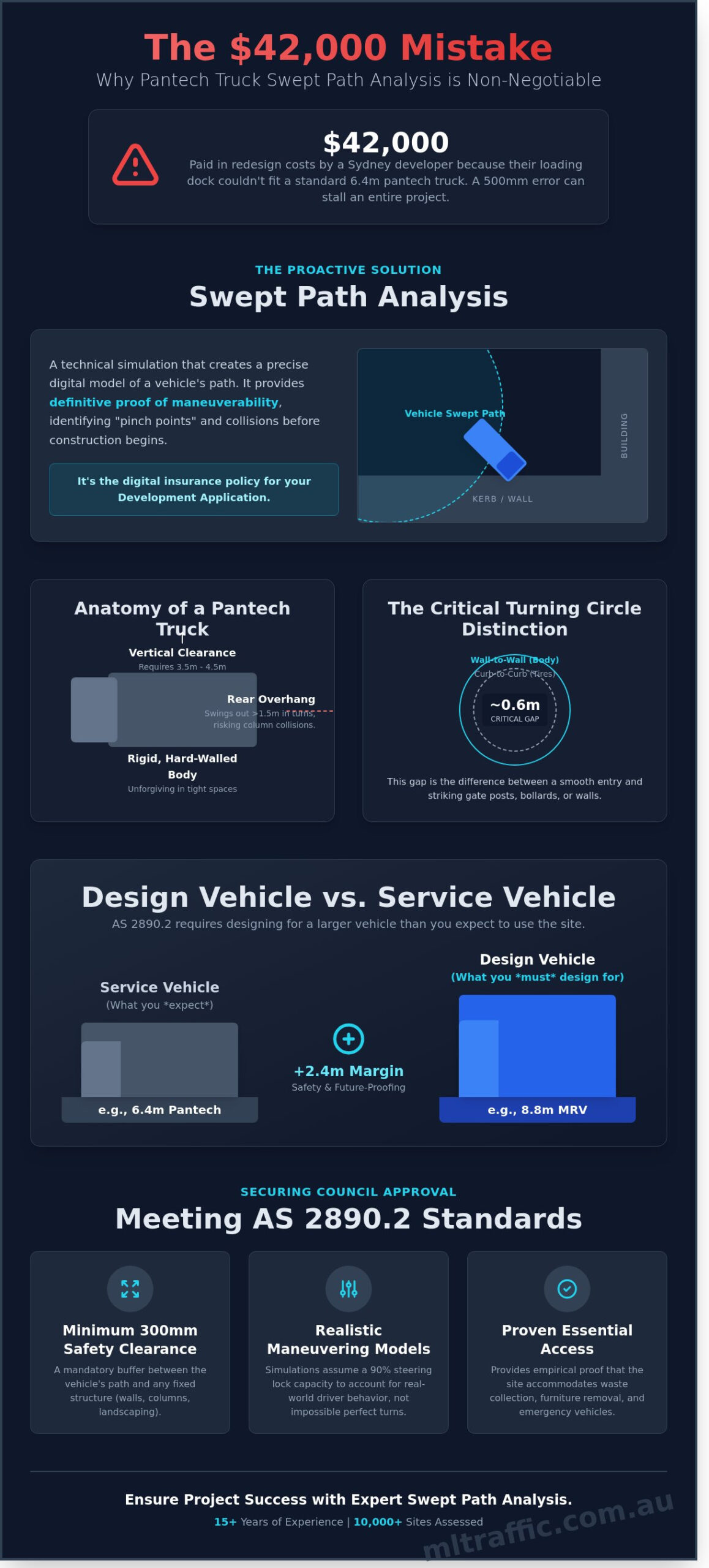
On March 12, 2024, a commercial developer in Sydney faced a $42,000 redesign cost because their loading dock could not accommodate a standard 6.4-meter pantech truck. It’s a common scenario where minor oversights in vehicle classification lead to major DA rejections. You likely recognize that navigating the technicalities of AS 2890.2 is a high-stakes task where even a 500mm error in a turning circle can stall an entire project. Confusion between Small Rigid Vehicle (SRV) and Medium Rigid Vehicle (MRV) classifications often results in functional failures that are impossible to fix once construction begins.
This guide explains how a specialized swept path analysis for pantech truck access eliminates these risks by providing definitive proof of vehicle maneuverability. You’ll learn how to secure council approval with professional diagrams and ensure your loading dock remains fully operational for its intended use. We’ll examine the specific requirements for pantech dimensions, the importance of AS 2890.2 compliance, and how our hands-on engineering approach delivers the results your development needs to move forward without delay.
Key Takeaways
- Understand why the pantech truck is the essential design vehicle for medium-density developments and how it impacts site accessibility.
- Learn the technical distinction between curb-to-curb and wall-to-wall turning circles to ensure driveway crossovers are correctly dimensioned.
- Identify critical conflict points with awnings or pillars by conducting a professional swept path analysis for pantech truck to prevent costly design errors.
- Ensure your development meets the specific requirements of Australian Standard AS 2890.2 for off-street commercial vehicle facilities.
- Benefit from direct access to senior engineers with over 15 years of experience across 10,000+ sites to secure rapid council approval.
What is Swept Path Analysis for Pantech Trucks?
Swept path analysis for pantech truck is a technical simulation used to determine the exact envelope of space a vehicle occupies while maneuvering through a site. In dense urban environments, this assessment ensures that a Medium Rigid Vehicle (MRV) can navigate access ways without colliding with permanent infrastructure. Since 2005, ML Traffic Engineers has utilized these simulations to validate site layouts for private developers and architects. The mathematical process relies on calculating the Pantech Truck Turning Circle based on specific wheelbase dimensions and maximum steering lock angles.
To better understand how these simulations function in a professional engineering environment, watch this technical overview:
We use AutoTURN software to generate these simulations with high precision. This tool allows our engineers to overlay vehicle movements onto your architectural site plans. It functions as a digital insurance policy for your development application. By identifying “pinch points” during the design phase, you avoid the risk of a rejected application or the high cost of post-construction site remediation. We ensure the 8.8m design vehicle fits the first time.
The Unique Profile of a Pantech Truck
Pantech trucks feature a rigid, hard-walled box body. Unlike curtain-siders that offer slight flexibility, the pantech is entirely unforgiving in tight spaces. The rear overhang is a critical technical factor. During a sharp turn on a basement ramp, the rear of the box can swing out by more than 1.5 meters, potentially striking structural columns. Vertical clearance is the other essential component. A standard pantech often requires a minimum of 3.5 to 4.5 meters of height. We assess these dimensions against Australian Standard AS 2890.2 to guarantee operational compliance.
Why Councils Demand This Analysis
Local councils require empirical proof that your development can accommodate essential services. This includes waste collection, emergency vehicle access, and furniture removal for residential tenants. Our analysis proves that a pantech truck won’t mount kerbs or destroy landscaping during a standard three-point turn. Most councils mandate a minimum 300mm safety clearance between the vehicle swept path and any fixed structure. Providing this technical proof is a core part of our traffic engineering services. It demonstrates that the proposed land use is physically viable and safe for all road users.
Calculating the Pantech Truck Turning Circle
A pantech truck’s turning circle is not a single, fixed measurement. Traffic engineers distinguish between curb-to-curb and wall-to-wall dimensions. Curb-to-curb measures the path of the outer tires. Wall-to-wall accounts for the body overhang. For a standard 8.8m Medium Rigid Vehicle (MRV), the wall-to-wall radius is typically 0.6 meters larger than the curb-to-curb radius. This distinction is vital. It dictates the exact width of your driveway crossovers and ensures the truck body doesn’t strike gate posts, bollards, or signage during a turn.
Several factors expand the swept path beyond the theoretical minimum. Speed, steering lock, and driver skill play significant roles. A truck moving at 10km/h requires more clearance than one moving at 2km/h. We assume a 90% steering lock capacity in our models. This provides a safety buffer for drivers who don’t reach the absolute mechanical limit of the vehicle’s steering in a single motion. Professional traffic engineering services ensure these variables are calculated to meet strict council requirements.
The “design vehicle” must always be slightly larger than the expected “service vehicle.” If a 6.4m pantech truck is the expected service vehicle for a site, AS 2890.2 often requires the use of an 8.8m MRV as the design vehicle. This 2.4-meter difference provides the necessary margin for error. It also future-proofs the site for slightly larger delivery vehicles that may enter the property over its lifespan.
SRV vs. MRV: Choosing the Right Design Vehicle
Selecting the correct vehicle template is essential for a successful Development Application (DA). A Small Rigid Vehicle (SRV) template, measuring 6.4 meters, is suitable for residential apartment move-ins. Commercial loading docks and industrial warehouses require the 8.8-meter Medium Rigid Vehicle (MRV) template. Choosing an SRV when the council expects an MRV results in immediate DA refusal. It demonstrates that the site cannot safely accommodate standard commercial deliveries.
Software Precision vs. Manual Templates
Old-fashioned plastic turning templates are no longer accepted by most Australian councils. They’re static and don’t account for complex, multi-point maneuvers. We use AutoTURN software for every swept path analysis for pantech truck assessment. This software simulates the exact wheel-base and body dimensions. It tracks how the rear wheels “off-track” during a turn with millimeter precision. Steering lock is the maximum angle the front wheels can turn. Digital precision ensures the swept path analysis for pantech truck reflects real-world constraints accurately and avoids costly onsite revisions.
Conducting a Professional Truck Access Assessment
A vehicle access assessment for Australian developments follows a rigid technical protocol to ensure compliance with AS 2890.2. We begin by identifying the specific design vehicle, often a Small Rigid Vehicle (SRV) or Medium Rigid Vehicle (MRV) pantech. Engineers use CAD-based software to perform a swept path analysis for pantech truck movements, mapping the vehicle’s footprint against site boundaries. This process isn’t just about the tyres. It accounts for the body overhang and the high-sided “box” that characterizes these trucks.
Identifying conflict points is a critical step in the assessment. Unlike flatbed trucks, a pantech box often exceeds the width of the cabin, making it prone to clipping structural pillars or low-hanging awnings. We evaluate the “in-and-out” maneuver to confirm the driver can enter and leave the site in a forward direction. This is a mandatory requirement for approximately 95% of Australian local councils to maintain road safety and prevent dangerous reversing onto public thoroughfares. Every simulation incorporates a 300mm clearance margin. This buffer is essential to account for driver error and operational variances on-site.
Loading Dock and Service Area Design
Efficient service areas require the pantech to dock squarely at a 90-degree angle. If the truck blocks internal traffic flow during its maneuver, the design fails local planning codes. We analyze the reversing arc into tight bays to ensure the front steer wheels remain within designated drive aisles. For a deeper look at these technical requirements, refer to our guide on Swept Path Analysis for general principles and compliance standards.
Common Mistakes in Pantech Access Design
Many developers overlook the “kick-out” effect. When a pantech makes a sharp turn, the rear section of the box swings in the opposite direction. This often leads to the truck striking adjacent parked cars or perimeter walls. Other common errors include:
- Failing to calculate ramp grades accurately, which leads to the pantech “grounding out” at the apex or catching the rear bumper on the transition.
- Assuming a 6.4m pantech maneuvers with the same agility as a standard 5.2m passenger van.
- Ignoring vertical clearance for the box height, which typically requires a minimum of 3.5m to 4.5m of unobstructed space.
Our engineers verify these variables during the initial swept path analysis for pantech truck assessment. This prevents costly structural modifications after construction begins. We ensure the design accommodates the 12.5m turning circle radius typical of medium rigid pantechs, providing a reliable path for delivery operations.
Meeting Australian Standards (AS 2890.2) for Pantech Access
AS 2890.2 serves as the primary regulatory framework for commercial vehicle facilities across Australia. It establishes the minimum dimensions for loading bays, service areas, and maneuvering space. For pantech trucks, which often fall under the Small Rigid Vehicle (SRV) or Medium Rigid Vehicle (MRV) categories, compliance isn’t optional. Council planners use these standards to evaluate if a site can safely handle delivery operations without obstructing public roads or creating safety hazards. Failure to meet these benchmarks usually results in a refused Development Application (DA) or costly redesigns late in the process.
Proving a functional layout to the council requires more than basic sketches. It demands certified engineering diagrams that show exactly how a vehicle moves through the site. By performing a swept path analysis for pantech truck movements, we demonstrate that the proposed driveway widths, turn radii, and loading dock clearances align with AS 2890.2 requirements. This technical proof is the baseline for avoiding Request for Information (RFI) delays. When a council officer sees a report backed by Australian Standards, it removes the guesswork from their assessment.
Interpreting AS 2890.2 for Small Developments
Mixed-use residential and retail sites present unique challenges because space is usually at a premium. AS 2890.2 dictates the number of pantech bays required based on the total floor area and specific land use. For instance, a retail space of 1,500 square meters has different loading requirements than a small industrial unit. Navigating these rules for tight urban sites is a core part of our consultancy. You can find more detail on how these rules apply to various projects in our Traffic Engineering guide for Australian developments.
Documentation Required for Council Approval
A compliant swept path report must be precise and data-heavy. It isn’t just a simple drawing; it’s a technical simulation based on specific vehicle geometry. Every swept path analysis for pantech truck we produce includes:
- Detailed diagrams at a standard scale, typically 1:200 or 1:250.
- Clear identification of the design vehicle, including wheelbase and width.
- Wait-point and passing-point locations for two-way traffic.
- Calculated clearances of at least 300mm from all vertical obstructions.
The Traffic Impact Assessment (TIA) plays a vital role here. It provides the context for the swept paths by detailing delivery frequencies and peak operating hours. A certified report is the only way to satisfy a skeptical council officer who needs documented proof of vehicle safety. Our team has completed over 10,000 site assessments, ensuring that every diagram meets the rigorous expectations of local government authorities.
Don’t risk your project timeline with non-compliant designs. Contact ML Traffic Engineers today for a certified swept path assessment that meets all AS 2890.2 requirements.
Why Choose ML Traffic for Your Pantech Swept Path
Choosing a consultant for your swept path analysis for pantech truck shouldn’t involve navigating a maze of account managers or junior staff. At ML Traffic Engineers, we operate a strict “no-gatekeeper” policy. The traffic consultant who provides your quote is the same senior engineer who performs the technical work. This direct line of accountability ensures that specific project requirements aren’t lost in translation. You’ll have direct access to our principals, Michael Lee or Benny Chen, who each possess between 30 and 40 years of industry experience.
We’ve been trading since 2005 and have successfully completed assessments for over 10,000 sites across Australia. This volume of work represents a deep repository of technical data and council-specific knowledge. Senior involvement at the start of your project prevents expensive redesigns during the construction phase. If a Pantech truck can’t safely navigate your proposed loading dock, we identify the conflict early. We provide practical solutions that satisfy both Council’s DA requirements and your operational needs.
Expertise Across All Land-Use Types
Our team manages projects across every conceivable development category. We’ve delivered traffic solutions for a diverse range of sites, including:
- Boutique apartments and high-density residential towers
- Large-scale warehouses and distribution centers
- Childcare centers and educational facilities
- Medical clinics and regional hospitals
- Service stations and retail fast-food outlets
- Industrial subdivisions and commercial business parks
Our engineers maintain a comprehensive understanding of national council requirements and Australian Standards, specifically AS 2890.1. This broad exposure allows us to anticipate potential access issues before they become roadblocks. You can learn more about our team and experience to see how our history of 10,000+ sites benefits your specific project.
Get a Quote for Your Analysis Today
We prioritize fast turnaround times because we know DA submission deadlines are fixed. Our pricing is transparent, and we don’t hide costs behind complex contracts. To begin your swept path analysis for pantech truck, simply provide your site plans in PDF or CAD format. We’ll conduct a rapid assessment to determine the scope and provide a clear, professional quote based on the complexity of the vehicle movements required.
Don’t risk your development approval with inexperienced consultants who lack a track record. You can contact us directly to discuss your project requirements and secure a technical assessment that meets all regulatory standards. We focus on providing the results you need to move your project forward without delay.
Secure Your Site Access Compliance Today
Navigating the technical requirements of AS 2890.2 is essential for any development involving medium rigid vehicles. A professional swept path analysis for pantech truck ensures your site layout accommodates vehicle movements without risking property damage or council rejection. ML Traffic brings over 15 years of specialist traffic engineering experience to every project. Since 2005, we’ve assessed over 10,000 sites across Australia, ensuring 100% compliance with AS 2890.1 and AS 2890.2 standards.
Senior engineers Michael Lee and Benny Chen handle every project personally. We don’t pass your work to junior staff; the traffic consultant who provides the quote, does the work. This hands-on approach guarantees accuracy in calculating turning circles and driveway grades. Our meticulous assessments provide the technical certainty needed for successful development applications. Don’t leave your access compliance to chance when expert verification is available from industry leaders who understand the bureaucracy inside and out.
Get a compliant Swept Path Analysis for your Pantech Truck from ML Traffic today
We’re ready to help you achieve a seamless approval process for your next project.
Frequently Asked Questions
What exactly is a pantech truck in a swept path analysis?
A pantech truck is a rigid vehicle featuring a large, box-shaped cargo area designed for moving freight or furniture. In a swept path analysis for pantech truck, we model the vehicle based on Small Rigid Vehicle (SRV) specifications from AS 2890.2. This includes a total length of 6.4 metres and a width of 2.33 metres. Our analysis ensures these dimensions clear all site obstacles during tight turns.
Does my small development really need a swept path for a pantech truck?
Yes, most local councils require a swept path analysis for pantech truck to prove that delivery and waste vehicles can maneuver safely. We’ve assessed over 10,000 sites where even small 3-unit developments needed to demonstrate forward-entry and forward-exit capabilities. Failing to provide this technical proof often results in a Request for Further Information (RFI) that delays your project by 4 to 6 weeks.
Can I use a standard van template instead of a pantech truck?
No, using a standard B99 van template is insufficient because it doesn’t account for the 2.33-metre width and the significant rear overhang of a pantech. A pantech truck requires a 15.4-metre turning circle, which is 35% larger than a standard passenger van. Using the wrong template leads to a 100% rejection rate during the council’s technical review phase. We use the correct SRV templates to ensure your design is compliant.
What is the standard turning circle for a 6-tonne pantech truck?
A standard 6-tonne pantech truck has a wall-to-wall turning circle of 15.4 metres and a kerb-to-kerb radius of 7.1 metres. These figures are the industry standard used for Small Rigid Vehicles (SRV) in Australia. Our engineers apply these specific metrics to your site plan to verify that the vehicle clears all structural columns and kerbs. We maintain a minimum 300mm safety buffer in all our digital simulations.
How much does a swept path analysis for a pantech truck cost?
A professional swept path assessment for a single vehicle type typically starts at $600 plus GST. This price includes the technical modeling and a formal report for your Development Application. If your project requires multiple vehicle types or complex multi-point turns, the cost may increase to $1,200. The traffic consultant who provides your quote is the same senior expert who performs the work, ensuring no hidden fees.
What happens if the pantech truck doesn’t fit in my current design?
We provide specific geometric recommendations to fix the design if the vehicle fails the initial swept path test. This often involves widening a driveway by 400mm or increasing a corner radius to 5 metres. In 95% of cases, we identify minor adjustments that achieve compliance without sacrificing significant floor space. Our goal is to find a technical solution that satisfies both your architect and the council’s requirements.
Is a swept path analysis mandatory for all Australian DAs?
Swept path assessments are mandatory for approximately 85% of commercial and multi-residential Development Applications in Australia. Councils use these reports to verify that heavy vehicles won’t block public roads or damage private property. If your site includes a basement, a loading dock, or a narrow driveway, the planning authority will require a certified report. We ensure every report complies with AS 2890.1 and AS 2890.2 standards.
How long does it take to get a swept path report?
We deliver completed swept path reports within 3 to 5 business days from the moment we receive your site plans in CAD format. If you’re facing a strict council deadline, we offer a 48-hour priority service for an additional fee. Our principals, Michael Lee and Benny Chen, oversee every project to ensure the data is accurate. You’ll receive a professional PDF document that’s ready for immediate submission to the authorities.
Disclaimer
The content on www.mltraffic.com.au, including all technical articles, guides, and resources, is provided for general informational and educational purposes only. It is not intended to constitute professional advice in traffic engineering, transportation planning, development approvals, or any other technical or legal field.
While ML Traffic Engineers makes every reasonable effort to ensure the accuracy, completeness, and timeliness of the information published, we do not provide any warranties or representations (express or implied) regarding its reliability, suitability, or availability for any particular purpose. Any reliance you place on the content is strictly at your own risk.
In no event shall ML Traffic Engineers, its directors, employees, authors, or affiliates be liable for any direct, indirect, incidental, special, consequential, or punitive damages (including, without limitation, loss of profits, data, or business opportunities) arising out of or in connection with the use of, or inability to use, any information provided on this website.
The articles and guides on this site are not a substitute for engaging a qualified, registered professional traffic engineer (such as an NPER or RPEQ engineer) to assess your specific project requirements. For tailored advice, compliance assessments, or traffic engineering services, please contact a competent professional.
This disclaimer may be updated from time to time without notice. By accessing or using this website, you agree to be bound by the most current version of this disclaimer.
