
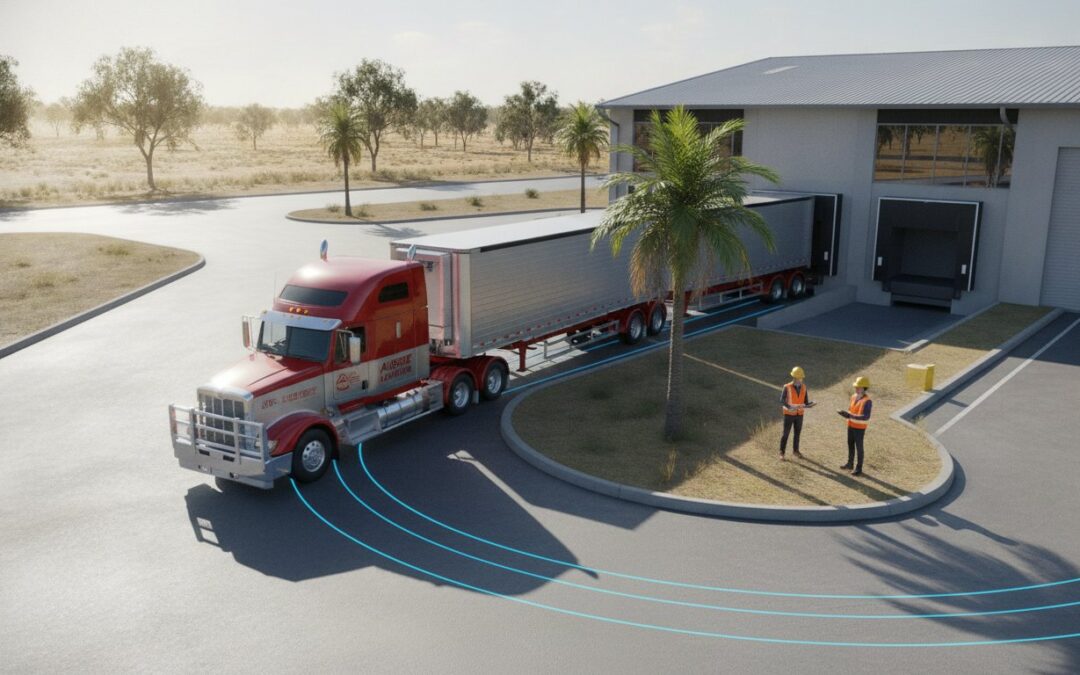
A single centimetre of miscalculated off-tracking in a Type 2 road train is often the difference between a seamless delivery and a structural collision that halts your entire industrial operation. You’ve likely felt the frustration of site layouts that look functional on paper but fail to meet the rigorous demands of multi-trailer physics or the inconsistent requirements of local Councils. Securing a quick DA approval requires more than just a rough sketch; it demands a precise swept path analysis for road train access that accounts for every pivot point and swept width.
We understand that navigating the technicalities of AS 2890.2:2018 and the latest Austroads Edition 4.0 guidelines can feel like a bureaucratic minefield. This guide simplifies those complexities, showing you how to master the technical requirements for road train manoeuvrability so your industrial development secures approval without costly redesigns. We’ll preview the essential role of AutoTURN simulations, the impact of the August 2026 Performance Based Standards (PBS) updates, and how to create a compliant layout that maximises your usable space while ensuring a safe environment for heavy vehicle drivers.
Key Takeaways
- Understand how multiple articulation points increase low-speed off-tracking, requiring specialised modelling to prevent structural damage and operational bottlenecks.
- Identify the regulatory differences between prescriptive vehicle access and the Performance Based Standards (PBS) scheme managed by the National Heavy Vehicle Regulator (NHVR).
- Learn how professional swept path analysis for road train access ensures your site layout complies with AS 2890.2:2018 and Austroads guidelines to avoid Council DA delays.
- Optimise industrial site efficiency by designing driveway radii and loading docks that specifically accommodate road train decoupling and heavy vehicle manoeuvring.
- Utilise senior principal expertise and AutoTURN simulations to maximise your usable development area while meeting all national safety and compliance standards.
What is Swept Path Analysis for Road Train Access?
Swept path analysis is a technical simulation that models the precise movement and space requirements of a vehicle as it performs a specific manoeuvre. When applied to industrial developments, swept path analysis for road train access provides a digital blueprint of how these heavy vehicles enter, exit, and circulate within a site. Unlike standard passenger cars, road trains possess multiple articulation points and extreme lengths. These factors create a complex “swept path” envelope that is significantly wider than the vehicle’s physical width.
A critical distinction in this technical field is the difference between the wheel path and the swept path. The wheel path tracks the trajectory of the tyres, while the swept path accounts for the entire body of the vehicle, including front and rear overhangs. For heavy vehicle infrastructure, relying solely on wheel paths is a recipe for disaster. This analysis is now a mandatory component of a Traffic Impact Assessment (TIA) for most industrial DAs. It provides Council with the evidence that a site can operate safely without impacting public infrastructure or neighbouring properties. Our Vehicle Swept Path Analysis services utilise AutoTURN software to ensure every simulation meets these rigorous regulatory expectations.
Understanding Road Train Configurations in Australia
The Australian logistics industry utilises several high-productivity vehicle combinations. A Road train generally falls into two primary categories for site access assessments. Type 1 (Double) road trains typically reach lengths of 36.5 metres, while Type 2 (Triple) road trains can extend up to 53.5 metres. Modern fleets also frequently include A-doubles and B-triples. These vehicles require specific modelling because their low-speed off-tracking characteristics vary wildly based on hitch types and trailer lengths. We use vehicle dimensions from the Austroads AP-G34 guidelines, as these are the gold standard for Australian compliance. These dimensions ensure that our models reflect the actual heavy vehicle fleet currently operating on Australian roads.
Why ‘Eyeballing’ It Leads to Project Failure
Relying on generic turning circle diagrams or “eyeballing” a site layout is a high-risk strategy that often leads to project failure. Minor design errors in driveway radii or gate widths result in kerb strikes, damaged fencing, and structural impacts to buildings. These mistakes are expensive to rectify once construction has commenced. Beyond physical damage, there are significant legal and safety implications. If a site cannot safely accommodate the heavy vehicles it was designed for, the developer may face Council enforcement actions or liability claims following an operational accident. Professional swept path analysis for road train access eliminates this guesswork. It provides a meticulous, data-driven foundation for your site design, ensuring that your industrial facility is both safe and compliant from day one.
The Physics of Off-Tracking: Why Road Trains Require Specialist Analysis
Low-speed off-tracking is the primary physical constraint in heavy vehicle site design. It occurs because the rear wheels of a trailer follow a path closer to the centre of the turn than the wheels of the prime mover. As vehicle length increases, this discrepancy grows significantly. For a Type 2 road train, the rear trailer might track several metres inside the prime mover’s arc. This is why swept path analysis for road train access is a technical necessity rather than a luxury. It ensures that the designed infrastructure can accommodate the actual physical footprint of the vehicle.
The type of trailer hitch used also dictates the size of the swept path envelope. B-doubles use a fifth-wheel coupling, which offers a more stable and predictable path. In contrast, road trains often utilise converter dollies that add extra articulation points. These additional pivots increase the complexity of the movement. Calculating the “swept width”, which is the total lateral space the vehicle occupies during a turn, requires precise data on axle spacing and hitch offsets. Accurate swept path analysis for road train access must account for these dynamics to prevent the simulation from underestimating the required space.
Low-Speed vs. High-Speed Off-Tracking
Low-speed manoeuvres are the critical focus for industrial site access. At low speeds, the rear of the vehicle “cuts in” toward the turn centre. High-speed off-tracking, which involves the rear trailers swinging outward due to centrifugal force, is generally a concern for highway engineering rather than site circulation. Managing the cut-in effect at entry and exit gates is vital. If the driveway is too narrow or the radius is too tight, the rear trailers will strike kerbs or gate posts. If you’re concerned about your current site layout, you can contact our senior principals for a direct technical assessment.
Articulated Vehicle Constraints
Road trains present significantly more challenges than standard B-doubles. Each additional trailer compounds the off-tracking effect. While a B-double has two articulation points, a triple road train can have up to five. This creates a much larger and more complex footprint during turns. The swept path envelope is the total footprint occupied by the vehicle body as it moves through a specific manoeuvre. Engineers must also consider steering lock angles. If a driver is forced to use a maximum steering lock to make a turn, the off-tracking is maximised, increasing the risk of a collision.
Performance-Based Standards (PBS) vs. Prescriptive Access
Road trains in Australia operate under two distinct regulatory frameworks. Prescriptive access relies on fixed dimensional limits, such as the standard 36.5-metre Type 1 road train. If a vehicle fits these predefined envelopes, it follows established road access maps. However, the industry is rapidly shifting toward the Performance-Based Standards (PBS) scheme managed by the National Heavy Vehicle Regulator (NHVR). This scheme focuses on how a vehicle performs on the road rather than just its physical size. Significant updates to the PBS Scheme will come into effect on 1 August 2026, following the implementation of the Heavy Vehicle National Law Amendment Bill 2025. These changes are designed to increase flexibility and reduce barriers for high-productivity vehicles.
A professional swept path analysis for road train access is the primary tool used to prove a PBS vehicle can operate safely on the existing road network. While prescriptive rules are “off-the-shelf,” PBS allows for innovative designs that match the vehicle to the specific freight task. This approach improves productivity and sustainability by allowing larger loads per trip. The analysis acts as technical proof for Councils and the NHVR that a custom rig will not strike infrastructure or encroach on opposing traffic lanes. By using this data-driven method, you can secure site-specific access approvals that would be impossible under traditional prescriptive limits.
The Role of AutoTURN in PBS Assessments
We use AutoTURN software to simulate non-standard vehicle configurations that don’t exist in standard Austroads libraries. This is essential for custom logistics needs where trailer lengths, axle spacings, or hitch positions are unique. High-fidelity simulations allow us to prove safety outcomes to local Councils for larger-than-standard road trains. It provides a visual and mathematical guarantee that the vehicle will remain within its designated path. Our senior principals use these specialised tools to verify that your proposed fleet can manoeuvre through your site without operational failures. This precision is what distinguishes a successful DA from one that faces constant Council requisitions.
Site-Specific Access Requirements
Addressing “last mile” challenges in industrial estates is often the most difficult part of securing a heavy vehicle permit. We analyse route-specific constraints, such as tight intersections and narrow entry points, that lead directly to your facility. Our assessments ensure your site design maintains strict compliance with AS 2890.2 for commercial vehicle facilities. By conducting a meticulous swept path analysis for road train access, you can identify and rectify bottlenecks before they become permanent construction errors. This proactive analysis ensures that your site is ready for the specific road train permits required for your operations.
Practical Applications: Designing for Road Train Manoeuvrability
Translating technical simulations into a functional site layout requires a meticulous approach to spatial allocation. Industrial developments must provide enough room for heavy vehicles without sacrificing valuable storage or operational areas. A precise swept path analysis for road train access identifies the exact spatial requirements for every turn, allowing designers to optimise the site footprint. This analysis is particularly vital when integrating heavy vehicle movements with standard Car Park Design, as it prevents dangerous conflict points between passenger vehicles and multi-combination rigs.
Clearance is another critical factor often overlooked in preliminary sketches. Designers must ensure adequate vertical and lateral clearance for overhanging structures, signage, and lighting and power poles. Road trains have significant body swing, meaning the “envelope” of the vehicle extends well beyond the wheel tracks. Our senior principals perform detailed technical assessments to ensure these clearances meet national safety standards, preventing expensive property damage and operational downtime.
Gate and Driveway Design
Gate placement is a common point of failure in industrial site planning. A Type 2 road train requires a significant “throat length” at the entry point to ensure the entire 53.5-metre combination can pull off the public road completely before stopping at a security gate. Failure to account for this leads to trailers protruding into traffic lanes, creating a major safety hazard. Driveway radii must be designed for the specific off-tracking characteristics of the intended vehicle fleet. We also assess whether the site should operate with a one-way flow or if two-way heavy vehicle traffic is manageable within the available sight distances at the property boundary.
Loading Docks and Hardstands
The hardstand area must accommodate the “apron” space required for road trains to reverse into loading docks. Reversing a multi-articulated vehicle is a high-skill manoeuvre that requires substantial lateral room. Site layouts should be organised to minimise complex reversing wherever possible. Many modern logistics hubs now include dedicated areas for trailer storage and decoupling. This allows a road train to break down into smaller combinations if the final loading point cannot accommodate a full-length triple. Proving these areas are functional requires a detailed swept path analysis for road train access during the design phase.
Council DA Requirements and Compliance
Council planners scrutinise swept path reports to ensure a development will not negatively impact the surrounding road network. A common reason for a Request for Further Information (RFI) is a report that fails to show the “worst-case scenario” vehicle or uses incorrect steering lock assumptions. We integrate our high-fidelity diagrams into a comprehensive Traffic Impact Assessment to provide a robust argument for approval. This documentation proves to the Council that your site is safe, compliant, and operationally viable. To ensure your site layout meets these rigorous standards, view our full range of traffic engineering services and secure expert support for your next project.
Why Choose ML Traffic Engineers for Road Train Analysis?
Selecting a consultant for a swept path analysis for road train access is a decision that directly impacts your project’s timeline and budget. At ML Traffic Engineers Australia, we operate on a model of accountability and technical excellence. Unlike larger, impersonal firms where work is often delegated to junior staff, our senior principals are directly involved in every technical assessment. This “no-gatekeepers” approach ensures you have a direct line to the expert performing the work. We provide specific names, professional qualifications, and direct contact lines to ensure transparency and personnel continuity throughout the life of your project.
With over 15 years of experience in traffic engineering, we understand the specific nuances of Australian Council requirements. We’ve successfully navigated thousands of projects across diverse environments, from regional freight hubs to complex urban industrial estates. This extensive project volume serves as proof of our capability. We understand that delays in Council approval are costly. Therefore, we focus on rapid turnaround times for swept path reports to keep your development application on track without compromising on technical accuracy.
Our Technical Expertise
- Advanced proficiency in AutoTURN for complex road train simulations.
- Meticulous attention to Australian Standards and Austroads guidelines.
- Experience across diverse industrial and commercial project types.
Our team maintains high-level technical competency in AutoTURN, the industry-standard software for complex vehicle tracking. We meticulously apply the latest Australian Standards, including AS 2890.2:2018, to every model. This technical rigour is essential for simulating the movement of Type 1 and Type 2 road trains accurately. Our experience spans a vast range of practical environments, allowing us to anticipate site-specific challenges before they lead to design failures. We promise that the same expert who initiates your relationship will be the one performing the technical analysis.
Securing Your DA Approval
A successful development application requires reports that address Council concerns before they escalate into formal objections. ML Traffic Engineers Australia provides professional representation for complex transport planning matters, ensuring your site’s access strategy is defended with data-driven evidence. Our reports are designed to be scannable and information-dense, providing Council planners with the precise metrics they need for a quick assessment. This results-oriented approach minimises the risk of RFIs and prevents costly redesigns late in the planning phase. You can contact our Senior Principals directly to discuss your project requirements and secure a compliant swept path analysis for road train access.
Securing Your Industrial Site’s Operational Future
Managing the extreme off-tracking physics of multi-combination vehicles is a technical necessity for any modern industrial development. A precise site layout doesn’t just prevent structural damage; it ensures your facility remains productive and safe for heavy vehicle operators. By aligning your design with the latest AS 2890.2:2018 standards and the upcoming 2026 PBS Scheme updates, you eliminate the guesswork that leads to costly Council delays. Expert swept path analysis for road train access provides the mathematical certainty required to secure your DA approval on the first attempt.
At ML Traffic Engineers Australia, we prioritise technical accuracy and senior principal accountability above all else. With over 15 years of experience in the Australian market, we provide the specialised AutoTURN modelling necessary to validate even the most complex multi-trailer combinations. You won’t deal with junior intermediaries; our senior staff perform the technical work from inception to completion. Contact ML Traffic Engineers Australia for a Compliant Swept Path Report to ensure your site is operationally sound. We look forward to securing your project’s success through meticulous engineering and regulatory compliance.
Frequently Asked Questions
What is the difference between a wheel path and a swept path?
The wheel path tracks the specific trajectory of the vehicle’s tyres on the road surface, while the swept path encompasses the total area covered by the entire vehicle body, including front and rear overhangs. For road trains, the swept path is significantly wider than the wheel path due to body swing and off-tracking during turns. Designing based on wheel paths alone will likely result in structural collisions and operational failures during heavy vehicle manoeuvres.
Do I need a swept path analysis for a B-double if my site is on a road train route?
You must perform an analysis for the largest vehicle combination expected to access your site, regardless of the road’s general classification. If your development is situated on a road train route and you intend to allow these vehicles to enter, a B-double analysis is technically insufficient. A specific swept path analysis for road train access ensures your site can safely accommodate the 36.5-metre or 53.5-metre combinations typical of these routes.
What software is used for road train swept path analysis in Australia?
AutoTURN is the industry-standard software used by Australian traffic engineers to conduct vehicle tracking simulations. It allows for the precise modelling of multi-articulated vehicles against national design standards and Austroads guidelines. Our senior principals use this high-fidelity software to verify that complex combinations, such as A-doubles and B-triples, can navigate your industrial site without encroaching on restricted areas or striking fixed infrastructure.
Can an architect perform a swept path analysis for a road train?
While some architectural software includes basic turning templates, local Councils usually require a report prepared by a qualified traffic engineer for development applications. Road train physics involve complex off-tracking and multiple articulation points that generic templates cannot accurately model. Professional engineers provide the technical rigour and accountability needed to address Council concerns and ensure the safety of the heavy vehicle environment.
How much clearance is required between the swept path and a fixed object?
Australian Standard 2890.2:2018 generally requires a minimum lateral clearance of 300mm between the swept path envelope and any fixed object for low-speed manoeuvres. This clearance should increase to at least 600mm in areas with higher operational speeds or complex reversing requirements. Providing adequate clearance accounts for driver error and minor variations in vehicle configurations, preventing expensive damage to gate posts, signage, and buildings.
What vehicle dimensions should be used for a Type 1 road train?
A standard Type 1 road train, often referred to as a double road train, typically has a maximum length of 36.5 metres. We use the design vehicle dimensions specified in the Austroads Guide to Road Design and AP-G34, which provide the gold standard for Australian compliance. These dimensions include specific values for prime mover wheelbase, trailer lengths, and coupling offsets to ensure the simulation reflects actual fleet characteristics currently operating on Australian roads.
How does the NHVR PBS scheme affect swept path requirements?
The NHVR Performance Based Standards (PBS) scheme allows for innovative vehicle designs that may exceed prescriptive length or weight limits if they meet specific safety standards. A swept path analysis for road train access is essential for PBS applications to prove the vehicle can navigate the intended route and site. This performance-based approach often allows for higher productivity vehicles that wouldn’t be permitted under traditional, rigid rules.
What happens if my site layout doesn’t accommodate the required swept path?
Non-compliant site layouts typically result in a Request for Further Information (RFI) from Council, causing significant project delays and potential DA refusal. If a site is constructed with inadequate manoeuvring space, it creates permanent operational hazards, including frequent property damage and safety risks for drivers. In extreme cases, you may be forced to perform a total redesign of the site entry and loading facilities to meet safety standards.

Disclaimer
The content on www.mltraffic.com.au, including all technical articles, guides, and resources, is provided for general informational and educational purposes only. It is not intended to constitute professional advice in traffic engineering, transportation planning, development approvals, or any other technical or legal field.
While ML Traffic Engineers makes every reasonable effort to ensure the accuracy, completeness, and timeliness of the information published, we do not provide any warranties or representations (express or implied) regarding its reliability, suitability, or availability for any particular purpose. Any reliance you place on the content is strictly at your own risk.
In no event shall ML Traffic Engineers, its directors, employees, authors, or affiliates be liable for any direct, indirect, incidental, special, consequential, or punitive damages (including, without limitation, loss of profits, data, or business opportunities) arising out of or in connection with the use of, or inability to use, any information provided on this website.
The articles and guides on this site are not a substitute for engaging a qualified, registered professional traffic engineer (such as an NPER or RPEQ engineer) to assess your specific project requirements. For tailored advice, compliance assessments, or traffic engineering services, please contact a competent professional.
This disclaimer may be updated from time to time without notice. By accessing or using this website, you agree to be bound by the most current version of this disclaimer.
