

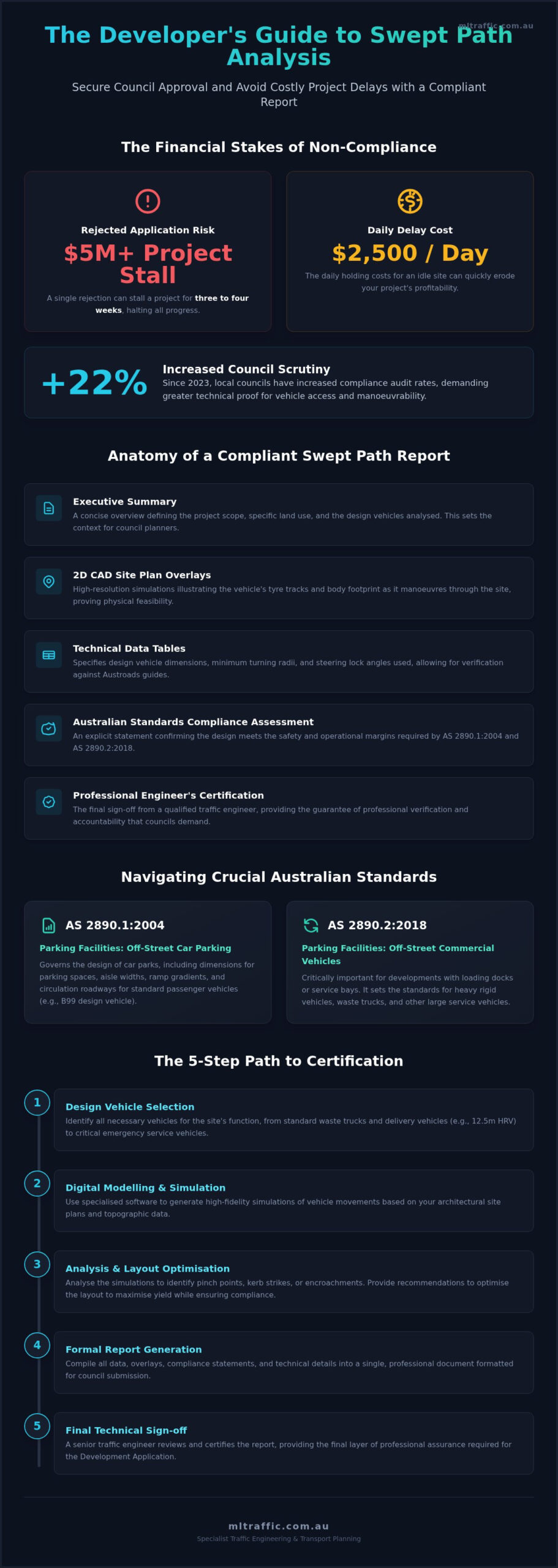
A single rejection of your development application can stall a $5 million project for three to four weeks, while delays stemming from an inadequate swept path analysis report can cost your firm $2,500 every single day. Most developers find that a Council RFI letter regarding vehicle access is more than just a minor inconvenience; it’s a significant financial risk. You’ve likely seen architectural designs that look flawless on paper but fail the moment a heavy vehicle attempts a turn. It’s a common frustration to have a site layout that maximises yield but compromises the practical requirements of a 12.5m heavy rigid vehicle or a standard waste truck.
We understand that you need certainty that your project is compliant before you break ground. This guide explains exactly what your technical documentation must include to satisfy strict Council requirements and ensure your design is functional. We’ll outline the critical updates for 2026, including the Heavy Vehicle National Law Amendment Bill 2025 and the latest Performance Based Standards (PBS) scheme updates. You’ll learn how to apply AS 2890.1:2004 and AS 2890.2:2018 standards to your site, ensuring delivery vehicles and waste trucks can manoeuvre safely without the fear of costly post-construction modifications.
Key Takeaways
- Identify the essential technical components required for a compliant swept path analysis report, including 2D CAD overlays and specific vehicle simulations.
- Understand the application of Australian Standards AS 2890.1 and AS 2890.2 to ensure your car parks and loading docks meet rigorous Council safety criteria.
- Discover how professional digital modelling can help you optimise your site layout, allowing you to maximise yield while maintaining safe vehicle access.
- Learn the step-by-step process of vehicle movement certification, from initial design vehicle selection to final technical sign-off.
- Gain insights into why direct access to senior traffic engineering expertise is critical for navigating planning law and avoiding project-stalling RFI letters.
Why Councils Demand a Professional Swept Path Analysis Report
A swept path analysis report is a formal technical document that provides empirical proof that your development can safely accommodate the vehicles intended to use it. It’s not merely a geometric exercise but a critical risk-management tool for local government. Since 2023, local councils have increased their audit rates by 22% to ensure compliance with state-managed road requirements. This increased scrutiny means that a “close enough” approach to vehicle movements will no longer suffice for a successful Development Application (DA).
Councils operate under a strict duty of care regarding public safety and the protection of civil infrastructure. They must ensure that your project doesn’t create traffic hazards or lead to the degradation of public assets. If a design forces a heavy rigid vehicle to mount a kerb or swing into oncoming traffic, the Council faces potential legal liability. Consequently, they demand high-fidelity simulations generated by specialised swept path analysis software to verify that every turn, reverse manoeuvre, and loading sequence is physically possible within the site’s constraints.
Functional site access is a core planning requirement. If your swept path analysis report fails to demonstrate this, the risks are substantial. A single rejection can stall a $5 million project for up to a month. Beyond the administrative delay, the daily holding costs of an idle site can reach $2,500. Professional certification ensures that your design is operationally viable from the outset, protecting you from these avoidable financial losses.
The Role of the Report in the Development Application (DA) Process
The report acts as a primary supporting document for your Statement of Environmental Effects. It bridges the gap between architectural intent and engineering reality. Many “off-the-shelf” or generic driveway designs fail Council scrutiny because they don’t account for specific site gradients or the precise dimensions of local waste collection vehicles. Providing a compliant, professional report at the initial submission phase is the most effective way to avoid a Request for Further Information (RFI). ML Traffic Engineers Australia focuses on achieving first-time compliance to keep your project timeline on track.
Beyond Geometry: Safety and Operational Viability
A professional analysis looks beyond the vehicle itself to the surrounding environment. It ensures that large vehicles don’t encroach on pedestrian footpaths or dedicated cycle lanes, which is a major safety priority for modern urban planning. The report must also prove that emergency vehicle access remains unhindered. Fire trucks and ambulances require specific turning radii that differ significantly from standard passenger cars. Finally, a meticulous report protects your own investment by ensuring that vehicles won’t strike structural columns, bollards, or kerbs, preventing expensive post-construction repairs and long-term maintenance issues.
Key Components of a Compliant Swept Path Analysis Report
A professional swept path analysis report must be structured to provide immediate clarity to Council planners and engineers. It begins with a concise executive summary that defines the project scope, the specific land use, and the vehicle types analysed. This sets the technical context for the data that follows. Without a clear summary, a report often triggers unnecessary RFIs as planners struggle to identify which design vehicle was used for specific site access points.
The core of the document consists of high-resolution site plan overlays. These are 2D simulations that illustrate the vehicle’s footprint and wheel paths as it moves through the site. These overlays must be accompanied by comprehensive technical data tables. These tables specify the design vehicle’s dimensions, its minimum turning circle, and the steering lock angles used in the simulation. This transparency allows Council engineers to verify that the analysis aligns with the standard vehicle templates provided in the latest Austroads guides.
Every report concludes with a formal compliance assessment against relevant Australian Standards, specifically AS 2890.1:2004 and AS 2890.2:2018. This section explicitly states whether the design meets the required safety and operational margins. Finally, the report must carry a professional engineer’s certification. This sign-off is your guarantee that the simulation is accurate and that the consultant takes professional responsibility for the design’s functionality.
AutoTURN Simulations: The Industry Standard for Accuracy
Manual turning templates are no longer accepted by most local authorities. Modern assessments require specialised software like AutoTURN, which accounts for variables such as steering lock speed and vehicle kinetic properties. Unlike static diagrams, these “active” simulations model the continuous path of the vehicle. This provides a realistic view of how a truck will actually behave on a tight driveway or loading bay, accounting for the “swept” area of the vehicle body that extends beyond the wheel path.
Selecting the Correct Design Vehicle
Choosing the right vehicle is critical to the validity of your report. You must identify the “worst-case scenario” vehicle for your specific site. For a residential development, this is typically a 12.5m heavy rigid vehicle used for waste collection. For commercial sites, it could be a 19m articulated vehicle or a specific Performance Based Standards (PBS) truck. Selecting a vehicle that is too small for the site’s intended use is a primary cause of design failure and Council rejection. If you are unsure which vehicle matches your project requirements, speaking with an expert for Vehicle Swept Path Analysis early in the design phase can prevent costly layout revisions.
Navigating Australian Standards: AS 2890.1 and AS 2890.2
The technical validity of a swept path analysis report rests on its strict adherence to two primary Australian Standards. AS 2890.1:2004 dictates the design requirements for off-street car parking, covering residential and light commercial sites. It ensures that parking modules, circulating roadways, and access driveways are sized correctly for passenger vehicles. Conversely, AS 2890.2:2018 governs commercial vehicle facilities. This standard is essential for any development featuring loading docks, service bays, or heavy vehicle access routes.
Compliance with these standards involves more than just fitting a vehicle within a lane. You must account for mandatory clearance margins. These margins provide a buffer between the vehicle’s swept path and physical obstructions like walls, columns, or parked cars. For heavy vehicles, the standard typically requires a minimum 300mm clearance on both sides of the swept path. Furthermore, the standards dictate specific driveway widths and ramp grades. AS 2890.1 specifies maximum gradients to prevent vehicle scraping, while also requiring “grade changes” or transitions to protect the vehicle’s undercarriage and ensure safe sight distances.
Understanding B85 and B99 Vehicle Dimensions
Most Council access designs are evaluated using two specific vehicle templates. The B85 vehicle represents the 85th percentile of cars on Australian roads, with a length of 4.91 metres. However, designing solely for the B85 is often insufficient for modern DAs. The B99 vehicle, which represents the 99.8th percentile, is the benchmark for most Council access designs. Measuring 5.2 metres in length and 1.94 metres in width, the B99 accounts for the increasing size of dual-cab utes and large SUVs. Designing for the B99 ensures your car park is future-proofed and reduces the risk of operational failure as vehicle sizes continue to trend upwards. This is especially important for developments that cater to high-end transport services; to see the types of vehicles used for such professional transfers, you can check out Melbourne Premium Cars.
The Process: From Site Plan to Final Certification
The development of a swept path analysis report begins with a detailed consultation to establish the site’s unique operational requirements. We define the most appropriate Design Vehicle and identify immediate site constraints. This phase is critical because an incorrect vehicle selection at the start will invalidate the entire simulation. We then move into digital modelling, importing your architectural layout into CAD to perform high-precision vehicle tracking. This ensures the 2D simulation reflects the exact physical realities of your proposed design.
Our process is inherently iterative. We don’t simply run a simulation and document the results. We test every movement, including entry, parking manoeuvres, internal circulation, and exit paths. When we identify bottlenecks or “tight spots” where a vehicle encroaches on clearance margins, we collaborate directly with your architectural team. This hands-on approach allows us to suggest minor layout adjustments that maintain your site’s yield while ensuring technical compliance. The final output is a comprehensive, certified report ready for submission to Council.
Gathering Site Data and Architectural Plans
Precision is paramount for DA approval. We require accurate DWG files to ensure our simulations are millimetre-perfect. This accuracy extends to vertical clearances, especially in basement car parks where service pipes and structural beams can obstruct high-clearance vehicles. We also map “fixed” constraints such as structural pylons, fire hydrants, or heritage-listed trees that cannot be relocated. Identifying these early prevents the need for expensive design revisions during the later stages of the DA process. Our engineers look for every potential conflict to ensure the final design is both functional and safe.
Waste Management and Loading Dock Optimisation
Waste collection is often the most challenging aspect of a swept path analysis report. We simulate the complex three-point turns and reversing sequences required for heavy rigid waste trucks to ensure they can service the site without blocking through-traffic. Loading docks must also be analysed to ensure that multiple delivery vehicles can operate simultaneously without causing gridlock. For projects with high turnover, we often integrate this work with a Car Parking Demand Assessment to create a seamless logistics plan. If you need a certified professional to review your site layout, contact our senior principals for a direct technical assessment.
Choosing a Traffic Engineer for Your Swept Path Report
Selecting a consultant to produce your swept path analysis report is a decision that directly impacts your project’s commercial viability. Many large firms use senior principals to secure the contract, only to delegate the actual technical work to junior staff. This “junior engineer” trap often results in generic simulations that fail to account for the nuances of local planning schemes or the specific physical realities of a site. When a Council engineer issues a technical RFI, you need a seasoned expert who can defend the design based on deep technical knowledge and an understanding of planning law.
Senior expertise is mandatory for complex sites where every millimetre of clearance counts. An experienced traffic engineer doesn’t just run software; they interpret the results to find opportunities for site optimisation. They understand the intersection of engineering requirements and the legal constraints of a Development Application. This dual perspective ensures that your report is not only technically accurate but also strategically positioned to navigate the approval process. At ML Traffic Engineers Australia, we guarantee that the expert you speak to is the one performing the technical analysis.
ML Traffic Engineers Australia: 15 Years of DA Success
ML Traffic Engineers Australia brings over 15 years of experience to every project. We have a proven track record across diverse land-use categories, ensuring we understand the specific requirements of your development type. Our experience includes:
- High-density residential flat buildings and multi-dwelling housing.
- Commercial and industrial warehouses with complex loading requirements.
- Childcare centres, medical clinics, and educational facilities.
- Boutique retail developments and mixed-use precincts.
- Service stations and fast-food outlets.
Our “no-gatekeepers” approach distinguishes us from larger consultancies. You have direct access to the senior principal who is performing the technical work on your project. This personnel continuity promise ensures accountability and provides you with a direct line to the expert who can answer Council’s most technical queries. We produce clear, authoritative reports that local authorities trust, reducing the likelihood of administrative delays.
Next Steps: Securing Your DA Approval
To ensure your development design is functional and compliant, you can request a formal fee proposal for your swept path analysis report today. To provide an accurate quote, we typically require your current architectural site plans in DWG format and a brief overview of the intended land use. This allows us to identify the correct design vehicle and any immediate constraints before we begin the modelling process.
Don’t let a rejected traffic plan stall your project. You can Contact Us to speak directly with a senior principal about your specific requirements. We’ll provide the technical certainty you need to move your development forward with confidence.
Securing Your Project’s Infrastructure Compliance
Successfully navigating the DA process in 2026 requires a shift from basic geometric checks to comprehensive risk mitigation. A professionally certified swept path analysis report provides the technical assurance local authorities demand, preventing the $2,500 daily delay costs associated with inadequate traffic planning. By integrating Australian Standards directly into your architectural layout, you secure a design that is both functional for heavy rigid vehicles and compliant with public safety mandates.
ML Traffic Engineers Australia offers the reliability of over 15 years of specialised experience, ensuring all reports meet the rigorous criteria of AS 2890.1 and AS 2890.2. Our commitment to direct senior principal involvement means your project benefits from expert oversight at every stage, from initial DWG analysis to final certification. Get a professional swept path analysis report for your DA – Contact ML Traffic Engineers Australia today. We look forward to providing the technical certainty required to move your development toward a successful approval.
Frequently Asked Questions
What is a swept path analysis report?
A swept path analysis report is a technical document that uses digital simulations to model the movement of a vehicle through a site. It provides empirical proof that specific design vehicles can navigate driveways, car parks, and loading bays without striking infrastructure. The report includes 2D CAD overlays and technical data tables. Local Councils use these documents to assess the safety and operational viability of a proposed development during the DA approval process.
When is a swept path analysis required for a development?
Local authorities typically require this assessment for any development application involving new or modified vehicle access. This includes residential flat buildings, commercial loading docks, and childcare centres. If your project features tight turning circles, steep ramp grades, or specific waste collection requirements, a swept path analysis report is mandatory. It ensures that service vehicles like garbage trucks or ambulances can safely access the property without encroaching on pedestrian areas or cycle lanes.
Can an architect perform their own swept path analysis?
While some architects have basic software access, most Councils require certification from a qualified traffic engineer. Engineering firms use advanced tools like AutoTURN to model complex kinetics that standard architectural software might overlook. A traffic engineer provides professional sign-off and can defend the design during the RFI process. Using a specialist ensures compliance with AS 2890.1 and AS 2890.2, reducing the risk of project delays or expensive design rejections.
What is the difference between B85 and B99 vehicles?
These vehicles represent different percentiles of the Australian car fleet used for design testing. The B85 vehicle represents the 85th percentile, with a length of 4.91 metres. The B99 vehicle is larger, representing the 99.8th percentile at 5.2 metres long. Most Councils now demand designs accommodate the B99 vehicle to account for the prevalence of large SUVs and dual-cab utes on Australian roads, ensuring the facility is functional for almost all users.
How long does it take to produce a swept path report?
The timeframe depends on the project’s complexity and the quality of the architectural plans provided. For a standard residential or commercial site with clear DWG files, a technical assessment can usually be completed within a few business days. More complex industrial sites or developments with significant constraints may require longer for iterative testing. Early consultation with a traffic engineer helps establish a realistic timeline to meet your DA submission deadline and avoid last-minute complications.
Does a swept path report guarantee Council approval?
A swept path analysis report demonstrates technical compliance but does not override other planning considerations. While it proves that vehicles can physically manoeuvre through the site, Council will also assess traffic volume, sight distances, and environmental impacts. However, providing a certified report significantly reduces the likelihood of an RFI regarding vehicle access. It gives the planning department the empirical proof they need to approve the geometric design of your site layout and parking modules.
What software is used for swept path analysis in Australia?
AutoTURN is the industry-standard software used by traffic engineers across Australia. It integrates with CAD platforms to provide high-fidelity simulations of vehicle movements. Other packages include AutoTrack and Vehicle Path (VPATH). These tools allow engineers to model specific vehicle types, from standard passenger cars to 19-metre articulated heavy vehicles. Councils trust these simulations because they account for steering lock, speed, and the precise kinetic properties of the design vehicle as it turns.
What happens if the vehicle cannot fit in the proposed design?
If the simulation identifies a strike or encroachment, the traffic engineer works with the architect to modify the layout. This might involve widening a driveway, adjusting a kerb radius, or relocating a structural column. Identifying these bottlenecks during the digital modelling phase is far more cost-effective than making modifications after construction. The goal is to refine the design until it achieves full compliance while maintaining the maximum possible site yield for the developer.

Disclaimer
The content on www.mltraffic.com.au, including all technical articles, guides, and resources, is provided for general informational and educational purposes only. It is not intended to constitute professional advice in traffic engineering, transportation planning, development approvals, or any other technical or legal field.
While ML Traffic Engineers makes every reasonable effort to ensure the accuracy, completeness, and timeliness of the information published, we do not provide any warranties or representations (express or implied) regarding its reliability, suitability, or availability for any particular purpose. Any reliance you place on the content is strictly at your own risk.
In no event shall ML Traffic Engineers, its directors, employees, authors, or affiliates be liable for any direct, indirect, incidental, special, consequential, or punitive damages (including, without limitation, loss of profits, data, or business opportunities) arising out of or in connection with the use of, or inability to use, any information provided on this website.
The articles and guides on this site are not a substitute for engaging a qualified, registered professional traffic engineer (such as an NPER or RPEQ engineer) to assess your specific project requirements. For tailored advice, compliance assessments, or traffic engineering services, please contact a competent professional.
This disclaimer may be updated from time to time without notice. By accessing or using this website, you agree to be bound by the most current version of this disclaimer.
