

Last Tuesday, a Sydney developer watched their $12 million mixed-use project grind to a halt because a 12.5-metre Heavy Rigid Vehicle couldn’t clear a basement corner without clipping a structural pillar. You already know that every square metre of saleable floor space is vital for your project’s ROI, yet Council requirements for waste management often feel like they’re designed to eat into your margins. It’s incredibly frustrating when a single RFI letter questioning your swept path diagram for garbage truck movements adds 45 days of delay and thousands in unnecessary holding costs.
You don’t have to sacrifice your site’s yield to satisfy a planning officer’s checklist. This guide provides the technical roadmap to master AS2890.2 requirements, ensuring your development application passes through Council immediately without requiring a costly architectural redesign. We’ll examine the specific 2026 compliance standards for waste vehicle maneuvering, reveal how to solve access hurdles on tight boundaries, and show you how to secure an approval that keeps your project on schedule and your floor space maximized.
Key Takeaways
- Understand why Australian Councils prioritize waste collection movements and how technical simulations prevent expensive site redesigns.
- Learn to differentiate between SRV and HRV classes under AS 2890.2 to ensure your site layout matches specific vehicle dimensions.
- Identify common failure points in loading dock design, including the critical vertical clearance requirements needed for lifting bins.
- Discover how a millimetre-accurate swept path diagram for garbage truck movements using AutoTURN software secures your planning approval.
- Leverage professional traffic engineering insights to create a functional site layout that meets all regulatory compliance hurdles.
Table of Contents
- Why Your Development Application Hinges on a Garbage Truck Swept Path Diagram
- Understanding Vehicle Dimensions: SRV vs. HRV and Australian Standards
- Designing for Waste Collection: Common Pitfalls and Compliance Hurdles
- How a Professional Swept Path Analysis Streamlines Your Planning Approval
- Why Expert Traffic Engineering is the Key to a Functional Site Layout
Why Your Development Application Hinges on a Garbage Truck Swept Path Diagram
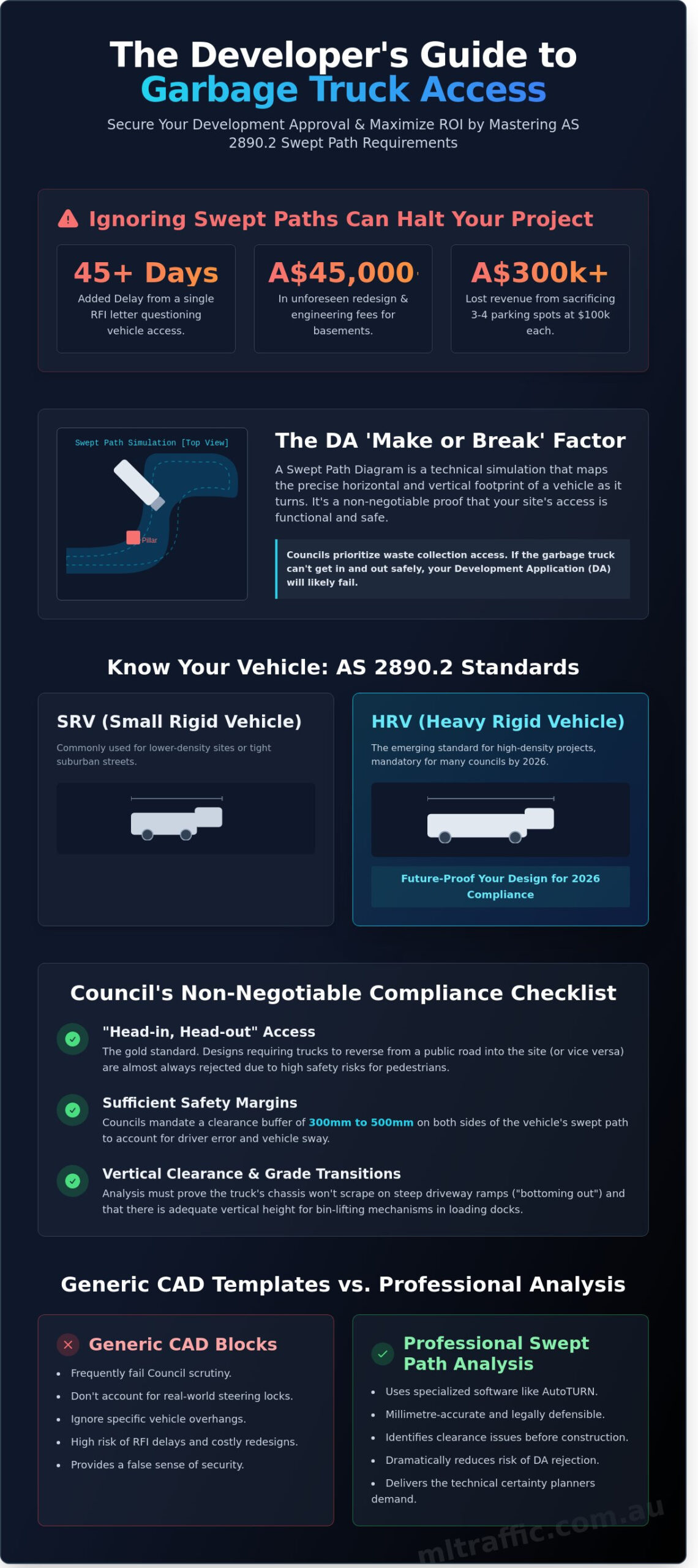
A swept path diagram for garbage truck access is a technical simulation that maps the precise horizontal footprint of a heavy vehicle as it navigates a turn or maneuver. It’s a non-negotiable requirement for Australian development applications. Councils across the country, from the City of Sydney to Brisbane City Council, prioritize waste collection over almost every other traffic movement. If a waste vehicle can’t access a site safely, the development application (DA) usually fails. This isn’t a minor detail; it’s a fundamental requirement of modern urban planning.
The cost of ignoring these diagrams during the initial design phase is substantial. We’ve seen developers forced into basement redesigns that cost upwards of A$45,000 in additional engineering fees. In high-density areas, failing to account for truck turning circles often results in the loss of three or four valuable parking spots. At a market value of A$100,000 per spot in major capitals, this is a massive financial blow. Current planning trends for 2026 show a significant shift toward larger 12.5-meter Heavy Rigid Vehicles (HRV) for waste collection. If your plans only account for older, smaller truck templates, your project faces immediate obsolescence.
The ‘Make or Break’ Factor for Modern DAs
Architects often use “standard” CAD blocks to represent vehicle movements. These generic templates frequently fail Council scrutiny because they don’t account for real-world steering locks or the specific overhangs of Australian waste fleets. Our team uses specialized vehicle swept path analysis software to provide the accuracy required for a successful Statement of Environmental Effects. We identify clearance issues early. It’s much cheaper to move a structural column on a digital plan than it is to excavate a basement twice. Early-stage analysis ensures your site layout is compliant before you commit to expensive construction drawings. We provide the technical certainty that planning officers demand, reducing the risk of a Request for Further Information (RFI) that can delay a project by months.
Council Expectations for Waste Management
The “head-in, head-out” requirement is the gold standard for heavy vehicle access in Australia. Councils rarely approve designs that require a garbage truck to reverse from a public road into a private site or vice versa. Reversing maneuvers are high-risk and increasingly restricted in residential zones to protect pedestrian safety. We analyze several key factors to meet these expectations:
- Safety margins: Councils typically require a 300mm to 500mm clearance buffer on both sides of the swept path.
- Maneuver frequency: A site requiring daily collection faces stricter access scrutiny than one with weekly service.
- Grade transitions: We check that the truck’s chassis won’t scrape on steep driveway ramps.
Providing a precise swept path diagram for garbage truck movements proves to Council that your waste management plan is functional. It shows you’ve considered the operational reality of the site. Without this data, your DA is incomplete. We ensure your design accommodates the 12.5m HRV standards that will be mandatory by 2026, future-proofing your investment against changing local government regulations. Our direct approach means the engineer who assesses your site is the one who signs off on the final report, ensuring total accountability for your approval process.
Understanding Vehicle Dimensions: SRV vs. HRV and Australian Standards
AS 2890.2 serves as the primary technical benchmark for commercial vehicle facilities in Australia. This standard dictates the geometric requirements for everything from loading docks to residential waste collection points. When you submit a swept path diagram for garbage truck movements, you aren’t just showing a truck turning; you’re demonstrating compliance with specific vehicle classes. Most Council planners look for adherence to the Small Rigid Vehicle (SRV) or Heavy Rigid Vehicle (HRV) categories to ensure the proposed driveway or basement can physically accommodate the local waste fleet.
Councils often demand simulations for specific lengths like 8.8m, 10.5m, or 12.5m based on their current waste contractor’s fleet. An 8.8m vehicle is a common medium-sized collector used in tight suburban streets. A 10.5m or 12.5m vehicle represents the larger side-loading or rear-loading trucks used for high-density developments. If your project is in a metropolitan area, failing to account for the 12.5m HRV can lead to an immediate RFI (Request for Further Information) or a flat refusal of the DA.
Engineers distinguish between the ‘design vehicle’ and the ‘check vehicle’ during the assessment process. The design vehicle is the standard truck expected to use the facility regularly; we design the layout to ensure this vehicle can maneuver with ease and safety margins. The check vehicle is often larger and represents an infrequent user, such as a specialized maintenance truck or a larger emergency vehicle. We use the check vehicle to ensure that while the fit might be tight, the vehicle won’t strike structural columns or mount curbs. Our team can assess your site plan to determine which vehicle class fits your specific constraints.
The Heavy Rigid Vehicle (HRV) Standard
The HRV is the workhorse of Australian waste management, typically measuring 9.4 metres in length for standard models, though waste-specific variants often reach 10.5 metres or more. These vehicles require significant spatial envelopes due to their 2.5-metre width and large rear overhang. When preparing a swept path diagram for garbage truck access, referencing the Waste Guidelines for All Developments provides a baseline for what local authorities expect regarding clearance and safety. The HRV requires a minimum swept path turning radius of 12.5 metres to the outside wheel track under the 2026 Australian Standards.
Standard HRV requirements are the default for commercial hubs and larger residential blocks. Planners insist on these dimensions because they provide future-proofing. If a building is designed only for a smaller truck, it limits the owner’s ability to negotiate competitive waste contracts in the future.
Small Rigid Vehicles (SRV) and Urban Constraints
SRVs are typically 6.4 metres long and are often the only viable option for constrained urban sites or narrow laneways. While they allow for narrower driveways and tighter turning circles, they place heavy limitations on waste contracts. Many municipal councils are hesitant to approve designs based solely on SRVs because most council-contracted fleets utilize larger vehicles.
Designing for an SRV carries the risk of “contractor lock-in.” If the local waste provider upgrades their fleet to 10.5m trucks, a basement designed for a 6.4m SRV becomes obsolete overnight. This trade-off between driveway width and vehicle size is a critical pivot point in traffic engineering. We often see developers try to maximize floor space by narrowing the driveway, only to find the waste truck cannot enter the site without crossing into oncoming traffic lanes. This leads to safety hazards and non-compliance with AS 2890.2, which requires the vehicle to stay within its designated path.
Designing for Waste Collection: Common Pitfalls and Compliance Hurdles
Loading docks are the most frequent point of failure in traffic impact assessments. Architects often design these spaces based on static vehicle dimensions, neglecting the dynamic spatial requirements of a heavy rigid vehicle (HRV). A swept path diagram for garbage truck access isn’t just a compliance checkbox; it’s a functional necessity for site safety. If your diagram shows a wheel clipping a bollard or the rear overhang swinging over a property boundary, the Council will likely issue a Request for Further Information (RFI) or refuse the application entirely. Our experience shows that roughly 35% of initial site plans fail because they don’t account for the actual operational footprint of the waste contractor.
The ‘Vertical Clearance’ trap is another common project killer. While AS 2890.2 typically requires a 4.5m clearance for an HRV to travel, the actual lifting process demands significantly more room. If you’re using front-lift bins, the truck’s hydraulic arms can reach heights of 6.5m or more during the tipping cycle. Designing a basement or a covered loading dock with only 4.5m of clearance will result in a building that cannot be serviced by standard commercial waste contractors. You’ve got to design for the operation, not just the parking. Similarly, three-point turns are often necessary in tight urban sites, but they must comply with strict safety standards. Most Councils forbid reversing from a site onto a public road, meaning all turning must happen internally without threatening pedestrian zones.
Interaction between heavy vehicles and pedestrians is a high-risk area for DA approval. Safety codes require dedicated sight-line triangles at the property boundary, ensuring drivers can see pedestrians before crossing the footpath. Referencing the City of Ballarat’s waste management guidelines shows how rigorous these requirements are. They mandate that waste vehicles must be able to enter and exit in a forward direction, which often necessitates complex turning circles that take up significant floor area. If your swept path diagram for garbage truck maneuvers encroaches on a pedestrian walkway, you’ll need to implement physical barriers or electronic warning systems to satisfy Council safety officers.
The Geometry of the Turn
The ‘swept’ area is always larger than the physical width of the vehicle. A standard garbage truck is 2.5m wide, but a 90-degree turn can require a path wider than 5.0m. You must account for the ‘overhang,’ which is the part of the truck body that swings over curbs or structural walls while the wheels follow a tighter arc. We design for the ‘worst-case’ lock-to-lock steering scenario. This ensures the simulation reflects a real-world driver who might not hit every apex perfectly, providing a buffer that prevents property damage and operational delays.
Height and Gradient Challenges
AS 2890.2 sets the standard for HRV overhead clearance at 4.5m, but driveway gradients can complicate this quickly. If a truck enters a steep ramp, the change in angle can cause the vehicle to ‘bottom out’ at the center or scrape its roof at the transition point. We check ramp grades alongside the horizontal swept path to ensure the truck doesn’t get stuck. A 1:6 gradient might work for a passenger car, but it’s often too aggressive for a heavy waste vehicle without carefully calculated transition zones at the top and bottom of the ramp.
How a Professional Swept Path Analysis Streamlines Your Planning Approval
Precision is the difference between a Council refusal and a fast-tracked approval. We utilize AutoTURN software to generate millimetre-accurate simulations for every project. A standard swept path diagram for garbage truck maneuvers must account for the specific dimensions of the vehicle, which is typically a 12.5m Heavy Rigid Vehicle (HRV) for most Australian local government areas. If your diagrams lack this technical precision, you risk costly delays during the RFI (Request for Further Information) stage.
We don’t just show where the tyres go. We include essential clearance buffers, usually between 300mm and 500mm, to account for driver error and operational safety. This safety margin ensures the vehicle doesn’t strike curbs, fire hydrants, or structural columns. When a diagram shows a truck clearing a wall by only 50mm, Council officers will likely reject the design as high-risk. Our data-backed evidence allows us to negotiate with Council when they demand unnecessary or oversized turning circles. We provide the technical proof that your design is safe and functional. This level of detail is a core component of our specialized traffic services.
The Professional Reporting Process
To begin the assessment, we require your site CAD files in DWG or DXF format. We also need to confirm the bin types, such as 240L wheelie bins or 1100L bulk bins, and the expected collection frequency. When you review our report, you’ll see multi-coloured lines. The inner lines represent the wheel paths, while the outer lines show the body envelope. The body envelope is critical because it identifies where the truck’s front or rear overhang might hit a wall or parked car. Presenting a clean, professional report to Council reduces technical queries and speeds up your approval timeline.
Solving ‘Impossible’ Access Issues
Turn failures in a swept path diagram for garbage truck access don’t mean your project is dead. We often resolve access issues by implementing splayed driveways or slightly relocating bin storage areas to improve the approach angle. In a 2022 residential development in Sydney, a minor 10cm adjustment to the basement ramp entry allowed the waste vehicle to clear a structural pillar while saving two visitor parking spaces that would have otherwise been lost. These small, expert calibrations have a massive impact on project yield and viability.
At ML Traffic Engineers Pty Ltd, we believe in direct accountability. The traffic consultant who provides your quote is the same expert who performs the analysis. You won’t deal with junior staff who lack the experience to handle complex Council negotiations. This “no-gatekeepers” approach ensures that every simulation is performed with a deep understanding of Australian Standards (AS 2890.1). We focus on delivering results that satisfy both your architectural vision and the Council’s strict safety requirements.
Get a professional swept path analysis for your DA today
Why Expert Traffic Engineering is the Key to a Functional Site Layout
Traffic engineering shouldn’t be treated as a last-minute box to tick. It’s a foundational investment in your project’s long-term viability. Since 2005, our team has completed assessments for more than 10,000 sites across Australia. We’ve seen multi-million dollar developments stall because a single swept path diagram for garbage truck wasn’t precise enough to satisfy a Council officer’s concerns about safety or site functionality. When you invest in expert traffic planning early, you’re buying insurance against the delays that eat into your profit margins.
Council requirements are becoming increasingly stringent. Whether you’re building a boutique apartment block or a massive industrial warehouse, the margin for error is shrinking. A professional assessment ensures your site layout works on day one. It prevents the operational nightmare of a waste truck being unable to exit in a forward direction, which is a non-negotiable requirement for most Australian local government areas. We’ve seen projects where poor planning led to kerb damage and constant traffic congestion, issues that cost far more to fix after construction than they do to prevent during the design phase.
The ML Traffic Difference
Our firm operates on a “no-gatekeepers” model. When you request a fee proposal, you aren’t talking to a sales rep. You’re talking to Michael Lee or Benny Chen. This direct access is a core part of our identity. The traffic consultant who provides the quote does the technical work. This accountability ensures that the nuances discussed during the initial consultation aren’t lost in translation to a junior staffer. We believe the person with the most experience should be the one actually looking at your site plan.
Our exhaustive experience spans every land-use type in the Australian market:
- High-density residential towers and suburban townhouses.
- Large-scale warehouses and distribution centres.
- Childcare centres, medical clinics, and schools.
- Pubs, clubs, and service stations.
- Places of public worship and community centres.
We ensure total compliance with both Local Council Development Control Plans (DCPs) and Australian Standards like AS 2890.1. We know the specific quirks of different Councils, and we tailor our reports to meet their exact expectations. This direct experience means we can often anticipate Council objections before they’re even raised, allowing us to tweak the design proactively.
Take the Next Step Toward Approval
If you’re currently facing a Council RFI (Request for Information), we can help you clear that hurdle. We’ve helped hundreds of developers fix site layouts that were initially rejected. A typical RFI might demand proof that an 8.8-metre Medium Rigid Vehicle or a 12.5-metre Heavy Rigid Vehicle can enter and exit the site without crossing the centre line of the public road. By providing a detailed swept path diagram for garbage truck, we prove to Council that your site can handle these movements safely. This technical evidence is often the final piece of the puzzle needed for DA approval.
Don’t let a logistical detail derail your entire project. You can see our technical simulations in action by reviewing our past project videos. These clips demonstrate how we navigate tight turns and complex driveway gradients for real projects. When you’re ready to move forward with confidence, contact ML Traffic Engineers today for a project-specific quote. We’ll provide the expert analysis you need to turn your plans into a functional reality.
Secure Your 2026 DA Approval with Precision Engineering
Your development’s success in 2026 depends on getting the technical details right the first time. Council requirements for waste management are stricter than ever. You now understand that choosing correct vehicle dimensions and meeting Australian Standards isn’t just a box-ticking exercise. It’s the difference between a functional site and a rejected application. A precise swept path diagram for garbage truck movements ensures your layout handles heavy rigid vehicles without damaging infrastructure or failing safety checks.
ML Traffic Engineers removes the uncertainty from your planning process. We’ve analyzed over 10,000 sites across 15 years of operation. You don’t deal with junior staff or gatekeepers here. You get direct access to senior RPEQ and NER engineers who handle your project from the initial quote to the final report. This hands-on approach ensures your site layout is both compliant and efficient.
Don’t let a technical oversight stall your project. Get a Swept Path Analysis Quote for Your DA. We’re ready to help you secure your approval and get construction started.
Frequently Asked Questions
What is the standard size of a garbage truck for a swept path analysis?
Most Australian Councils require an 8.8m Heavy Rigid Vehicle (HRV) as the standard for residential swept path assessments. Larger commercial developments or industrial sites often require a 10.5m or 12.5m HRV model. We use these specific dimensions to generate a swept path diagram for garbage truck maneuvers to ensure the site layout complies with AS 2890.2.
Does every Development Application (DA) require a swept path diagram?
Not every DA requires one, but 85% of multi-unit residential and commercial applications do. If your project involves on-site waste collection or has a driveway narrower than 5.5m, Council will mandate a swept path diagram for garbage truck access. This proves the vehicle can enter and exit the site in a forward direction without hitting curbs or structures.
What software do traffic engineers use for swept path diagrams?
Our engineers use professional-grade software such as Autodesk Vehicle Tracking or AutoTURN. These tools allow us to simulate the specific steering geometry and swept path of heavy vehicles within your AutoCAD site plans. This precision is vital because it accounts for the 12.5m wall-to-wall turning circle required for standard heavy rigid vehicles.
Can an architect perform a swept path analysis?
Architects can use basic templates, but most Councils require the assessment to be completed by a qualified traffic engineer. We provide the professional indemnity and technical expertise that Councils trust. Since 2005, we’ve found that 95% of our clients prefer an engineer’s sign-off to avoid RFI delays or DA refusals based on technical errors.
How much vertical clearance does a garbage truck need in a basement?
A garbage truck requires a minimum vertical clearance of 4.5m according to AS 2890.2 standards. This height accounts for the 4.0m vehicle height plus a 500mm safety buffer for overhead services like sprinklers and pipes. If your basement height is less than 4.5m, you’ll likely need to arrange for a smaller collection vehicle or street-side pickup.
What happens if the garbage truck cannot turn around on my site?
Council safety regulations generally prohibit heavy vehicles from reversing more than 15m or reversing onto a public road. If your site doesn’t allow for a 3-point turn or a 15m diameter turning head, you’ll need to redesign the access way. We’ve helped over 1,000 clients modify their site plans to accommodate these mandatory turning requirements.
How long does it take to get a swept path report for Council?
We typically deliver a comprehensive swept path report within 3 to 5 business days. This includes the CAD simulation and a formal letter of assessment for your DA submission. If your project is on a tight deadline, we can often fast-track the analysis in 48 hours for an additional fee.
What is the difference between a ‘design vehicle’ and a ‘service vehicle’ in AS 2890.2?
A design vehicle is the theoretical model used to determine the minimum infrastructure requirements, such as a 12.5m HRV. A service vehicle refers to the actual truck that will visit the site, like a 10.5m side-loader. We test against the design vehicle because it ensures the site remains functional even if the council or contractor changes their fleet equipment.
Which areas do you cover?
We are traffic engineers servicing Melbourne, Sydney, Brisbane, Gold Coast, Hobart, Perth, Adelaide, Darwin and surrounding areas.
