

A single non-compliant driveway gradient or an overlooked swept path requirement can stall your Sydney development for months; architectural merit alone won’t bypass rigid council scrutiny. You’re likely aware that local regulations and state road authority requirements are becoming more technical and harder to satisfy on the first attempt. As experienced traffic engineering consultants sydney, we see how easily projects get bogged down in bureaucratic delays and hidden costs due to minor technical oversights.
You deserve a clear path to approval without the frustration of constant redesigns or non-compliant parking layouts. This article provides the technical guidance you need to master Traffic Impact Assessments and car park designs that meet the strictest Australian Standards. We’ll examine the 2024 Transport for NSW Guide to Transport Impact Assessment and the critical requirements of AS/NZS 2890.1:2004, including the anticipated 2026 revisions for modern vehicles. You’ll learn how to secure council approval on your first submission through precise technical compliance and direct communication with seasoned experts.
Key Takeaways
- Understand why engaging professional traffic engineering consultants sydney is essential for navigating council mandates and avoiding costly DA delays.
- Learn the technical requirements of a Traffic Impact Assessment, from calculating trip generation to analysing road network performance.
- Ensure your parking layouts and loading docks strictly adhere to AS 2890.1 and AS 2890.2 to prevent non-compliance issues.
- Discover how Vehicle Swept Path Analysis and AutoTURN software verify site access for seamless vehicle manoeuvrability.
- Identify the benefits of direct access to senior principals, ensuring your technical reports are handled by seasoned experts from start to finish.
The Role of Traffic Engineering Consultants in Securing Planning Approval
Traffic engineering involves the technical analysis of vehicle, pedestrian, and cyclist movements to ensure the safe and efficient operation of the transport network. For developers, engaging traffic engineering consultants sydney is a functional necessity rather than a choice. These experts evaluate how a proposed development interacts with existing road infrastructure and parking supply. Local councils require these reports to verify that a project won’t cause gridlock or safety hazards in the surrounding community.
A Traffic Impact Assessment serves as a core component of the Statement of Environmental Effects (SEE). It provides the empirical data councils need to justify an approval. Without this technical backing, a DA is often viewed as incomplete or high-risk. Early consultation with a specialist allows for the identification of potential access issues before designs are finalised. This proactive approach prevents the need for expensive modifications or complete redesigns after the DA has been lodged, saving both time and capital.
When is a Traffic Report Mandatory?
A formal traffic report is triggered when a development meets specific criteria regarding size, intensity, or location. While minor alterations might only require a short-form traffic statement, larger projects necessitate a comprehensive TIA. Common land-use types that almost always require professional assessment include:
- Residential flat buildings and multi-dwelling housing.
- Childcare centres and educational facilities.
- Industrial units and warehouse distributions.
- Commercial offices and retail developments.
The distinction between a statement and a full report depends on the projected trip generation. If a site is expected to significantly increase vehicle movements or alter existing traffic patterns, council will mandate a detailed analysis of intersection performance and parking demand. Professional traffic engineering consultants sydney determine the appropriate level of reporting to ensure compliance without unnecessary over-servicing.
Navigating the DA Process with Expert Advice
Securing approval involves more than just submitting a report; it requires active liaison with local government authorities and Transport for NSW. Expert consultants ensure that every traffic engineering service provided aligns with current regional growth strategies and local Development Control Plans (DCPs). This alignment is critical for projects situated on or near state-managed roads where state transport bodies have a say in the outcome.
Within current Australian planning frameworks, the DA traffic requirement is defined as a mandatory technical submission that demonstrates a proposed development maintains or improves the safety, capacity, and efficiency of the transport network for all users. Seasoned experts provide the technical weight needed to satisfy these regulatory benchmarks. Their involvement ensures the project remains compliant with state-wide transport objectives while addressing the specific concerns of local planning officers.
Essential Components of a Traffic Impact Assessment (TIA)
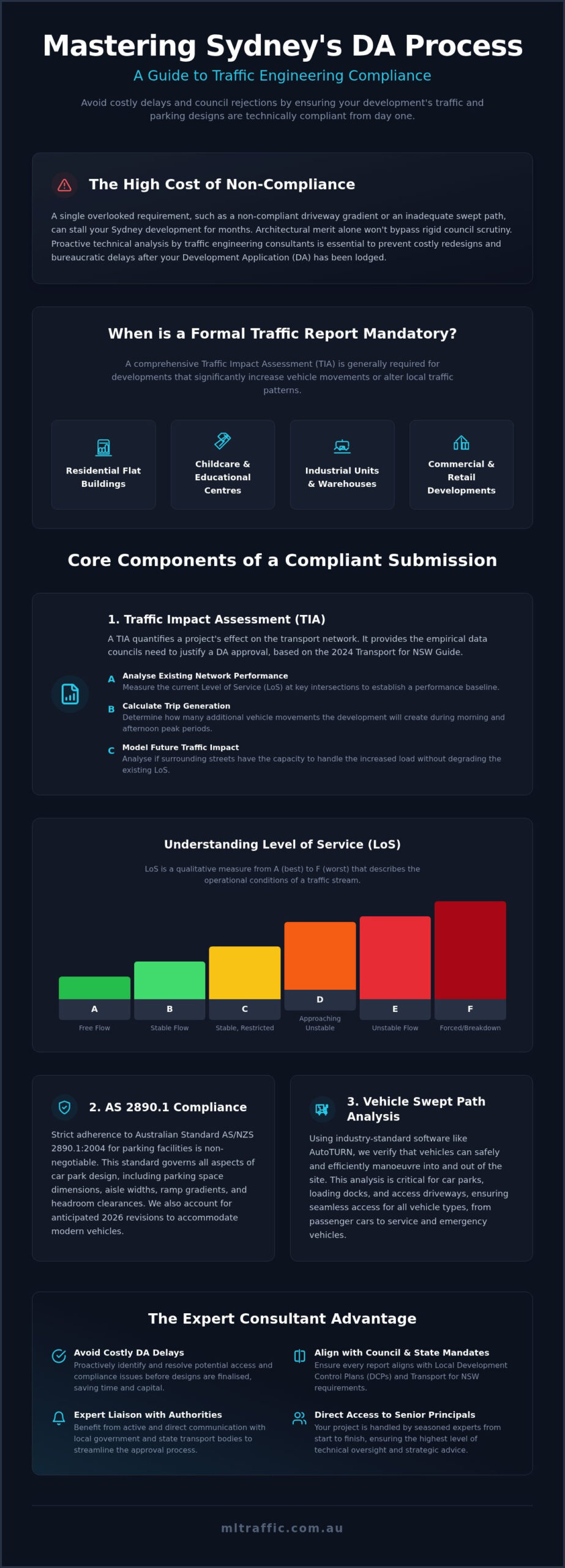
A comprehensive TIA quantifies how a project influences the movement of people and vehicles. Professional traffic engineering consultants sydney begin by establishing a baseline through a detailed analysis of existing road network performance. This involves measuring the current Level of Service (LoS) at key intersections near the site. LoS is a qualitative measure describing operational conditions within a traffic stream, ranging from LoS A, representing free-flowing conditions, to LoS F, indicating total congestion. Understanding this baseline is a mandatory prerequisite for any development application.
The primary reference for these assessments is the Guide to Transport Impact Assessment 2024. This document provides the framework for evaluating trip generation and distribution. It requires consultants to calculate exactly how many additional vehicle movements a development will contribute during morning and afternoon peak periods. High-quality intersection modelling then determines if surrounding streets possess the residual capacity to handle this increased load without degrading the existing LoS. Learn more about our Traffic Impact Assessment services to see how we apply these metrics to your project.
Trip Generation and Parking Demand
Calculations for trip generation rely on established TfNSW data or specific local council Development Control Plans (DCPs). These figures dictate the minimum number of parking spaces required for the specific land-use type. If a design cannot meet these quotas, traffic engineering consultants sydney must provide a robust technical justification for the parking shortfall. This often involves car parking demand assessments based on empirical data from similar local developments or proximity to high-frequency public transport hubs. For a deeper dive into these requirements, read our Traffic Impact Assessment: The Definitive Guide for Australian Developers.
Safety and Access Considerations
Technical compliance extends beyond vehicle numbers to the physical safety of the site access points. Assessing sight distances at proposed driveways is a non-negotiable requirement. Consultants must verify that both motorists and pedestrians have clear visibility to avoid collisions. A thorough TIA also evaluates the impact on cycling infrastructure and pedestrian pathways, ensuring the development integrates safely with the broader urban environment. Incorporating sustainable transport options, such as Green Travel Plans, can often help mitigate traffic impacts and satisfy council’s environmental objectives. If you require assistance with these technicalities, you can speak directly with our senior principals for expert guidance.
Compliance with Australian Standards: AS 2890.1 and Car Park Design
AS 2890.1:2004 remains the fundamental standard for off-street car parking in Australia. While a 2026 revision is anticipated to account for larger modern vehicles and SUVs, current compliance is measured against these established dimensions. Professional traffic engineering consultants sydney must certify that every bay, aisle, and ramp meets these specific technical benchmarks. A car park design that ignores these standards won’t pass council assessment, as compliance is a mandatory condition for most development approvals in New South Wales.
Meticulous attention to driveway ramp grade assessments is required to prevent vehicle scraping and ensure user comfort. This process involves calculating precise ramp gradients and ensuring appropriate transitions are integrated at every change in grade. Without these transitions, low-clearance vehicles are at high risk of ‘bottoming out’ or scraping their undercarriage on the pavement. Certification by a qualified expert provides council with the technical assurance that the car park is fit for purpose, safe, and operationally efficient for all expected users.
Key Design Requirements for Compliant Parking
Parking bay dimensions and aisle widths aren’t arbitrary; they’re determined by the specific user class of the development. Retail centres require wider bays to accommodate high turnover and trolley access, whereas long-stay residential or employee parking allows for more compact dimensions. Ramp gradients don’t just affect vehicle safety; they must also comply with maximum limits to ensure safety for pedestrians. For a comprehensive breakdown of these technicalities, see AS 2890.1 Explained: The Ultimate Guide to Compliant Car Park Design.
Commercial and Industrial Loading Requirements
Developments involving freight or service deliveries must comply with AS 2890.2, which governs commercial vehicle facilities. This standard ensures that loading docks and manoeuvring areas are sized correctly for the specific heavy vehicles intended to use the site. Designers must account for the turning circles and clearance heights of Small Rigid Vehicles (SRVs), Medium Rigid Vehicles (MRVs), and Heavy Rigid Vehicles (HRVs). Failure to meet AS 2890.1 compliance checks results in immediate council refusal or costly retrospective structural alterations. Seasoned traffic engineering consultants sydney verify that these heavy vehicles can enter and exit the site in a forward direction, which is a critical safety requirement for industrial and commercial development applications.
Optimising Site Access with Vehicle Swept Path Analysis
Vehicle swept path analysis is the digital simulation of a vehicle’s movement through a defined space. It visualises the ‘envelope’ or the total area required by the vehicle body and its outer turning radius during a manoeuvre. Professional traffic engineering consultants sydney use AutoTURN and AutoTURN Pro 2026 software to generate these precise turning diagrams. These simulations are a mandatory requirement for most development applications to prove that vehicles can manoeuvre safely within the site boundaries without striking structural elements or other vehicles. Explore our technical expertise and about our firm to understand how we apply this technology to secure DA approvals.
Ensuring that garbage trucks, emergency vehicles, and delivery vans can enter and exit a site in a forward direction is a critical safety benchmark. Reversing onto a public road, especially high-traffic or state-managed roads, is generally prohibited for new developments. Swept path analysis provides the technical proof council requires to verify that these heavy vehicles can operate efficiently within the proposed layout. Our senior principals personally perform this technical work to ensure the highest level of accuracy and accountability for your project.
The Importance of Forward Entry and Exit
Councils strictly enforce forward-gear movements for sites fronting busy road networks to maintain public safety and traffic flow. Swept path analysis identifies ‘dead zones’ or unusable areas in car park layouts where vehicle overhangs might strike structural columns, walls, or landscaping. By simulating various approach angles and speeds, we ensure that every parking bay and access point is operationally viable. This level of detail prevents the need for retrospective design changes during the council assessment phase. For a detailed breakdown of this process, see our Swept Path Analysis: A Complete Guide for Australian Developments.
Heavy Vehicle and Waste Management Planning
Coordinating swept paths with a Waste Management Plan (WMP) is essential for residential flat buildings and commercial developments. Councils require empirical proof that waste collection vehicles can access the bin storage area, perform the collection, and exit the site safely. This requires verifying both vertical clearance for overhead structures and horizontal clearance for tight turning circles. A common objection from developers is that a site is too small for heavy vehicle access. We address this by finding clever design solutions, such as specific bin presentation areas or adjusted driveway alignments, that satisfy regulatory mandates without sacrificing developable area. If you need to verify your site’s accessibility, contact our senior principals for a Vehicle Swept Path Analysis.
Choosing the Right Traffic Consultant for Your Project
Selecting a consultant for your development is a decision that directly impacts your project’s timeline and budget. Many large firms use senior staff to secure a contract only to delegate the technical work to junior graduates. This often leads to errors and delays when council assessors identify non-compliant designs. As premier traffic engineering consultants sydney, we operate on a principle of personnel continuity. The senior principal you consult with at the start of your project is the same expert who performs the technical analysis and drafts your report.
This “no-gatekeepers” approach ensures high-level problem solving is applied to every aspect of your application. Whether your project is a small dual occupancy or a large industrial estate, direct access to leadership provides the accountability required for complex DA approvals. We’ve managed thousands of assessments across diverse land-use categories, ensuring each one meets the rigorous demands of local government authorities and state road bodies. Contact ML Traffic Engineers Australia for a professional assessment to discuss your specific site requirements.
The ML Traffic Engineers Australia Difference
With over 15 years of specialised consultancy in traffic and transport planning, our firm has developed a reputation for technical precision. We employ a no-nonsense, fact-based approach that focuses entirely on compliance and results. Council assessors trust our reports because they’re meticulous, dependable, and strictly adhere to Australian Standards. We dislike unnecessary bureaucracy and focus on delivering clear, actionable advice that moves your development forward. Our involvement ensures that your project is handled by a seasoned expert who understands the technicalities and bureaucratic requirements of the Sydney planning landscape inside and out.
Getting Started with Your Traffic Report
To provide a fast and accurate fee proposal, we require your current architectural site plans and a description of the proposed land use. Our workflow is structured and efficient. It begins with a comprehensive site inspection to assess existing traffic conditions and sight distances. We then move through the technical modelling phases, including car park design verification and vehicle swept path analysis, before delivering the final report for submission. This structured process ensures your application is robust enough to withstand council scrutiny on the first attempt. Our commitment to technical excellence makes ML Traffic Engineers Australia the most reliable choice for developers who value professional accountability and deep-seated expertise.
Securing Your Development Approval with Technical Precision
Technical compliance is the only reliable method for navigating the complexities of Sydney’s planning landscape. By prioritising precise car park designs and robust Traffic Impact Assessments, you eliminate the risk of avoidable council refusals. The integration of current transport guidelines and AS 2890 standards ensures your project remains operationally sound and legally compliant. Engaging professional traffic engineering consultants sydney provides the technical weight necessary to satisfy both local and state authorities on the first submission.
ML Traffic Engineers Australia offers over 15 years of specialist experience with a unique promise of direct principal-led service on every report. This high level of accountability ensures your technical work meets all council requirements without the delays often caused by junior staff errors. We provide meticulous assessments that turn complex regulatory hurdles into straightforward paths for approval. Our focus remains on delivering results that are both dependable and meticulously accurate.
Request a Traffic Assessment Quote from ML Traffic Engineers Australia to secure the expert guidance your project requires. Your development’s success depends on technical accuracy, and we’re ready to provide the dependable results you need.
Frequently Asked Questions
What is a Traffic Impact Assessment (TIA) report?
A TIA is a formal technical document that evaluates how a proposed development will influence the surrounding road network and parking supply. It provides local councils with empirical data on trip generation, parking demand, and intersection performance to justify the project’s impact. This report is a mandatory requirement for most development applications to ensure the safety and efficiency of the transport network.
When do I need to hire a traffic engineering consultant?
You should engage a consultant as soon as your project triggers a council requirement for a traffic study or parking assessment. This typically occurs for multi-residential, commercial, or industrial developments that increase vehicle movements or alter site access. Hiring traffic engineering consultants sydney early in the design phase prevents costly modifications to car park layouts and driveway ramps later in the DA process.
Is AS 2890.1 compliance mandatory for all car parks?
Yes, compliance with AS 2890.1:2004 is a mandatory requirement for all off-street car parking facilities in Australia. Local councils use this standard as the benchmark for assessing the safety and functionality of parking bay dimensions, aisle widths, and ramp gradients. Failure to meet these specific technical requirements will result in a non-compliant design and likely refusal of your development application.
What is the difference between a Traffic Management Plan and a Traffic Guidance Scheme?
A Traffic Management Plan is a high-level strategic document outlining the broad approach to managing traffic for a project or precinct. In contrast, a Traffic Guidance Scheme (TGS) is a specific technical diagram that shows the exact placement of signs and devices for traffic control. We provide professional TGS documentation to ensure site access and work zones meet all regulatory safety standards.
How long does it take to prepare a traffic report for a DA?
Preparation timelines depend on the scale of the development and the complexity of the required intersection modelling. A standard report involves a structured workflow including a site inspection, data collection, and technical analysis of parking and access. For most small to medium developments, traffic engineering consultants sydney can complete a comprehensive assessment once the final architectural plans are provided.
Can a traffic engineer help if council has already rejected my parking design?
Yes, we specialise in resolving non-compliance issues through technical redesign and expert justification. If a design has been rejected, we perform a detailed audit of the ramp grades, aisle widths, and swept paths to identify the specific failure points. We then provide a compliant car park design that satisfies council’s objections while maintaining the project’s operational requirements.
What software is used for vehicle swept path analysis?
We use AutoTURN and AutoTURN Pro 2026 to generate accurate, council-accepted turning diagrams. This industry-standard software allows us to simulate the precise movement of vehicles, including garbage trucks and emergency services, through your site. These diagrams provide the technical proof that your layout accommodates the necessary vehicle manoeuvres in a forward direction.
Do you provide traffic engineering services outside of Sydney?
Yes, we provide professional traffic engineering and transport planning services across all regions of Australia. With over 15 years of industry experience, we understand the varying requirements of different state road authorities and local government areas. Our reports are prepared to national Australian Standards, ensuring they’re suitable for any jurisdiction across the country.

Disclaimer
The content on www.mltraffic.com.au, including all technical articles, guides, and resources, is provided for general informational and educational purposes only. It is not intended to constitute professional advice in traffic engineering, transportation planning, development approvals, or any other technical or legal field.
While ML Traffic Engineers makes every reasonable effort to ensure the accuracy, completeness, and timeliness of the information published, we do not provide any warranties or representations (express or implied) regarding its reliability, suitability, or availability for any particular purpose. Any reliance you place on the content is strictly at your own risk.
In no event shall ML Traffic Engineers, its directors, employees, authors, or affiliates be liable for any direct, indirect, incidental, special, consequential, or punitive damages (including, without limitation, loss of profits, data, or business opportunities) arising out of or in connection with the use of, or inability to use, any information provided on this website.
The articles and guides on this site are not a substitute for engaging a qualified, registered professional traffic engineer (such as an NPER or RPEQ engineer) to assess your specific project requirements. For tailored advice, compliance assessments, or traffic engineering services, please contact a competent professional.
This disclaimer may be updated from time to time without notice. By accessing or using this website, you agree to be bound by the most current version of this disclaimer.
