

A single technical error in your traffic data can stall a multi-million dollar project for months. While most developers trust their initial reports, the reality is that Council engineers often find discrepancies that lead to costly Requests for Further Information (RFIs) and unexpected redesigns. A professional peer review of traffic impact assessment serves as a critical technical stress-test; it identifies the minor errors in trip generation or swept path analysis that typically cause the majority of application delays.
We understand the frustration of conflicting consultant opinions and the high stakes of non-compliance with Australian Standards. This guide demonstrates how an independent audit of your traffic report ensures your parking and access designs align strictly with AS 2890.1. By validating every data point before submission, you can mitigate the risk of expensive redesigns and secure a faster DA approval with zero RFIs. We’ll detail the specific methodology used to build a technically defensible report that withstands the most rigorous Council scrutiny.
Key Takeaways
- Understand how an independent peer review of traffic impact assessment identifies critical data errors and methodology flaws before they trigger Council RFIs.
- Learn to validate complex SIDRA intersection modelling and ensure heavy vehicle access through rigorous Swept Path Analysis.
- Identify common red flags, such as outdated traffic count data or unjustified parking reductions, that frequently lead to project delays.
- Explore why post-occupancy performance reviews are now a standard expectation for major projects to validate theoretical traffic models.
- Discover how principal-led technical audits streamline the DA process and ensure full compliance with Australian Standards like AS 2890.1.
What is a Peer Review of Traffic Impact Assessment?
A peer review of traffic impact assessment is an independent technical audit of a third-party report. It serves as a critical verification layer for developers who must ensure their traffic data, methodology, and adherence to Australian Standards are beyond reproach. While a standard Impact assessment identifies the broad consequences of a project, this technical review focuses specifically on the integrity of traffic-related claims. It identifies gaps in parking demand assessments and vehicle access designs that the original consultant might’ve overlooked.
The process provides an expert second look to resolve disputes between developers and authorities. By scrutinizing the underlying assumptions of a report, the reviewer ensures that the findings are technically defensible. This meticulous approach is designed to build confidence with Council engineers. It demonstrates that the development’s impact has been evaluated by a seasoned expert who understands the bureaucratic requirements of the field.
To better understand the fundamentals of traffic studies, watch this helpful video:
The Difference Between a TIA and a Peer Review
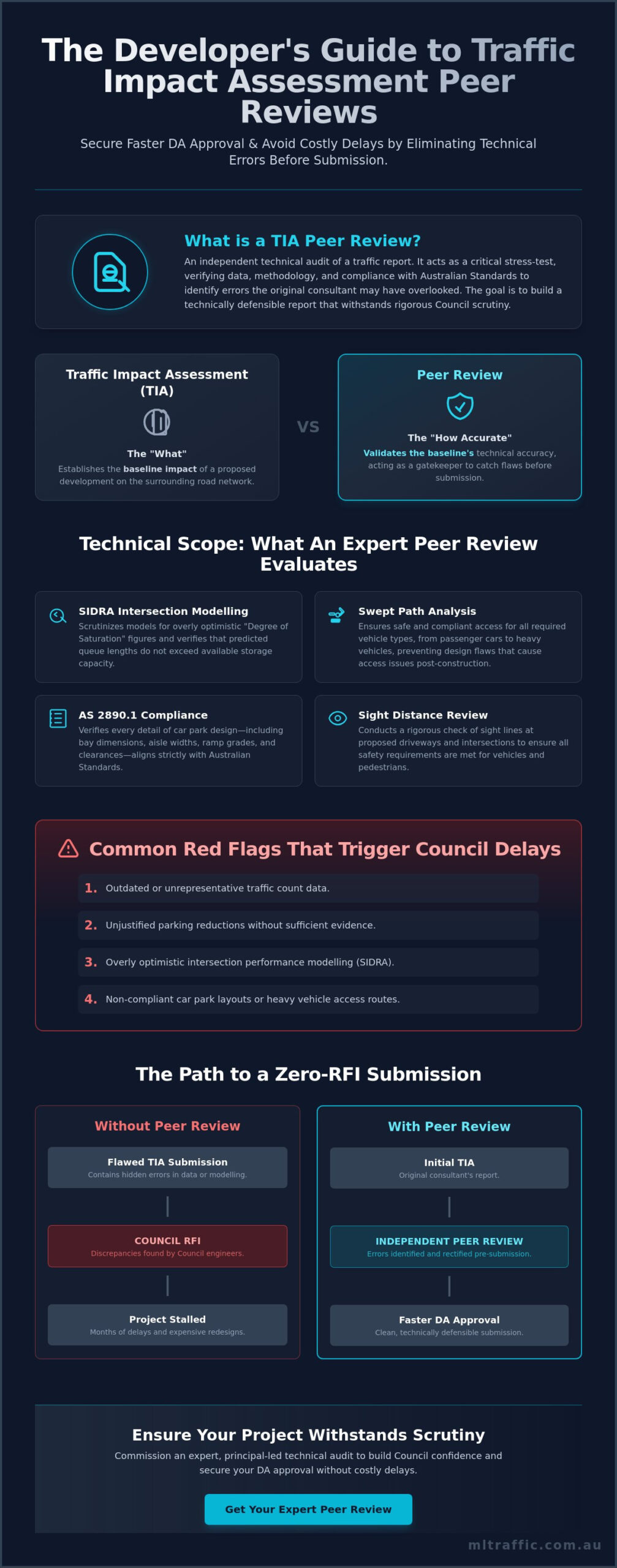
A Traffic Impact Assessment (TIA) establishes the baseline impact of a proposed development on the surrounding road network. In contrast, a peer review validates that baseline’s technical accuracy. Peer reviews focus on identifying the specific weak links in modelling or data sets that typically trigger Council Requests for Further Information (RFIs). The auditor acts as a technical gatekeeper. They ensure the report is robust before final submission. This prevents the common pitfall where a developer relies on flawed data that Council engineers will inevitably reject during the assessment phase.
When to Commission an Independent Traffic Audit
Timing is critical for effective risk mitigation. Developers should commission a peer review of traffic impact assessment prior to DA lodgement to ensure a clean submission. This proactive approach minimizes the likelihood of project-stalling delays. An audit is also essential after receiving a Council RFI that challenges the original consultant’s findings. It provides a professional second opinion to resolve technical disputes. In more complex scenarios, such as Land and Environment Court proceedings, these reviews serve as expert witness support. They validate or contest specific traffic engineering claims with authoritative expertise.
Technical Scope: What an Expert Peer Review Evaluates
An expert peer review of traffic impact assessment dissects the mathematical and geometric foundations of a developer’s submission. It moves beyond high-level summaries to verify the granular data that Council engineers use to approve or reject a Development Application (DA). This technical audit ensures that every assumption, from trip generation rates to intersection performance, is backed by empirical evidence and current industry standards. We focus on identifying the specific technical discrepancies that lead to project-stalling RFIs.
The scope of this review encompasses several critical engineering domains. We validate SIDRA intersection modelling, assess complex Swept Path Analysis for heavy vehicle access, and verify full compliance with AS 2890.1 for all car park layouts. Additionally, we conduct a rigorous review of sight distance at proposed driveway and intersection locations to ensure safety requirements are met before the plans reach the Council’s desk.
SIDRA Modelling and Intersection Capacity
We scrutinize the SIDRA models to identify overly optimistic “Degree of Saturation” figures. It’s common for initial reports to use generic gap acceptance parameters that don’t match real-world driver behaviour in specific Australian contexts. Our audit verifies that predicted queue lengths don’t exceed available storage capacity, which is a frequent trigger for Council rejection. We also check that the model accounts for mandated traffic growth rates, such as the 1.5 percent per year often required in town center forecasts, to ensure the intersection remains functional over the long term.
Geometric Design and Parking Compliance
Geometric errors in car park design are among the costliest mistakes a developer can make. We perform a detailed audit of driveway ramp grades to prevent vehicle scraping, a common issue when transition zones are ignored. Our review verifies that parking space dimensions and aisle widths meet specific land-use requirements under AS 2890.1. We also ensure that swept paths account for the 99th percentile vehicle where required by local planning policies. If your project involves complex heavy vehicle movements, you can view our full range of technical assessment services to see how we validate these designs.
Meticulous attention to these details is what separates a defensible report from one that fails under scrutiny. We analyze the sight distance at every entry and exit point, ensuring that landscaping or signage doesn’t create safety hazards. This comprehensive approach provides the technical assurance needed to navigate the approval process with confidence.
Post-Occupancy Traffic Performance Review: Validating Theoretical Models
A post-occupancy traffic performance review is a specialized empirical study conducted once a development becomes operational. Its primary purpose is to compare real-world traffic volumes and parking behavior against the theoretical projections established in the initial TIA. By 2026, these reviews have transitioned from optional audits to standard regulatory requirements for large-scale developments. Authorities increasingly mandate these studies as a ‘Condition of Consent’ to ensure that a project’s actual impact doesn’t exceed approved limits. A comprehensive peer review of traffic impact assessment often identifies the specific variables that require post-occupancy monitoring to mitigate long-term community concerns.
This data-driven approach allows developers to refine future stages of multi-phase projects. It provides a technical basis for adjusting infrastructure contributions or traffic management strategies based on fact rather than forecast. When theoretical models are validated by actual performance, it builds significant credibility with local government engineers and planning panels.
Actual vs. Predicted Traffic Generation
The core of a post-occupancy review involves measuring peak-hour trip rates against the original TIA projections. We analyze whether the actual vehicle movements align with the models used during the DA phase. A critical component is verifying if parking demand matches the initial Car Parking Demand Assessment. This is particularly vital for developments that secured parking rate reductions based on proximity to public transport or shared-use arrangements. We also evaluate whether off-site traffic impacts at key intersections were accurately forecasted or if unforeseen congestion has developed.
Managing Operational Traffic Issues
Post-completion audits often reveal unforeseen bottlenecks in internal circulation or loading areas that weren’t apparent in the design phase. These issues can lead to dangerous vehicle queuing on public roads or internal gridlock during peak periods. Our reviews provide data-driven solutions for congestion management, ensuring that driveway operations and waste collection movements remain efficient. We validate the effectiveness of implemented Traffic Management Plans and recommend geometric or operational adjustments where necessary. This proactive monitoring protects the developer from liability and ensures the site functions safely for all users.
Utilizing real-world data to resolve operational friction is a hallmark of a results-oriented project management strategy. It ensures that the technical integrity of the development is maintained throughout its lifecycle, not just during the approval process.
Identifying Red Flags in TIAs That Trigger Council Delays
Council engineers maintain a rigorous checklist when evaluating development applications. They look for specific technical weaknesses to justify issuing a Request for Further Information (RFI) to protect public infrastructure. A professional peer review of traffic impact assessment identifies these vulnerabilities before they become formal roadblocks. One of the most common red flags is the use of outdated traffic count data. If your data is older than three years, it likely fails to reflect current network stress or the cumulative impacts of recently approved neighboring developments. Most jurisdictions now require studies older than two years to be updated to ensure accuracy.
Aggressive parking rate reductions also trigger immediate scrutiny. Proposing a significant discount on parking requirements without robust, empirical justification often leads to project rejection. We frequently encounter reports that fail to apply Austroads or State-specific guidelines consistently. This creates a technical disconnect that Council’s senior engineers will exploit during their assessment. Ensuring your consultant hasn’t ignored the “fair share” contributions required for intersections already included in a city’s Transportation Improvement Program is critical for compliance.
Data Integrity and Methodology Errors
Methodological flaws are often hidden in the technical appendices of a report. We identify “cherry-picked” peak periods where the original consultant analyzed a time window that doesn’t represent the true peak network stress. Mathematical inconsistencies between summary tables and raw data sets are another frequent oversight. We also verify the source of trip generation rates. Relying solely on the ITE Trip Generation Manual when local authority guides specify different metrics is a common error that undermines a report’s technical defensibility and leads to immediate questioning by authorities.
Access and Safety Oversight
Safety elements are non-negotiable for regulatory bodies. Many TIA reports focus on vehicle capacity but neglect critical sight distance assessments for pedestrians and cyclists. Inadequate swept path analysis for waste collection or emergency vehicles is another critical failure point that can force a complete site redesign late in the approval process. Sight Distance Assessment is the most scrutinized safety element by Council engineers because it directly impacts public liability and intersection safety. If your current report lacks these specific safety validations, it remains a high-risk document. You can contact our senior principals today for a comprehensive technical audit of your traffic documentation.
Implementing Peer Reviews for National Project Success
Integrating a peer review of traffic impact assessment into your development timeline doesn’t require project downtime. We perform these technical audits concurrently with final architectural refinements to ensure the documentation is bulletproof before DA lodgement. This proactive approach identifies the 5% of errors responsible for 95% of Council delays, as established in our previous sections. We leverage over 15 years of specialized experience to mediate between developers and Council staff. This experience is vital when technical disputes arise regarding intersection performance or parking shortfalls. Every report we review is signed off by a suitably qualified senior traffic engineer, providing the accountability that planning panels and the Land and Environment Court expect.
A successful peer review provides more than just a second opinion; it offers a technical shield against bureaucratic scrutiny. By validating every data point, you eliminate the uncertainty that often leads to costly redesigns. Our process ensures that the technical integrity of your project is maintained from the initial concept through to the final approval. We focus on results-oriented strategies that prioritize project momentum while maintaining strict adherence to Australian Standards.
The ML Traffic Principal-Led Advantage
In many large engineering firms, junior staff perform the bulk of the technical work while senior leaders only provide a final signature. We eliminate this ‘gatekeeper’ barrier by providing direct access to senior principals who perform the actual technical audit. This ensures that the expert who initiates the relationship is the same person conducting the analysis. This personnel continuity is a core signature of our firm’s philosophy. It guarantees that the technical depth of your peer review of traffic impact assessment isn’t diluted by internal bureaucracy.
- Direct Accountability: You have a direct line to the senior engineers performing the work.
- Expert Precision: Senior leadership brings decades of experience to every swept path and intersection model.
- Efficient Workflow: Eliminating junior tiers speeds up the audit process without sacrificing technical rigour.
- Reliable Continuity: The engineer who starts your review is the one who finishes it.
Securing Your DA Approval in 2026
A peer-validated traffic submission reduces long-term legal costs and prevents expensive post-DA redesigns. By identifying technical red flags early, you ensure the project’s financial feasibility remains intact. As we move through 2026, the standard for technical defensibility continues to rise. A bulletproof submission must verify that traffic counts are current, SIDRA models are validated against local growth rates, and all safety assessments are complete. Contact our senior team for a confidential Traffic Impact Assessment peer review today to secure your project’s approval path.
Secure Your DA Approval with Technical Certainty
A robust peer review of traffic impact assessment is the final safeguard against project-stalling Council RFIs. By validating SIDRA models and geometric designs before submission, you eliminate the technical discrepancies that typically lead to expensive redesigns. This meticulous audit ensures full compliance with Australian Standards and builds immediate credibility with regulatory authorities. It transforms a standard report into a technically defensible document that withstands the most rigorous bureaucratic scrutiny.
We leverage over 15 years of specialist traffic engineering experience to provide a proven track record of resolving complex Council RFIs nationally. Our principal-led approach guarantees direct access to senior experts on every project. This ensures your technical work is performed by the same qualified engineer from the initial review through to final sign-off. You can Secure a Principal-Led Peer Review for Your Next Project to fortify your submission and maintain critical project momentum. Taking this proactive technical step today protects your development’s timeline and long-term financial feasibility. We look forward to helping you navigate the technical requirements of your next traffic submission with confidence.
Frequently Asked Questions
What is the primary purpose of a peer review for a traffic report?
The primary purpose of a peer review of traffic impact assessment is to verify the technical integrity and regulatory compliance of a third-party report. It serves as a meticulous audit of data sets, modelling assumptions, and geometric designs against Australian Standards like AS 2890.1. This process identifies hidden errors that often trigger Council RFIs. By validating every data point, developers mitigate the risk of project-stalling delays and unexpected redesign requests.
How much time does a professional peer review typically add to the DA process?
A professional peer review typically adds one to two weeks to the preparation timeline but often saves months in the overall DA process. We perform these technical audits concurrently with final architectural refinements to maintain project momentum. This proactive step prevents the lengthy delays associated with responding to formal Council requests for further information. The time invested upfront ensures a cleaner, more defensible submission that moves through the assessment phase more efficiently.
Can a peer review help if Council has already rejected my traffic report?
A peer review is highly effective if Council has already challenged or rejected your traffic documentation. It provides an independent technical audit that can identify where the original report failed to meet regulatory expectations. Our senior principals use this data to mediate between developers and Council staff. We provide a technically sound second look that often resolves disputes through refined modelling or more robust empirical evidence.
Does the peer review consultant need to be located in the same city as the project?
The peer review consultant doesn’t need to be located in the same city as the project. Modern traffic engineering relies on national standards and state-specific guidelines that an experienced professional can apply regardless of location. What matters most is the engineer’s familiarity with local planning schemes and their ability to interpret specific regional traffic growth rates. We provide national project support by leveraging over 15 years of experience across diverse project environments.
What are the most common technical errors found during a traffic peer review?
The most common errors found during a peer review of traffic impact assessment include outdated traffic count data and aggressive parking rate reductions. Many reports utilize data sets older than three years which Councils now routinely reject. Other frequent issues involve inconsistent SIDRA modelling parameters and inadequate swept path analysis for waste collection vehicles. Identifying these flaws early prevents the technical disconnects that lead to project rejection during the formal assessment phase.
Is a post-occupancy traffic performance review mandatory for all developments?
Post-occupancy traffic performance reviews aren’t mandatory for all developments but have become a standard requirement for large-scale projects in 2026. Authorities often include these studies as a ‘Condition of Consent’ for high-impact sites. They ensure that actual traffic generation aligns with the theoretical projections made during the DA phase. This requirement is particularly common for developments that requested significant parking discounts or those located in sensitive town center environments.
How do peer reviews handle conflicting SIDRA modelling results?
Peer reviews resolve conflicting SIDRA modelling results by scrutinizing the raw data inputs and gap acceptance parameters. We identify whether a model uses overly optimistic saturation figures that don’t reflect real-world driver behaviour. By verifying that queue lengths don’t exceed available storage capacity, we find the most realistic representation of intersection performance. This technical audit provides a defensible baseline that resolves disputes between different consultants or with Council engineers.
What qualifications should I look for in a peer review traffic engineer?
You should look for a suitably qualified senior traffic engineer with a minimum of 15 years of specialist experience. It’s critical that the review is principal-led rather than delegated to junior staff. Look for professionals with a proven track record of resolving complex Council RFIs and those who maintain direct accountability for their technical findings. Ensuring the engineer has experience in Land and Environment Court proceedings also adds a layer of technical authority to your submission.

Disclaimer
The content on www.mltraffic.com.au, including all technical articles, guides, and resources, is provided for general informational and educational purposes only. It is not intended to constitute professional advice in traffic engineering, transportation planning, development approvals, or any other technical or legal field.
While ML Traffic Engineers makes every reasonable effort to ensure the accuracy, completeness, and timeliness of the information published, we do not provide any warranties or representations (express or implied) regarding its reliability, suitability, or availability for any particular purpose. Any reliance you place on the content is strictly at your own risk.
In no event shall ML Traffic Engineers, its directors, employees, authors, or affiliates be liable for any direct, indirect, incidental, special, consequential, or punitive damages (including, without limitation, loss of profits, data, or business opportunities) arising out of or in connection with the use of, or inability to use, any information provided on this website.
The articles and guides on this site are not a substitute for engaging a qualified, registered professional traffic engineer (such as an NPER or RPEQ engineer) to assess your specific project requirements. For tailored advice, compliance assessments, or traffic engineering services, please contact a competent professional.
This disclaimer may be updated from time to time without notice. By accessing or using this website, you agree to be bound by the most current version of this disclaimer.
