
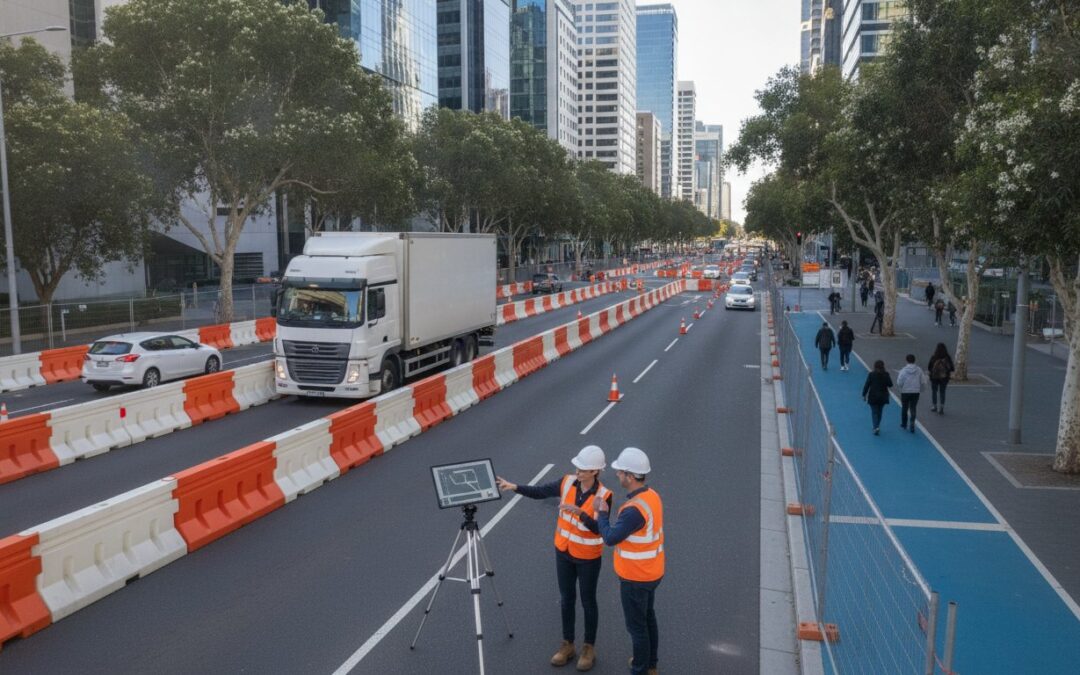
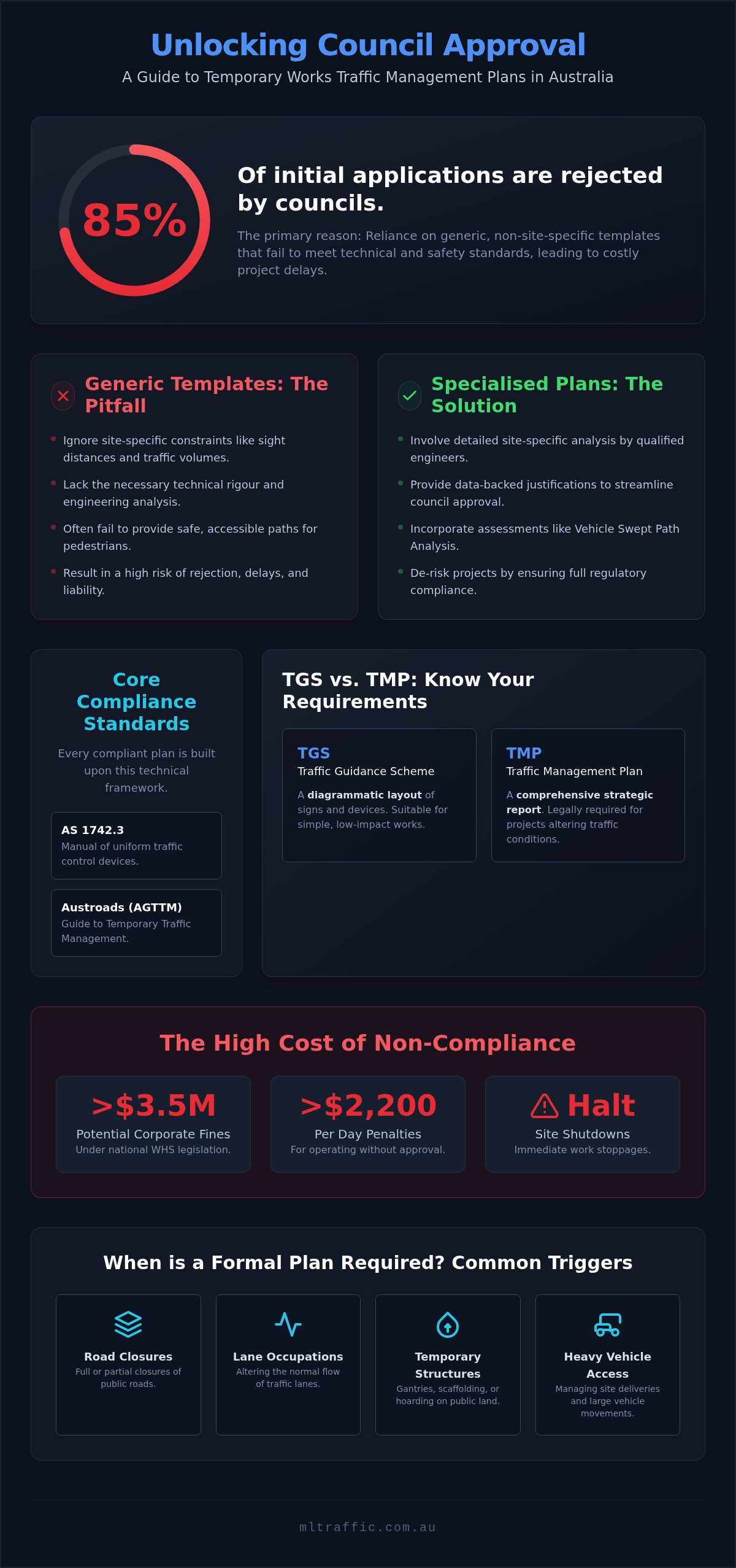
Did you know that in 2026, approximately 85% of initial traffic management plan applications were rejected by councils because they relied on generic, non-site-specific templates? For project managers and developers, these avoidable delays translate directly into mounting costs and compromised delivery schedules. You likely recognise the frustration of navigating bureaucratic hurdles or the high liability risks associated with construction phases when a temporary works traffic management plan lacks the necessary technical rigour.
This guide provides the engineering clarity required to master compliance standards and ensure site safety while facilitating rapid council approval. We’ll provide a detailed breakdown of the technical requirements mandated by AS 1742.3 and the latest Austroads standards. You’ll learn to distinguish between TGS and TMP obligations, the critical role of Vehicle Swept Path Analysis in site layout, and how to design a robust strategy that minimises disruption to public road networks. By applying these specialised engineering principles, you can eliminate confusion and ensure your project remains fully compliant with the 2026 regulatory landscape.
Key Takeaways
- Understand how a temporary works traffic management plan acts as a dynamic safety document necessary for securing Council and Road Authority approvals.
- Learn the critical engineering differences between AS 1742.3 and the Austroads Guide to Temporary Traffic Management (AGTTM) to ensure full regulatory compliance.
- Identify when a diagrammatic Traffic Guidance Scheme (TGS) is sufficient versus when a comprehensive, strategic report is legally required for your project.
- Discover the primary technical reasons for Council rejection and how to use data-backed justifications to streamline the approval process.
- Recognise the value of direct principal involvement and specialised assessments, such as Swept Path Analysis, in de-risking development projects.
Defining Temporary Works Traffic Management Plans for Australian Projects
A temporary works traffic management plan is a dynamic engineering document designed to mitigate risks during construction, maintenance, or infrastructure upgrades. It is not merely a static diagram; it’s a comprehensive strategy that ensures the safety of workers, motorists, and pedestrians while maintaining the functionality of the surrounding road network. This document is a mandatory requirement for securing Council and Road Authority approvals across Australia. Without it, projects cannot legally occupy public space or modify existing traffic conditions. Professional planning ensures that the site remains operational while minimising liability through rigorous technical analysis.
To better understand the components and importance of these safety documents, watch this helpful video:
Generic templates often fail because they ignore site-specific constraints like sight distances, local traffic volumes, or heavy vehicle turning circles. Effective plans require detailed road traffic control measures that account for the unique geometry of the site and the specific nature of the works. Integrating pedestrian management is equally critical. Failing to provide safe, accessible paths for the public often leads to immediate rejection by regulatory authorities. Our firm prioritises direct senior principal involvement to ensure every plan addresses these technical nuances from the initial assessment through to final approval.
The Legal and Safety Imperative
Construction firms hold a strict duty of care under Australian Work Health and Safety (WHS) legislation. Professionally engineered documentation serves as the primary defence against liability and site-related incidents. The consequences of non-compliance are severe. Under national WHS laws, fines for corporations can exceed $3.5 million. Additionally, sites risk immediate shutdowns and significant daily penalties, which in some jurisdictions reach upwards of $2,200 per day for operating without an approved temporary works traffic management plan. A robust strategy reduces the likelihood of safety incidents and protects the project’s commercial viability.
When is a Formal Plan Required?
A formal plan is triggered by any activity that alters the normal operation of a road or footpath. Common trigger points include full or partial road closures, lane occupations, and the installation of temporary structures such as gantries, scaffolding, or hoarding on public land. Heavy vehicle access requirements for site deliveries also necessitate formal documentation to manage traffic flow and ensure safety. Council-specific mandates for Development Applications (DA) frequently require these plans to be submitted well before work commences. This ensures the public road network remains functional and that all temporary structures meet strict national safety and engineering standards.
Core Engineering Standards and Regulatory Compliance
Engineering standards provide the technical framework for every compliant temporary works traffic management plan. The primary reference in Australia is AS 1742.3:2019, which specifies the manual for uniform traffic control devices. This is supplemented by the Austroads Guide to Temporary Traffic Management (AGTTM). As of June 2026, nine parts of the AGTTM were updated, requiring practitioners to re-verify all technical layouts against Edition 1.2. These standards ensure that every sign, bollard, and taper meets national safety benchmarks for both high-speed and low-speed environments.
State road authorities frequently release specific supplements that clarify or override national guides. A qualified Traffic Engineer acts as the technical interpreter when these regulations overlap. They ensure the documentation satisfies both local requirements and Safe Work Australia’s traffic management guidelines. This level of professional oversight is essential to mitigate the 22% increase in national audit rates observed since 2023. Precise adherence to these standards is the only way to manage the significant liability risks associated with construction traffic.
Swept Path Analysis in Temporary Works
Performing a swept path analysis is a non-negotiable step for any site with restricted access. Temporary hoardings and scaffolding often narrow the effective road width, creating hazards for heavy vehicles. We use AutoTURN software to simulate complex turns for 12.5m heavy rigid vehicles or 19.5m articulated vehicles. These simulations validate that plant equipment can enter and exit the site without striking temporary structures or encroaching on live traffic lanes. If your project involves tight urban corners or complex site geometry, you can contact our senior principals to verify your site’s technical feasibility.
Pedestrian and Cyclist Safety Integration
Protecting vulnerable road users is a core requirement of national engineering standards. When construction hoardings occupy footpaths, the plan must include compliant diversions that maintain accessible paths of travel. This includes specific requirements for barricading, temporary ramps, and tactile indicators. Under the latest AGTTM updates, signage must be placed at precise intervals to give cyclists adequate warning of lane merges or surface changes. Failure to integrate these elements often results in immediate site shutdowns by regulatory bodies. Every temporary works traffic management plan must demonstrate a clear, safe, and unobstructed route for all non-vehicular traffic.
Comparing Traffic Guidance Schemes (TGS) and Traffic Management Plans
Understanding the distinction between a Traffic Guidance Scheme (TGS) and a Traffic Management Plan (TMP) is essential for project continuity. A TGS is a technical diagram illustrating the precise placement of signs, bollards, and devices. It provides the “how” of site-level traffic control. In contrast, a traffic management plan is a comprehensive strategic document. It addresses the “why” and “when” of traffic movements across the broader road network. For most Australian developments, a temporary works traffic management plan must integrate both to meet regulatory expectations.
The choice between a simple layout and a detailed report depends on project complexity and the level of impact on public infrastructure. While a minor footpath repair might only require a standard TGS, any development involving lane occupations or heavy vehicle access demands a strategic TMP. Investing in professional engineering early reduces long-term costs. It prevents the common cycle of council rejections and site shutdowns that plague projects relying on generic, non-site-specific schemes.
Technical Components of a Traffic Guidance Scheme
A TGS focuses on the immediate physical environment of the worksite. It must specify signage placement, taper lengths, and buffer zones according to the speed environment and road type. Standard schemes work for routine tasks, but modified schemes are necessary for sites with unique constraints like hidden driveways or steep gradients. Every TGS must be designed or endorsed by an accredited traffic designer. This ensures the layout is not only safe but also technically defensible if an incident occurs on-site.
The Strategic Traffic Management Plan
A strategic TMP provides a high-level risk assessment and mitigation strategy, particularly for high-volume urban areas. It outlines stakeholder consultation protocols and details how the project will communicate with residents, emergency services, and public transport authorities. This document is not static. It must evolve alongside the project, with regular monitoring and updates to reflect changing site conditions. A robust temporary works traffic management plan includes clear contingency measures for peak periods or unexpected road network incidents. Our senior principals remain involved throughout this lifecycle to ensure the strategy remains effective and compliant from inception to completion.
Ultimately, a well-conceived plan acts as a project insurance policy. It provides a data-backed justification for temporary road occupations, making it significantly easier to secure approvals from road authorities. By addressing strategic impacts before they become operational hurdles, you ensure the project stays on schedule and within budget.
Navigating Council Approvals for Temporary Structures
Securing council approval for a temporary works traffic management plan requires more than a standard checklist. Councils frequently reject applications that lack site-specific technical data or fail to address local infrastructure impacts. Common rejection triggers include insufficient sight distance assessments, inadequate pedestrian protection, or poorly justified parking losses. To avoid these delays, engineering reports must provide data-backed justifications. This includes detailed traffic volume analysis and clear evidence that the proposed occupation is the safest viable option for the specific site geometry.
Integrating this documentation with the broader Construction Management Plan (CMP) is a regulatory necessity. The timeline from the initial site assessment to the issuance of a final permit varies between jurisdictions, but professional oversight ensures the traffic component aligns with the overall construction programme. This prevents the common bottleneck where physical work is ready to commence but the authorised permits are still pending. Our senior principals manage this process directly, ensuring that the technical requirements of the road authority are met without unnecessary bureaucratic delays.
Gantry and Hoarding Traffic Engineering
Installing temporary structures like gantries or hoardings creates immediate physical constraints on the road network. We analyse sight distances around these structures to ensure motorists and pedestrians maintain clear visibility at intersections and driveway crossings. Hoardings often require the removal of existing on-street parking or the narrowing of traffic lanes. Our engineering reports quantify these impacts and propose mitigation strategies that satisfy council safety requirements. Using specialised assessments ensures that temporary structures don’t become hazards during the construction phase.
Heavy Vehicle and Crane Access
Major plant installations and oversized vehicle deliveries require meticulous planning. Coordinating temporary road closures for crane standing involves managing the impact on local public transport routes and emergency service access. A robust temporary works traffic management plan must detail these movements with precision. This includes identifying specific times of day for heavy vehicle entry to minimise peak-hour disruption. If your project involves complex crane lifts or heavy plant access, you can request a specialised traffic assessment from our senior principals to secure the necessary permits.
Effective approval navigation relies on professional accountability. Our “no-gatekeepers” approach means the expert who conducts the technical swept path analysis or site assessment is the same person who defends the plan to council officers. This continuity ensures that technical questions are answered immediately. It reduces the risk of multiple RFI cycles and keeps your project on schedule.
Engaging a Specialist Traffic Engineer for Temporary Works
Engaging a specialist for a temporary works traffic management plan is a strategic decision to de-risk your development and ensure operational continuity. Professional traffic engineering provides the technical rigour required to satisfy regulatory officers while maintaining site productivity. Many large firms delegate technical work to junior staff once the contract is signed. We reject this model. Direct principal involvement ensures that senior expertise is applied to every calculation and site assessment. This leads to better project outcomes and significantly fewer requests for information (RFIs) from road authorities.
The “personnel continuity promise” is a core signature of our consultancy. The expert who initiates your project brief is the same professional who performs the technical delivery. This hands-on approach ensures accountability and deep-seated knowledge of your site’s specific constraints. It eliminates the communication gaps that often occur in impersonal, multi-layered firms. By maintaining this direct line, we ensure that the strategic intent of the traffic plan is never lost during the technical drafting phase.
The ML Traffic Engineers Australia Approach
Our consultancy leverages over 15 years of experience in the Australian traffic sector. We focus on providing meticulous, compliance-focused reporting that adheres to the latest national standards. Clients receive direct access to senior experts who perform the technical work, including Vehicle Swept Path Analysis and site-specific risk assessments. This level of professional status and regulatory certification is essential for high-stakes projects involving arterial roads or complex urban environments. We don’t use generic templates. Every report is a site-specific engineering document designed to facilitate rapid approval.
Getting Started with Your Assessment
To initiate a professional traffic engineering assessment, you must provide a clear project brief. This allows us to identify potential constraints before they become costly delays. Essential documentation includes:
- Detailed site plans and architectural drawings.
- Land survey data showing existing road geometry and infrastructure.
- Proposed project timelines and construction phases.
- Details of heavy vehicle requirements and crane standing locations.
The consultation process begins by identifying site constraints early. This proactive approach prevents the high rejection rates often associated with non-site-specific schemes. Once we review your documentation, we provide a data-backed strategy tailored to your development’s specific needs. You can contact ML Traffic Engineers Australia for a professional quote and direct access to our senior principals.
Securing Project Continuity Through Engineering Excellence
Mastering the technical requirements of a temporary works traffic management plan is the most effective way to eliminate project delays and mitigate corporate liability. This guide has detailed the necessity of adhering to AS 1742.3 and the 2026 Austroads updates to ensure both site safety and regulatory compliance. You now understand that a site-specific, data-backed strategy is essential for navigating the increasingly rigorous council approval process and avoiding the high rejection rates associated with generic templates.
Our firm brings over 15 years of specialised Australian consultancy experience to every project. We prioritise a “no-gatekeepers” approach, providing you with direct access to senior principals who perform the technical work themselves. This ensures that your documentation remains robust, accountable, and fully aligned with current engineering standards. We invite you to request a professional traffic management assessment from our senior engineers to secure your site’s operational future. Professional oversight is the definitive path to a safe, compliant, and successful development.
Frequently Asked Questions
What is the difference between a TGS and a TMP?
A Traffic Guidance Scheme (TGS) is a technical diagram showing the precise layout of signs and devices on a worksite. It focuses on the immediate physical control of traffic. A Traffic Management Plan (TMP) is a strategic document that outlines the overall risk management, stakeholder consultation, and network impact. While a TGS provides the “how” for site workers, a temporary works traffic management plan integrates both to satisfy council and road authority safety requirements.
How long does it take to get a traffic management plan approved by Council?
Approval timelines vary significantly depending on the complexity of the project and the specific road authority involved. Most local councils require between 10 and 30 business days to review and process applications. Complex projects involving arterial roads or major lane occupations often require longer lead times for multi-agency consultation. We recommend submitting your documentation well in advance of the scheduled construction commencement date to avoid costly delays or site shutdowns.
Do I need a swept path analysis for temporary site access?
A vehicle swept path analysis is essential whenever a site involves heavy vehicle movements or restricted access points. Temporary structures like hoardings and gantries often narrow the available road width, creating potential collision risks. Using specialised software like AutoTURN, we simulate the turning circles of heavy rigid or articulated vehicles to ensure they can safely enter and exit the site. This technical validation is a common requirement for council approvals and de-risks the development.
Who is qualified to prepare a temporary works traffic management plan?
These documents must be prepared by individuals holding the relevant state-specific accreditation, such as an accredited traffic designer or a qualified traffic engineer. Professional consultancy firms with specialised experience in transport planning provide the technical rigour necessary for high-stakes developments. Our senior principals personally oversee every temporary works traffic management plan, ensuring that the expert who initiates the project brief is the one who performs the technical delivery and reporting.
How often does a traffic management plan need to be reviewed?
Plans should be reviewed whenever there is a significant change to the site layout, construction phase, or local traffic conditions. Even if the site remains static, regular audits are necessary to ensure ongoing compliance with Australian Standards. Regulatory bodies often specify review intervals, such as every six months or at the commencement of a new project stage. Maintaining an up-to-date document is critical for managing liability and ensuring the safety of all road users.
What Australian Standards apply to temporary traffic management?
The primary standards are AS 1742.3:2019, which covers traffic control for works on roads, and the Austroads Guide to Temporary Traffic Management (AGTTM). Additionally, AS 2890.1 and AS 2890.2 apply to parking and off-street access. As of June 2026, nine parts of the AGTTM were updated, making it essential to re-verify all technical layouts against the latest editions. Adherence to these national standards is mandatory for securing planning and road occupancy permits.
Can I use a generic traffic control plan for a complex construction site?
Generic templates are unsuitable for complex construction environments and are frequently rejected by regulatory authorities. In 2026, approximately 85% of initial application rejections were attributed to the use of non-site-specific plans. A complex site requires a tailored approach that accounts for unique geometry, local traffic volumes, and pedestrian movements. Professionally engineered, site-specific documentation is the only way to ensure compliance and facilitate a smooth approval process with local councils.
What happens if our site fails to follow the approved traffic management plan?
Failing to adhere to an approved plan can result in severe legal and financial consequences. In New South Wales, non-compliant sites face daily fines of $2,200, while corporate penalties under Australian Work Health and Safety laws can exceed $3.5 million. Beyond financial risks, unauthorised modifications to traffic flow can lead to immediate site shutdowns and increased liability if an incident occurs. Strict compliance is essential to protect the safety of the public and the project’s commercial viability.

Disclaimer
The content on www.mltraffic.com.au, including all technical articles, guides, and resources, is provided for general informational and educational purposes only. It is not intended to constitute professional advice in traffic engineering, transportation planning, development approvals, or any other technical or legal field.
While ML Traffic Engineers makes every reasonable effort to ensure the accuracy, completeness, and timeliness of the information published, we do not provide any warranties or representations (express or implied) regarding its reliability, suitability, or availability for any particular purpose. Any reliance you place on the content is strictly at your own risk.
In no event shall ML Traffic Engineers, its directors, employees, authors, or affiliates be liable for any direct, indirect, incidental, special, consequential, or punitive damages (including, without limitation, loss of profits, data, or business opportunities) arising out of or in connection with the use of, or inability to use, any information provided on this website.
The articles and guides on this site are not a substitute for engaging a qualified, registered professional traffic engineer (such as an NPER or RPEQ engineer) to assess your specific project requirements. For tailored advice, compliance assessments, or traffic engineering services, please contact a competent professional.
This disclaimer may be updated from time to time without notice. By accessing or using this website, you agree to be bound by the most current version of this disclaimer.
