

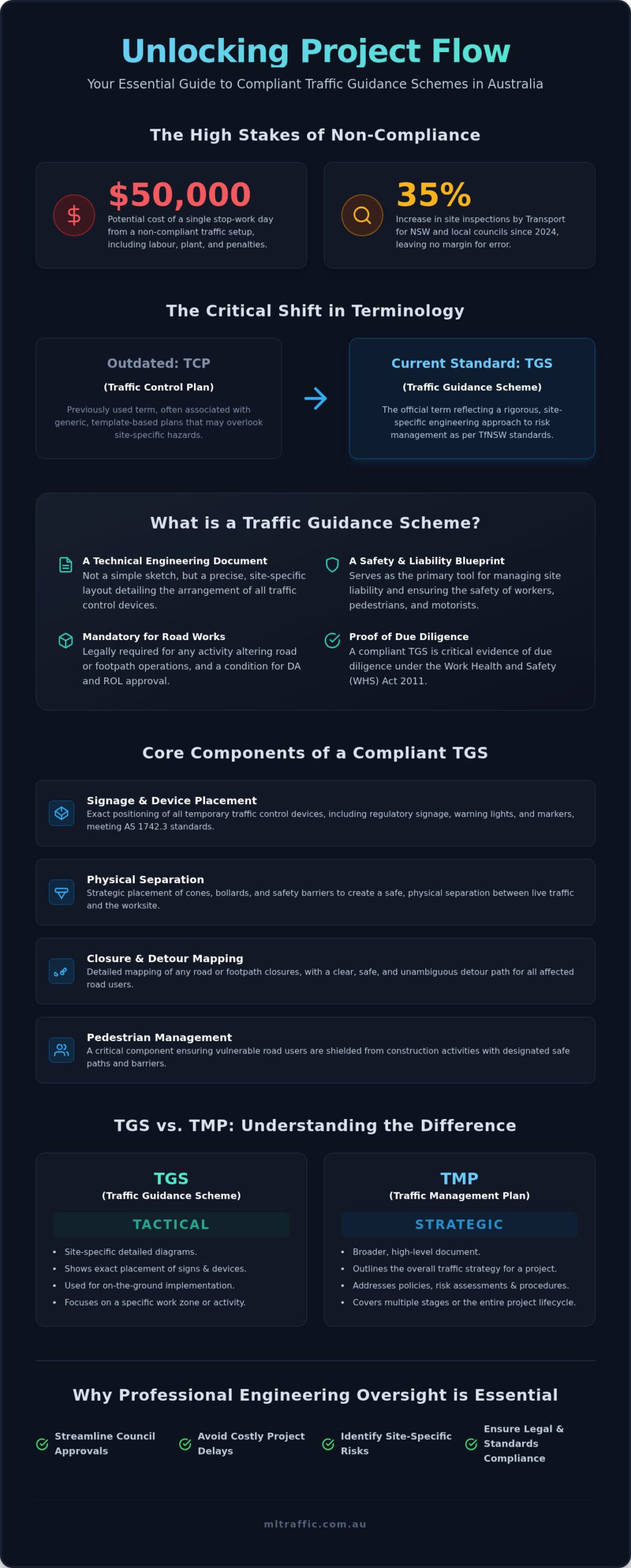
A single unplanned stop-work day due to a non-compliant traffic setup can cost a large construction project up to $50,000 in combined idle labour, plant, and contractual penalties. Transport for NSW and local councils increased site inspections by 35% since 2024. The margin for error is gone. You recognise that securing a compliant traffic guidance scheme Sydney authorities will approve is more than a simple drawing. It’s a technical engineering document that dictates your project’s legal and financial viability.
We understand the frustration of council delays caused by non-compliant plans or the confusing shift from TCP to TGS terminology. This guide outlines the essential requirements for a compliant Traffic Guidance Scheme to secure fast council approval and ensure site safety across Australia. You’ll learn how to align documentation with the latest TCAWS Technical Manual standards, specifically Technical Standard TS 05492:1.0, and Australian Standard AS 1742.3:2019. We provide a clear breakdown of the regulatory framework, accreditation needs, and the technical details required to keep your worksite efficient and compliant.
Key Takeaways
- Understand the technical transition from Traffic Control Plans (TCP) to the current Traffic Guidance Scheme (TGS) requirements under Australian Standards.
- Identify the mandatory visual elements, including temporary signage and device placement, required for a compliant traffic guidance scheme Sydney councils will approve.
- Distinguish between strategic Traffic Management Plans (TMP) and tactical Traffic Guidance Schemes (TGS) to ensure documentation aligns with specific regulatory expectations.
- Streamline the acquisition of Road Occupancy Licences (ROL) and local council permits by avoiding common submission errors that cause project delays.
- Recognise why professional engineering oversight is essential for identifying site-specific risks that generic templates often overlook.
What is a Traffic Guidance Scheme (TGS)?
A Traffic Guidance Scheme (TGS) is a technical engineering document that specifies the exact arrangement of temporary traffic control devices for a worksite. It isn’t a simple diagram or a rough sketch. It’s a site-specific layout that applies the principles of road traffic control to a unique geographical and traffic context. For developers, a traffic guidance scheme Sydney authorities will approve serves as the primary mechanism for managing site liability and ensuring the safe movement of vehicles and pedestrians.
This scheme acts as a tactical blueprint for safety on any construction site or infrastructure project. It protects personnel, pedestrians, and motorists by providing clear, visual instructions through the placement of signs, barriers, and markers. Under the Work Health and Safety (WHS) Act 2011, a compliant TGS is evidence of due diligence. It’s a mandatory requirement for any work that impacts the standard operation of public road networks or private roads with public access.
To better understand how these technical schemes are developed and implemented, watch this step-by-step guide:
The transition from TCP to TGS
Terminology in the New South Wales civil sector has evolved. The term Traffic Control Plan (TCP) has been officially replaced by Traffic Guidance Scheme (TGS) in the Transport for NSW (TfNSW) Traffic Control at Work Sites (TCAWS) Technical Manual. This change reflects a broader industry shift towards site-specific risk management. At ML Traffic Engineers Australia, our specialists ensure every traffic service we provide aligns with the latest Technical Standard TS 05492:1.0. Councils now specifically request a TGS because it implies a more rigorous assessment of unique site hazards than older, generic templates allowed.
When do you legally require a TGS?
You legally require a TGS for any activity that alters the normal operation of a road or footpath. This includes lane closures, plant crossing a public verge, or restricting access to construction sites from public thoroughfares. Local government authorities typically include TGS submission as a non-negotiable condition of a Development Application (DA). It’s also a prerequisite for obtaining a Road Occupancy Licence (ROL) through the OPLINC system. Without this documentation, your site remains non-compliant and vulnerable to significant penalties for directing work without a proper traffic management framework in place.
Key Components of a Compliant Traffic Guidance Scheme
A compliant traffic guidance scheme Sydney developers rely on for site safety is a high-precision document. It details the exact positioning of every temporary traffic control device. This includes the visual layout of regulatory signage, warning lights, and markers. These plans must also specify the placement of cones and bollards to create physical separation between live traffic and the worksite. Meticulous documentation of these components is the only way to satisfy the heavy enforcement seen in 2026.
Detailed mapping of road or footpath closures is a core requirement for any infrastructure project. If a project necessitates a detour, the TGS must provide a clear, safe path for all road users. Pedestrian management is equally critical in high-density urban environments. Safety barriers must be integrated into the design to ensure vulnerable road users are shielded from construction activities. Understanding the council approval process for a TGS reveals that authorities prioritise these technical details over generic sketches.
Adherence to Australian Standards (AS 1742.3)
National compliance rests on the Manual of Uniform Traffic Control Devices. Every sign size, colour, and font must meet the engineering benchmarks set by AS 1742.3. Generic plans frequently fail council inspections because they ignore these standardisation rules. A professional TGS ensures that every device is legally defensible and provides clear, unambiguous instructions to motorists. This level of detail is necessary to avoid the significant penalties associated with non-compliant worksites. Our principals, with over 15 years of consultancy experience, ensure that every plan adheres to these rigorous national standards.
Advanced Engineering Inputs for TGS Design
Effective schemes require more than just sign placement. We use Swept Path Analysis to verify vehicle manoeuvrability within the proposed scheme. This is vital in tight Sydney streetscapes where heavy vehicles require specific turning paths that generic templates cannot accommodate. Intersection analysis further informs the placement and timing of traffic controllers to prevent unnecessary congestion and local complaints. Professional oversight ensures your scheme accounts for sight distances and gradient changes that impact stopping times. If you require technical precision for your next project, you can contact our specialist engineers for a compliant solution.
TGS vs. TMP: Understanding the Differences
Distinguishing between strategic planning and tactical implementation is a regulatory necessity for modern developments. A Traffic Management Plan (TMP) provides the high-level framework, whereas a Traffic Guidance Scheme (TGS) is the site-specific diagram used for physical execution. It’s a clear hierarchy where the TMP defines the ‘what’ and ‘why’ of traffic mitigation, and the TGS provides the literal ‘how’ for the worksite. The TMP sets the safety objectives that the TGS must physically manifest on-site.
The Strategic Role of a Traffic Management Plan
A TMP evaluates the cumulative impact of a construction project on the broader road network and public transport infrastructure. This document addresses project staging, pedestrian desire lines, and stakeholder consultation requirements. For projects affecting arterial routes, this involves direct coordination with the Transport Management Centre to ensure network-wide coordination. The TMP is the overarching strategy for traffic mitigation. It proves to authorities that the project is viable from a network capacity perspective before any work commences.
Strategic planning prevents the ‘domino effect’ where a minor lane closure in one precinct causes gridlock in another. A TMP assesses these risks through data-driven analysis of traffic volumes and peak-hour demands. It ensures that the project doesn’t just work in isolation but integrates safely with the existing urban fabric. This document is typically required during the early planning and Development Application (DA) phases to establish the project’s feasibility and safety commitments.
The Tactical Execution of a TGS
While the TMP manages the ‘big picture’, the TGS provides the literal map for site safety. A traffic guidance scheme Sydney councils approve must be granular enough to guide site personnel through daily adjustments. It focuses on the ‘boots on the ground’ layout, detailing the precise location of every sign, cone, and barrier required for a specific work stage. It’s the primary document traffic controllers use to manage live traffic flow. Unlike the static strategy of a TMP, a TGS accounts for immediate site hazards and shifting operational needs.
ML Traffic Engineers Australia ensures that the strategic goals of the TMP are accurately translated into the tactical TGS. We maintain a strict policy of personnel continuity; the engineer who designs your overarching strategy is the same professional who prepares the site-specific diagrams. This prevents the technical disconnect that often occurs in larger firms when work is siloed across different departments. Each phase of work, from initial excavation to final utility fit-outs, requires its own tactical layout to remain compliant. Our principals remain directly involved in the design of these schemes to ensure that tactical execution never compromises the safety standards set by the TMP.
Navigating the Council Approval Process for your Scheme
Securing approval for a traffic guidance scheme Sydney authorities will accept requires more than just technical accuracy. It demands an understanding of bureaucratic timelines and specific technical triggers. Councils frequently reject submissions that lack site-specific detail or fail to account for the cumulative impact of nearby worksites. Common reasons for rejection include incorrect sign spacing, failure to account for clearway restrictions, and inadequate provision for pedestrian detours. Avoiding these errors is critical to preventing the stop-work orders that can cost projects up to $50,000 per day in idle labour and plant costs.
Integrating the TGS into your broader Construction Management Plan (CMP) is a standard requirement for major developments. A TGS that exists in isolation often fails during the public consultation phase because it doesn’t address the concerns of local residents and businesses. Professional planning demonstrates to the council that you have considered the impact on local access and noise levels. This proactive approach manages stakeholder expectations and reduces the likelihood of community complaints that can trigger additional council inspections. With TfNSW and councils increasing site inspections by 35% in 2026, your documentation must be beyond reproach.
Securing Road Occupancy Licences (ROL)
Applying for a Road Occupancy Licence (ROL) is a mandatory step for any work that occupies road space. For state-managed roads, applications are lodged through the OPLINC system. TfNSW typically processes complete ROL applications within 10 business days. For local roads, council approvals for road occupancy generally take between 7 to 15 business days. A professionally designed TGS speeds up this process by providing the precise technical data assessors require, which minimises the need for time-consuming revisions. Coordinating with state road authorities for arterial road impacts is particularly complex and requires a plan that accounts for peak traffic flow and clearway times.
Meeting Development Application (DA) Conditions
Translating complex DA conditions into a workable traffic guidance scheme is a significant technical hurdle. Councils often issue detailed queries regarding heavy vehicle access or pedestrian safety that require specialised Traffic Engineering expertise to resolve. It’s essential that your TGS aligns with the Traffic Impact Assessment submitted during the initial planning phase. Any discrepancy between these documents can lead to immediate rejection. Professional oversight ensures that your tactical on-site plans remain consistent with your strategic planning commitments. If you are facing council delays or complex DA conditions, contact our expert principals to streamline your approval process.
Why Professional Engineering Oversight is Essential for a TGS
The reliance on non-certified or ‘template’ traffic guidance schemes remains a significant liability for Australian developers. Generic diagrams often ignore site-specific variables such as road gradients, existing street furniture, or complex sight distances that impact motorist reaction times. Professional engineers identify these technical risks during the design phase, preventing on-site accidents and the immediate prohibition notices issued by SafeWork NSW. A template may seem cost-effective at the quoting stage, but the lack of technical accountability often leads to expensive council rejections and avoidable project delays.
Principal-led consultancy is a prerequisite for managing the complexities of high-stakes development projects. Meticulous traffic planning ensures long-term project viability by addressing compliance requirements before any plant arrives on-site. Engineering oversight provides a legally defensible position in the event of a site incident, offering a level of technical rigour that generic sign-off services cannot match. This professional scrutiny is necessary to manage the increasingly strict regulatory environment where even minor deviations from an approved traffic guidance scheme Sydney authorities have issued can result in work stoppages.
The ML Traffic Engineers Australia Advantage
We provide direct access to senior principals who hold over 15 years of Australian consultancy experience. Our unique personnel continuity promise ensures that the engineer who starts your project is the one who finishes it. This hands-on approach distinguishes us from larger, more impersonal firms where technical work is often delegated to junior staff. Our expertise extends across the full project lifecycle, from initial Car Park Design to the final TGS implementation on-site. You receive technical work performed by the experts you actually speak with, ensuring technical accountability and precision.
Getting Started with your Traffic Guidance Scheme
To secure a rapid and accurate quote, you should provide detailed site plans, proposed work dates, and any specific council DA conditions. Our consultation process begins with a thorough site assessment to identify practical constraints that generic services miss. We then develop a final council-ready plan that aligns with AS 1742.3 and the latest TCAWS Manual requirements. This streamlined workflow ensures your project moves from the planning stage to active work without unnecessary technical errors or bureaucratic friction.
If your project requires immediate technical oversight or a compliant scheme for council approval, contact our team of senior engineers today. We offer direct lines to our principals to ensure you get expert advice without gatekeepers. Whether you are managing a single work zone or a complex multi-stage development, we provide the engineering rigour required for a safe, compliant, and efficient worksite.
Securing Your Project’s Compliance and Site Safety
The transition from outdated Traffic Control Plans to the current TGS framework requires technical precision and a deep understanding of New South Wales regulations. A compliant traffic guidance scheme Sydney councils will approve is a rigorous engineering document, not a generic sketch. Professional oversight identifies site-specific risks early, preventing the stop-work orders and significant fines that derail project timelines and budgets.
ML Traffic Engineers provides the technical accountability needed for high-stakes developments. We offer direct access to senior principals with over 15 years of traffic engineering experience. Our schemes ensure full compliance with Australian Standards AS 1742.3 and AS 2890, providing you with a legally defensible and safe worksite. We guarantee personnel continuity; the expert who starts your project is the one who finishes it.
Request a Professional Traffic Guidance Scheme for Your Project to ensure your next site establishment is efficient and compliant. We’re ready to help you streamline your council approval process and maintain the highest safety standards on-site.
Frequently Asked Questions
What is the difference between a TGS and a TCP?
A Traffic Guidance Scheme (TGS) is the current terminology replacing the older Traffic Control Plan (TCP). This change is codified in the Transport for NSW TCAWS Technical Manual. While a TCP often served as a generic template, a TGS is a site-specific technical diagram detailing the exact placement of signs and devices. It reflects a modern shift towards rigorous risk management. A compliant traffic guidance scheme Sydney authorities accept must account for real-time site variables.
Who is authorised to design a Traffic Guidance Scheme in Australia?
In New South Wales, the designer must hold a “Prepare a Work Zone Traffic Management Plan” certification from Transport for NSW. This accreditation ensures the individual understands the technical requirements of AS 1742.3 and the TCAWS Manual. At ML Traffic Engineers, all schemes are designed by senior principals with over 15 years of consultancy experience. Using uncertified individuals to prepare these documents will result in immediate rejection by local councils and state road authorities.
How much does a Traffic Guidance Scheme cost for a standard development?
Professional fees for a TGS vary based on project complexity and the road classification involved. Factors influencing the final cost include the number of work stages, whether the road is state-managed or local, and the need for advanced engineering inputs like Swept Path Analysis. While basic diagrams for local roads are less intensive, complex arterial road occupations require significant technical design. We provide fixed-fee quotes once we assess your specific site plans and council conditions.
How long does it take to get a TGS approved by a local council?
Council approval timelines for local road occupancy typically range from 7 to 15 business days. For state-owned roads, Transport for NSW generally processes Road Occupancy Licence (ROL) applications within 10 business days through the OPLINC portal. These timeframes assume the initial submission is technically sound. Submitting a non-compliant traffic guidance scheme Sydney councils reject can double these wait times, leading to significant site establishment delays and expensive idle plant costs.
Do I need a TGS for minor works on a nature strip?
Yes, a TGS is mandatory if the work affects pedestrian movement or requires plant to cross a public verge. Even minor works on a nature strip impact the safety of the public thoroughfare. Councils require a formal scheme to ensure that appropriate warning signs and physical barriers are in place. This documentation protects the developer from liability under the WHS Act 2011 and ensures the site meets local government permit requirements for road occupancy.
What happens if I operate without a compliant TGS on my worksite?
Operating without an approved TGS can result in on-the-spot fines exceeding $21,420 for directing work without a proper plan. SafeWork NSW inspectors may also issue prohibition notices, effectively shutting down the site until compliance is achieved. Beyond financial penalties, the lack of a compliant plan increases the risk of accidents, leaving the developer legally vulnerable. For broader site management concerns, including independent investigations into workplace misconduct or harassment, makalinvestigation.com.au offers professional support to ensure all aspects of site culture remain compliant. Councils can also issue daily fines of up to $2,200 for unauthorised road occupancy or non-compliant traffic setups.
A TGS must accurately reflect the current site layout, meaning updates are essential for each new construction phase. A scheme designed for site establishment will not be compliant during a major concrete pour or utility connection phase. Each stage introduces unique hazards and vehicle movement patterns. We provide modular schemes that account for these transitions, ensuring that your traffic management remains compliant with Australian Standards throughout the entire project lifecycle from excavation to completion.

Disclaimer
The content on www.mltraffic.com.au, including all technical articles, guides, and resources, is provided for general informational and educational purposes only. It is not intended to constitute professional advice in traffic engineering, transportation planning, development approvals, or any other technical or legal field.
While ML Traffic Engineers makes every reasonable effort to ensure the accuracy, completeness, and timeliness of the information published, we do not provide any warranties or representations (express or implied) regarding its reliability, suitability, or availability for any particular purpose. Any reliance you place on the content is strictly at your own risk.
In no event shall ML Traffic Engineers, its directors, employees, authors, or affiliates be liable for any direct, indirect, incidental, special, consequential, or punitive damages (including, without limitation, loss of profits, data, or business opportunities) arising out of or in connection with the use of, or inability to use, any information provided on this website.
The articles and guides on this site are not a substitute for engaging a qualified, registered professional traffic engineer (such as an NPER or RPEQ engineer) to assess your specific project requirements. For tailored advice, compliance assessments, or traffic engineering services, please contact a competent professional.
This disclaimer may be updated from time to time without notice. By accessing or using this website, you agree to be bound by the most current version of this disclaimer.
