
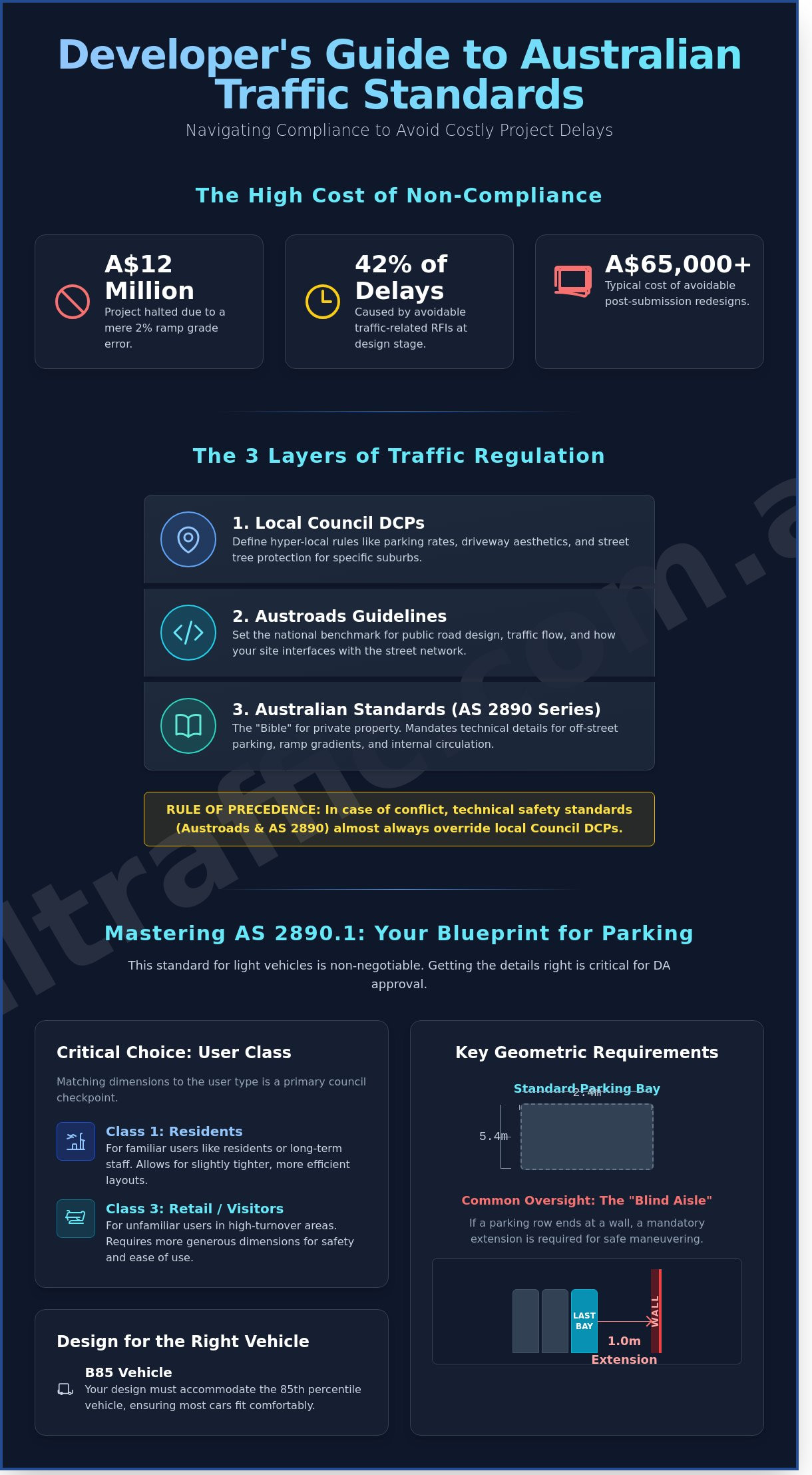
Last month, a Melbourne developer saw their A$12 million project grind to a halt because a basement ramp failed to meet AS 2890.1 grades by a mere 2%. It’s a high-stakes mistake, especially since 42% of development delays are linked to traffic-related RFIs that could’ve been avoided at the design stage. You shouldn’t need to spend hours decoding technical jargon like RPEQ certifications or Swept Path assessments. This developer’s guide to Australian traffic standards cuts through the noise to give you a clear, actionable path to compliance.
We know that dealing with Council requests often feels like chasing a moving target, leading to expensive redesigns that eat into your bottom line. You’re about to learn how to master AS 2890 and Austroads requirements so you can secure your DA approval without the typical delays or extra consultant fees. We’ll provide a straightforward roadmap of the mandatory standards, show you how to RFI-proof your submissions, and explain how to maximize parking efficiency within strict legal limits.
Key Takeaways
-
Gain a clear understanding of the hierarchy between Australian Standards, Austroads, and Council DCPs to ensure your project remains legally compliant and safe from the start.
-
Learn how to master AS 2890.1 and AS 2890.2 requirements to design parking and loading areas that satisfy even the strictest Council criteria for residential and commercial use.
-
Navigate complex state-specific regulations, such as NSW referrals and Victoria’s Clause 52.06, using this comprehensive developer’s guide to Australian traffic standards.
-
Discover how to leverage Traffic Impact Assessments and 3D Swept Path Analysis to build a bulletproof case for your development’s approval.
-
Understand the strategic advantage of working with hands-on engineers who handle your project from quote to completion to effectively resolve Council objections and RFIs.
Table of Contents
-
AS 2890.1 & AS 2890.2: The Developer’s Blueprint for Parking
-
Turning Standards into Strategy: The TIA and Swept Path Analysis
Understanding the Hierarchy of Australian Traffic Standards
Securing a development approval in Perth involves more than just architectural aesthetics. You must navigate a complex technical landscape with precision. This developer’s guide to Australian traffic standards provides the essential roadmap for that journey. Success depends on balancing three distinct regulatory layers: Australian Standards (AS), Austroads Guidelines, and local Council Development Control Plans (DCPs). Compliance is mandatory. Failing to meet these requirements can lead to A$65,000 in avoidable redesign fees or a flat refusal from the Joint Development Assessment Panel (JDAP).
Safety and legal liability drive these regulations. If a visitor’s car scrapes a structural pillar because your parking bays are 150mm too narrow, the liability falls squarely on the developer and the design team. Beyond physical safety, the financial stakes are high. Lenders now frequently require documented proof of compliance with AS 2890.1 before releasing construction finance for multi-residential or commercial projects. You cannot afford to treat these technical requirements as suggestions.
-
AS 2890 Series: Governs off-street parking, driveway gradients, and internal site circulation.
-
Austroads: Sets the benchmark for public road design and how your site interacts with the broader network.
-
Local DCPs: Define specific parking rates and aesthetic requirements for specific suburbs.
Tension often arises between these documents. A local DCP might demand high parking volumes that physically cannot fit while maintaining the safety clearances required by Austroads or national safety standards. When these conflicts occur, the technical safety standard almost always takes precedence in a legal or tribunal setting. By 2026, Western Australian planning updates will further prioritize ‘Integrated Transport.’ This shift means your site access must support pedestrians and cyclists, not just passenger vehicles, to meet modern sustainability benchmarks and density bonuses.
The Role of Australian Standards (AS 2890 series)
Think of AS 2890 as the ‘Bible’ of private development access. It dictates everything from the 1:20 maximum ramp gradients to the 5.4-meter length of a standard parking bay. Council assessors use this series as a rigid checklist for every private application. If your plans ignore AS 2890.1, you risk immediate DA refusal. Worse, ignoring these standards creates massive insurance gaps. One non-compliant driveway sightline could result in a significant payout that your professional indemnity policy might not cover.
Austroads vs. Local Council DCPs
Austroads provides the national technical framework for how your site interacts with the public street, focusing on road geometry and traffic flow. Conversely, Council DCPs allow local governments to tweak these rules for specific neighborhoods. A DCP might cap driveway widths at 3.0 meters to protect street trees, even if your projected traffic volume suggests a wider entry. You must determine which document governs your site before the first drawing is finished to avoid costly revisions during the formal Request for Information (RFI) stage.
AS 2890.1 & AS 2890.2: The Developer’s Blueprint for Parking
Think of AS 2890.1 and AS 2890.2 as the non-negotiable rules of the game. If you’re looking for a developer’s guide to Australian traffic standards, these two documents dictate whether your project is functional or a logistical failure. AS 2890.1 focuses on light vehicles, categorising them into User Classes. Class 1 is for residents or all-day commuters who know the space. Class 3 is for high-turnover retail like shopping centres. If you try to apply Class 1 dimensions to a busy retail site, you’ll end up with scraped paint, blocked aisles, and a very unhappy Council planner. Getting the user class wrong is one of the fastest ways to see a DA rejected during the initial assessment phase.
Mastering the Geometry of Off-Street Parking
Designers often try to squeeze an extra bay into a tight footprint to meet yield targets. This is a mistake. You must design for the B85 vehicle, representing the 85th percentile of cars, while ensuring the B99 vehicle can maneuver in critical areas. Standard bays are usually 2.4m wide and 5.4m long, but these shift based on the angle and aisle width. A common oversight is the "blind aisle" extension. If your parking row ends at a wall, you must provide a 1m extension beyond the last bay so drivers can actually turn out safely.
Commercial Vehicle Access and Loading Docks
AS 2890.2 handles the heavy lifting. You’ve got to distinguish between a Small Rigid Vehicle (SRV) and a Heavy Rigid Vehicle (HRV). An SRV needs at least 3.5m of vertical clearance. We’ve seen projects where the basement ceiling was set at 2.2m, effectively banning delivery trucks and forcing them to double-park on the street. Most Councils now mandate "forward-in, forward-out" movement. This means your loading dock must have enough swept path clearance for a truck to turn around internally without reversing onto a public road.
Driveway ramp grades are another area where developers get caught out. A 1 in 4 (25%) grade might be technically allowed for private residential use, but without proper 2m transitions at the top and bottom, cars will bottom out. This isn’t just a maintenance issue; it’s a safety hazard that can void insurance. While these national codes provide the foundation, you should also consult State-Specific Traffic Requirements to see how local authorities interpret these rules. If you’re unsure about your layout, our senior engineers can review your swept paths to ensure compliance before you lodge.
Finally, don’t forget the 5m by 2.5m sight distance triangles at your exit. If a driver can’t see a pedestrian on the footpath because of a pillar or a high fence, your design won’t pass the first stage of assessment. Safety isn’t just a box to tick; it’s a core requirement of any developer’s guide to Australian traffic standards. Ensuring your exit doesn’t create a blind spot is as much about risk management as it is about Council approval. By sticking to these geometric and commercial requirements, you protect your investment and ensure a smoother path through the regulatory process.
State-Specific Traffic Requirements Across Australia
Building in Perth is one thing, but crossing state lines introduces a new layer of red tape. Every state authority has its own quirks, and missing a single local requirement can stall a project for months. This developer’s guide to Australian traffic standards breaks down the essential differences you’ll encounter when moving your capital between regions. Understanding these regional nuances is the difference between a smooth approval and a costly redesign.
Navigating the NSW Planning System
In New South Wales, the local council isn’t always the final word. Projects often trigger a formal referral to Transport for NSW (TfNSW). This usually happens if your development sits on a classified road or exceeds certain size thresholds defined in the State Environmental Planning Policy (Transport and Infrastructure) 2021. For large-scale Sydney developments, the Transport Management Centre (TMC) gets involved to ensure your project doesn’t paralyze the city’s arterial flow. You’ll need a detailed Construction Traffic Management Plan (TMP) just to get your DA through. It’s a rigorous process that demands technical precision from the start.
The Victoria VPP and Clause 52.06
Victoria operates under a different logic. The Victoria Planning Provisions (VPP), specifically Clause 52.06, dictate exactly how many parking spaces your project must provide. If you’re building a gym, a warehouse, or a multi-unit residential block, the ratios are set in stone unless you can prove a reduction is justified. This requires a professional Car Parking Demand Assessment. Since 1 July 2021, Victoria has also implemented the Professional Engineers Registration Act. This means your traffic engineer must be locally registered to sign off on high-stakes designs. We’ve seen developers lose weeks because they used consultants who weren’t up to date with these registration shifts.
RPEQ and Professional Certification in QLD and Beyond
Queensland is perhaps the strictest environment for engineering reports. A standard traffic impact statement is worthless there without an RPEQ (Registered Professional Engineer of Queensland) certification. This isn’t just a best-practice suggestion; it’s a legal mandate under the Professional Engineers Act 2002. Any engineering service carried out for a project in Queensland must be performed or supervised by an RPEQ-certified professional.
-
Legal Compliance: Reports without an RPEQ stamp are rejected by councils immediately.
-
Rising Standards: Other states like Victoria are following this lead to increase accountability through mandatory registration.
-
Expert Oversight: ML Traffic Engineers provides national coverage with the specific RPEQ credentials needed for the Sunshine State.
We’ve been trading since 2005, and our hands-on approach means you get direct access to principals who understand these legislative nuances. The traffic consultant who provides your quote is the one who does the work, ensuring no technical details are lost in translation between states.
Western Australia and Main Roads WA
Back in the West, Main Roads WA holds significant power over site access. For major developments, they influence where you can place a driveway and how vehicles enter the network. They focus heavily on primary distributors and freight routes. If your site access isn’t compliant with their sight-line assessments or vehicle swept path requirements, they’ll block the application. This developer’s guide to Australian traffic standards emphasizes that while Australian Standard AS 2890.1 is the baseline, state-specific policies often override the general rules. Our team ensures your site layout works for both the local council and the state authority, preventing last-minute design overhauls that eat into your profit margins.
Turning Standards into Strategy: The TIA and Swept Path Analysis
A Traffic Impact Assessment (TIA) isn’t just a bureaucratic hurdle; it’s the technical narrative that proves your project is viable. When you’re following a developer’s guide to Australian traffic standards, you’ll find that the TIA serves as your formal argument to Council and the Department of Transport. It moves beyond simple compliance to show how a project integrates with existing infrastructure. Our approach focuses on data-driven evidence to ensure your development isn’t stalled by perceived traffic concerns.
The Anatomy of a Successful TIA Report
A robust TIA starts with a baseline analysis of existing traffic conditions, often using SIDRA Intersection software to model current delays and queue lengths. We then calculate trip generation based on specific land-use, whether it’s a 50-unit residential complex or a 2,000sqm industrial warehouse. Finally, we assess the "Level of Service" (LoS) impact. If a project drops an intersection from LoS B to LoS D, we provide the mitigation strategies to fix it before the Council asks.
Proving Maneuverability with Swept Path Diagrams
Council planners look for precision in swept path diagrams. They want to see 300mm clearances and realistic "lock-to-lock" turning speeds for B99 vehicles or heavy rigid vehicles (HRVs). Accurate AutoTURN modeling can save a tight site by proving that waste trucks or delivery vans can navigate the layout without hitting curbs. Integrating these paths early into your Car Park Design is the most effective way to maximize your yield while meeting AS 2890.1 requirements.
Traffic generation is another area where developers often lose money by over-providing parking. Many local planning schemes demand high parking ratios that don’t reflect modern transport habits. We use empirical data from similar sites and proximity to high-frequency transit to argue for lower parking rates. Reducing your parking requirement by just five basement bays can save between A$150,000 and A$250,000 in construction costs. It’s about using this developer’s guide to Australian traffic standards to build a case for what the site actually needs, not just what the default table says.
Safety at the driveway interface is non-negotiable. Sight-line assessments prove that a driver exiting your property can see pedestrians and oncoming cyclists in time to react. We measure these "sight triangles" against the specific speed environment of your street. If a street tree or a neighboring fence blocks the view, we find the engineering solution, such as splayed walls or adjusted exit points, before it becomes a liability issue. This meticulous attention to detail is why our senior engineers handle every assessment personally.
At ML Traffic Engineers, the consultant who provides your quote is the person who does the work. This direct accountability ensures that your TIA is technically sound and ready for the most rigorous scrutiny from planning authorities. We’ve successfully navigated over 10,000 sites by turning complex standards into actionable development strategies.
Ready to secure your project’s approval? Contact ML Traffic Engineers today for a professional TIA that stands up to Council scrutiny.
Navigating Council Objections with ML Traffic Engineers
Your Development Application (DA) often hits a wall when it reaches the Council’s desk. It isn’t just about technical drawings; it’s about how those drawings stand up to intense scrutiny. We’ve seen projects delayed by months because of a single ‘Request for Further Information’ (RFI) regarding car parking numbers or driveway sight-lines. This is where our philosophy makes the difference: the traffic consultant who provides the quote, does the work. When you’re facing a Council objection, you don’t want a messenger. You want the person who calculated the swept paths and assessed the traffic impact to be the one defending it.
This final section of our developer’s guide to Australian traffic standards focuses on closing the gap between a theoretical plan and a physical building permit. When a Council issues an RFI, they’re often looking for technical justification for a deviation from the local planning scheme. Whether it’s a 15% reduction in required parking bays or a complex vehicle turnaround in a tight commercial lot, the response must be authoritative. We use specific data from similar land uses to prove that your development won’t negatively impact the local road network. This evidence-based approach turns a subjective objection into a technical approval.
Michael Lee and Benny Chen don’t just sign off on reports. They lead the advocacy. If a Council officer questions a parking shortfall, you need a response grounded in AS 2890.1 and backed by empirical data. We’ve managed over 10,000 sites across Australia since 2005. This volume of work means we’ve likely already solved the exact access problem your Perth project is currently facing. We move beyond theory to ensure your DA is secured, allowing you to transition into the construction phase without costly redesigns. Our direct involvement ensures that the technical integrity of your project is maintained from the first quote to the final Council sign-off.
The ML Traffic Engineers Pty Ltd Advantage: Direct Access and Accountability
Large firms often hand your project to a junior engineer once the contract is signed. This ‘junior engineer’ trap leads to weak RFI responses and missed deadlines because the person speaking to the Council doesn’t have the experience to negotiate. At ML Traffic Engineers Pty Ltd, you get direct access to principals with 30 to 40 years of experience each. This seniority is vital during high-stakes negotiations with local government authorities. You can learn more About us and our hands-on approach that prioritizes accountability over corporate layers.
Next Steps for Your Development Application
Success starts with a precise brief. To provide an accurate traffic engineering quote, we need your latest architectural site plans and a clear description of the proposed land use. Engaging us before your architect finalizes the layout is critical for your developer’s guide to Australian traffic standards compliance. It’s much cheaper to adjust a driveway on a screen than to move a structural column once construction starts. If you’re ready to clear the traffic hurdle, Contact our principals today for a direct consultation that puts your project on the right track.
-
Preparation: Gather site plans and land-use details.
-
Timing: Engage a traffic engineer during the early design phase.
-
Advocacy: Ensure your consultant is ready to defend the RFI.
-
Result: Move from DA approval to physical construction faster.
Secure Your DA with Expert Traffic Strategy
Navigating the complex hierarchy of AS 2890.1 and state-specific regulations doesn’t have to stall your progress. You’ve seen how precise Swept Path Analysis and a robust TIA can transform technical hurdles into a clear path for approval. This developer’s guide to Australian traffic standards proves that compliance is your strongest tool for overcoming council objections. Success comes down to getting the technical details right the first time so your project stays on schedule and within budget.
At ML Traffic Engineers, we’ve spent 15 years mastering the requirements of every Australian state. Our team has successfully assessed over 10,000 sites, providing the data-backed assurance you need for a smooth application. You’ll work directly with our principals, Michael Lee and Benny Chen. We believe the engineer who quotes your project should be the one doing the work. It’s a hands-on approach that cuts through bureaucracy and delivers results you can trust without the typical firm overheads.
Get a direct quote from a senior traffic engineer for your next project. We’re ready to help you navigate the standards and get your development moving forward today.
Frequently Asked Questions
What is the difference between a Traffic Impact Statement (TIS) and a Traffic Impact Assessment (TIA)?
A Traffic Impact Statement (TIS) is a concise report for small-scale developments generating fewer than 10 to 100 vehicle trips during peak hours. In contrast, a Traffic Impact Assessment (TIA) is an extensive technical document required for major projects like shopping centres or high-density apartments. This developer’s guide to Australian traffic standards clarifies that TIAs involve complex intersection modelling and multi-modal analysis that simple statements omit.
When is an AS 2890.1 compliance check required for a DA?
You need an AS 2890.1 compliance check for any Development Application (DA) that includes off-street parking or driveway access. Local councils in Perth and across Western Australia mandate these checks to ensure parking bays, aisles, and ramps meet safety dimensions. Failing to provide this certification often leads to immediate RFI letters from council planners, which can delay your project by 4 to 6 weeks.
Can I propose fewer parking spaces than what the Council DCP requires?
You can propose a parking shortfall if you provide a professional Parking Demand Assessment that justifies the reduction. We’ve successfully negotiated 20% to 35% reductions for sites near high-frequency transit hubs like Perth Underground or Claisebrook Station. Your application must prove that the actual peak demand won’t overflow into residential streets or create safety hazards for pedestrians in the surrounding 200-metre radius.
How much does a Swept Path Analysis cost for a standard development?
A standard Swept Path Analysis for a single driveway and one service vehicle typically costs between A$450 and A$950 plus GST. Prices vary based on the number of vehicle types, such as 8.8m MRVs or 12.5m HRVs, and the complexity of the site layout. Investing in these digital simulations early prevents expensive structural revisions during the construction phase when columns or walls are already set.
What happens if my driveway ramp doesn’t meet the AS 2890.1 grade requirements?
If your driveway ramp exceeds the 1:20 or 1:5 grades specified in AS 2890.1, your project risks vehicle scraping or "bottoming out." We use specialized software to test your specific longitudinal sections against 99.8th percentile vehicle profiles. If it fails, you’ll need a redesign or a formal performance-based justification to satisfy council engineers that the transition remains safe for all standard passenger vehicles.
Does a traffic engineer need to be registered (like RPEQ) in every state?
No, registration requirements vary significantly by jurisdiction. While Queensland requires an RPEQ (Registered Professional Engineer of Queensland), Western Australia currently relies on the engineer’s specific qualifications and industry experience. Our senior consultants maintain high-level credentials to ensure every report meets the rigorous criteria found in any developer’s guide to Australian traffic standards across all states, including Victoria’s Professional Engineers Act requirements.
How long does it typically take to produce a Traffic Impact Assessment report?
It typically takes 10 to 15 business days to produce a comprehensive Traffic Impact Assessment report from the moment we receive your final architectural plans. This timeframe includes site observations, data collection from Main Roads WA, and technical modelling. Complex projects involving SIDRA intersection analysis might require an additional 5 days to ensure every simulation reflects accurate peak-hour traffic volumes for the target year.
What is a Sight-Line Assessment, and why is it critical for safety?
A Sight-Line Assessment is a technical evaluation of the visibility available to drivers exiting a property onto a public road. It’s critical because it ensures a driver can see approaching cars, cyclists, and pedestrians from 2.5 metres back from the property boundary. In 2023, over 15% of DA delays in metropolitan Perth were caused by inadequate sight-line provisions at proposed driveway locations or obscured exit points.
Which areas do you cover?
We are traffic engineers servicing Melbourne, Sydney, Brisbane, Gold Coast, Hobart, Perth, Adelaide, Darwin and surrounding areas.
