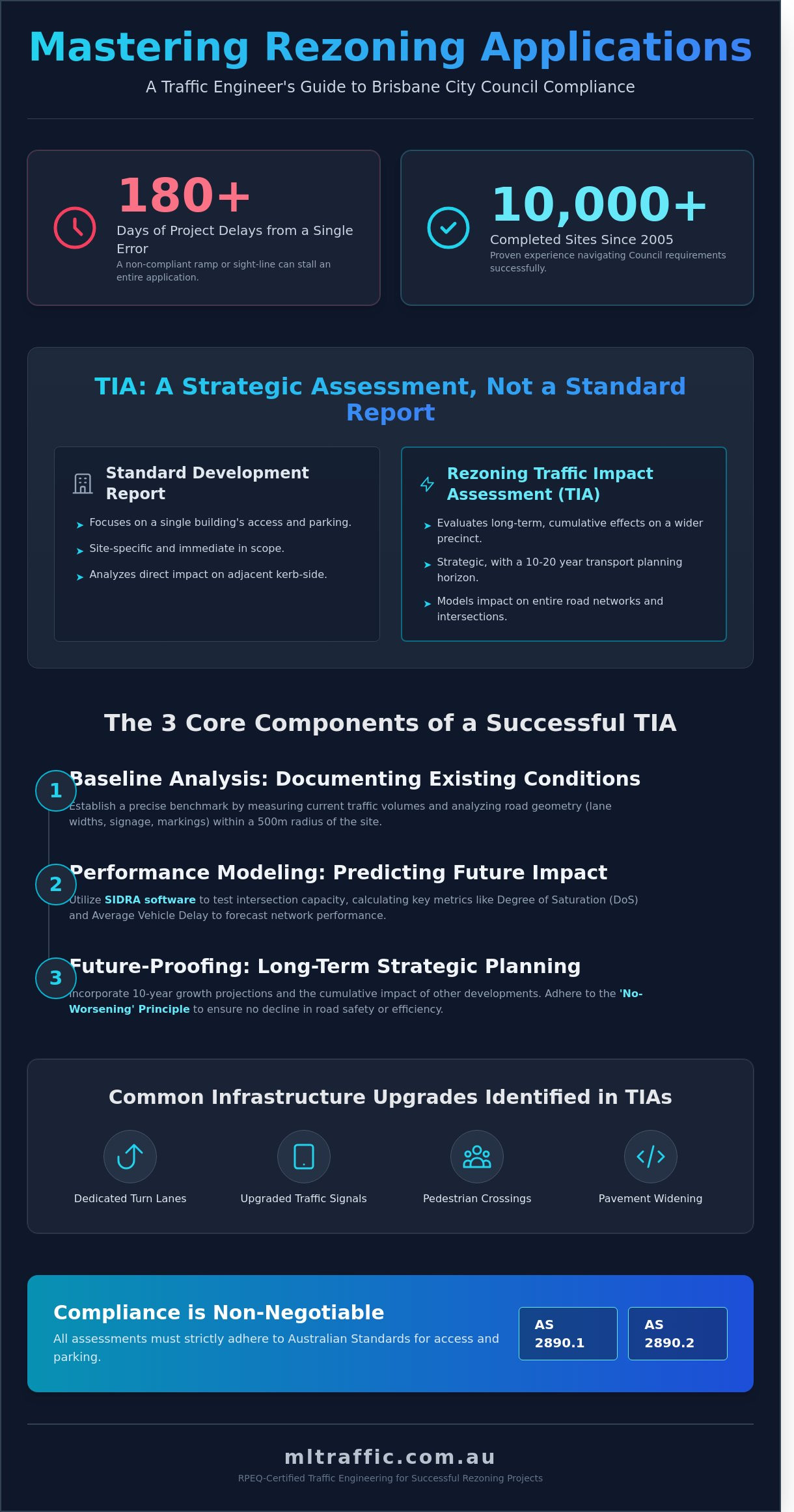

A single non-compliant driveway ramp grade or a miscalculated sight-line assessment can stall a rezoning application for over 180 days. When you’re dealing with Brisbane City Council, technical precision isn’t optional; it’s the difference between a project that breaks ground and one that sits in a bureaucratic deadlock. You likely already understand that the transport component is often the most scrutinized part of your development application. As an experienced traffic engineer Brisbane firm with over 10,000 completed sites since 2005, we know that uncertainty regarding Council requirements leads to costly redesigns and missed deadlines.
This guide will help you master the complexities of Traffic Impact Assessments (TIA) to ensure your rezoning achieves full regulatory compliance. We provide a clear roadmap for TIA preparation that adheres strictly to AS 2890.1 and other relevant Australian Standards. You’ll learn how to streamline your path to planning approval by eliminating the layers of management and bureaucracy found in large firms. We will preview the critical elements of a successful report, including Vehicle Swept Path Assessments and car parking demand, so you can move forward with total confidence in your submission.
Key Takeaways
-
Understand why Council mandates a detailed Traffic Impact Assessment (TIA) to evaluate how proposed land-use changes will affect the surrounding road network.
-
Learn how to accurately forecast trip generation and analyze existing road geometry to ensure your rezoning application meets all regulatory standards.
-
Navigate parking demand and access compliance by applying AS 2890.1 and AS 2890.2 standards to justify necessary variations from standard rates.
-
Discover strategies to proactively address Council Requests for Further Information (RFIs) and negotiate proportional infrastructure contributions.
-
Consult with a senior traffic engineer Brisbane to leverage a hands-on approach that ensures RPEQ-qualified oversight for your rezoning project’s success.
Table of Contents
-
The Critical Role of Traffic Reports in Rezoning Applications
-
Addressing Council Concerns and Infrastructure Contributions
The Critical Role of Traffic Reports in Rezoning Applications
A rezoning traffic report is a specialized technical assessment required when a landowner seeks to change the designated use of a property under a local planning scheme. Unlike a standard development application, this report evaluates the long-term capacity of the existing road network to absorb new traffic volumes over a broad horizon. Brisbane City Council and other local authorities mandate a Traffic Impact Assessment (TIA) to ensure that land-use changes don’t lead to gridlock or safety hazards. A qualified traffic engineer Brisbane applies the principles of traffic engineering to model how these changes affect local intersections and arterial roads.
To better understand this concept, watch this helpful video:
Standard development reports typically focus on site-specific access and parking for a single building. Rezoning reports are more strategic. They examine the cumulative implications of changing density from a low-impact use to a high-intensity one across a larger precinct. A professional traffic engineer Brisbane bridges the gap between a developer’s commercial vision and Council’s 20-year transport strategy. At ML Traffic Engineers, the consultant who provides the quote is the one who performs the analysis, ensuring technical accountability throughout the entire rezoning process.
Future-Proofing the Road Network
Planning authorities require data that accounts for 10-year growth projections to satisfy long-term planning criteria. This analysis isn’t limited to your specific site; it involves evaluating the cumulative impact of all approved and pending developments within the immediate catchment area. We utilize SIDRA software to model intersection degrees of saturation and queue lengths to ensure the network remains functional. The ‘no-worsening’ principle dictates that a proposed rezoning must not result in a net decline in the safety or operational performance of the surrounding road infrastructure compared to its current state.
The Intersection of Land Use and Transport Planning
Changing a site from industrial to residential shifts traffic patterns from mid-day freight movements to intense morning and afternoon commuter surges. These shifts necessitate different road geometry and signal timings to maintain safety standards. Identifying required infrastructure upgrades early in the application process prevents project delays and unexpected costs. ML Traffic Services offers a full range of assessment types to determine if your project requires new turning lanes, signalized crossings, or specific pavement reinforcements. Common requirements identified in these reports include:
-
Dedicated turn lanes to prevent through-traffic congestion.
-
Upgrades to existing traffic signal controllers.
-
Pedestrian refuge islands or signalized crossings for residential density increases.
-
Pavement widening to accommodate increased bus or heavy vehicle movements.
By providing a meticulous analysis of these factors, our RPEQ-certified engineers ensure that your rezoning application meets every regulatory benchmark while supporting your development goals.
Core Components of a Rezoning Traffic Impact Assessment
A rezoning application requires a technical evaluation of how a land-use change affects the local transport network. A traffic engineer Brisbane begins this process by documenting existing conditions. This includes measuring current traffic volumes and analyzing existing road geometry. We examine lane widths, pavement markings, and signage within a 500-meter radius of the site. This baseline data is essential for accurate modeling.
Intersection performance modeling is the next vital step. We use SIDRA software to test the capacity of nearby junctions. This analysis determines the Degree of Saturation (DoS) and Average Delay. If a rezoning proposal increases the DoS beyond 0.90, mitigation measures are usually required. Safety remains a priority. We conduct sight distance assessments to ensure all proposed access points comply with Australian Standard AS 2890.1. This involves measuring clear lines of vision for exiting drivers to prevent collisions. Key components of this assessment include:
-
Queue Length Analysis: Predicting how far traffic will back up at traffic lights during peak periods.
-
Swept Path Analysis: Using specialized software to ensure waste collection vehicles and emergency services can maneuver safely within the site.
-
Gap Acceptance: Calculating if there are sufficient breaks in through-traffic for vehicles to exit the new development safely.
Data Collection and Traffic Counting
Accurate data is the foundation of any successful application. We prioritize traffic counts conducted within the last 12 months to ensure relevance. Generic estimates often fail to account for local fluctuations. We analyze peak-hour data, specifically the 60-minute windows of highest intensity in the morning and afternoon. This identifies bottlenecks before they become grounds for refusal. Site-specific constraints, such as proximity to schools or heavy vehicle routes, dictate the scope of our data collection. Following official government guidance ensures the methodology meets the rigorous standards expected by assessing authorities.
Forecasting Future Demand
Forecasting requires applying industry-standard trip generation rates to the proposed land use. For a residential rezoning, we might calculate 0.8 trips per dwelling during peak hours. We then distribute this traffic across the local network based on likely travel patterns. This identifies impact zones where road upgrades might be necessary. A holistic report doesn’t just look at cars. It addresses pedestrian flow and cyclist safety. Ensuring a 1.5-meter minimum width for footpaths or adequate bike storage can be the difference between approval and a request for further information. If you’re preparing a submission, reviewing our range of technical services can help clarify the specific assessments your project needs.
Navigating Parking Demand and Access Compliance
Rezoning applications in Queensland require strict adherence to parking and access codes to ensure new land uses don’t create safety hazards or overspill on local roads. A qualified
**traffic engineer Brisbane
**identifies the specific requirements of the
[Brisbane City Plan 2014
](https://www.brisbane.qld.gov.au/planning-and-building/planning-guidelines-and-tools/brisbane-city-plan-2014), specifically the Transport, access, parking and servicing code. Compliance isn’t optional. It’s a technical necessity for approval.
We conduct parking demand assessments to justify variations from standard council rates. If a site sits within 400 metres of a high-frequency busway station or train line, we can often argue for a reduction in the required number of bays. This assessment uses empirical data from similar developments to prove that a lower parking provision won’t impact the surrounding street network.
Designers must balance space optimization with safety. This includes:
-
Maintaining minimum aisle widths to prevent vehicle conflict.
-
Providing adequate sight distances at the property boundary.
-
Designing waste collection areas that don’t require trucks to reverse onto major roads.
-
Allocating space for 12.5 metre Heavy Rigid Vehicles (HRV) where industrial or large commercial uses are proposed.
Australian Standards for Parking Design
Compliance with AS 2890.1 and AS 2890.2 is the benchmark for private development approval. We verify driveway ramp grades to ensure vehicles don’t scrape and aisle widths to guarantee easy circulation. Our reports provide the technical data needed to satisfy council RPEQ certification requirements.
It’s vital to use
[AS 2890.1 explained
](https://www.mltraffic.com.au/articles/as-2890-1-explained-the-ultimate-guide-to-compliant-car-park-design/)as the primary guide for private car park layouts. This includes the integration of disabled parking bays, which must meet specific clearance and shared zone standards. We also plan for bicycle facilities, including lockers and end-of-trip showers, which are increasingly mandated in the 2014 City Plan for commercial rezonings.
Vehicle Swept Path Analysis
A
**traffic engineer Brisbane
**uses AutoTURN software to simulate vehicle movements within the site. This process, known as swept path analysis, proves that the largest expected vehicles can maneuver safely without hitting curbs or structures. We visualize truck turning paths for loading docks and waste collection areas to ensure operational efficiency.
For detailed technical requirements on these simulations, refer to our
[Swept Path Analysis Guide
](https://mltraffic.com.au)
Addressing Council Concerns and Infrastructure Contributions
Council planners frequently issue Requests for Further Information (RFIs) when rezoning applications lack technical depth. Common triggers for these delays include insufficient data on peak hour trip generation or a failure to provide swept path analysis for service vehicles. In Brisbane, the City Plan 2014 dictates specific performance outcomes that must be met. Engaging a qualified traffic engineer Brisbane early in the process ensures these technical requirements are addressed in the initial submission, preventing the 30 to 60-day delays typically associated with RFI responses.
Credibility in these reports stems from RPEQ (Registered Professional Engineer of Queensland) certification. This isn’t a mere formality; it’s a guarantee that the assessment adheres to Australian Standards such as AS 2890.1. Reports without this level of professional oversight are often dismissed during the assessment phase. A robust, RPEQ-certified report significantly lowers the risk of Land and Environment Court appeals. These legal disputes often last 12 months or longer, costing developers tens of thousands in legal fees. Professional engineering reports provide the evidence needed to defend a proposal based on facts rather than community sentiment.
-
Accurate SIDRA intersection modeling to prove network capacity.
-
Proportional infrastructure contribution calculations to avoid overpayment.
-
Compliance with the Queensland Development Code and Austroads guidelines.
-
Detailed sight-line assessments for all proposed access points.
Mitigating Traffic Impacts
Mitigation strategies must balance developer costs with the public benefit of infrastructure upgrades. We often propose specific physical works like road widening, new signalization, or dedicated turn lanes to manage increased volume. For instance, if a project adds 12% more traffic to a local intersection, we negotiate contributions based solely on that proportional impact. A traffic engineer Brisbane acts as your technical advocate during Council meetings, ensuring that requested upgrades are necessary, fair, and directly related to the development’s footprint.
Managing Public and Pedestrian Safety
Safety is a primary concern for Councils and local residents during rezoning. We conduct rigorous sight distance assessments at all proposed entry points using Austroads standards. This includes calculating safe intersection sight distance (SISD) based on a 2.0-second reaction time for urban environments. Integrating active transport is also essential. We design 2.0-meter wide footpaths and cycling connections to encourage walking, which helps mitigate community opposition regarding vehicle density in residential areas.
Ensure your rezoning application meets all Council requirements with an RPEQ-certified assessment. Contact our senior engineers today to discuss your project requirements.
Expert Traffic Engineering for Successful Rezoning Projects
Rezoning applications represent a significant shift in land-use intensity. They demand a high level of technical scrutiny that junior staff simply cannot provide. For these complex projects, senior-level involvement is non-negotiable. A qualified traffic engineer Brisbane must evaluate how a change from residential to commercial, or industrial to mixed-use, affects the existing road network. Failure to address these impacts early leads to costly delays and potential application refusal.
Our firm has been trading since 2005, providing a stable foundation of expertise for private developers. We understand that traffic reports don’t exist in a vacuum. They must integrate seamlessly with your wider development application requirements, including town planning and civil design. We focus on delivering reports that are technically robust and ready for council submission. Our experience includes:
-
Direct accountability through principal-led project management on every file.
-
Over 15 years of operational history and technical data collection.
-
Deep industry knowledge derived from over 10,000 completed site assessments.
-
Expertise in RPEQ certification and Australian Standards like AS 2890.1.
We’ve delivered successful outcomes for a vast range of land-use types. This includes apartments, bars, child care centres, churches, gyms, medical centres, schools, and warehouses. This breadth of experience means we’ve likely solved similar traffic challenges on a site near yours. We ensure every Traffic Impact Assessment (TIA) or Traffic Impact Statement (TIS) is compliant with local government codes and state-controlled road requirements.
The ML Traffic Engineers Approach
We provide direct access to our senior experts, Michael Lee and Benny Chen. They bring between 30 and 40 years of individual experience to every project. Our firm operates on a unique signature: the traffic consultant who provides the quote, does the work. You won’t find your project handed off to an inexperienced graduate after the contract is signed. This hands-on model ensures that every report is meticulous and results-oriented. We pride ourselves on being dependable and direct, avoiding the bureaucracy found in larger consultancies.
Getting Started with Your Assessment
To initiate your traffic assessment, we require a site plan and a description of the proposed land-use changes. We don’t use generic templates. Instead, we tailor our services to your specific site constraints and development goals. Whether you need a Vehicle Swept Path Assessment, a Car Parking Demand Assessment, or a Sight-Line Assessment, we provide the technical data required for approval. Contact our team for a professional quote to secure the expertise your rezoning project requires.
Secure Your Rezoning Approval with Professional Engineering
Successful rezoning applications depend on technical accuracy and proactive infrastructure planning. You must address parking demand, access compliance, and council objections using data-backed assessments that meet RPEQ standards. ML Traffic Engineers has been trading since 2005, providing the technical reports required to move complex projects forward. We’ve completed assessments for over 10,000 sites across various land-use types, including residential, commercial, and industrial developments.
When you engage a traffic engineer Brisbane developers trust for compliance, you ensure your application adheres to AS 2890.1 and specific local government requirements. Our firm operates with a direct-access model where the senior principal who provides your quote is the same expert who performs the work. This hands-on approach removes bureaucracy and ensures total accountability at every stage of the assessment. With over 15 years of experience, we provide the authoritative evidence needed to satisfy council queries and infrastructure contribution mandates. Partnering with seasoned experts reduces the risk of costly delays and strengthens your position during the planning process. We look forward to helping you achieve a successful outcome for your next development.
Get an Expert Traffic Report for Your Rezoning Application
Frequently Asked Questions
What is the difference between a Traffic Impact Assessment and a Traffic Management Plan?
A Traffic Impact Assessment (TIA) evaluates the long-term effects of a permanent land-use change on the existing road network. In contrast, a Traffic Management Plan (TMP) outlines specific safety measures for the construction phase. You’ll need a TIA for your rezoning application to prove the local infrastructure can handle the increased load. The TMP comes later, once construction starts.
When is a traffic report mandatory for a rezoning application?
A traffic report is mandatory when a rezoning proposal increases vehicle trip generation or alters site access. Brisbane City Council typically triggers this requirement if the development adds 10 or more vehicle movements during peak hours. It’s essential for any shift from low-density to high-density usage. Without an RPEQ-certified report, your application won’t meet the necessary assessment criteria.
How long does it take to prepare a professional traffic assessment report?
A professional traffic engineer Brisbane typically takes 10 to 15 business days to complete a report from the initial site inspection. This timeframe includes 5 days for data collection and 5 to 10 days for technical analysis and drafting. If your project requires external traffic counts, add another 7 days for the count data to be processed. We prioritize accuracy to ensure the report passes Council scrutiny the first time.
Can a traffic engineer help if Council has already rejected my initial application?
An experienced traffic engineer Brisbane can assist by reviewing the Council’s reasons for refusal and providing technical solutions. We analyze the Information Request to identify specific concerns, such as safety or parking shortfalls. By using empirical data and revised Sight-Line Assessments, we can often overcome objections that led to the initial rejection. Our RPEQ certification provides the professional weight needed for appeals.
What are the common Australian Standards applied to rezoning traffic reports?
The most common standards are AS 2890.1:2004 for off-street parking and AS 2890.2:2018 for commercial vehicles. We also apply the Austroads Guide to Traffic Management to ensure the project meets national safety benchmarks. These documents specify the exact requirements for driveway ramp grades, aisle widths, and turning circles. Compliance with these 3 sets of standards is non-negotiable for rezoning approval.
How much does a traffic impact assessment cost for a rezoning project?
Costs depend on the complexity and scale of the rezoning project. Because every site has unique challenges, we provide fixed-price quotes after reviewing your specific site plans. Professional fees are a necessary investment to avoid the much higher costs of application delays or Council refusals. Contact our senior engineers directly for an accurate quote based on your development’s requirements.
What is a Vehicle Swept Path Analysis and why is it required?
Vehicle Swept Path Analysis is a computer simulation that maps the path of a vehicle’s body and wheels during a turn. It’s required to demonstrate that the largest intended vehicle, like an 8.8m truck, can safely navigate the site. This analysis ensures the design complies with AS 2890.2 and prevents vehicles from mounting curbs or blocking traffic. It’s a critical component of the TIA.
Does a rezoning traffic report cover pedestrian safety as well?
Pedestrian safety is a core component of every rezoning traffic report. We evaluate sight distances at all access points to ensure drivers can see pedestrians on the footpath. Our assessments include the 5-second visibility rule to protect vulnerable road users. A report that ignores pedestrian movements will likely face an Information Request from Council planners during the assessment phase.
What suburbs do you cover within Brisbane Metropolitan Area?
We are traffic engineers servicing Brisbane, Brisbane City, Fortitude Valley, New Farm, Teneriffe, Kangaroo Point, East Brisbane, South Brisbane, West End, Highgate Hill, Dutton Park, Woolloongabba, Ascot, Clayfield, Albion, Bowen Hills, Newstead, Bulimba, Hawthorne, Morningside, Balmoral, Indooroopilly, Taringa, Toowong, Auchenflower, Milton, Paddington, Red Hill, Bardon, Ashgrove, The Gap, Enoggera, Mitchelton, Aspley, Chermside, Kedron, Stafford, Everton Park, Gordon Park, Wilston, Grange, Alderley, Kelvin Grove, Herston, Lutwyche, Windsor, Nundah, Wavell Heights, Chermside West, Zillmere, Carseldine, Bald Hills, Bracken Ridge, Brighton, Sandgate, Shorncliffe, Deagon, Taigum, Fitzgibbon, Boondall, Virginia, Banyo, Nudgee, Northgate, Hamilton, Hendra, Eagle Farm, Murarrie, Cannon Hill, Seven Hills, Norman Park, Coorparoo, Camp Hill, Carina, Carindale, Mount Gravatt, Upper Mount Gravatt, Mansfield, MacGregor, Robertson, Sunnybank, Sunnybank Hills, Acacia Ridge, Inala, Oxley, Corinda, Graceville, Sherwood, Yeronga, Annerley, Moorooka, Tarragindi, Holland Park, Holland Park West, Coopers Plains, Greenslopes, Fairfield, Yeerongpilly, Stones Corner, Wynnum, Wynnum West, Manly, Manly West, Tingalpa, Hemmant, Lota, Wakerley, Rochedale, Eight Mile Plains, Runcorn, Calamvale, Parkinson, Algester, Doolandella, Forest Lake, Richlands, Darra, Wacol, Archerfield, Rocklea, Salisbury, Nathan, Mount Gravatt East, Wishart, Karawatha, Stretton, Kuraby, Belmont, Chandler, Gumdale, Lytton, Port of Brisbane, Kenmore, Jindalee, Mount Ommaney, Sinnamon Park, Fig Tree Pocket, Chapel Hill, St Lucia, Petrie Terrace, Spring Hill, Wooloowin, Newmarket, Gaythorne, Keperra, Ferny Grove, Upper Kedron, Bridgeman Downs, McDowall, Stafford Heights, Geebung, Pinkenba, Brisbane Airport, Nudgee Beach, Kalinga, Albion (duplicate avoided), Anstead, Bellbowrie, Brookfield, Chelmer, Chuwar, England Creek, Enoggera Reservoir, Jamboree Heights, Karana Downs, Kenmore Hills, Kholo, Lake Manchester, Middle Park, Moggill, Mount Coot-tha, Mount Crosby, Pinjarra Hills, Pullenvale, Riverhills, Seventeen Mile Rocks, Upper Brookfield, Westlake, Banks Creek, Burbank, Drewvale, Durack, Ellen Grove, Heathwood, Larapinta, Mackenzie, Pallara, Sumner, Tennyson, Willawong, Carina Heights, Ransome, Cannon Hill (duplicate avoided), Carindale, Manly, Moreton Island, Bulwer, Cowan Cowan, Kooringal.
Can you help with developments outside of Brisbane, like the Gold Coast or Sunshine Coast?
Yes. While we have deep expertise in Brisbane, our senior engineers have extensive experience securing DA approvals with councils across Queensland, including the Gold Coast, Sunshine Coast, Moreton Bay, Logan, and Ipswich.

Disclaimer
The content on www.mltraffic.com.au, including all technical articles, guides, and resources, is provided for general informational and educational purposes only. It is not intended to constitute professional advice in traffic engineering, transportation planning, development approvals, or any other technical or legal field.
While ML Traffic Engineers makes every reasonable effort to ensure the accuracy, completeness, and timeliness of the information published, we do not provide any warranties or representations (express or implied) regarding its reliability, suitability, or availability for any particular purpose. Any reliance you place on the content is strictly at your own risk.
In no event shall ML Traffic Engineers, its directors, employees, authors, or affiliates be liable for any direct, indirect, incidental, special, consequential, or punitive damages (including, without limitation, loss of profits, data, or business opportunities) arising out of or in connection with the use of, or inability to use, any information provided on this website.
The articles and guides on this site are not a substitute for engaging a qualified, registered professional traffic engineer (such as an NPER or RPEQ engineer) to assess your specific project requirements. For tailored advice, compliance assessments, or traffic engineering services, please contact a competent professional.
This disclaimer may be updated from time to time without notice. By accessing or using this website, you agree to be bound by the most current version of this disclaimer.