
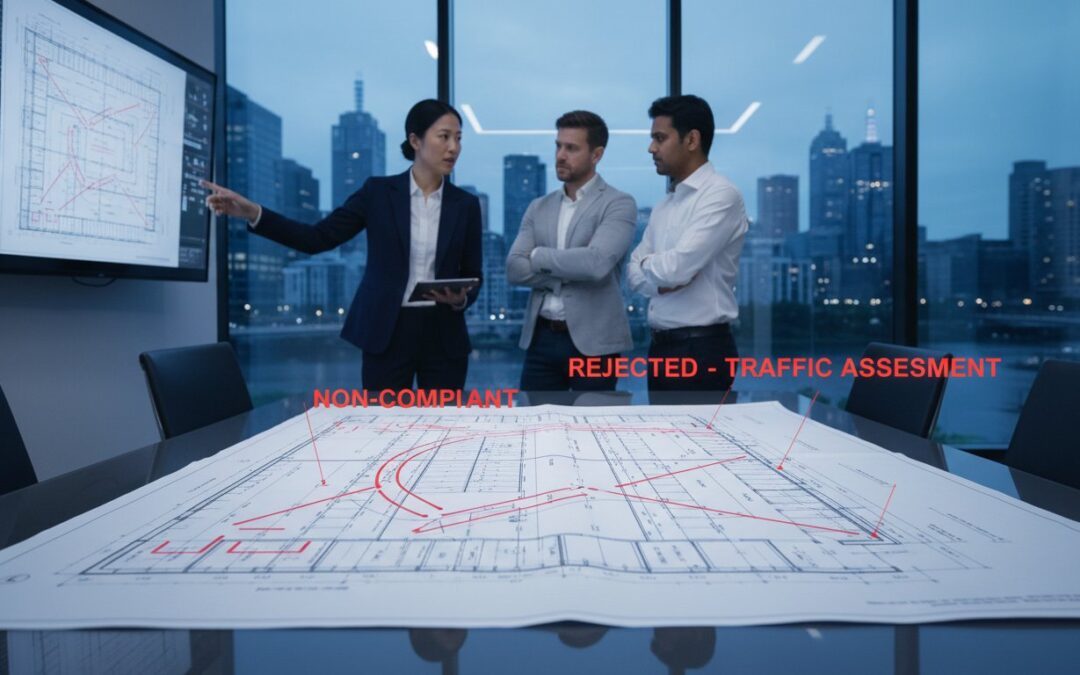
A budget traffic report is often the most expensive mistake a developer can make. You know that every week of delay on a development site costs thousands in holding charges and lost momentum. It’s a common frustration when a local council or planning authority rejection arrives because of a non-compliant parking layout or a flawed Traffic Impact Statement (TIS). Engaging a qualified traffic engineer who understands the technicalities of AS 2890.1 is the difference between a seamless approval and a five-figure redesign after the DA is submitted.
This guide reveals how technical oversights in traffic reports trigger expensive council delays and how to identify high-quality engineering advice that secures DA approval on the first attempt. We’ll examine the specific compliance failures that stall projects, the importance of accurate vehicle swept path assessments, and the metrics used to evaluate professional traffic assessments. Following these principles ensures you maintain a predictable project timeline and maximize your site’s car park efficiency without traffic-related setbacks.
Key Takeaways
-
Understand why a "checkbox" approach to traffic engineering fails and how overlooking cumulative road impacts leads to expensive Council delays.
-
Identify critical technical pitfalls in Swept Path Analysis and AS 2890.1 compliance that can compromise the functionality of your parking and loading zones.
-
Calculate the hidden financial burden of poor assessments, including the A$ costs of holding land during RFI revisions and the waste of valuable site area.
-
Learn how to vet a traffic engineer Adelaide based on their specific land-use experience and the level of senior involvement in your technical report.
-
Discover the advantage of working directly with principals to ensure report accuracy and eliminate the communication gaps that often stall DA approvals.
Table of Contents
-
Why a ‘Checkbox’ Approach to Traffic Engineering Often Fails
-
Technical Compliance Pitfalls: Beyond the Traffic Impact Statement
-
Vetting Your Traffic Consultant: Quality Indicators for DA Approval
-
Securing Your Project with Authoritative Traffic Engineering Expertise
Why a ‘Checkbox’ Approach to Traffic Engineering Often Fails
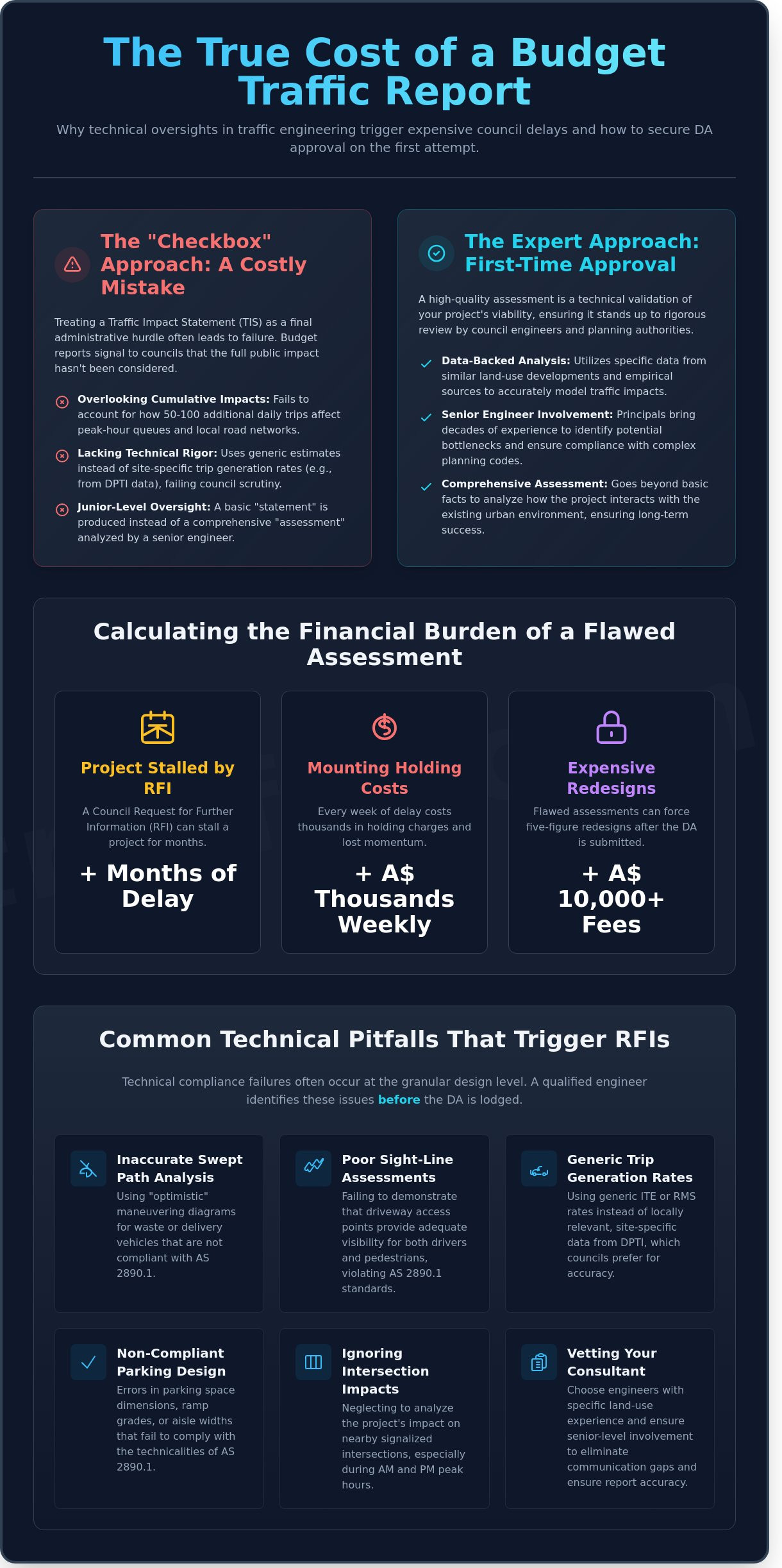
Many developers in South Australia treat traffic reports as a final administrative hurdle before Council approval. This "checkbox" mentality is a significant mistake. A Traffic Impact Assessment is more than a permit requirement; it’s a technical validation of your project’s commercial and operational viability. If you hire a Traffic engineer Adelaide to produce a low-cost, generic report, you risk significant delays and expensive redesigns. Budget assessments frequently overlook the cumulative traffic impacts on the local road network, failing to account for how 50 or 100 additional daily trips affect specific peak-hour queue lengths.
Council planners in Adelaide don’t just look at the final numbers. They scrutinize the methodology used to reach those conclusions. This involves applying fundamental Traffic engineering principles to ensure the safety and efficiency of the transport network. When a report lacks technical rigor, it signals to authorities that the developer hasn’t fully considered the public impact of their site.
To better understand how professional engineering improves local flow, watch this video of the Britannia 5-way Intersection in Adelaide:
The Reality of Council Scrutiny
Adelaide Councils frequently issue a Request for Further Information (RFI) when reports lack technical depth. An RFI can stall a project for months, increasing holding costs. Common reasons for these requests include:
-
Inadequate sight-line assessments that fail to meet AS 2890.1 standards.
-
Failure to use site-specific trip generation rates from the DPTI or similar empirical data.
-
Ignoring the impact on nearby signalized intersections during the 8:00 AM and 5:00 PM peaks.
-
Poorly executed vehicle swept path assessments for waste collection or delivery vehicles.
A weak initial report damages your project’s credibility with planning authorities. Planners prefer data-backed rates over generic estimates. Using specific data from similar land-use developments ensures the assessment stands up to rigorous technical review by Council engineers.
The Role of Professional Expertise
Navigating complex planning schemes requires senior-level involvement. There’s a major difference between a basic "statement" and a "comprehensive assessment" in traffic engineering. A statement might list basic facts, but an assessment analyzes how those facts interact with the existing urban environment. For complex sites, you need an experienced Traffic engineer Adelaide who understands the nuances of the South Australian Planning and Design Code.
Senior engineers bring decades of experience to identify potential bottlenecks before they become RFI triggers. They ensure that every driveway ramp grade and parking space dimensions comply with current regulations. Learn more about our core traffic services to see how professional oversight ensures compliance and long-term project success.
Technical Compliance Pitfalls: Beyond the Traffic Impact Statement
A Traffic Impact Statement (TIS) provides the high-level justification for a project, but technical compliance failures often occur at the granular design level. These errors lead to Council RFI (Request for Further Information) letters or, worse, unusable infrastructure. A qualified traffic engineer Adelaide must identify these issues before the development application (DA) is lodged to avoid project delays.
The Precision of Swept Path Analysis
Inaccurate Swept Path Analysis is a frequent cause of site plan rejection. Many designers use an "optimistic" maneuvering diagram that assumes perfect driver behavior. This doesn’t reflect real-world conditions. It’s non-negotiable to use the correct design vehicle; for instance, substituting a Small Rigid Vehicle (SRV) of 6.4 metres for a Heavy Rigid Vehicle (HRV) of 12.5 metres in a loading dock design will result in operational failure. We apply AutoTURN software to simulate movements with a 300mm clearance margin to ensure vehicles don’t clip kerbs or structural columns.
Parking Design and AS 2890 Standards
Strict adherence to AS 2890.1 for off-street parking is the baseline for South Australian planning authorities. Common errors include insufficient aisle widths; a User Class 1A spot requires a 5.8-metre aisle, while a User Class 3A spot for short-term high-turnover retail requires more space. Blind-aisle extensions are another frequent oversight. AS 2890.1 requires a 1.0-metre extension beyond the last parking space to allow for vehicle maneuvering. Without this, the final parking spots become "dead" spaces that cannot be legally counted toward your parking provision.
Driveway ramp grades require precise calculation to prevent vehicle scraping. The maximum grade for a domestic driveway is 1 in 4 (25%), but the transition is what matters. A 1 in 20 (5%) grade for the first 6.0 metres into the property is often required to maintain pedestrian safety and vehicle clearance. Miscalculating these gradients by even 2% can lead to non-compliant access that requires expensive concrete remediation.
Safety liabilities also arise from overlooking sight distance requirements at property boundaries. AS 2890.1 Figure 3.2 specifies a 2.0-metre by 2.5-metre sight triangle where no obstructions higher than 600mm can exist. This ensures drivers can see pedestrians on the footpath before exiting. Modern urban developments must also integrate micromobility and pedestrian safety. Ignoring the 1.2-metre minimum width for accessible paths or failing to provide secure bicycle parking per the Planning and Design Code will trigger a refusal. Understanding the broader transportation planning process ensures these site-specific designs align with regional safety frameworks.
Engaging an experienced traffic engineer Adelaide prevents these technical pitfalls by certifying the design at the drawing board stage. For a detailed review of your site plans, you can view our comprehensive traffic services to ensure full compliance with Australian Standards.
Calculating the Financial Impact of Assessment Errors
Inaccurate traffic assessments lead to Request for Information (RFI) cycles that stall development. Every day a site sits idle, the developer incurs holding costs. In the context of traffic-related delays, holding costs are the cumulative financial burdens of interest, land tax, and council rates paid while a project awaits planning approval. For a mid-scale residential project in Adelaide with a land value of A$4,000,000, a 7% interest rate results in roughly A$23,300 per month in interest alone. A three-month delay caused by poor reporting can erase over A$70,000 from the profit margin before construction begins.
Engaging a qualified Traffic engineer Adelaide ensures that the initial submission is technically sound. Poorly prepared reports often trigger multiple rounds of revisions, which extend the assessment timeline. These delays don’t just cost money in interest; they can cause a project to miss a specific market window or construction start date, leading to further escalation in material and labour costs.
Holding Costs and Project Delays
Quantifying the daily cost of a delayed Development Application (DA) is essential for risk management. For a commercial development valued at A$10,000,000, the daily holding cost can exceed A$2,000. A 3-month delay significantly erodes the internal rate of return (IRR) for investors. When a traffic report fails to address Council concerns regarding vehicle swept paths or sight-line assessments, the project remains in a state of expensive limbo.
The Opportunity Cost of Wasted Space
Inefficient parking layouts and over-designed access points reduce the total number of yield-generating units on a site. An inexperienced Traffic engineer Adelaide might over-specify infrastructure to compensate for a lack of technical certainty. This often results in oversized driveway widths or inefficient turning circles that exceed the requirements of Australian Standards (AS 2890.1).
-
Yield Loss: Losing 25 square metres to an unnecessary aisle extension can cost a developer A$200,000 in lost apartment sales or commercial floor space.
-
Parking Optimization: A specialist traffic engineer can often find space for an additional 2 to 3 parking spots through precise geometric design.
-
Long-term Value: Comparing the one-time fee of a specialist vs. the lifetime loss of a lost parking space shows that expert advice pays for itself immediately.
Post-submission architectural redesigns are another major expense. If the Council identifies a fundamental access flaw, architects must rework entire floor plans. This typically costs between A$5,000 and A$20,000 in additional consultancy fees. If the error leads to a refusal, the developer faces the Environment, Resources and Development (ERD) Court. Legal and expert witness fees for a tribunal appeal frequently range from A$30,000 to A$60,000. These costs are avoidable with a compliant Traffic Impact Statement at the outset.
Vetting Your Traffic Consultant: Quality Indicators for DA Approval
Selecting a Traffic engineer Adelaide involves more than comparing quote totals. You need a consultant who understands the specific nuances of your land-use type. A 90-place childcare center requires vastly different sight-line assessments and pedestrian safety considerations than a 5,000sqm industrial warehouse. If a firm hasn’t worked on your specific project type, they may overlook critical requirements in the Planning and Design Code, leading to costly delays.
Senior involvement is the most reliable indicator of report quality. Many large firms delegate the actual technical analysis to junior staff, using senior engineers only for a final signature. This often results in errors in SIDRA intersection modeling or parking demand calculations. It’s better to work with a firm where the consultant who provides the quote is the same person performing the technical work. This ensures accountability and technical accuracy from the initial site visit to the final submission.
Verify that the firm uses industry-standard software for all modeling. Professional reports must include Vehicle Swept Path Assessments generated via AutoTURN. These diagrams prove that waste collection vehicles or delivery vans can navigate the site without hitting curbs or obstructing traffic. Without these technical proofs, Councils will likely issue a Request for Further Information (RFI), which can stall your DA for 4 to 8 weeks. High-quality consultants have a track record of minimal RFIs because they address Council concerns before the report is even submitted.
Questions to Ask Before Hiring
Before signing a contract, ask these three specific questions to gauge the consultant’s competence:
-
“Who will be performing the technical swept path analysis for my site?”
-
“How do you stay updated with changes to AS 2890 and local South Australian planning policies?”
-
“Can you provide examples of sites where you optimized parking yield to save a development from being downsized?”
Identifying Red Flags in Quotes
Unusually low quotes are a significant red flag. These prices often indicate that the consultant is using a "template" report. These documents frequently fail to address unique site constraints like steep driveway ramp grades or existing street trees. A template report might save money upfront, but it often leads to rejection by Council traffic planners. Professional fees reflect the time required for site-specific analysis and rigorous data collection. You can read more about ML Traffic Engineers and our 15+ years of experience handling complex DA requirements across Australia.
For a technical assessment that meets strict Council standards, contact our senior engineers today.
Securing Your Project with Authoritative Traffic Engineering Expertise
ML Traffic Engineers provides a definitive advantage for developers requiring a traffic engineer Adelaide. The primary difference lies in our operational structure. We ensure direct access to our principals, Michael Lee and Benny Chen. This eliminates the common industry issue where a senior staff member sells the project, but a junior graduate performs the actual technical analysis. When the consultant who provides the quote also does the work, the risk of report inaccuracies or misaligned expectations drops to zero. Technical precision is maintained from the first site visit to the final submission.
Our hands-on methodology bridges the gap between initial site assessment and the final Traffic Impact Statement (TIS). We’ve successfully managed over 10,000 sites since 2005. This extensive history allows us to anticipate Council objections before they’re even raised. We integrate parking design, vehicle swept paths, and impact assessments into one cohesive strategy. This prevents the need for costly redesigns late in the Development Application (DA) process. We don’t just provide data; we provide solutions that align with the South Australian Planning and Design Code.
The Value of Accountable Consulting
Accountability is the foundation of a successful DA. Having a principal engineer personally handle your assessment ensures that every technical detail, from driveway ramp grades to sight-line requirements, meets Australian Standard AS 2890.1. Senior accountability reduces technical errors that often lead to Council RFI (Request for Further Information) delays. This direct involvement ensures that the logic used to justify parking shortfalls or access points is robust and defensible. Principal involvement is the best insurance a developer can have against the financial risks and time delays of a rejected planning application.
Getting Started with Your Assessment
Engaging a traffic engineer Adelaide early in the site planning phase is critical for project viability. Identifying constraints like poor sight distance or inadequate parking capacity early prevents wasted architectural fees and avoids fundamental design flaws. We provide comprehensive quotes that cover every specific Council requirement for your land-use type, whether it’s a warehouse, medical center, or residential apartment block. Our process is transparent, professional, and focused on results. Contact ML Traffic Engineers today for a professional assessment to ensure your project moves forward without technical hurdles.
Protect Your Project From Costly Compliance Failures
Inadequate traffic assessments lead to expensive redesigns and significant delays in DA approvals. A simple checkbox approach often misses technical nuances in Australian Standards like AS 2890.1, resulting in financial losses that outweigh the initial cost of professional advice. Success requires technical precision and a thorough understanding of local council expectations. Relying on junior staff or generic reports puts your development’s ROI at risk.
ML Traffic Engineers brings over 15 years of industry experience to your project. We’ve successfully navigated the complexities of over 10,000 sites nationwide, ensuring senior staff involvement at every stage. If you’re looking for a traffic engineer Adelaide developers rely on for accuracy, we provide the direct accountability you need. The consultant who quotes your job is the one who completes the work. This ensures your project remains compliant and your budget stays intact.
Get a professional traffic engineering quote from our senior consultants to secure your project’s future. We’re ready to help you achieve a seamless approval process.
Frequently Asked Questions
What is a Traffic Impact Assessment (TIA) report?
A Traffic Impact Assessment is a technical document evaluating how a proposed development affects the surrounding transport network. It’s mandatory for large-scale projects like 50 unit apartments or 1,000sqm retail spaces. A TIA assesses trip generation, parking demand, and intersection capacity. Our traffic engineer Adelaide experts ensure these reports comply with the Department for Infrastructure and Transport (DIT) guidelines and Australian Standards AS 2890.1.
Why did my Council reject the traffic report provided by my architect?
In 85% of cases we review, Council rejects architect-prepared reports because they lack the technical depth required by the Planning and Design Code. Architects typically address spatial layout but miss 85th percentile speed data or SIDRA intersection modelling. Without a qualified traffic engineer’s signature, reports fail to meet Section 102 of the Planning, Development and Infrastructure Act 2016. It’s a technical requirement architects aren’t trained to meet.
How much can a poor traffic assessment cost a developer in the long run?
A poor assessment can lead to A$50,000 to A$200,000 in unnecessary infrastructure upgrades or redesign costs. Incorrectly calculated trip rates might trigger a requirement for a signalised intersection when a simple priority junction would suffice. Additionally, a 4 month delay in Council approval due to multiple RFI cycles can cost A$5,000 per week in holding costs for mid-sized commercial sites. Accurate data prevents these financial drains.
What is the difference between a Traffic Management Plan and a Traffic Impact Statement?
A Traffic Impact Statement (TIS) is a concise report for low-impact developments, while a Traffic Management Plan (TMP) outlines specific traffic control measures during construction. A TIS focuses on permanent site access and parking compliance for projects like small medical clinics. In contrast, a TMP details temporary signage, lane closures, and pedestrian detours according to the Manual of Uniform Traffic Control Devices (MUTCD) and state regulations.
Is a Swept Path Analysis required for all development applications?
No, but it’s mandatory for any site where vehicle manoeuvrability is tight or non-standard. Specifically, applications involving waste collection vehicles, B-doubles, or basement car parks require a Vehicle Swept Path Assessment using software like AutoCAD Vehicle Tracking. We verify that a B85 or B99 vehicle can enter and exit the site in a forward direction. This is a strict requirement stipulated by AS 2890.1:2004.
How do I choose the right traffic engineer for my specific project type?
Choose a consultant based on their direct experience with your land-use type and their history with local Adelaide Councils. Ensure the professional who provides your quote is the same person performing the technical work. You should verify they have 20 plus years of experience and a deep understanding of the South Australian Planning and Design Code. This direct accountability prevents communication gaps common in larger, impersonal firms.
What are the most common mistakes found in budget traffic reports?
Budget reports in 60% of cases omit sight-line assessments and fail to account for peak-hour saturation levels. We don’t recommend using reports that rely on outdated 2010 census data instead of current RTA Guide to Traffic Generating Developments rates. These omissions lead to immediate Council refusals. A professional traffic engineer Adelaide will include specific driveway ramp grades and queue length analysis to ensure the report passes the first assessment.
Can a traffic engineer help increase the number of parking spaces on my site?
Yes, traffic engineers optimise car park layouts to maximise yield while maintaining compliance with AS 2890.1. By applying empirical data from similar land uses, we regularly argue for a parking reduction of 15% to 30% compared to standard Code requirements. This is achieved through a formal Car Parking Demand Assessment. We prove that the actual peak demand is lower than the theoretical rates, potentially saving valuable site area.
Which areas of Adelaide do you provide traffic engineering service?
We are traffic engineers servicing Aberfoyle Park, Adelaide, Adelaide Airport, Albert Park, Alberton, Aldinga, Aldinga Beach, Allenby Gardens, Angle Park, Ascot Park, Athelstone, Auldana, Beaumont, Belair, Bellevue Heights, Blackwood, Brighton, Broadview, Burnside, Camden Park, Campbelltown, Christie Downs, Christies Beach, Clarence Park, Clearview, Clovelly Park, Coromandel Valley, Croydon, Daw Park, Dernancourt, Dulwich, Eden Hills, Edwardstown, Elizabeth, Enfield, Felixstow, Findon, Flagstaff Hill, Fulham, Gawler, Gepps Cross, Gilles Plains, Gillman, Glen Osmond, Glenelg, Glenelg North, Glengowrie, Glenunga, Golden Grove, Goodwood, Grange, Greenacres, Hackham, Hackney, Hallett Cove, Happy Valley, Hawthorn, Henley Beach, Highbury, Hindmarsh, Hope Valley, Ingle Farm, Kensington, Kent Town, Keswick, Kilburn, Kilkenny, Kingswood, Kurralta Park, Largs Bay, Linden Park, Lockleys, Magill, Malvern, Marion, Mawson Lakes, Melrose Park, Mile End, Mitcham, Modbury, Morphett Vale, Mount Barker, Mount Osmond, Myrtle Bank, Nailsworth, Netherby, Newton, Noarlunga Centre, North Adelaide, North Plympton, Norwood, Oaklands Park, Panorama, Para Hills, Parafield Gardens, Paralowie, Parkside, Pasadena, Payneham, Pennington, Plympton, Pooraka, Port Adelaide, Port Noarlunga, Prospect, Regency Park, Reynella, Richmond, Rose Park, Rostrevor, Salisbury, Seacliff, Seaton, Semaphore, Somerton Park, St Marys, St Peters, Stepney, Stonyfell, Sturt, Tea Tree Gully, Tennyson, Toorak Gardens, Torrensville, Tranmere, Tusmore, Unley, Vale Park, Walkerville, Warradale, Wayville, West Beach, West Lakes, Woodville, Wynn Vale.
Disclaimer
The content on www.mltraffic.com.au, including all technical articles, guides, and resources, is provided for general informational and educational purposes only. It is not intended to constitute professional advice in traffic engineering, transportation planning, development approvals, or any other technical or legal field.
While ML Traffic Engineers makes every reasonable effort to ensure the accuracy, completeness, and timeliness of the information published, we do not provide any warranties or representations (express or implied) regarding its reliability, suitability, or availability for any particular purpose. Any reliance you place on the content is strictly at your own risk.
In no event shall ML Traffic Engineers, its directors, employees, authors, or affiliates be liable for any direct, indirect, incidental, special, consequential, or punitive damages (including, without limitation, loss of profits, data, or business opportunities) arising out of or in connection with the use of, or inability to use, any information provided on this website.
The articles and guides on this site are not a substitute for engaging a qualified, registered professional traffic engineer (such as an NPER or RPEQ engineer) to assess your specific project requirements. For tailored advice, compliance assessments, or traffic engineering services, please contact a competent professional.
This disclaimer may be updated from time to time without notice. By accessing or using this website, you agree to be bound by the most current version of this disclaimer.
