

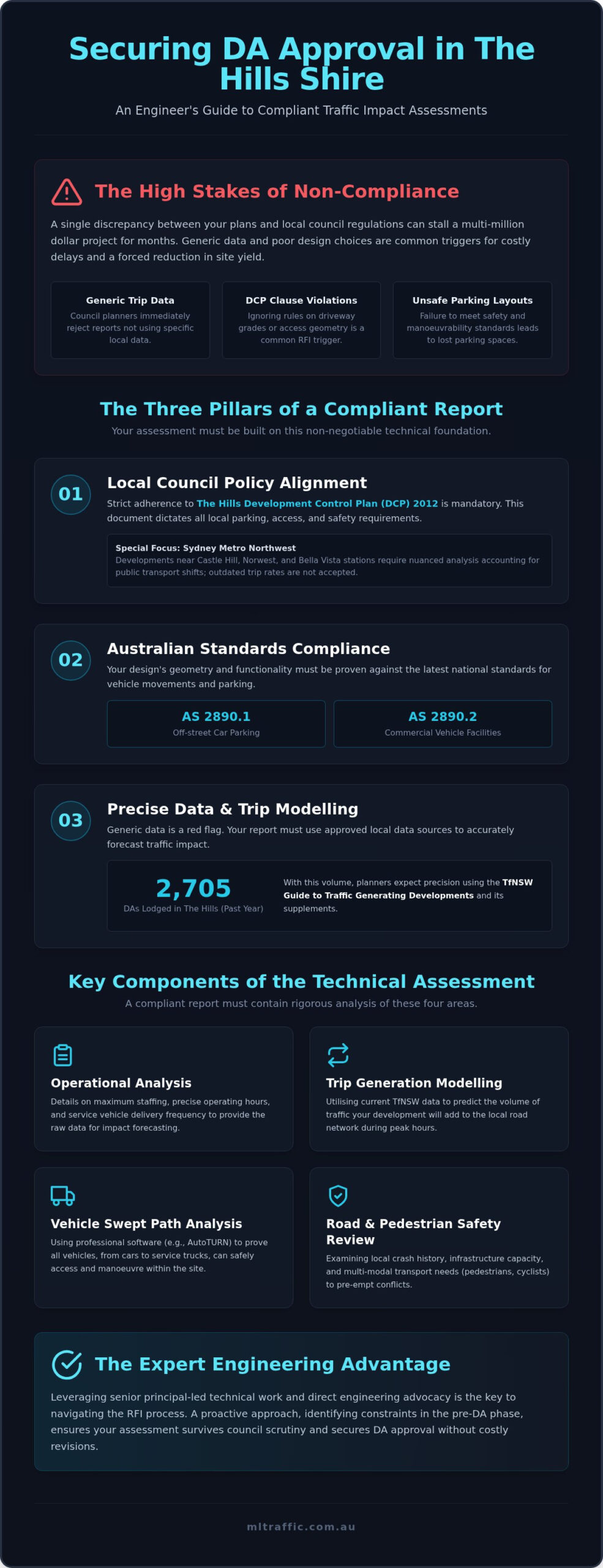
A single technical discrepancy between local planning regulations and the latest Australian Standards can stall a multi-million dollar development for months. Many developers find themselves trapped in a cycle of revisions because they’ve relied on generic data rather than the specific trip generation rates preferred by local planners. Securing a successful development traffic impact assessment requires more than just filling out a template; it demands a precise alignment of site geometry, parking demand, and local infrastructure constraints.
We understand the frustration of facing unexpected Requests for Information (RFIs) that threaten your project timelines and site yield. This guide provides the expert engineering insights necessary to navigate these technical complexities and ensure your documentation meets the local council’s rigorous standards. You’ll learn how ML Traffic Engineers Australia integrates AS 2890.1 compliance with clever parking design to optimise your development while maintaining clear advocacy throughout the assessment process.
Key Takeaways
- Understand how The Hills Development Control Plan 2012 dictates parking and access requirements to avoid common DA pitfalls and costly delays.
- Identify the essential components of a the hills shire council traffic impact assessment, including detailed operational analysis and local road safety history.
- Ensure strict adherence to AS 2890.1 and AS 2890.2 standards to provide the non-negotiable technical foundation required for every traffic report.
- Utilise professional vehicle swept path analysis and AutoTURN software to prove site manoeuvrability and accessibility to Council assessors.
- Leverage senior principal-led technical work and direct engineering advocacy to navigate the RFI process and secure your project’s DA approval.
Navigating The Hills Shire Council Traffic Requirements
The Hills Shire Council requires a technical justification for any development that alters local traffic patterns. A the hills shire council traffic impact assessment is the primary instrument for this justification. It aligns your project with The Hills Development Control Plan (DCP) 2012. This ensures parking, access, and safety meet local benchmarks. The process relies on fundamental traffic engineering principles to predict site functionality and potential impacts on the surrounding road network.
The Sydney Metro Northwest has fundamentally altered local study requirements. Council now demands nuanced analysis for developments near Castle Hill, Norwest, and Bella Vista stations. You cannot apply outdated trip generation rates for these sites. Reports must account for the shift towards public transport and the specific precinct-based DCPs that apply in these growth areas. This ensures that new developments don’t overwhelm the existing infrastructure while supporting the Shire’s densification goals.
To better understand the general requirements for a Development Application in this region, watch this helpful 60-second guide:
When is a Formal Traffic Report Mandatory?
Council uses specific triggers to determine documentation levels. A basic Traffic Statement might suffice for minor residential additions or low-impact commercial changes. However, a comprehensive TIA is mandatory for larger scales. Residential flat buildings, child care centres, and significant multi-dwelling housing projects always require formal reports. Industrial developments with heavy vehicle access requirements also trigger this need. Any ‘change of use’ that increases trip generation rates above existing levels will require a formal assessment. In station precincts, Council maintains high sensitivity regarding road network capacity. Even mid-sized projects in these zones often require full TIAs to justify their impact on local intersections.
The Cost of Non-Compliance in The Hills
Non-compliant reports lead to ‘Requests for Further Information’ (RFI). These requests cause significant project delays and increase holding costs. Common triggers include ignoring local trip generation data or failing to address DCP clauses on driveway grades. You don’t want to rely on generic data that Council planners will immediately reject. Poorly designed car parks often result in a forced reduction in site yield. This happens when designers fail to meet minimum safety standards or swept path requirements. Engaging a qualified traffic engineer during the pre-DA phase identifies these constraints early. This proactive step ensures your the hills shire council traffic impact assessment is technically sound. It prevents expensive roadblocks and ensures the report survives Council scrutiny without multiple revisions.
Core Components of a Compliant Traffic Impact Assessment
A compliant the hills shire council traffic impact assessment is a rigorous technical document that moves beyond simple site descriptions. It requires a granular operational analysis. This analysis must detail maximum staffing levels, precise operating hours, and the frequency of service vehicle deliveries. These figures provide the raw data necessary for accurate impact forecasting. We also conduct a thorough review of the existing road environment. This includes examining local safety history and current infrastructure capacity to identify potential conflicts before they reach the Council’s planning desk.
Trip generation modelling forms the core of our technical work. We utilise the Transport for NSW (TfNSW) Guide to Traffic Generating Developments and its 2026 supplements to ensure data accuracy. With 2,705 development applications lodged in the Shire over the past year, Council planners expect precise modelling that reflects current local conditions. Our reports also integrate multi-modal transport assessments. This ensures pedestrian and cycle safety aligns with the Shire’s Integrated Transport Direction, particularly for sites within the Sydney Metro Northwest precincts.
Intersection Performance and SIDRA Modelling
Council mandates SIDRA modelling for any development expected to have a noticeable impact on the surrounding road network. This software allows us to analyse the Level of Service (LoS) and Degree of Saturation (DoS) at key junctions. We identify network bottlenecks and propose specific mitigation measures, such as intersection upgrades or modified access arrangements. This level of detail is essential for high-impact projects where existing infrastructure is near capacity. If you require technical clarity on your site’s potential impact, a direct technical consultation with our senior engineers can identify these issues early.
Parking Demand vs. Council Supply Requirements
We calculate parking requirements using the strict metrics found in The Hills DCP 2012 and relevant Local Environmental Plans (LEP). Council expectations are high, and unjustified shortfalls often lead to immediate RFIs. When a project cannot meet the prescribed rates, we provide expert parking demand assessments to justify the variation. This justification involves empirical surveys and comparative analysis of similar land uses. Every design we produce includes dedicated allocations for accessible parking, motorcycle bays, and bicycle storage as per national standards. This meticulous approach ensures your site yield is optimised without compromising compliance.
Australian Standards (AS 2890) and Council Policy
Compliance with Australian Standard AS 2890 is the non-negotiable foundation for every traffic report submitted in Australia. It provides the essential technical metrics for safety, functionality, and accessibility. Every the hills shire council traffic impact assessment we produce demonstrates total adherence to these national benchmarks. We apply AS 2890.1 (Off-street car parking) to residential and retail designs to ensure parking bays and accessways meet modern vehicle requirements. For service areas, loading docks, and delivery zones, AS 2890.2 (Off-street commercial vehicle facilities) dictates the necessary clearances and manoeuvring space. Professional certification from a senior principal ensures Council planners cannot fault the technical layout or safety of your car park. This high-level oversight is critical because even minor deviations from these standards can trigger an immediate RFI.
Car Park Geometry and Compliance
We categorise parking areas based on specific user classes, such as Class 1A for residential residents or Class 3 for short-term retail shoppers. Each class has unique requirements for bay width and door opening clearances. Tight basement designs in high-density precincts like Rouse Hill or Castle Hill often present challenges with blind aisles and turnaround areas. We resolve these spatial constraints by designing compliant car parks that maximise site yield while strictly meeting safety codes. Our methodology incorporates the March 2026 TfNSW Supplement to AS 2890. This ensures that the latest state-level variations and safety requirements are fully integrated into your DA documentation.
Driveway Ramps and Sight Distances
Driveway ramp grades require precise mathematical calculation to prevent vehicle scraping. This is particularly vital in The Hills Shire, where steep topography often complicates site access. We utilise B85 and B99 vehicle templates to test transition gradients and breakover angles, ensuring all vehicles can enter and exit without damage. Motorists exiting onto Council roads must also maintain unobstructed sight lines. We assess these sight distances against AS 2890 requirements to protect both vehicle occupants and pedestrians on the footpath. For commercial loading docks, we verify headroom and overhead clearance for the specific design vehicles expected on-site. This technical rigour prevents structural conflicts and ensures your development operates safely and efficiently from the moment it opens.
Swept Path Analysis: Proving Access and Manoeuvrability
Swept path analysis is a mandatory component for any development involving heavy vehicle movements or complex car park layouts. It is a computer-simulated model mapping the precise path a vehicle takes while turning. Within a the hills shire council traffic impact assessment, these simulations provide the technical proof that your site accommodates the intended design vehicles. We use AutoTURN software to simulate real-world movements on-site. This ensures every turn is achievable without striking kerbs, structural walls, or other parked cars. Council planners prioritise safety and traffic flow. They typically mandate that all waste collection and emergency vehicles enter and exit the property in a forward direction. Reversing onto public roads is generally prohibited for heavy vehicles.
These simulations directly influence the architectural footprint of your development. The swept paths determine the placement of structural columns, the width of access gates, and the radius of internal curves. Failing to integrate these paths early leads to forced redesigns after DA lodgement. For expert assistance with these technical requirements, you can request a vehicle swept path analysis to secure your layout’s compliance.
Service Vehicle and Waste Truck Access
The Hills Shire Council maintains specific waste vehicle dimensions that our engineers must apply. We simulate turning circles for these heavy vehicles to ensure they navigate narrow urban driveways without encroaching on oncoming traffic lanes. Loading bays must be designed so stationary service vehicles don’t interfere with general traffic flow or block pedestrian thoroughfares. Our technical reports provide the exact dimensions required for these zones based on the specific fleet used by Council contractors. This prevents operational conflicts once the development is occupied.
Optimising Complex Site Layouts
We use swept path analysis to justify narrow access points where site constraints are significant. By integrating passing bays and queuing areas based on simulated data, we prove to Council that the site operates efficiently despite reduced driveway widths. This requires early-stage collaboration between architects and traffic engineers. We help designers position structural elements to accommodate vehicle movements while maximising the usable floor area and site yield. This proactive approach identifies spatial conflicts before they become expensive construction problems.
Securing DA Approval with Expert Traffic Engineering
Senior principal involvement is the most critical factor in ensuring your the hills shire council traffic impact assessment survives the rigorous Council review process. Many larger firms delegate technical work to junior staff; this often leads to oversights and subsequent RFIs. We operate with a personnel continuity promise. This ensures the senior engineer who initiates your project is the same expert who performs the technical modelling and signs off on the final report. This high-level accountability ensures every driveway grade, parking bay, and swept path calculation meets the precise requirements of The Hills DCP 2012.
Beyond the initial report, a qualified traffic engineer acts as your technical advocate. Council planners often have specific concerns regarding local traffic volume or pedestrian safety that require expert negotiation. We provide clear, evidence-based responses to Council queries, drawing on decades of experience to defend your site’s design. This advocacy is especially vital for projects in high-growth precincts where infrastructure capacity is a primary concern for local authorities. Our involvement doesn’t end at the DA stage. We also prepare Traffic Guidance Schemes (TGS) to manage vehicle movements safely during the construction phase of your project.
Choosing the Right Traffic Consultancy
Selecting a consultancy with a proven track record across diverse land-use categories is essential. Your engineer should demonstrate extensive experience in residential flat buildings, childcare centres, medical suites, and industrial warehouses. This breadth of knowledge allows for more accurate trip generation forecasting and better site yield optimisation. You need a partner who maintains a no-gatekeepers approach, providing you with direct access to senior leadership for technical queries. It’s also vital that your consultant maintains a deep understanding of traffic engineering national standards to ensure every aspect of your car park design is legally defensible.
Next Steps for Your Development Application
Engaging a traffic engineer early in your project timeline prevents expensive architectural redesigns later. We recommend seeking technical advice during the concept design phase to identify potential access or parking constraints before they are locked into your plans. To provide an accurate quote for your the hills shire council traffic impact assessment, we require your current site plans and a detailed description of the proposed land use. This information allows us to determine the appropriate level of assessment, whether it’s a standard Traffic Statement or a comprehensive TIA with SIDRA modelling. You can contact ML Traffic Engineers Australia directly to discuss your project’s specific technical requirements and secure a path toward DA approval.
Secure Your DA Approval with Precision Engineering
Navigating the regulatory landscape of The Hills Shire requires more than just a surface-level understanding of planning documents. Successful developers prioritise technical accuracy by aligning their site designs with both local DCP 2012 requirements and national AS 2890 standards. A professionally prepared the hills shire council traffic impact assessment serves as your project’s technical foundation. It addresses critical factors like parking demand, intersection performance, and vehicle manoeuvrability through rigorous swept path analysis. These components ensure your development operates safely without placing undue pressure on the Shire’s growing infrastructure.
ML Traffic Engineers Australia provides over 15 years of specialised expertise to help you bypass costly delays. We ensure direct senior principal involvement in every report, providing the meticulous oversight needed for AS 2890 compliance and swept path analysis. This hands-on approach guarantees that the expert you start with is the one performing the technical work. Speak directly with a senior traffic engineer about your DA to secure a compliant, results-oriented report. Your project’s success depends on precision, and we are ready to help you meet Council’s expectations with confidence.
Frequently Asked Questions
What is a Traffic Impact Assessment (TIA) and why does The Hills Shire Council require one?
A Traffic Impact Assessment is a formal engineering report that evaluates how a proposed development will affect the local road network. The Hills Shire Council requires this document to verify that your project complies with the safety and capacity standards set out in the Development Control Plan 2012. It ensures that new traffic does not compromise the efficiency of existing infrastructure.
Does every small development in The Hills Shire need a traffic report?
Not every development requires a full the hills shire council traffic impact assessment. Minor residential alterations or low-impact commercial changes may only require a basic Traffic Statement. Council typically mandates a full TIA when a project exceeds specific trip generation thresholds, involves significant changes to site access, or is located within a sensitive station precinct.
How long does it typically take to prepare a compliant traffic assessment for Council?
Preparation times generally range from one to two weeks. This timeframe depends on the availability of current traffic data and the complexity of the required modelling. Projects requiring original intersection counts or SIDRA analysis may take longer to ensure all technical data meets Council’s 2026-2027 evidentiary standards.
What is the difference between a Traffic Management Plan (TMP) and a Traffic Guidance Scheme (TGS)?
A Traffic Management Plan provides a high-level strategic overview of traffic movements and safety risks for a project. A Traffic Guidance Scheme, formerly known as a Traffic Control Plan, is a detailed technical diagram showing the specific placement of signs and bollards. The TGS is the practical document used on the ground during the construction phase.
How do I know if my car park design complies with AS 2890.1?
Compliance is determined through a detailed engineering review of your site plans against the specific metrics in AS 2890.1. We verify bay dimensions, aisle widths, and turnaround areas for the relevant vehicle class. Our senior engineers use precision software to confirm that every element of your car park design meets the current national code before you lodge your DA.
Can I use a generic traffic report for multiple Council areas in Sydney?
Generic reports are not acceptable for Development Applications. Every the hills shire council traffic impact assessment must be site-specific and address the unique DCP requirements of the local government area. Planners will reject reports that fail to account for local intersection performance or specific precinct policies like those found in Box Hill or North Kellyville.
What happens if my site cannot meet the Council’s minimum parking requirements?
If your project cannot meet the minimum parking rates, you must provide a formal justification for the shortfall to avoid an RFI. We conduct a Car Parking Demand Assessment to prove that the proposed supply is sufficient for the intended use. This justification often relies on empirical data from similar developments or the site’s proximity to high-frequency public transport.
How much does a professional traffic impact assessment cost for a DA?
The cost of a professional traffic assessment varies based on the scale of the development and the technical complexity of the report. A complex mixed-use project requiring intersection modelling and SIDRA analysis involves more engineering hours than a simple residential assessment. We provide fixed-fee quotes based on your specific site plans and the land-use categories involved.

Disclaimer
The content on www.mltraffic.com.au, including all technical articles, guides, and resources, is provided for general informational and educational purposes only. It is not intended to constitute professional advice in traffic engineering, transportation planning, development approvals, or any other technical or legal field.
While ML Traffic Engineers makes every reasonable effort to ensure the accuracy, completeness, and timeliness of the information published, we do not provide any warranties or representations (express or implied) regarding its reliability, suitability, or availability for any particular purpose. Any reliance you place on the content is strictly at your own risk.
In no event shall ML Traffic Engineers, its directors, employees, authors, or affiliates be liable for any direct, indirect, incidental, special, consequential, or punitive damages (including, without limitation, loss of profits, data, or business opportunities) arising out of or in connection with the use of, or inability to use, any information provided on this website.
The articles and guides on this site are not a substitute for engaging a qualified, registered professional traffic engineer (such as an NPER or RPEQ engineer) to assess your specific project requirements. For tailored advice, compliance assessments, or traffic engineering services, please contact a competent professional.
This disclaimer may be updated from time to time without notice. By accessing or using this website, you agree to be bound by the most current version of this disclaimer.
