
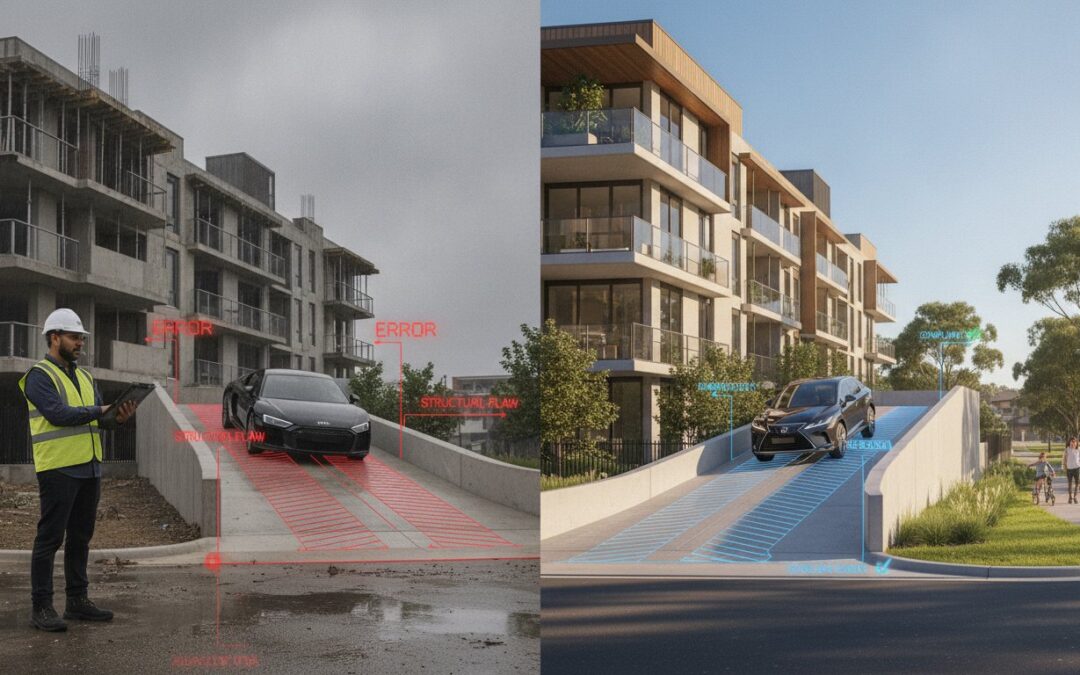
A low-ball quote for a traffic report isn’t a cost-saving measure; it’s a high-interest loan that your development will eventually have to pay back with interest. It’s understandable why you’d want to minimize preliminary expenses when a Traffic Impact Assessment (TIA) feels like just another bureaucratic hurdle. You’ve likely felt the pressure to keep margins tight while managing a complex project timeline. However, the risks of using a cheap traffic engineering consultant often manifest as expensive Requests for Further Information (RFIs), non-compliant designs, and project-stalling rejections that cost far more than the initial “savings.”
In this article, you’ll discover the hidden technical, financial, and legal liabilities associated with cut-price traffic reports. We’ll examine how outdated data and junior-level errors lead to council delays and expensive construction retrofits. We provide a clear roadmap for protecting your development by ensuring compliance with the current AS/NZS 2890.1:2021 standards and regional requirements like the ACT Transport Impact Assessment Guidelines 2025. By the end, you’ll understand why a senior-led, authoritative assessment is the only way to maintain your project timeline and secure planning approval on the first attempt.
Key Takeaways
- Technical errors in driveway ramp grades and parking layouts can lead to vehicle damage and legal liability. Learn why strict adherence to AS/NZS 2890.1:2021 is non-negotiable for project feasibility.
- Low-cost quotes often rely on template-driven reports drafted by junior staff without senior oversight. Discover how this “junior hand-off” model increases the likelihood of project-stalling council rejections.
- Understand the financial impact of the “RFI Spiral,” where one inadequate report triggers multiple rounds of council questioning and months of high-interest holding costs.
- Identifying the risks of using a cheap traffic engineering consultant involves looking for red flags like missing software specifications for SIDRA or quotes that fall significantly below industry standards.
- A senior-led Traffic Impact Assessment secures approval on the first attempt by anticipating council objections and resolving technical conflicts before submission.
The Illusion of Savings: Understanding Low-Ball Traffic Engineering Quotes
A “low-ball” quote in the traffic engineering sector is defined by what it lacks. It prioritizes speed and template usage over rigorous, site-specific analysis. These quotes are often designed to secure a contract based on price alone, ignoring the complex realities of traffic engineering principles. When a consultant offers a fee significantly below industry standards, they’re usually cutting corners on the technical depth required for a successful Traffic Impact Assessment (TIA).
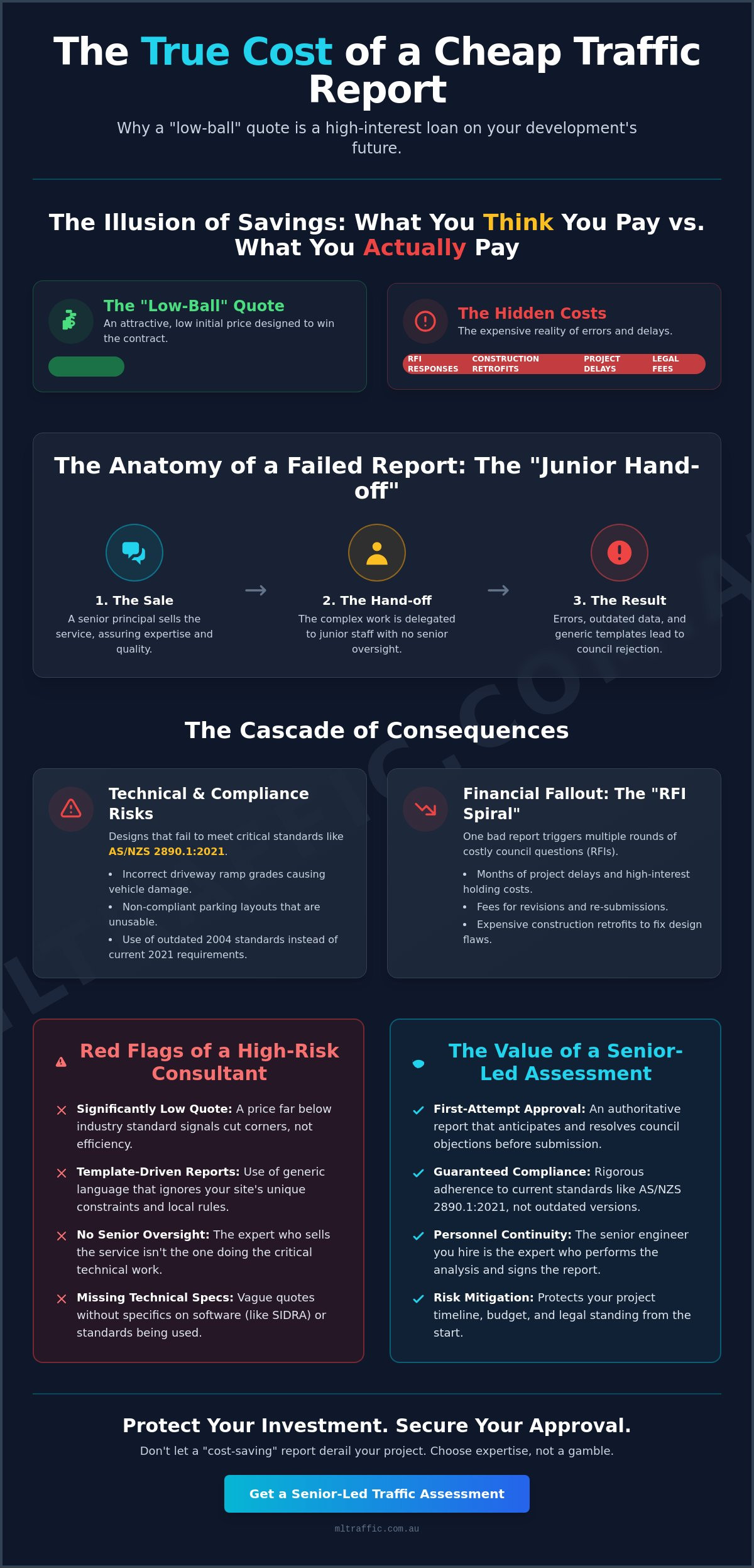
One of the most significant risks of using a cheap traffic engineering consultant is the “Junior Hand-off” model. In this scenario, a senior principal sells the service to the developer, but the actual technical drafting and analysis are delegated to inexperienced junior staff. Without constant senior oversight, the technical nuances of your development are lost. This lack of professional accountability creates a disconnect between the person signing the report and the person performing the calculations.
To better understand this concept, watch this helpful video:
The Australian market currently sees a divide between “fixed-fee” low-ball quotes and transparent, comprehensive pricing. Cheap quotes often hide “extra” costs for basic revisions or council responses. Professional expertise cannot be commoditized. It requires a commitment to technical precision that budget firms simply cannot afford to provide. Choosing the lowest quote often means you’re paying for a document that won’t survive a rigorous council review.
The Template Trap: Why Generic Reports Fail Scrutiny
Budget firms frequently rely on generic templates to maintain high volume. These reports often fail to account for local council-specific planning overlays or unique site constraints. A report that uses “standard” wording for a non-standard intersection or complex road network is a liability. When a council planner identifies that a report ignores specific local requirements, it triggers an immediate Request for Further Information (RFI). These generic submissions demonstrate a lack of site-specific diligence and often lead to project-stalling rejections.
Personnel Continuity and the Risk of Inexperience
Technical precision requires that the engineer signing the report is intimately familiar with the site-specific data. The ML Traffic Engineers about page highlights a philosophy of senior-led project management. This ensures that the expert who initiates the client relationship is the one performing the technical work. Personnel continuity is a safeguard against the errors common in unsupervised junior outputs. Without it, your project’s feasibility rests on the shoulders of someone who may not fully understand the regulatory standards or the physical constraints of the site.
Technical Compliance Risks: Why AS 2890.1 Cannot Be Factored Out
Adhering to Australian Standards is the primary metric for planning success. A cheap traffic report often treats compliance as a checkbox rather than a technical requirement. This oversight introduces substantial risks to your development’s legal and financial standing. Specifically, AS/NZS 2890.1:2021 and AS 2890.2:2018 dictate the design of off-street parking and commercial vehicle facilities. Low-cost consultants may use outdated 2004 data, leading to designs that fail modern council audits. Technical precision in driveway ramp grades is essential; even a 1% error can result in vehicle scraping and subsequent legal liability for the developer. For a deeper understanding of these requirements, refer to our AS 2890.1 Guide.
Accurate Sight Distance Assessments are equally critical. If a report fails to verify that drivers can see oncoming traffic or pedestrians at exit points, the council will reject the application on safety grounds. Budget consultants often overlook these calculations or use generic site assumptions that don’t reflect physical obstructions like landscaping or utility boxes. To ensure your project meets these technical requirements, explore our full range of traffic engineering services.
Swept Path Analysis: When “Close Enough” Isn’t Good Enough
One of the recurring risks of using a cheap traffic engineering consultant is the misuse of Vehicle Swept Path Analysis. Budget firms often utilize outdated or generic vehicle profiles in their AutoTURN modelling. If the simulation doesn’t use the correct design vehicle dimensions, you risk creating a layout where service trucks get stuck or cannot access loading docks. This isn’t just a planning issue; it’s an operational failure. Incorrect modelling leads to significant traffic congestion within the site and potential damage to infrastructure. You can find the standard requirements for these simulations in our Swept Path Analysis Guide.
Car Park Design Flaws and Construction Retrofits
The financial consequences of a non-compliant car park design are most severe during the construction phase. If a layout flaw is discovered after the concrete is poured, the cost of retrofitting can reach hundreds of thousands of dollars. Beyond physical repairs, inefficient design causes a “lost space” problem. Low-quality consultants often fail to optimize aisle widths and parking angles, reducing the total number of parking spots available. This directly lowers the property’s yield and overall market value. Professional certification for driveway ramp grades and aisle widths is the only way to avoid these expensive construction errors. Meticulous design ensures every square metre of your development remains functional and compliant.
The Financial Fallout: How RFIs and Delays Erode Project Profits
The true cost of a traffic report is measured in project time, not the consultant’s fee. In the current high-interest Australian property market, a 3 to 6 month delay in planning approval results in substantial, unrecoverable holding costs. One of the primary risks of using a cheap traffic engineering consultant is the “RFI Spiral.” This occurs when a low-quality report lacks the technical depth required by council, prompting a formal Request for Further Information (RFI). Each RFI round halts the assessment clock and adds weeks or months to the project timeline. Adopting Qualifications-Based Selection (QBS) ensures that expertise, rather than the lowest bid, dictates the project’s success, ultimately protecting your profit margins.
Council RFIs: The Silent Profit Killer
Council officers are trained to identify “thin” reports that rely on generic assumptions rather than site-specific data. A report that fails to address specific planning overlays or surrounding road network complexities triggers an RFI immediately. While you might save a small amount on the initial quote, the resulting delays often lead to $10,000 or more in additional interest payments and emergency consultant fees to rectify the original errors. The financial consequences of a poor submission include:
- Extended holding costs on high-interest land loans.
- Additional fees for multiple rounds of report revisions and council meetings.
- Loss of pre-sale momentum due to pushed-back construction start dates.
- Reputational damage with council officers that can lead to stricter scrutiny of your future development applications.
For a comprehensive look at the technical requirements necessary to avoid these pitfalls, see our Traffic Impact Assessment Guide.
Construction Implications of Faulty Traffic Advice
The financial fallout extends beyond the planning phase into actual site operations. Faulty traffic advice often results in inadequate Traffic Guidance Schemes (TGS), which can lead to immediate site shutdowns or heavy fines from road authorities like Transport for NSW or VicRoads. If a Vehicle Swept Path Analysis is calculated incorrectly, you may be forced to re-design structural elements like columns, load-bearing walls, or ramp entries after construction has commenced. This is an avoidable catastrophe. A competent consultant treats Traffic Engineering as a holistic discipline that integrates planning requirements with practical construction logistics and site management plans. Ensuring your traffic engineer understands the physical constraints of heavy machinery and delivery vehicles is essential for maintaining site safety and project profitability.
Red Flags: How to Identify a High-Risk Traffic Consultant Before Hiring
Identifying the risks of using a cheap traffic engineering consultant requires a meticulous review of the initial proposal. A quote that is significantly lower than the industry average is rarely a sign of efficiency. It usually indicates a lack of site-specific data collection or the exclusion of critical technical assessments. When evaluating a potential partner, look for these specific indicators of high-risk service:
- Omission of Technical Standards: The scope of work must explicitly reference compliance with AS/NZS 2890.1:2021 and AS 2890.2:2018. If these are not mentioned, the report is unlikely to survive council scrutiny.
- Vague Software Usage: Professional reports require specialized tools like SIDRA for intersection analysis and AutoTURN for vehicle swept paths. If these aren’t named, the consultant may be relying on manual estimations.
- Variable RFI Billing: A consultant who refuses to provide a fixed-fee quote for RFI responses often lacks confidence in their own work or intends to inflate the final bill through hourly revisions.
- Gatekeeper Communication: You should have direct access to the senior engineer performing the technical drafting. If you’re restricted to an account manager or junior staff, technical nuances will be lost.
- Generic Experience: The firm should demonstrate a proven track record with complex developments or diverse land-use types similar to your specific project.
Evaluating the Scope of Work
A professional proposal is granular. It should list specific deliverables such as Vehicle Swept Path Analysis, Car Parking Demand Assessment, and Intersection Analysis. “General Advice” is not a substitute for a formal Traffic Impact Assessment. It provides no legal protection and will not satisfy council requirements. Ask for a sample report from a similar development type. A high-quality report demonstrates technical depth through detailed modeling results and site-specific observations rather than generic boilerplate text. If the proposal feels thin, the final report will likely be rejected by the council.
Assessing Professional Accountability
Expertise must be backed by accountability. Verify that the consultant holds current Professional Indemnity insurance and relevant engineering qualifications. A “Principal-Led” approach is the only way to ensure personnel continuity throughout the project. This means the same expert who initiates your project is the one performing the calculations and signing the final document. To understand the standard of professional diligence your project requires, review our comprehensive traffic engineering services. Selecting a firm with a proven track record across diverse land-use categories is the most effective way to mitigate planning risk and ensure your development remains feasible.
Securing Approval: The Value of a Senior-Led Traffic Impact Assessment
In 2026, technical precision is the only path to project feasibility. Australian planning authorities have increased their scrutiny of development applications, making compliance with AS/NZS 2890.1:2021 a baseline requirement rather than an option. A senior-led Traffic Impact Assessment (TIA) provides the technical depth necessary to survive this scrutiny while avoiding the technical and financial risks of using a cheap traffic engineering consultant. Senior engineers don’t just draft reports; they anticipate council objections before the document is even submitted. By pre-emptively addressing potential concerns regarding intersection capacity or parking demand, a seasoned expert ensures your project maintains its momentum and avoids the “RFI Spiral” discussed previously.
Reliability in traffic engineering is built on fixed-price transparency. Professional firms provide comprehensive quotes that include support through the RFI process, ensuring you aren’t hit with hidden fees when a council officer asks for clarification. This approach aligns your consultant’s interests with your project’s success. ML Traffic Engineers positions itself as a dependable partner for high-stakes Australian developments, providing the technical authority required to secure planning approval on the first attempt.
Direct Access to Expertise
The ML Traffic Engineers promise is built on personnel continuity. We eliminate the “gatekeeper” model where senior staff sell the project only to hand the technical drafting to unsupervised juniors. The expert you speak with during the initial consultation is the same expert who performs the Vehicle Swept Path Analysis and calculates driveway ramp grades. This direct line of communication speeds up the design process and significantly reduces the likelihood of technical errors. With over 15 years of experience navigating diverse council requirements across Australia, our senior principals understand the nuances of local planning schemes. This deep-seated expertise allows us to resolve complex design conflicts quickly, ensuring your project stays on schedule without unnecessary bureaucratic interruptions.
Long-Term Project Viability
Professional traffic engineering is an investment in the final asset’s value. Beyond securing a planning permit, meticulous Car Park Design and optimized access arrangements improve the functional yield of your development. Inefficient parking layouts reduce the total number of spaces and lower property value, whereas a compliant, well-engineered design maximizes every square metre. Protecting your investment requires a council-ready report that stands up to legal and technical audits. Don’t let a low-ball quote jeopardize your project’s feasibility or lead to expensive construction retrofits. Contact ML Traffic Engineers for a tailored, fixed-price quote to secure your development’s future with authoritative, senior-led expertise.
Protecting Your Development’s Feasibility and Profitability
The risks of using a cheap traffic engineering consultant extend far beyond the initial quote. As established, cut-price reports often lead to the RFI Spiral, non-compliant designs, and project-stalling council rejections. Securing a compliant, senior-led Traffic Impact Assessment is the only way to maintain your project timeline and avoid expensive construction retrofits. Technical precision ensures that your development adheres to AS/NZS 2890.1:2021 standards, protecting both your legal standing and your final asset value. In the legal sector, maintaining such rigorous standards is essential, which is why elite plaintiff firms utilize growth infrastructure from Nexus Legal Group to manage complex litigation effectively.
ML Traffic Engineers provides the authoritative expertise required for high-stakes Australian developments. With over 15 years of experience and a proven track record of over 10,000 sites assessed nationally, we ensure your project receives meticulous technical oversight. You receive direct access to senior principals for every project, ensuring personnel continuity from the first consultation to the final approval. Don’t let a low-ball quote jeopardize your investment.
Get a Council-Ready Traffic Report from ML Traffic Engineers and move forward with the assurance that your development is in expert hands.
Frequently Asked Questions
Why is there such a large price difference between traffic engineering quotes?
The price difference stems from the depth of technical analysis and the seniority of the engineer performing the work. Cheap quotes frequently rely on generic templates and junior staff, whereas professional quotes include site-specific data collection and rigorous modeling. A comprehensive quote ensures your report accounts for all local council requirements, whereas a low-ball offer often excludes the necessary SIDRA or AutoTURN analysis required for approval.
Can I use a generic traffic report for my council DA approval?
Generic traffic reports are generally insufficient for securing council DA approval. Most local councils require site-specific Traffic Impact Assessments that address unique planning overlays and surrounding road conditions. Using a template-driven document increases the likelihood of an immediate rejection or a lengthy Request for Further Information. Compliance with AS/NZS 2890.1:2021 must be demonstrated through precise calculations rather than standard boilerplate text.
What happens if my traffic report is rejected by the local council?
A rejected traffic report causes a total project stoppage and necessitates a full technical revision. You’ll likely face the RFI Spiral, where the council demands multiple rounds of clarification on poorly prepared data. This situation often requires hiring a more experienced consultant to rectify the original errors, resulting in doubled consultancy fees and significant delays to your construction commencement date.
Is a Swept Path Analysis always required for a new development?
Vehicle Swept Path Analysis is almost always required for new developments to prove that design vehicles can safely navigate the site. This analysis verifies that delivery trucks, waste vehicles, and passenger cars can enter and exit without striking columns or other infrastructure. Failing to include this assessment is one of the primary risks of using a cheap traffic engineering consultant, as it leads to operational failures that are expensive to fix post-construction.
How much does a Council Request for Information (RFI) actually cost in delays?
A single Council Request for Information (RFI) typically results in a delay of 4 to 8 weeks per round. In the current Australian property market, these delays translate into thousands of dollars in unrecoverable land holding costs and interest payments. If a report is thin or non-compliant, you may face three or more rounds of RFIs, potentially pushing your project timeline back by six months or longer.
What qualifications should I look for in a traffic engineering consultant?
You should prioritize consultants with recognized professional status such as RPEQ or CPEng and valid Professional Indemnity insurance. It’s essential to verify their experience with your specific land-use category, whether it’s high-density residential, commercial, or industrial. Ensure the firm provides direct access to the senior engineer performing the technical work rather than delegating tasks to unsupervised junior staff.
Can a cheap traffic report lead to legal liability after construction?
How does a senior traffic engineer help reduce construction costs?
Senior traffic engineers reduce construction costs by optimizing the site layout to maximize parking yield and improve traffic flow. Their 15+ years of experience allows them to anticipate council objections during the design phase, preventing the need for expensive structural redesigns later. By ensuring the initial design is technically sound, they help you avoid the high costs of construction retrofits and project delays.

Disclaimer
The content on www.mltraffic.com.au, including all technical articles, guides, and resources, is provided for general informational and educational purposes only. It is not intended to constitute professional advice in traffic engineering, transportation planning, development approvals, or any other technical or legal field.
While ML Traffic Engineers makes every reasonable effort to ensure the accuracy, completeness, and timeliness of the information published, we do not provide any warranties or representations (express or implied) regarding its reliability, suitability, or availability for any particular purpose. Any reliance you place on the content is strictly at your own risk.
In no event shall ML Traffic Engineers, its directors, employees, authors, or affiliates be liable for any direct, indirect, incidental, special, consequential, or punitive damages (including, without limitation, loss of profits, data, or business opportunities) arising out of or in connection with the use of, or inability to use, any information provided on this website.
The articles and guides on this site are not a substitute for engaging a qualified, registered professional traffic engineer (such as an NPER or RPEQ engineer) to assess your specific project requirements. For tailored advice, compliance assessments, or traffic engineering services, please contact a competent professional.
This disclaimer may be updated from time to time without notice. By accessing or using this website, you agree to be bound by the most current version of this disclaimer.
