

We are traffic engineers servicing every suburb of Melbourne metropolitan area, Mornington Peninsula and Geelong.
A planning application presents numerous challenges, but few can derail a project as effectively as unresolved traffic and parking issues. Navigating council requirements for a Traffic Impact Assessment or a Car Parking Demand Assessment can be a complex process, often leading to costly delays and requests for information (RFIs). Misinterpreting these requirements is a common cause of project rejection. This is the precise point where professional traffic engineering provides critical value, transforming a potential obstacle into a streamlined part of your approval.
This article provides a direct, no-nonsense guide to the role of a traffic engineer in the development process. You will gain a clear understanding of what a traffic consultant does, why their input is essential for your planning application, and the correct time to engage their services. We will outline how expert traffic assessment de-risks your project, ensuring the final design is safe, compliant with Clause 52.06 of the Victorian Planning Scheme, Australian Standards, and strategically planned for a successful council outcome.
What is Traffic Engineering? A Practical Definition for Developers
Traffic engineering is the applied science of ensuring the safe and efficient movement of vehicles and pedestrians. Beyond the textbook, for property developers, it is the critical discipline that provides the evidence to prove your project will not adversely impact the local road network. This evidence is a fundamental requirement for achieving council approval for your town planning application.
While a comprehensive answer to What is Traffic Engineering covers broad public network management, for a private developer, the focus is hyper-local and project-specific. It is less about city-wide flow and more about demonstrating your site’s functional viability and compliance.
To better understand this concept, this video provides a clear overview:
Ultimately, the work of a traffic engineer is governed by four primary objectives: ensuring safety for all road users, providing equitable accessibility, optimising traffic flow efficiency, and guaranteeing strict compliance with all relevant codes such as Clause 52.06, AS2890.1, AS2890.2 and AS2890.6.
Public vs. Private Sector Traffic Engineering
Public sector engineers manage broad-scale infrastructure such as city-wide road networks, traffic signal coordination, and public transport systems. In contrast, private sector traffic engineering focuses on the site-specific impacts of new developments. A private consultant acts as the essential liaison, communicating technical findings and negotiating outcomes with public authorities like local councils and state bodies such as Department of Transport and Planning to secure project approvals.
The Key Questions a Traffic Engineer Answers
A professional traffic consultant provides definitive answers to the critical questions that councils will ask about your development. Their assessment, typically presented in a Traffic Impact Assessment (TIA) report, will address:
-
How much new traffic will the development generate during peak hours?
-
Is the proposed on-site parking supply sufficient and compliant with relevant planning codes (Clause 52.06, AS2890.1 and/or AS2890.6)?
-
Can all design vehicles, from cars to service trucks, safely enter, exit, and maneuver within the site without conflict?
-
Are any upgrades required for surrounding roads, intersections, or footpaths to accommodate the project?
Core Services: What a Traffic Engineer Delivers for Your Project
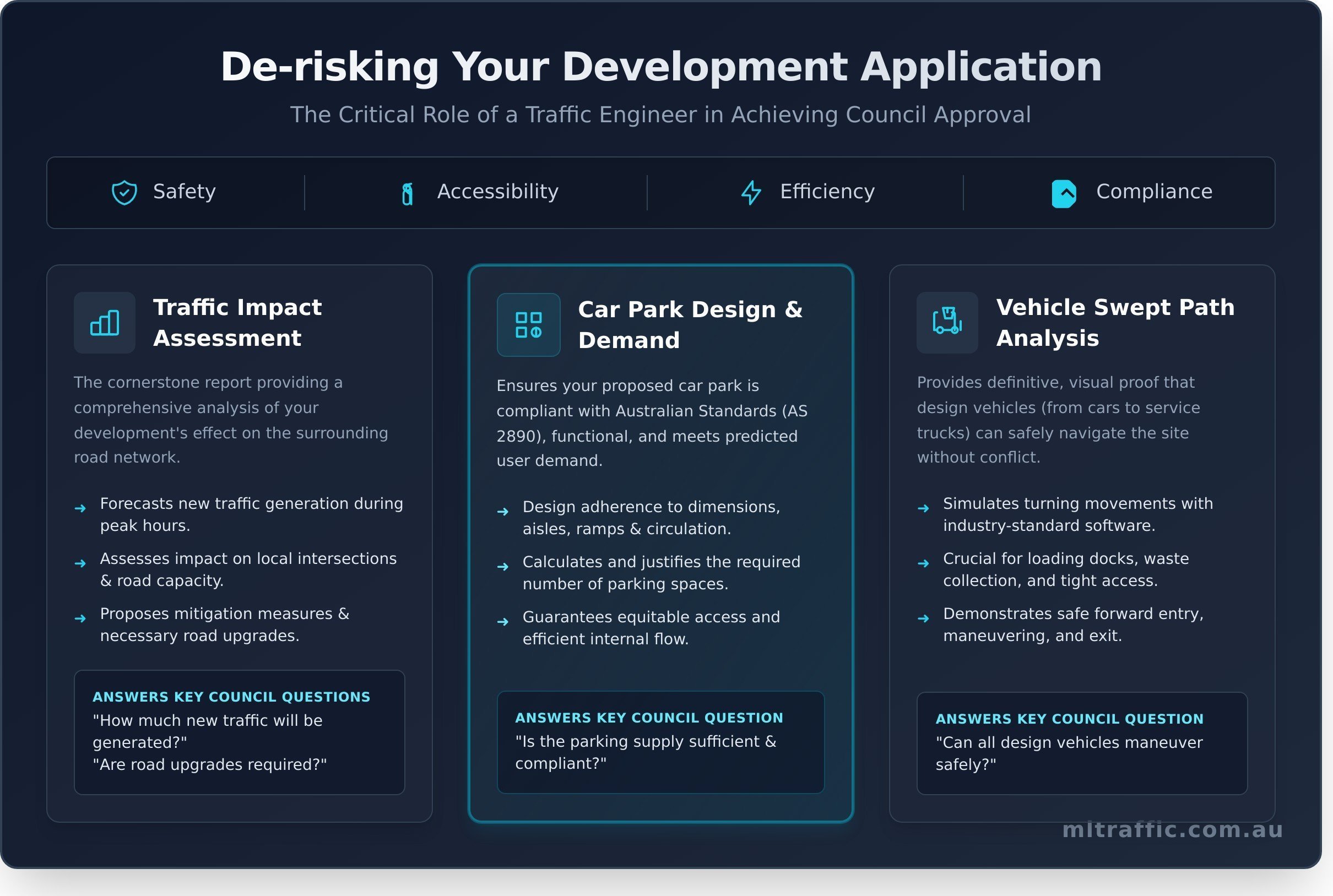
Professional traffic engineering is not a single task but a suite of specialised assessments. Each report is commissioned to address specific council concerns regarding your development’s impact on the local transport network. These core traffic engineering services provide the objective data and analysis required by planning authorities. Ultimately, these reports form a key component of your Planning Application, demonstrating due diligence and providing council with the necessary evidence to approve your development application.
Traffic Impact Assessment (TIA)
The Traffic Impact Assessment is the cornerstone report for most development applications. It is often the first document a council requests as it provides a comprehensive analysis of the development’s effect on the surrounding road network. A TIA meticulously details existing traffic conditions, forecasts the traffic your project will generate, and assesses the impact on nearby intersections. Where required, it proposes specific mitigation measures to ensure the network continues to operate safely and efficiently.
Car Park Design and Parking Demand Assessment
This assessment ensures your proposed car park is both compliant and functional. The design component focuses on adherence to Clause 52.06 and/or Australian Standards (AS 2890.1 and/or AS2890.6), covering critical details like parking space dimensions, aisle widths, ramp grades, and internal circulation. The parking demand analysis calculates the required number of spaces based on council codes and the specific land use, justifying the proposed supply and ensuring it meets the needs of future users, including provisions for accessible parking.
Vehicle Swept Path Analysis
A Vehicle Swept Path Analysis provides definitive, visual proof that design vehicles can safely navigate your site. Using industry-standard software like AutoTURN, we simulate the turning movements of specific vehicles, from a standard car to a large delivery truck. This analysis is crucial for developments with loading docks, waste collection points, or tight access ways. It demonstrates to council that all vehicles can enter, manoeuvre within, and exit the site in a forward direction without conflict.
The Traffic Engineering Process: From Concept to Council Submission
A successful town planning application requires more than just architectural drawings; it needs a robust, evidence-based assessment of its traffic and parking implications. The professional traffic engineering process is a systematic investigation designed to provide this evidence. Engaging an experienced consultant early is critical, as it can prevent costly redesigns and significant delays during council assessment. A qualified traffic engineer acts as your advocate, navigating complex council requirements and ensuring your project is compliant and defensible from the outset. The final output is a formal report that directly supports your DA submission.
Stage 1: Initial Consultation and Scoping
The process begins with a thorough review of your architectural plans to understand the project’s vision and operational needs. We identify key requirements from the local’s planning codes and pinpoint potential traffic challenges, such as sight-line issues or non-compliant access. This allows us to provide preliminary advice to optimise the site layout, parking configuration, and driveway location before plans are finalised, saving significant time and money.
Stage 2: Data Collection and Analysis
This stage involves gathering the empirical data required to justify the development. A comprehensive assessment is built on objective evidence and includes:
-
Conducting on-site traffic counts and vehicle speed surveys to establish accurate baseline conditions.
-
Analysing historical road crash data for the surrounding road network to assess existing safety performance.
-
Applying industry-standard models and traffic generation rates to accurately forecast the traffic impact of the proposed development.
Stage 3: Reporting and Submission
All findings are compiled into a comprehensive Traffic and Parking Impact Assessment report. This document is structured to meet council expectations and includes clear diagrams, swept path analyses (confirming compliance with Clause 52.06 and relevant Australian Standards such as AS 2890.1, AS2890.2 or AS2890.6), and technical drawings. Most importantly, the report methodically addresses each relevant clause in the council’s planning code, providing clear evidence of compliance. This professional report gives the council’s traffic department the information they require to assess and approve your application. Start your project with an expert consultation.
Essential Tools and Standards in Australian Traffic Engineering
Professional traffic engineering is not a matter of opinion. It is a technical discipline built on a foundation of standardised guidelines and sophisticated software. These tools are essential for producing assessments that are objective, repeatable, and legally defensible. For any development application, compliance with these standards is non-negotiable for achieving council approval. An expert engineer knows precisely which standards apply to your specific project and council, ensuring a compliant design from the outset.
Clause 52.06 and Australian Standards (AS/NZS 2890 Series)
Clause 52.06 is the 1st point of reference for vehicle access, car parking layout and site servicing in Victoria. For aspects where Clause 52.06 does not cover, AS2890.1, AS2890.2 and AS2890.6 are called upon.
These documents provide prescriptive, non-negotiable requirements for every element of a car park, including:
-
Parking space and aisle dimensions
-
Ramp gradients and transitions
-
Circulation roadway widths
-
Sight lines for safety at access points
Demonstrating full compliance with these standards is a core component of any traffic report submitted for council assessment.
Austroads Guides and Council’s Planning Codes
Compliance involves navigating multiple layers of regulation. Austroads publishes the national best-practice guides for road design, traffic management, and road safety. Concurrently, local councils enforce their own specific requirements through Clause 52.06 of the Victorian Planning Scheme. These local rules can often be more stringent or specific than the national guides. An experienced traffic consultant must expertly interpret and satisfy both sets of requirements to secure project approval.
Specialised Software (AutoCAD & AutoTURN)
Technical design concepts must be translated into verifiable evidence for assessment. This is achieved using industry-standard software. AutoCAD is used to create precise, scaled technical drawings of car parks and accessways. AutoTURN is then used to perform swept path analysis, simulating vehicle movements to prove that design vehicles-from standard cars to large service trucks-can safely and efficiently navigate the proposed layout. These analyses provide councils with the definitive proof needed to assess a design’s compliance and functionality.
Mastery of these standards and tools is what distinguishes professional traffic engineering. It ensures that every design is not only functional but also fundamentally safe and approvable.
Why Expert Traffic Engineering is a Smart Investment
Viewing professional traffic consulting as a project cost is a fundamental miscalculation. It is a critical, upfront investment in your development’s viability, functionality, and ultimate profitability. Proactive traffic planning is not about ticking a box for council; it is about mitigating significant financial and logistical risks that can delay or derail a project entirely. A well-prepared traffic report provides the necessary evidence to support your plans, ensuring a smoother path to approval and a safer, more efficient final product.
The right advice from an experienced consultant ensures your development is not only compliant but also practical and functional for its entire lifecycle.
De-Risking Your Development Application
A primary function of a thorough traffic impact assessment is to streamline the planning application process with local councils. By anticipating and addressing potential issues before submission, you can avoid common pitfalls that lead to significant delays and budget overruns.
-
Reduces Scope and Likelihood of Council RFIs: A comprehensive report answers council’s questions before they are asked, minimising the likelihood of receiving a Request for Information (RFI) that halts progress.
-
Avoids Costly Redesigns: Identifying and resolving access, parking, or circulation issues early in the design phase prevents the need for expensive architectural changes late in the process.
-
Provides a Robust Defence: Should your plans be challenged, an evidence-based traffic report founded on established standards and sound engineering principles serves as a powerful and credible defence.
Maximising Site Potential and Functionality
Expert traffic engineering goes beyond securing approvals to directly enhance the operational efficiency and long-term value of your site. A compliant design is the minimum requirement; a functional and user-friendly design is what creates a successful development.
-
Optimised Layouts: Professional analysis ensures car park layouts are designed for maximum efficiency, safety, and ease of use, compliant with all relevant Australian Standards.
-
Guaranteed Access: We ensure safe and practical access for all potential users, from customers in passenger vehicles to essential service and delivery trucks, verified with vehicle swept path analysis.
-
Future-Proofs Your Investment: A forward-thinking assessment considers potential changes in local traffic conditions and land use, ensuring your development remains functional and accessible for years to come.
Ensure your project’s success with a professional traffic assessment.
Secure Your Project’s Success with Expert Traffic Engineering
As we have detailed, engaging a traffic engineer is a foundational step for any successful development. Professional traffic engineering moves beyond a simple compliance requirement, providing the critical analysis that ensures your project is safe, efficient, and meets all council and Australian Standards. This proactive approach is not an expense, but a strategic investment to de-risk your project and streamline the path to approval.
At ML Traffic Engineers, we bring over 30 years of specialised experience to your project. Our proven track record, built on thousands of successful Development Applications across Australia, speaks to our meticulous, results-oriented approach. Our model guarantees direct access to principal engineers on every project, providing the authoritative guidance needed to navigate complex requirements without delay.
Secure the expertise your development deserves. Get a no-obligation quote for your project from our senior traffic engineers. Let our team provide the clarity and confidence you need to move your project forward.
Frequently Asked Questions
When in my project timeline should I hire a traffic engineer?
A traffic engineer should be engaged as early as possible, ideally during the concept design or pre-DA (Development Application) phase. Early involvement allows for expert input on site access, parking layout, and vehicle circulation before architectural plans are finalised. This proactive approach to traffic engineering prevents costly redesigns and ensures compliance with council requirements (Clause 52.06 of the Victorian Planning Scheme) and Australian Standards (AS 2890.1, AS2890.2 and AS2890.6) from the outset, streamlining the approval process.
How much does a typical traffic impact assessment report cost in Australia?
The cost of a traffic impact assessment report varies significantly with project scale and complexity. For a small-scale development with straightforward access and parking, a report may cost between A$2,000 and A$5,000. For larger projects requiring extensive traffic surveys, detailed intersection modelling, and council negotiations, the cost can range from A$7,000 to A$20,000 or more. A detailed, project-specific quote is essential for an accurate cost estimate.
How long does it take to prepare a traffic report for a DA?
The timeframe for preparing a traffic report for a Development Application (DA) is dependent on the project’s scope. A standard report for a small development can typically be completed within one to two weeks. More complex assessments that require new traffic data collection, detailed swept path analysis, or formal council consultation may take between three and five weeks. The consultant’s capacity and the responsiveness of third parties can also influence the final timeline.
What happens if the council disagrees with the findings of my traffic report?
If a council raises objections or issues a Request for Information (RFI) regarding a traffic report, it is standard procedure for the traffic consultant to liaise directly with the council’s engineers. This process involves clarifying technical details, providing supplementary analysis, or negotiating design amendments to resolve the concerns. An experienced consultant will anticipate potential issues and address them methodically, aiming to reach a mutually acceptable outcome that satisfies council’s requirements.
Can a good traffic report guarantee my development application will be approved?
No, a traffic report cannot guarantee DA approval. A council’s decision is based on a holistic assessment of all planning aspects, including urban design, environmental impact, and community feedback. However, a comprehensive and technically robust traffic report is a critical component that demonstrates due diligence. It systematically resolves all traffic, parking, and access issues, thereby removing a significant potential reason for refusal and substantially increasing the likelihood of a favourable outcome.
What’s the difference between a traffic engineer and a transport planner?
A traffic engineer typically focuses on the micro-level operational details of the road network and specific developments. This includes car park design, intersection analysis, traffic signal timing, and ensuring vehicle access complies with Australian Standards. A transport planner operates at a macro-level, dealing with broader strategic issues such as public transport integration, city-wide network planning, travel demand management, and developing long-term transport policy for a region.
What areas do we service?
We are traffic engineers in Melbourne servicing metropolitan areas such as Abbotsford, Aberfeldie, Aintree, Airport West, Albanvale, Albert Park, Albion, Alphington, Altona, Altona Meadows, Altona North, Ardeer, Armadale, Arthurs Seat, Ascot Vale, Ashburton, Ashwood, Aspendale, Aspendale Gardens, Attwood, Avondale Heights, Balaclava, Balwyn, Balwyn North, Bangholme, Bayswater, Bayswater North, Beaconsfield, Beaumaris, Bellfield, Bentleigh, Bentleigh East, Berwick, Bittern, Blackburn, Blackburn North, Blackburn South, Bonbeach, Boronia, Box Hill, Box Hill North, Box Hill South, Braeside, Braybrook, Brentford Square, Brighton, Brighton East, Broadmeadows, Brooklyn, Brunswick, Brunswick East, Brunswick West, Bulla, Bulleen, Bundoora, Burnley, Burnside, Burwood, Burwood East, Cairnlea, Camberwell, Campbellfield, Canterbury, Carlton, Carlton North, Carnegie, Caroline Springs, Carrum, Carrum Downs, Caulfield, Caulfield East, Caulfield North, Caulfield South, Chadstone, Chelsea, Chelsea Heights, Cheltenham, Chirnside Park, Clarinda, Clayton, Clayton South, Clematis, Clifton Hill, Coburg, Coburg North, Cocoroc, Coldstream, Collingwood, Coolaroo, Craigieburn, Cranbourne, Cranbourne East, Cranbourne North, Cranbourne South, Cranbourne West, Cremorne, Croydon, Croydon Hills, Croydon North, Croydon South, Dandenong, Dandenong North, Dandenong South, Deer Park, Delahey, Derrimut, Diamond Creek, Diggers Rest, Dingley Village, Docklands, Doncaster, Doncaster East, Donnybrook, Donvale, Doreen, Doveton, Eaglemont, East Melbourne, Edithvale, Elsternwick, Eltham, Eltham North, Elwood, Emerald, Endeavour Hills, Epping, Essendon, Essendon Fields, Essendon North, Essendon West, Fairfield, Fawkner, Ferntree Gully, Ferny Creek, Fitzroy, Fitzroy North, Flemington, Footscray, Forest Hill, Frankston, Frankston North, Frankston South, Gardenvale, Gladstone Park, Glen Huntly, Glen Iris, Glen Waverley, Glenroy, Greensborough, Greenvale, Guys Hill, Hadfield, Hampton, Hampton East, Hampton Park, Harkaway, Hawthorn, Hawthorn East, Heathmont, Heidelberg, Heidelberg Heights, Heidelberg West, Highett, Hillside, Hoppers Crossing, Hughesdale, Huntingdale, Hurstbridge, Ivanhoe, Ivanhoe East, Jacana, Kalkallo, Kealba, Keilor, Keilor Downs, Keilor East, Keilor Lodge, Keilor North, Keilor Park, Kensington, Kew, Kew East, Keysborough, Kings Park, Kingsbury, Kingsville, Knoxfield, Lalor, Langwarrin, Laverton, Laverton North, Lilydale, Lower Plenty, Lynbrook, Lyndhurst, Lysterfield, Macleod, Maidstone, Malvern, Malvern East, Maribyrnong, McCrae, Meadow Heights, Melbourne, Mentone, Mernda, Mickleham, Middle Park, Mill Park, Mitcham, Mont Albert, Mont Albert North, Montmorency, Moonee Ponds, Moorabbin, Mooroolbark, Mordialloc, Mornington, Mount Waverley, Mulgrave, Murrumbeena, Narre Warren, Narre Warren North, Narre Warren South, Newport, Niddrie, Noble Park, Noble Park North, North Melbourne, Northcote, Notting Hill, Nunawading, Oak Park, Oaklands Junction, Oakleigh, Oakleigh East, Oakleigh South, Officer, Ormond, Pakenham, Parkdale, Park Orchards, Pascoe Vale, Pascoe Vale South, Patterson Lakes, Plenty, Point Cook, Port Melbourne, Portsea, Prahran, Preston, Princes Hill, Reservoir, Richmond, Ringwood, Ringwood East, Ringwood North, Ripponlea, Rosanna, Rosebud, Rowville, Roxburgh Park, Rye, Sandhurst, Sandringham, Scoresby, Seabrook, Seaholme, Seddon, Seaford, South Kingsville, South Melbourne, South Morang, South Wharf, South Yarra, Southbank, Spotswood, St Albans, St Helena, St Kilda, St Kilda East, St Kilda West, Strathmore, Sunshine, Sunshine North, Sunshine West, Surrey Hills, Sydenham, Tarneit, Taylors Hill, Taylors Lakes, Templestowe, Templestowe Lower, Thomastown, Thornbury, Toorak, Tottenham, Travancore, Truganina, Tullamarine, Vermont, Vermont South, Viewbank, Wantirna, Wantirna South, Watsonia, Watsonia North, Werribee, Werribee South, West Footscray, West Melbourne, Westgarth, Wheelers Hill, Wildwood, Williamstown, Williamstown North, Windsor, Wonga Park, Wyndham Vale, Yallambie, Yarraville.
Disclaimer
The content on www.mltraffic.com.au, including all technical articles, guides, and resources, is provided for general informational and educational purposes only. It is not intended to constitute professional advice in traffic engineering, transportation planning, development approvals, or any other technical or legal field.
While ML Traffic Engineers makes every reasonable effort to ensure the accuracy, completeness, and timeliness of the information published, we do not provide any warranties or representations (express or implied) regarding its reliability, suitability, or availability for any particular purpose. Any reliance you place on the content is strictly at your own risk.
In no event shall ML Traffic Engineers, its directors, employees, authors, or affiliates be liable for any direct, indirect, incidental, special, consequential, or punitive damages (including, without limitation, loss of profits, data, or business opportunities) arising out of or in connection with the use of, or inability to use, any information provided on this website.
The articles and guides on this site are not a substitute for engaging a qualified, registered professional traffic engineer (such as an NPER or RPEQ engineer) to assess your specific project requirements. For tailored advice, compliance assessments, or traffic engineering services, please contact a competent professional.
This disclaimer may be updated from time to time without notice. By accessing or using this website, you agree to be bound by the most current version of this disclaimer.
