

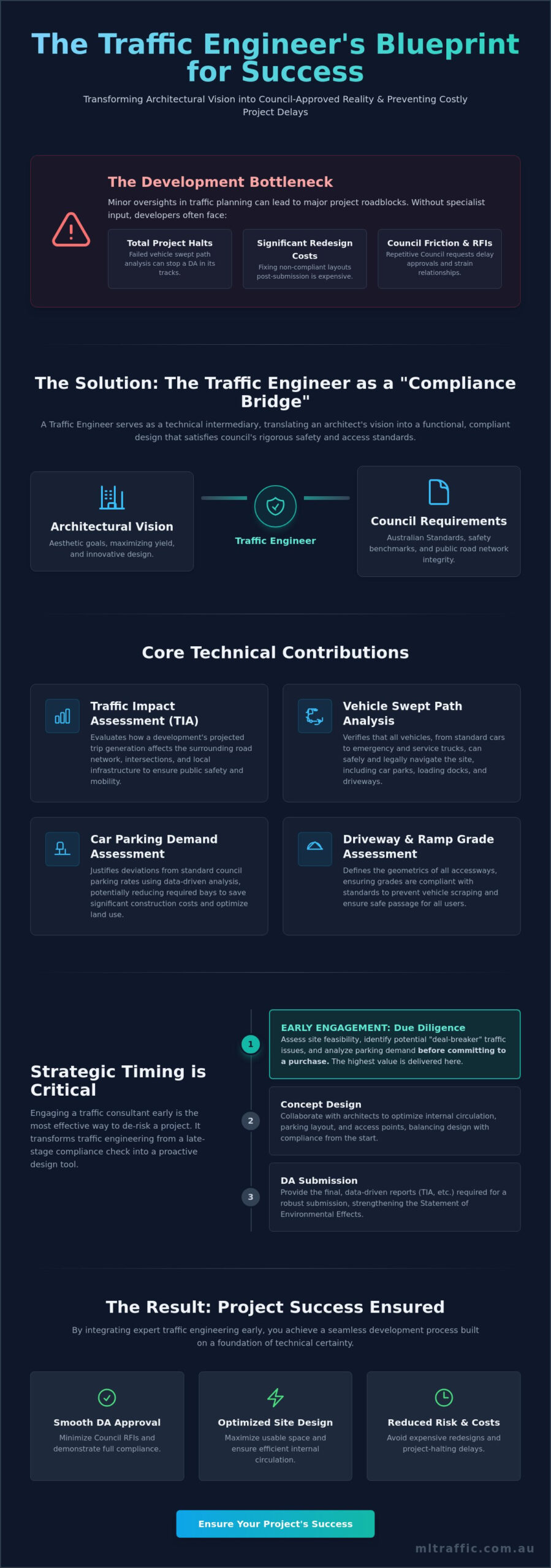
A developer recently discovered that a minor oversight in car park layout led to a total project halt after a failed vehicle swept path analysis. This scenario is common and expensive. It results in significant redesign costs and creates friction between architectural goals and council requirements. Understanding the technical role of a traffic engineer in the project team is the most effective way to prevent these bottlenecks. We agree that your primary goal is a smooth DA approval process without the burden of repetitive Council RFIs or layout non-compliance.
This guide explains how a traffic engineer integrates with your project team to secure council approvals and optimize site design. You’ll learn how to leverage technical expertise in car park design and driveway ramp grade assessments to meet current standards, such as the MUTCD 11th Edition Revision 1 effective March 5, 2026. We will detail how these specialists act as a compliance bridge that translates an architect’s vision into a functional reality. We also preview the essential reports, from Traffic Impact Assessments to intersection analysis, required for a successful submission.
Key Takeaways
- Understand how the role of a traffic engineer in the project team serves as a technical intermediary to bridge the gap between architectural vision and council regulatory requirements.
- Identify the critical technical reports, including Traffic Impact Assessments and Vehicle Swept Path Analysis, required to verify site navigation and safety.
- Learn the strategic benefits of early consultant engagement during due diligence to assess site feasibility and parking demand before committing to a purchase.
- Discover how collaboration between traffic experts, architects, and town planners optimizes internal circulation and strengthens the Statement of Environmental Effects.
- Recognize the value of personnel continuity where senior leadership remains directly accountable for the technical accuracy of your car park design and access assessments.
Table of Contents
-
Defining the Traffic Engineer’s Position Within a Project Team
-
Inter-Consultant Collaboration: How Traffic Engineers Work with Your Team
-
Ensuring Project Success with ML Traffic Engineers Australia
Defining the Traffic Engineer’s Position Within a Project Team
The role of a traffic engineer in the project team is to provide technical certainty during the development application process. They are specialist consultants responsible for the safe and efficient movement of vehicles and pedestrians within and around a site. Unlike generalists, they focus on the intersection of urban design and transportation physics. By acting as the technical intermediary between the developer and the local council, they ensure that the proposed land use is supported by the surrounding road infrastructure.
Developers often face resistance when proposing high-density projects or sites with constrained access. A traffic engineer provides the data-driven evidence required to justify parking variations or complex access arrangements. This involves applying principles of Traffic engineering to demonstrate that a project won’t negatively impact the safety or capacity of the public road network. Their involvement transforms subjective design choices into objective, compliant solutions that authorities can approve.
To better understand this concept, watch this helpful video:
The "Compliance Bridge" Concept
Traffic engineers serve as the translators of Australian Standards for the broader design team. They balance the commercial goals of the developer with the rigid regulatory requirements of state and local authorities. By identifying "deal-breaker" traffic issues before the final submission, they significantly reduce project risk. This proactive approach ensures that the architect’s aesthetic vision doesn’t conflict with mandatory safety clearances or vehicle turning circles. It’s about finding a functional middle ground that satisfies both the developer’s yield targets and the council’s safety benchmarks.
Traffic Engineer vs. Civil Engineer: The Distinction
It’s a common misconception that civil and traffic engineering are interchangeable. While both disciplines are essential, the traffic specialist focuses specifically on operational movement and regulatory compliance. A civil engineer handles the physical construction elements like drainage, pavement thickness, and earthworks. Conversely, the traffic engineer determines the "geometrics" of the site. They define the grades of driveway ramps and the dimensions of parking bays. Civil engineers often rely on this traffic data to finalize their own designs. For complex sites, having a dedicated specialist for traffic engineering is critical to ensure every vehicle, from a standard car to a heavy rigid vehicle, can navigate the site safely and legally.
Core Technical Contributions to the Development Lifecycle
The technical role of a traffic engineer in the project team centers on providing empirical proof of site functionality. This process begins with a Traffic Impact Assessment (TIA) Report. This document evaluates how a development’s projected trip generation affects the surrounding road network and existing intersections. Without this data, councils cannot assess the cumulative impact of new developments on local infrastructure. Professional bodies like the Institute of Transportation Engineers emphasize that these assessments are fundamental to maintaining urban mobility and safety.
Beyond network impacts, the engineer focuses on internal site mechanics. This includes conducting a Car Parking Demand Assessment to justify deviations from standard council parking rates. By analyzing actual usage data and site-specific factors, engineers can often reduce the required number of bays, saving significant construction costs. If you’re looking to optimize your site layout while maintaining compliance, you can view our full range of traffic services to see how we support development applications.
The Power of Swept Path Analysis in Design
A critical contribution is the performance of swept path analysis. This technical simulation prevents costly architectural errors, particularly regarding loading dock placement and basement access. Using specialized AutoTURN software, the engineer provides visual proof that service vehicles, waste collection trucks, and emergency vehicles can navigate the site safely. This analysis moves beyond theoretical compliance. It provides the real-world assurance that a 12.5-meter Heavy Rigid Vehicle (HRV) can enter and exit the site in a forward direction, which is a standard requirement for most local authorities.
Compliance with AS 2890: The Non-Negotiable Standard
The Australian Standard AS 2890 series forms the backbone of all parking and access designs. AS 2890.1 specifically governs off-street parking design for Australian developers, dictating everything from bay widths to blind aisle extensions. The traffic engineer’s role is to certify that every element, including driveway ramp grades and sight distances, meets these national standards. This oversight prevents the common pitfall of designs that look compliant on paper but prove impossible to navigate in reality. By ensuring strict adherence to AS 2890.1 and AS 2890.2, the engineer eliminates the risk of post-submission redesigns and ensures the final car park layout is both functional and legally compliant.
Inter-Consultant Collaboration: How Traffic Engineers Work with Your Team
A development’s success depends on the seamless integration of various technical disciplines. The role of a traffic engineer in the project team is to act as a pivot point between the architectural vision and the physical constraints of vehicle movement. They provide the specific parameters that allow other consultants to advance their designs without the risk of fundamental non-compliance. This collaboration ensures that the site functions as a cohesive unit rather than a collection of conflicting ideas.
Specific coordination occurs with civil engineers and landscape architects to address technical site details. The traffic specialist works with civil engineers to coordinate driveway levels and verify that sight distance requirements are met relative to the site’s topography. Simultaneously, they assist landscape architects in selecting and placing vegetation. This prevents the common issue of mature trees or shrubs obstructing critical sightlines at site entry points, which can lead to council refusals during the final assessment phase.
The Architect-Traffic Engineer Synergy
Architects prioritize the aesthetic and spatial efficiency of the building. The traffic engineer provides the functional skeleton that supports this vision. This synergy is most evident during the iterative design of basement layouts. The engineer works to refine the placement of structural columns and ramps to maximize parking yield while maintaining strict adherence to turning circles. When building footprint goals conflict with vehicle turning requirements, the engineer identifies the minimum necessary adjustments to ensure compliance. This prevents the architect from developing a design that is fundamentally unworkable for heavy vehicles or waste collection services. These early adjustments save weeks of redesign work after a council officer identifies a non-compliant driveway grade or an impossible turn.
Supporting the Town Planner’s Strategy
Town planners rely on technical data to build a persuasive case within the Statement of Environmental Effects. The role of a traffic engineer in the project team includes providing the empirical evidence needed for "merit-based" arguments. For instance, they provide the data required to justify parking reductions in transit-oriented developments by citing local census data or parking occupancy surveys. It’s essential that the traffic management plan aligns perfectly with the overall planning strategy. When council issues a Request for Further Information (RFI) regarding trip generation or local congestion, the traffic consultant provides the authoritative technical responses. This support allows the planner to resolve council concerns quickly and keep the DA timeline on track.
Strategic Timing: When to Engage a Traffic Consultant
Timing determines whether a project remains profitable or becomes mired in expensive redesign costs. The role of a traffic engineer in the project team is most effective when integrated into the earliest stages of site planning. Their involvement evolves through four distinct phases of the development lifecycle, providing technical assurance at each milestone.
-
Phase 1: Due Diligence. This stage involves identifying site constraints and access feasibility before a developer commits to a purchase.
-
Phase 2: Concept Design. The engineer sets the critical parameters for access points, driveway locations, and parking layouts to guide the architect.
-
Phase 3: DA Documentation. This phase focuses on finalizing formal Traffic Impact Assessment (TIA) Reports and Vehicle Swept Path Analysis for council submission.
-
Phase 4: Post-Submission. The traffic consultant acts as the technical advocate, negotiating with council and state road authorities to resolve objections or RFIs.
Engaging a traffic specialist during the due diligence phase is the most cost-effective timing because it identifies deal-breaker access issues before capital is committed to a site purchase. To secure your project timeline from the outset, speak directly with our senior principals for a preliminary site assessment.
The Cost of Late Engagement
Bringing in a traffic engineer only after receiving a council rejection is a high-stakes rescue mission. This delay often results in the financial burden of redesigning a structural basement because the initial driveway ramps or parking bays don’t meet AS 2890 standards. If columns are already positioned or levels are set, the cost of rectification is substantial. Conversely, early technical advice can actually increase the developable area of a site. By optimizing access arrangements and internal circulation, engineers can often reduce wasted space, allowing for higher yield without compromising safety or compliance.
Phase-by-Phase Integration
The role of a traffic engineer in the project team is vital during pre-DA meetings. Their presence helps soften council objections early by providing immediate technical justifications for proposed designs. This proactive communication prevents minor concerns from escalating into formal Request for Further Information (RFI) delays. The engineer’s involvement continues beyond the approval phase into the Construction Certificate (CC) stage. During this time, they develop a Traffic Guidance Scheme (TGS) to manage vehicle and pedestrian safety during site works. This continuity ensures that the technical requirements established during the planning phase are correctly implemented during construction.
Ensuring Project Success with ML Traffic Engineers Australia
ML Traffic Engineers Australia provides a specialized consultancy service designed to eliminate technical uncertainty and streamline the development application process. The role of a traffic engineer in the project team is to provide accountability through senior-level oversight and data-driven analysis. Our clients gain direct access to senior principals with over 15 years of national experience across diverse project environments, from high-density residential towers to complex commercial precincts. This seniority ensures that your project benefits from a deep understanding of both technical engineering requirements and the specific bureaucratic expectations of local councils.
We maintain a strictly hands-on approach that distinguishes our firm from larger, more impersonal consultancies. The expert who initiates your client relationship and attends design meetings is the same professional performing the technical analysis and drafting the reports. This personnel continuity promise ensures that the technical nuances of your site are fully understood and correctly addressed in every submission. Our comprehensive service list includes Traffic Impact Assessment (TIA) Reports, swept path analysis, car park design, and driveway ramp grade assessments. We have a proven track record of helping developers navigate the most complex council requirements across Australia through meticulous, compliant reporting.
The ML Traffic Engineers Australia Advantage: Reliability and Accountability
Our firm’s meticulous approach to Australian Standards, specifically AS 2890.1 and AS 2890.2, significantly reduces the likelihood of council RFIs. By delivering authoritative and compliant reports from the outset, we minimize the risk of costly post-submission redesigns. The role of a traffic engineer in the project team is to act as a dependable partner who manages the technical complexities of site access and parking demand. This commitment to reliability ensures that your project remains on schedule and meets all regulatory benchmarks. We focus on providing clear, functional solutions that balance developer yield with authority requirements.
Next Steps for Your Development Team
To secure a fast and accurate fee proposal, prepare a project brief that includes the site address, proposed land use, and current architectural concept plans. This information allows our engineers to determine the scope of required assessments, such as intersection analysis or sight distance assessments. Preparing for your first consultation with a senior traffic engineer involves identifying any known site constraints or specific council concerns. This early preparation allows us to provide strategic advice that can optimize your site layout before the design is finalized. Contact ML Traffic Engineers Australia to secure your project’s success and ensure your development team is supported by seasoned expertise.
Secure Your Development with Technical Certainty
Successful development applications rely on the precise integration of technical data and regulatory compliance. We have detailed how the role of a traffic engineer in the project team extends beyond simple reporting to include strategic design refinement and council negotiation. By addressing vehicle swept paths and driveway ramp grades during the concept phase, you eliminate the risk of structural redesigns and costly council RFIs. This proactive approach ensures your site layout is both functional and fully compliant with national standards.
ML Traffic Engineers Australia provides national coverage across all Australian jurisdictions with over 15 years of specialist traffic engineering experience. We guarantee senior leadership involvement in every project. You’ll work directly with the expert performing your technical analysis from inception to approval. Discuss your project needs with a Senior Traffic Engineer at ML Traffic Engineers Australia today. Taking the right technical steps early in the project lifecycle will safeguard your timeline and your budget.
Frequently Asked Questions
What is the primary role of a traffic engineer in a development project?
The primary role of a traffic engineer in the project team is to ensure the safe and efficient movement of vehicles and pedestrians within and around a development. They provide the technical evidence required to prove that a site’s access and parking arrangements are functional. This includes preparing formal reports that justify the project’s impact on the local road network while ensuring all internal designs meet mandatory safety and regulatory benchmarks.
Do I need a traffic engineer if my architect says the car park is fine?
Yes, you still require a specialist because architects often prioritize aesthetic layout over technical vehicle dynamics. While a car park may look functional, it must pass a Vehicle Swept Path Analysis to prove that service and emergency vehicles can actually maneuver. A traffic engineer certifies that the design accommodates real-world turning circles and clearance requirements that architectural software might not fully account for during the initial drafting phase.
How does a traffic engineer interact with a town planner during a DA?
A traffic engineer provides the town planner with the technical data needed for the Statement of Environmental Effects (SEE). This collaboration is essential when the project requires a merit-based argument for parking reductions or complex access arrangements. The engineer’s data-driven reports allow the planner to address council concerns regarding trip generation and local congestion with authoritative evidence, reducing the risk of project delays or formal refusals.
Can a civil engineer perform the role of a traffic engineer?
Civil engineers focus on physical infrastructure like drainage and pavement, whereas traffic engineers focus on the operational movement of vehicles and regulatory compliance. While there is overlap, a dedicated traffic specialist is necessary for complex assessments like Car Parking Demand Assessments or intersection analysis. Relying on a general civil engineer for specialized traffic tasks can lead to non-compliant designs that fail to meet specific council traffic requirements.
What is the difference between a Traffic Impact Assessment and a Traffic Management Plan?
A Traffic Impact Assessment (TIA) evaluates the long-term impact of a completed development on the surrounding road network during the planning phase. In contrast, a Traffic Guidance Scheme (TGS) outlines how vehicle and pedestrian safety will be managed during physical site works. The TIA is a prerequisite for DA approval, while the TGS is typically required for the Construction Certificate to manage temporary traffic flow during the building process.
At what stage of the project should I hire a traffic consultant?
You should hire a traffic consultant during the due diligence or concept design phase. Engaging an expert early allows for the identification of potential deal-breaker access issues before you commit to a site purchase or finalize architectural plans. This proactive approach optimizes the site’s developable area and ensures that the role of a traffic engineer in the project team is focused on prevention rather than expensive post-submission rescues.
How does a traffic engineer help with council negotiations?
Traffic engineers act as technical advocates who negotiate directly with council officers and state road authorities. They use empirical data from Intersection Analysis and Sight Distance Assessments to resolve objections raised by council engineers. By providing authoritative technical responses to Request for Further Information (RFI) letters, they help navigate bureaucratic hurdles and secure approvals for designs that might otherwise be deemed non-compliant by local authorities.
What specific Australian Standards do traffic engineers ensure compliance with?
Traffic engineers primarily ensure compliance with the AS 2890 series, which governs off-street parking and loading facilities. This includes AS 2890.1 for car parking, AS 2890.2 for commercial vehicle facilities, and AS 2890.6 for off-street parking for people with disabilities. Adhering to these standards is non-negotiable for securing council approval. They also reference the Austroads Guide to Traffic Management for broader network and intersection design requirements.
Which areas do you cover?
We are traffic engineers servicing Melbourne, Sydney, Brisbane, Gold Coast, Hobart, Perth, Adelaide, Darwin, Canberra and surrounding areas.

Disclaimer
The content on www.mltraffic.com.au, including all technical articles, guides, and resources, is provided for general informational and educational purposes only. It is not intended to constitute professional advice in traffic engineering, transportation planning, development approvals, or any other technical or legal field.
While ML Traffic Engineers makes every reasonable effort to ensure the accuracy, completeness, and timeliness of the information published, we do not provide any warranties or representations (express or implied) regarding its reliability, suitability, or availability for any particular purpose. Any reliance you place on the content is strictly at your own risk.
In no event shall ML Traffic Engineers, its directors, employees, authors, or affiliates be liable for any direct, indirect, incidental, special, consequential, or punitive damages (including, without limitation, loss of profits, data, or business opportunities) arising out of or in connection with the use of, or inability to use, any information provided on this website.
The articles and guides on this site are not a substitute for engaging a qualified, registered professional traffic engineer (such as an NPER or RPEQ engineer) to assess your specific project requirements. For tailored advice, compliance assessments, or traffic engineering services, please contact a competent professional.
This disclaimer may be updated from time to time without notice. By accessing or using this website, you agree to be bound by the most current version of this disclaimer.
