
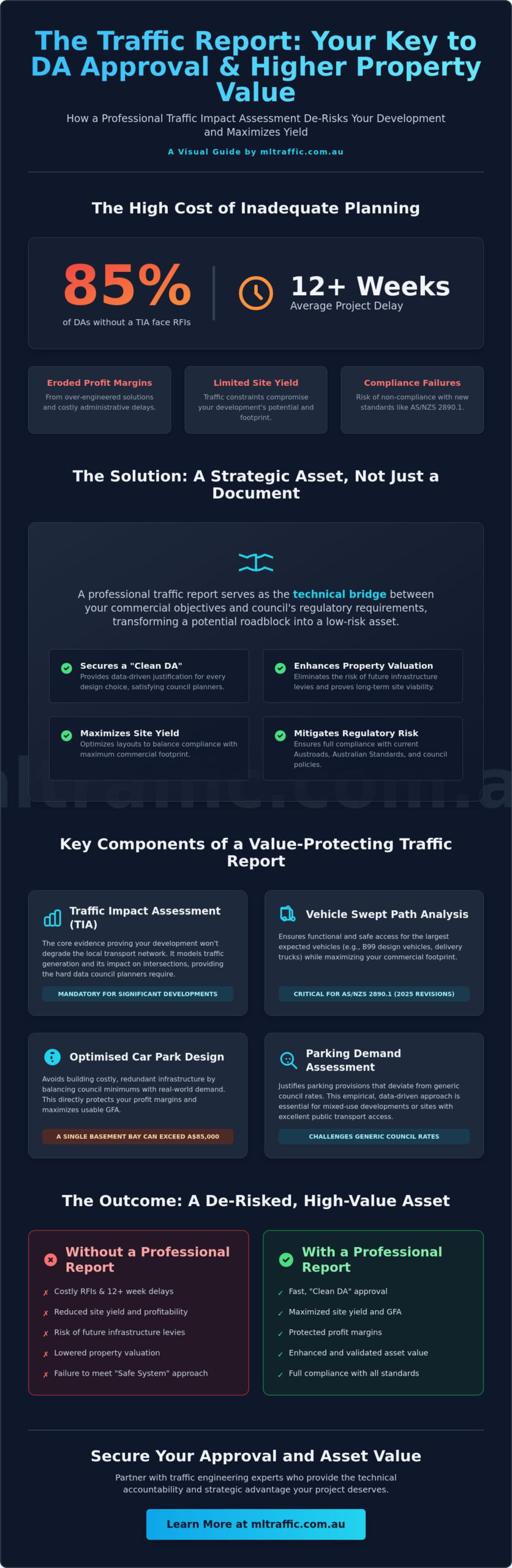
Did you know that 85% of applicants who submit a development application without a detailed Traffic Impact Assessment face Requests for Information (RFIs) that delay project starts by at least 12 weeks? This data highlights the critical role of traffic report in DA approval, especially as councils increase scrutiny under the current Safe System approach. You likely recognize the frustration of costly administrative delays or the uncertainty of how traffic constraints might limit your site’s yield. It’s a common fear that over-engineering a solution will erode your profit margins or fail to comply with the 2025 revisions to AS/NZS 2890.1 regarding B99 design vehicles.
Relying on guesswork compromises project timelines and profitability. This article explains how a professional traffic report secures your DA while simultaneously validating and enhancing your property’s market valuation. We’ll explore how precise vehicle swept path analysis and optimized car park design transform a technical requirement into a low-risk asset. We will also detail how aligning with the latest Austroads guidelines ensures a valuation that reflects a fully compliant, high-yield development.
Key Takeaways
- Understand the critical role of traffic report in DA approval as a technical bridge that validates site suitability and mitigates regulatory risk.
- Learn how a Traffic Impact Assessment (TIA) protects property valuation by securing a “Clean DA” and eliminating the risk of future infrastructure levies.
- Discover how to maximize site yield through optimized car park design and empirical car parking demand assessments that challenge generic council rates.
- Identify how vehicle swept path analysis ensures functional access for delivery and waste vehicles while maintaining maximum commercial footprint.
- Understand the strategic advantage of direct principal involvement to ensure technical accountability and compliance with current Austroads and Australian Standards.
Table of Contents
-
Defining the Role of a Traffic Report in the DA Approval Process
-
Technical Components That Protect Your Property’s Market Value
-
Strategic Steps to Maximise Development Yield via Traffic Design
-
Securing Approval and Asset Value with ML Traffic Engineers Australia
Defining the Role of a Traffic Report in the DA Approval Process
The role of traffic report in DA approval is to function as a technical bridge between a developer’s commercial objectives and the council’s regulatory requirements. It’s a formal verification that a proposed land-use change doesn’t compromise the safety or efficiency of the existing transport network. For high-density projects, this documentation is a mandatory prerequisite rather than an optional supporting file. It transforms a conceptual architectural plan into a compliant, buildable reality that local authorities can legally endorse.
In the 2026 regulatory environment, councils have increased scrutiny on traffic generation due to the "Safe System" approach. This standard focuses on designing a road system that absorbs human error and is a primary regulatory hurdle in modern assessments. A comprehensive Traffic Impact Assessment (TIA) is often integrated into a broader Environmental Impact Assessment to ensure sustainable urban growth. Without certified traffic engineering input, projects frequently stall. Data shows that 85% of applicants who omit a detailed TIA face Requests for Information (RFIs) that delay project commencement by an average of 12 weeks. This delay often results from failing to account for the 2025 revisions to AS/NZS 2890.1, which updated dimensions to accommodate the increased size of SUVs and B99 design vehicles.
To better understand the technical requirements of these reports, watch this detailed webinar:
Traffic Impact Assessment vs. Traffic Statements
The scale of your development determines the necessary documentation level. Small-scale projects with minimal trip generation might only require a brief traffic statement. However, any development involving significant land-use changes or high-density residential units must provide a full TIA. The Traffic Impact Assessment stands as the primary evidence for road network capacity. It validates that the surrounding infrastructure can absorb the predicted vehicle movements without creating bottlenecks or safety hazards. Engineers use current trip generation rates to model how your site impacts local intersections and thoroughfares, providing the data needed to satisfy council planners.
Council Triggers for Traffic Documentation
Specific triggers prompt council demands for detailed reports. Proximity to classified roads requires coordination with state transport authorities, who scrutinize site access points. If a project proposes a parking provision below the standard local environmental plan (LEP) rates, a Car Parking Demand Assessment becomes essential to justify the deviation. Safety and access remain paramount. Councils require an Intersection Analysis and Sight Distance Assessment to address the ‘safe intersection’ requirement. These technical components prove that the site is suitable for its proposed use and minimize the risk of technical pushback. The role of traffic report in DA approval is ultimately to de-risk the project by providing a data-driven justification for every design choice.
Technical Components That Protect Your Property’s Market Value
The role of traffic report in DA approval extends beyond mere compliance; it acts as a technical safeguard for the asset’s terminal value. Precision in traffic engineering prevents the "over-engineering" of access points that can unnecessarily consume developable land. Every square meter of a site has a commercial price. In 2026, the cost of a single basement parking bay can exceed A$85,000. Meticulous car park demand assessments ensure you aren’t building redundant infrastructure that eats into profit margins. We balance council minimums with actual commercial viability to protect your site yield.
A robust report also includes intersection analysis to prove the development won’t degrade the local Level of Service (LoS). Maintaining a high LoS is vital for the long-term accessibility and desirability of a commercial or residential asset. For standardized procedures on these assessments, professionals often reference the Caltrans Traffic Impact Study Guide. This level of technical rigor ensures that the property remains a low-risk, high-functioning asset for future investors.
The Value of Swept Path Analysis
We use AutoTURN software to conduct vehicle swept path analysis, proving accessibility in tight urban environments. Functional loading docks and waste collection areas are critical for commercial assets. If a heavy rigid vehicle cannot maneuver safely, the building’s operational efficiency drops, leading to lower rental yields. Providing clear evidence of vehicle movement paths eliminates council concerns regarding street blockage. For a deeper look at these requirements, see our Swept Path Analysis: A Complete Guide for Australian Developments.
Compliance with Australian Standards (AS 2890)
Non-compliant car parks lead to significant valuation haircuts during due diligence. Modern standards like AS/NZS 2890.1, revised in 2021 and updated for 2025, account for the fact that SUVs and light commercial vehicles now constitute over 75% of new car sales in Australia. Our designs reflect these larger B99 vehicle dimensions to ensure user safety and prevent vehicle damage. A car park that is difficult to navigate or fails to meet the November 2022 revisions for AS/NZS 2890.6 (accessible parking) creates a long-term liability. You can review the specifics in our guide to AS 2890.1 Explained: The Ultimate Guide to Compliant Car Park Design.
By addressing sight distance assessments early, we mitigate liability and ensure long-term safety compliance. This proactive approach prevents the need for expensive post-construction rectifications. If you need to verify your site’s technical compliance, you can view our full range of traffic engineering services to see how we secure your asset’s value.
How a Robust Traffic Report De-Risks Property Valuation
Investors and institutional buyers prioritize assets with a "Clean DA." This term describes a development approval free from unresolved technical conditions or pending Requests for Information (RFIs). The role of traffic report in DA approval is to eliminate these variables before the asset reaches the market. A high-quality report provides the empirical data required to support the capitalization rate used in property valuations. By proving that the site’s traffic generation and parking supply are fully compliant with current standards, you reduce the risk profile for potential purchasers.
A proactive traffic report also mitigates the risk of future infrastructure levies. Councils often impose heavy financial contributions on developers to fund road upgrades. Detailed intersection analysis can demonstrate that a development’s impact is negligible, potentially saving hundreds of thousands of dollars in developer contributions. Reframing the traffic report as a strategic financial instrument rather than a sunk cost is essential. It functions as an insurance policy that protects the site’s maximum yield and long-term commercial viability.
DA Certainty and Investor Confidence
Holding costs and interest payments make project delays extremely expensive. A 12-week hold-up, which is the average delay for applications without a TIA, can compromise a project’s feasibility. The signature of an experienced principal engineer on a report builds immediate trust with council assessors. It signals that the technical work adheres to the latest Austroads guidelines and Australian Standards. A traffic report reduces the probability of costly post-approval modifications. This certainty allows developers to lock in financing and construction contracts with greater confidence.
Mitigating Traffic-Related Objections
Community and council objections regarding local congestion often stall promising developments. We use hard data to neutralize these subjective claims. By providing factual evidence of trip generation and existing network capacity, we move the conversation from emotion to engineering. This evidence is also critical for success in the Land and Environment Court if an appeal becomes necessary. Understanding the role of a traffic engineer in developments is key to navigating these legal and regulatory hurdles. Accurate data ensures that the valuation reflects a fully compliant, low-risk asset that is ready for immediate progression.
Strategic Steps to Maximise Development Yield via Traffic Design
The role of traffic report in DA approval is often misunderstood as a mere compliance hurdle. In practice, it’s a strategic tool for yield optimization. By refining the driveway ramp grade assessment, we reclaim floor space that would otherwise be lost to inefficient vertical access. This reclaimed space directly increases the saleable or leasable area of your development. Our approach focuses on the commercial reality that every square meter must generate value while meeting regulatory standards.
Shared parking strategies offer another avenue for yield maximization, particularly in mixed-use developments. We analyze peak demand periods for different land uses to justify a reduction in the total number of required bays. This prevents the need for excessive basement levels, which are often the most expensive component of a build. A well-executed report proves to the council that the proposed parking supply is sufficient for the specific site context rather than relying on generic, often inflated, local environmental plan (LEP) rates.
Optimising Car Park Efficiency
Effective car park design requires a meticulous balance between column placement and aisle widths. We analyze these variables to squeeze more units out of the same footprint. Compliance with AS 2890.1 is non-negotiable, but it doesn’t have to result in wasted space. Our engineers use advanced modeling to ensure that car park layouts remain functional for the B99 design vehicle without sacrificing high-value real estate. For a comprehensive overview of these technical requirements, see our Traffic Engineering: The Definitive Guide for Australian Developments.
Evidence-Based Parking Reductions
Basement excavation is a primary driver of project costs. In 2026, the cost of a single basement parking bay can exceed A$85,000. Removing just five unnecessary bays through a successful Car Parking Demand Assessment can save over A$425,000 in construction costs. We conduct parking surveys to prove that actual demand is lower than standard council requirements. By leveraging proximity to public transport and using empirical data, we provide the justification needed to improve your project’s internal rate of return (IRR). This data-driven approach is a core part of the role of traffic report in DA approval for high-density urban projects.
Maximizing site yield requires early intervention from experienced professionals who understand the intersection of engineering and commercial viability. If you’re looking to optimize your site’s footprint and reduce excavation costs, contact our senior engineers for a technical car park design review.
Securing Approval and Asset Value with ML Traffic Engineers Australia
Selecting the right consultancy is the final step in securing your development’s commercial future. The role of traffic report in DA approval is only as effective as the technical expertise supporting it. At ML Traffic Engineers Australia, we eliminate the risk of junior staff handling your project’s valuation. You get direct access to senior principals who perform the technical work themselves. This personnel continuity promise ensures that the expert who starts your project is the one who finishes it, maintaining accountability at every stage.
Our 15-year track record includes securing approvals for diverse and complex Australian developments. We understand the bureaucratic requirements of local councils and state transport authorities intimately. This experience allows us to provide an information-dense suite of services tailored to your specific site needs. Our core offerings include:
-
Traffic Impact Assessment (TIA) Report
-
Vehicle Swept Path Analysis
-
Car Parking Demand Assessment
-
Intersection Analysis
-
Sight Distance Assessment
-
Car Park Design
-
Driveway Ramp Grade Assessment
-
Traffic Guidance Scheme (TGS)
Speed is essential when responding to council Requests for Information (RFIs). Our "no-gatekeepers" approach means you have a direct line to the decision-makers. We don’t use administrative intermediaries to relay technical information. This direct communication cycle accelerates the approval process and reduces the time your capital is tied up in the planning phase. It’s a results-oriented methodology designed for developers who value meticulous engineering and professional status.
Why Experience Matters in Council Negotiations
We’ve established professional reputations with councils across Australia through decades of qualification and compliance. Our reports are structured to pre-empt common technical questions before they become formal RFIs. This foresight is based on practical experience and a deep understanding of national regulatory standards like the Austroads Guide to Traffic Management. You can visit our services page to see our full technical capabilities and how they apply to your specific land-use category.
Get Started on Your Traffic Assessment
Early involvement in the design phase is the most effective way to maximize site yield. We identify potential traffic constraints before they are baked into your architectural plans. This proactive design saves you from expensive redesigns later in the DA process. We provide technical fee proposals that outline the exact scope of work required for your project. The role of traffic report in DA approval is to protect your interests through data-driven advocacy. Contact our senior principals today to discuss your project requirements and secure your asset’s market value.
Secure Your Development Yield and Approval Timeline
Professional traffic engineering is a financial necessity for modern Australian developments. We’ve demonstrated that the role of traffic report in DA approval is to provide a technical bridge between commercial goals and strict council regulations. By focusing on optimized car park design and evidence-based parking assessments, you protect your site’s maximum yield while ensuring full compliance with AS 2890.1 and AS 2890.2 standards. These technical safeguards prevent valuation "haircuts" that often occur during due diligence for non-compliant assets.
ML Traffic Engineers Australia provides over 15 years of specialist experience for your project. You receive direct access to senior principals who handle every technical detail; this ensures no junior-level errors compromise your valuation. This meticulous approach eliminates costly RFIs and secures a "Clean DA" that appeals to institutional investors. Our personnel continuity promise means the expert who starts your assessment is the one who delivers the final report. It’s a results-oriented methodology that doesn’t rely on administrative intermediaries.
Secure your DA approval and maximise asset value; contact ML Traffic Engineers Australia today. Taking these strategic steps early ensures your project remains a low-risk, high-performing asset from inception to completion.
Frequently Asked Questions
How much does a traffic report typically impact property valuation?
A professional traffic report protects valuation by de-risking the asset and maximizing its developable yield. It ensures the project secures a "Clean DA" without unresolved technical conditions that often lead to valuation "haircuts" during due diligence. By justifying parking reductions or reclaiming floor space through driveway ramp grade assessment, the report directly increases the site’s net present value.
Is a traffic report mandatory for all development applications in Australia?
No, but it’s required for any project that exceeds council trip generation thresholds or involves significant land-use changes. The role of traffic report in DA approval is specifically critical for high-density residential, commercial, or industrial developments. Triggers for mandatory documentation include proximity to classified roads, parking supply deviations, or the need for new site access points.
Can a traffic report help me reduce the number of parking spaces required by council?
Yes, a Car Parking Demand Assessment uses empirical data to justify lower parking rates than generic local environmental plan (LEP) standards. We conduct surveys of similar developments to prove that actual demand is lower than council minimums. This can save upwards of A$85,000 per basement parking bay by reducing the need for expensive sub-surface excavation.
What is the difference between a Traffic Statement and a Traffic Impact Assessment?
A Traffic Statement is a brief summary for low-impact developments with minimal vehicle movements. A Traffic Impact Assessment (TIA) is a comprehensive technical document required for larger projects. The TIA includes detailed intersection analysis, trip generation modeling, and safety assessments. It serves as the primary technical evidence for the role of traffic report in DA approval for complex sites.
How long does it take to prepare a traffic report for a DA?
Preparation typically takes between two and four weeks for standard assessments. Complex projects requiring extensive intersection modeling or multi-day traffic surveys may require additional time. Early involvement in the design phase allows us to identify constraints early, preventing the need for time-consuming architectural redesigns later in the approval cycle.
What happens if my DA is submitted without a traffic report?
Submitting without required documentation usually triggers a formal Request for Information (RFI) from the council. Data from the 2023-2024 financial year shows that 85% of applicants who omitted a TIA faced delays of at least 12 weeks. These hold-ups increase holding costs and can compromise project financing or construction schedules.
Does a traffic report cover construction traffic or just operational traffic?
A Traffic Impact Assessment primarily focuses on the long-term operational impacts of the development. However, councils also require specific documentation for the construction phase, such as a Traffic Guidance Scheme (TGS). The TGS details the temporary traffic control measures and site access points needed to maintain safety during the build while the TIA covers the final use.
How does swept path analysis affect the commercial value of a site?
Swept path analysis proves that the site can functionally accommodate the necessary waste and delivery vehicles. If a heavy rigid vehicle can’t maneuver safely, the building’s operational efficiency drops, which negatively impacts rental yields. Ensuring functional loading docks and access points through AutoTURN modeling makes the asset more attractive to commercial tenants and institutional investors.
Which areas do you cover?
We are traffic engineers servicing Melbourne, Sydney, Brisbane, Gold Coast, Hobart, Perth, Adelaide, Darwin, Canberra and surrounding areas.

Disclaimer
The content on www.mltraffic.com.au, including all technical articles, guides, and resources, is provided for general informational and educational purposes only. It is not intended to constitute professional advice in traffic engineering, transportation planning, development approvals, or any other technical or legal field.
While ML Traffic Engineers makes every reasonable effort to ensure the accuracy, completeness, and timeliness of the information published, we do not provide any warranties or representations (express or implied) regarding its reliability, suitability, or availability for any particular purpose. Any reliance you place on the content is strictly at your own risk.
In no event shall ML Traffic Engineers, its directors, employees, authors, or affiliates be liable for any direct, indirect, incidental, special, consequential, or punitive damages (including, without limitation, loss of profits, data, or business opportunities) arising out of or in connection with the use of, or inability to use, any information provided on this website.
The articles and guides on this site are not a substitute for engaging a qualified, registered professional traffic engineer (such as an NPER or RPEQ engineer) to assess your specific project requirements. For tailored advice, compliance assessments, or traffic engineering services, please contact a competent professional.
This disclaimer may be updated from time to time without notice. By accessing or using this website, you agree to be bound by the most current version of this disclaimer.
