

A poorly designed car park often costs a developer more in unnecessary excavation than the entire consultant fee. You likely understand the frustration of receiving a Council RFI that demands a complete redesign because of a minor non-compliance in a driveway ramp grade. These delays are avoidable when you follow a structured traffic engineering consultant engagement process. Whether you are managing a residential flat building or a warehouse, technical compliance with AS 2890.1 is the only way to protect your project timeline and budget.
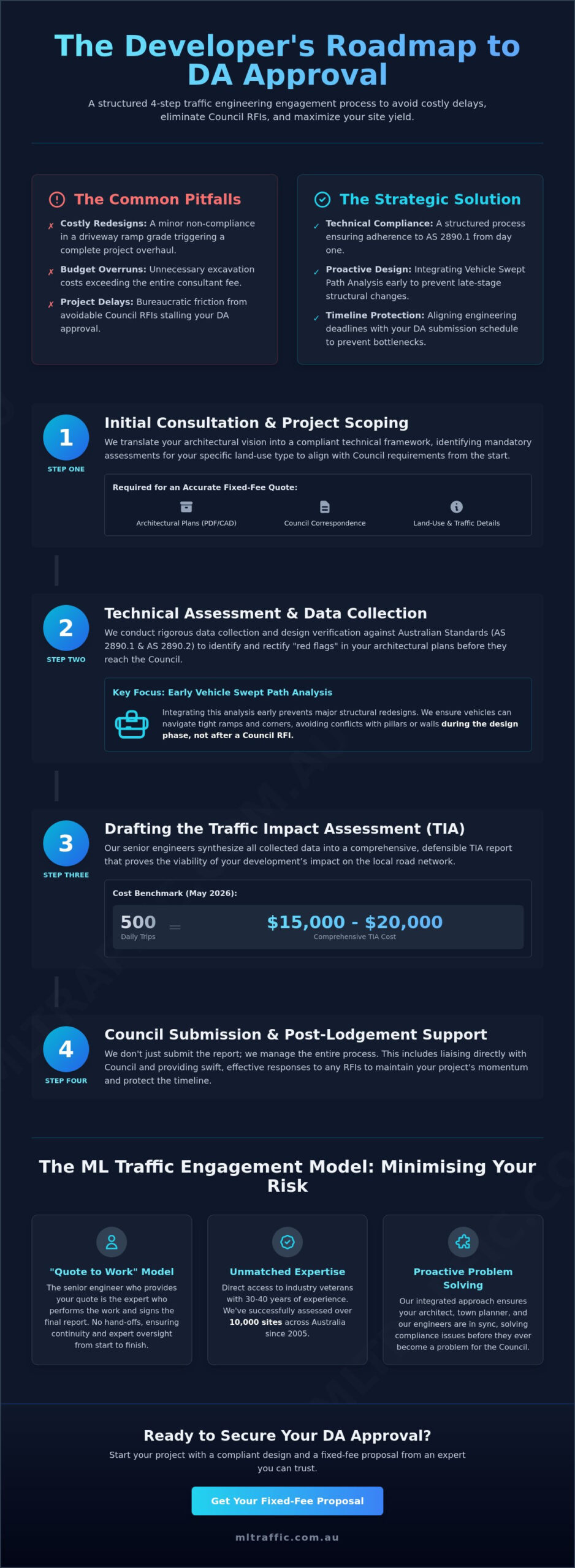
This guide provides a technical roadmap to help you secure DA approval while maximizing your site yield. We’ll show you how to move from a Traffic Impact Assessment (TIA) quote to a finished report without the typical bureaucratic friction. You’ll learn how to integrate Vehicle Swept Path Analysis early to prevent structural changes after the design is locked. We’ll also cover current May 2026 cost benchmarks, such as why a comprehensive study for a project generating 500 daily trips typically ranges from $15,000 to $20,000. At ML Traffic Engineers, the consultant who provides the quote does the work, ensuring your project remains compliant and on schedule.
Key Takeaways
- Learn how the traffic engineering consultant engagement process ensures your project scope aligns with specific Council requirements from the initial quote.
- Understand the importance of site-specific data collection and intersection analysis in proving the viability of your development’s road network impact.
- Discover how integrating Vehicle Swept Path Analysis early prevents structural redesigns during the drafting phase of your Traffic Impact Assessment (TIA).
- Gain insights into managing post-lodgement support to effectively respond to Council RFIs and maintain your project timeline.
Table of Contents
Step 1: Initial Consultation and Project Scoping
The initial consultation is the most critical phase of the traffic engineering consultant engagement process. It’s where we translate your architectural vision into a compliant technical framework. Traffic engineering isn’t just about counting cars; it’s about identifying potential bottlenecks before they become costly Council rejections. We analyze your specific land-use type, whether it’s an apartment complex, warehouse, or place of worship, to determine which technical assessments are mandatory for your Development Application (DA).
To better understand this concept, watch this helpful video:
At ML Traffic Engineers, we operate on a "Quote to Work" model. This means the senior engineer who assesses your project and provides the initial quote is the same person who performs the calculations and signs the final report. You won’t be passed off to junior staff once the contract is signed. Since 2005, we’ve applied this hands-on approach to over 10,000 sites across Australia. This direct access ensures that technical nuances, like a tight driveway ramp grade or a complex Vehicle Swept Path Analysis, are addressed by experts with 30 to 40 years of experience from day one. Our range of services is designed to cover every requirement a Council might request.
Required Documentation for an Accurate Quote
To provide a fixed-fee proposal that won’t change later, we need specific project data. Accuracy at this stage prevents scope creep during the traffic engineering consultant engagement process. We require architectural site plans and floor layouts in both PDF and CAD formats to begin our assessment. Any formal Council correspondence or pre-lodgement meeting minutes are also essential, as they highlight specific concerns the authorities already have. Finally, a detailed description of the intended land-use and expected traffic generation allows us to determine if you need a simple Traffic Statement or a comprehensive Traffic Impact Assessment (TIA).
Setting Clear Timelines and Deliverables
Timing is everything in property development. We align our engineering deadlines with your broader DA submission schedule to prevent bottlenecks. A standard Traffic Statement might take less time than a full TIA involving intersection analysis or a Car Parking Demand Assessment. We establish a direct communication protocol between your architect, town planner, and our engineering team. This ensures that if a swept path shows a vehicle hitting a structural pillar, we solve it during the design phase rather than during a Council RFI. You can contact us directly to discuss your specific project timeline and report requirements.
Step 2: Technical Assessment and Site Data Collection
Once the project scope is defined, the technical core of the traffic engineering consultant engagement process begins. We move from administrative planning to rigorous data collection and design verification. We don’t rely on guesswork or outdated assumptions. Our engineers analyze the existing road network to understand current intersection performance and traffic volumes. This stage is designed to identify "red flags" in your architectural plans before they reach the Council’s desk, saving you months of potential delays.
We review every proposed design against the rigid requirements of Australian Standards, specifically AS 2890.1 for off-street car parking and AS 2890.2 for commercial vehicle facilities. According to an industry guide to the TIA process, accurate data collection is the foundation of any defensible report. If your design features a driveway ramp grade that exceeds 1:20 without proper transitions, we flag it immediately. Identifying these non-compliance issues early allows for design adjustments that protect your site yield while satisfying regulatory bodies.
The Role of Site Inspections and Data
A desktop analysis is efficient, but a physical site visit is often mandatory for complex developments. We verify sight distances at proposed access points to ensure they meet safety parameters. Historical traffic data can be useful, but we prefer fresh counts if the last available survey is more than three years old. This ensures our Intersection Analysis reflects the actual current peak hour volumes on your surrounding road network. If you are unsure which data your project requires, you can review our full list of technical assessments to see how we validate site safety.
Gap Analysis: Design vs. Compliance
Architectural vision frequently clashes with technical traffic constraints. A common friction point is the basement layout, where structural pillars often interfere with parking aisle widths. We use Swept Path Analysis during this assessment phase to prove that the 99th percentile vehicle can maneuver through the site without conflict. This gap analysis doesn’t just find problems; it finds opportunities. If our Car Parking Demand Assessment shows that your specific land-use requires less parking than the standard DCP rate, we provide the data to justify a parking reduction, potentially saving you thousands in excavation costs.
Step 3: Drafting the Traffic Impact Assessment (TIA)
Drafting the TIA is the synthesis phase of the traffic engineering consultant engagement process. We transform raw traffic counts and site measurements into a structured technical argument that satisfies Council planners and State Road Authorities. A standard report includes an assessment of existing conditions, a description of the proposed development, and an analysis of future traffic impacts. We integrate detailed Swept Path diagrams as visual evidence. These diagrams prove that waste collection vehicles or delivery trucks can enter and exit the site in a forward direction without impacting structural elements.
We often encounter designs that require minor deviations from standard guidelines. Our role is to justify these deviations using expert engineering evidence. If a driveway location is constrained by existing street trees or utility pits, we provide the technical rationale to prove that the alternative location remains safe and functional. This drafting phase involves a tight feedback loop with your project architect. We review the draft report together to ensure the engineering requirements don’t compromise the aesthetic or functional goals of the building. By resolving these conflicts during the drafting stage, we prevent the need for costly revisions after the DA is lodged.
Optimising the Car Park Design
Compliance with AS 2890.1 design standards is non-negotiable for DA approval. During the drafting phase, we refine the car park layout to ensure ramp grades and aisle widths meet these benchmarks. Poorly planned ramps often lead to excessive basement excavation. By optimising the vertical alignment of the driveway, we can often reduce the depth of the dig, which directly lowers your construction costs. We also finalise the Car Parking Demand Assessment here. If the data supports it, we argue for a reduction in the number of required spaces based on the site’s proximity to public transport or specific land-use characteristics, such as for a warehouse or residential flat building.
Finalising the Traffic Statement
A successful TIA balances technical depth with accessibility. We ensure all technical jargon, such as "degree of saturation" or "average delay," is accompanied by clear summaries. This helps Council planners who don’t have an engineering background understand the report’s conclusions quickly. Every final report we produce carries the weight of senior engineer certification. In Queensland, this means RPEQ registration; in other states, it involves the signature of a principal with 30 to 40 years of experience. This certification is essential for the traffic component of your Statement of Environmental Effects. We deliver a document that is ready for immediate lodgement with your planning application.
Step 4: Council Submission and Post-Lodgement Support
Lodging your Development Application is a significant milestone, but it rarely marks the end of the technical journey. The traffic engineering consultant engagement process extends well into the assessment period. Council planners frequently refer reports to their internal traffic engineering departments. These departments often have specific queries regarding the data, parking calculations, or design assumptions. We don’t simply provide a report and walk away; we support the project until the Council makes a final determination.
If your architectural plans change during the assessment period—perhaps due to a request from the landscape architect or a structural requirement—the traffic documentation must be updated. We amend our assessments and Swept Path diagrams to ensure the final approved plans match the technical evidence. This continuity is vital for avoiding contradictions in the DA conditions that could lead to delays during the construction certificate phase. Since 2005, we’ve managed these transitions for over 10,000 sites, ensuring that technical compliance remains consistent through every design iteration.
Navigating the RFI Process
A Request for Further Information (RFI) is a common hurdle in the development cycle. Council often asks for additional detail on vehicle maneuvering, especially for waste collection or delivery vehicles. A seasoned traffic engineer acts as your technical advocate during these exchanges. We provide robust technical rebuttals to unreasonable requests, such as demands for parking provisions that exceed the local Development Control Plan (DCP). Our role is to resolve these disputes through engineering logic and evidence rather than allowing for costly, unnecessary design concessions.
Negotiating with Road Authorities
Developments located on or near state-managed roads require a higher level of scrutiny. This often involves securing concurrence from the relevant State Road Authority for site access and driveway locations. We manage this dialogue directly, ensuring that your proposed access doesn’t compromise the safety or efficiency of the broader road network. This process includes verifying sight distance parameters and managing pedestrian safety requirements. We also address the need for preliminary Traffic Guidance Schemes (TGS) if the Council requires proof that construction traffic won’t disrupt local circulation. Our senior engineers, with 30 to 40 years of experience, handle these high-level negotiations to protect your project’s viability.
If you have received a Council RFI and need immediate technical support, contact our senior engineers today for an expert response.
Why the ML Traffic Engagement Model Minimises Risk
Risk in property development often stems from technical oversight or a breakdown in communication. The standard traffic engineering consultant engagement process in many large firms involves a senior partner winning the work and then delegating the technical analysis to junior staff. This disconnect frequently leads to avoidable RFIs and design errors that cost time and money. We eliminate this risk through our "quote to work" philosophy. The engineer who assesses your architectural plans and provides the initial fee proposal is the same person who performs the Vehicle Swept Path Analysis and signs the final report. This ensures that the technical promises made during the quoting stage are delivered in the final documentation without information loss.
The Benefit of Senior-Level Involvement
Junior engineers don’t always identify the subtle compliance nuances required by AS 2890.1 or local Council DCPs. A minor error in a driveway ramp grade or a sight-line assessment can stall a DA for months. Our principals, Michael Lee and Benny Chen, bring between 30 and 40 years of individual experience to every project. This seniority ensures that your car park design is optimised for both compliance and site yield from the first draft. You also have direct mobile access to the principal handling your file. There are no gatekeepers or administrative layers. If your architect makes an urgent change or a Council engineer calls with a technical query, you speak directly to the expert who knows your project inside and out. This accountability is why we’ve been a trusted partner for private developers since 2005.
National Expertise, Local Results
Our technical expertise is backed by a resume of over 10,000 sites across Australia. We don’t provide generic advice; we provide results-oriented solutions tailored to your specific site. We have a proven track record across an exhaustive list of land-use types, including apartments, bars, boarding houses, car washes, childcare centres, clubs, gymnasiums, hotels, medical centres, motels, schools, temples, and warehouses. This breadth of experience means we’ve likely solved the specific traffic and parking challenges your site faces in the past. We understand the technicalities and bureaucratic requirements of transport planning so you don’t have to. Our focus is entirely on securing your DA approval and optimising your site design. Contact ML Traffic Engineers to begin your traffic engineering consultant engagement process and secure a technical partner who is personally accountable for your project’s success.
Secure Your Development Approval with Technical Certainty
Engaging the right expert early prevents the design friction that leads to costly Council RFIs. A structured traffic engineering consultant engagement process ensures every technical detail, from driveway ramp grades to parking demand, is backed by engineering evidence. We’ve applied this rigorous approach to over 10,000 site assessments conducted nationally. This volume of work provides us with the data needed to justify design deviations and protect your site yield during the assessment phase.
Success in transport planning requires more than just generic reporting. It requires the expertise of senior engineers with 30 to 40 years of experience. At ML Traffic Engineers, we don’t pass your project to junior staff. You get direct mobile access to our principals for every update. This accountability ensures your project remains compliant with Australian Standards while meeting your specific timeline. Get a direct quote from a senior traffic engineer today to begin your partnership with a seasoned expert. It’s the most reliable way to ensure your project moves from design to construction without technical delays.
Frequently Asked Questions
How long does the traffic engineering engagement process usually take?
A standard report typically takes between 7 and 14 business days from the receipt of all architectural plans. The timeline for the traffic engineering consultant engagement process depends on the specific data requirements, such as whether fresh intersection counts are needed. For complex sites involving major road authority concurrence, the timeframe may extend to 21 days to ensure a thorough technical analysis.
What documents do I need to provide for a traffic impact assessment quote?
You must provide current architectural site plans and floor layouts in PDF and CAD formats. We also require a clear description of the intended land-use and any existing Council correspondence or pre-lodgement minutes. These documents allow us to determine the exact scope of required assessments, such as Swept Path Analysis or Car Parking Demand Assessments, ensuring an accurate fixed-fee quote.
Will my traffic engineer deal with the Council directly on my behalf?
Yes, we liaise directly with Council traffic engineers to resolve technical queries and design disputes. This direct communication is a core part of our post-lodgement support. We provide engineering rebuttals to unreasonable requests and ensure that any design modifications remain compliant with AS 2890.1. This technical advocacy protects your project from unnecessary delays or excessive construction costs.
At what stage of the DA process should I engage a traffic consultant?
You should engage a traffic consultant during the early concept design phase before formal lodgement. Integrating the traffic engineering consultant engagement process at this stage allows us to identify non-compliance issues in driveway ramp grades or basement layouts before the design is locked. This proactive approach prevents the need for expensive structural redesigns after the Council has already reviewed your application.
Can a traffic consultant help me reduce the number of required parking spaces?
We can often justify a reduction in parking spaces through a formal Car Parking Demand Assessment. By analyzing site-specific data, such as proximity to public transport or empirical data from similar land-uses, we provide the evidence needed to deviate from standard DCP rates. This can significantly lower excavation costs, as a single basement parking space often requires 30 square meters of structural area.
What happens if Council issues an RFI after I have submitted my traffic report?
We respond to Requests for Further Information (RFIs) by providing additional technical evidence or amended Swept Path diagrams. Since our principals have between 30 and 40 years of experience, we can effectively address specific concerns regarding vehicle maneuvering or intersection performance. We maintain accountability for our reports until the Council reaches a final determination on your Development Application.
Is an RPEQ certified engineer required for my traffic report?
An RPEQ certified engineer is mandatory for reports submitted in Queensland to comply with the Professional Engineers Act 2002. In other Australian states, while the specific title may vary, Councils typically require certification from a senior engineer with recognized professional standing. All our reports are signed by principals with decades of experience to ensure they meet these regulatory standards.
Do you provide traffic engineering services for all of Australia?
Yes, we provide comprehensive traffic engineering services for developments across all Australian states and territories. We have assessed over 10,000 sites nationally, ranging from residential flat buildings to large-scale industrial warehouses. Our deep understanding of both national Australian Standards and local Council requirements allows us to deliver compliant results regardless of the project’s geographic location.
Which areas do you cover?
We are traffic engineers servicing Melbourne, Sydney, Brisbane, Gold Coast, Hobart, Perth, Adelaide, Darwin, Canberra and surrounding areas.

Disclaimer
The content on www.mltraffic.com.au, including all technical articles, guides, and resources, is provided for general informational and educational purposes only. It is not intended to constitute professional advice in traffic engineering, transportation planning, development approvals, or any other technical or legal field.
While ML Traffic Engineers makes every reasonable effort to ensure the accuracy, completeness, and timeliness of the information published, we do not provide any warranties or representations (express or implied) regarding its reliability, suitability, or availability for any particular purpose. Any reliance you place on the content is strictly at your own risk.
In no event shall ML Traffic Engineers, its directors, employees, authors, or affiliates be liable for any direct, indirect, incidental, special, consequential, or punitive damages (including, without limitation, loss of profits, data, or business opportunities) arising out of or in connection with the use of, or inability to use, any information provided on this website.
The articles and guides on this site are not a substitute for engaging a qualified, registered professional traffic engineer (such as an NPER or RPEQ engineer) to assess your specific project requirements. For tailored advice, compliance assessments, or traffic engineering services, please contact a competent professional.
This disclaimer may be updated from time to time without notice. By accessing or using this website, you agree to be bound by the most current version of this disclaimer.
