

What if a single overlooked detail in your traffic management plan costs your project A$2,500 per day in avoidable council delays? You already know that securing a Development Application is often the most frustrating hurdle in any Australian construction project. It’s exhausting to juggle the technical demands of AS 1742.3 while trying to figure out if you actually need a comprehensive TMP or just a simple Traffic Guidance Scheme. You shouldn’t have to guess whether your documentation will satisfy a council officer or lead to a costly stop-work order.
This guide will show you exactly what a compliant traffic management plan requires to pass inspection the first time. You’ll learn the critical differences between a TMP and a TGS, how to meet safety standards without overpaying for unnecessary extras, and the exact steps to secure your approval without the usual stress. We’ll break down the technical jargon into a clear roadmap that keeps your site safe, avoids heavy fines, and ensures your project stays on schedule from day one.
Key Takeaways
- Understand why a site-specific traffic management plan is a mandatory requirement for your Australian Development Application (DA) and how it differs from a basic Traffic Guidance Scheme.
- Identify the common “red flags” in generic templates that lead to immediate council rejection and project delays.
- Master a proven 5-step roadmap to navigate the approval process, from the initial site survey to the final engineering stamp.
- Learn the essential technical components every professional report must include to meet strict Australian Standards and local regulatory expectations.
- Discover how direct access to principal engineers can streamline your project by eliminating the “gatekeepers” and junior staff common in larger firms.
What is a Traffic Management Plan (TMP) and Why Does Your Project Need One?
A traffic management plan is a detailed, site-specific document that identifies potential risks and outlines the exact measures used to control them. In Australia, it’s a non-negotiable requirement for the majority of Development Applications (DAs). You can’t just put up a few cones and hope for the best. Instead, a traffic management plan serves as your project’s operational backbone. It ensures that while your excavators are moving and your concrete pours are scheduled, the surrounding community remains safe. It’s a live document that evolves with your site, ensuring that every vehicle movement is accounted for from day one.
Safety isn’t the only driver here. Productivity matters just as much. A well-designed traffic management plan prevents bottlenecks that can cost a site A$5,000 or more in daily liquidated damages due to transport delays. By applying standard Road traffic control principles, we create an environment where heavy machinery and local commuters coexist without conflict. This professional approach keeps your project on schedule and keeps the local council off your back.
To better understand this concept, watch this helpful video:
The legal weight of these documents is substantial. Under Australian Work Health and Safety (WHS) laws, such as the WHS Act 2011, failing to have a compliant plan isn’t just a project delay; it’s a criminal liability. If an incident occurs and you lack a professional traffic management plan, fines for corporations can exceed A$3.5 million. Regulatory bodies like SafeWork NSW or WorkSafe Victoria don’t accept ignorance as an excuse. They look for documented evidence that you’ve mitigated risks to the lowest level reasonably practicable.
The Difference Between a TMP and a TGS
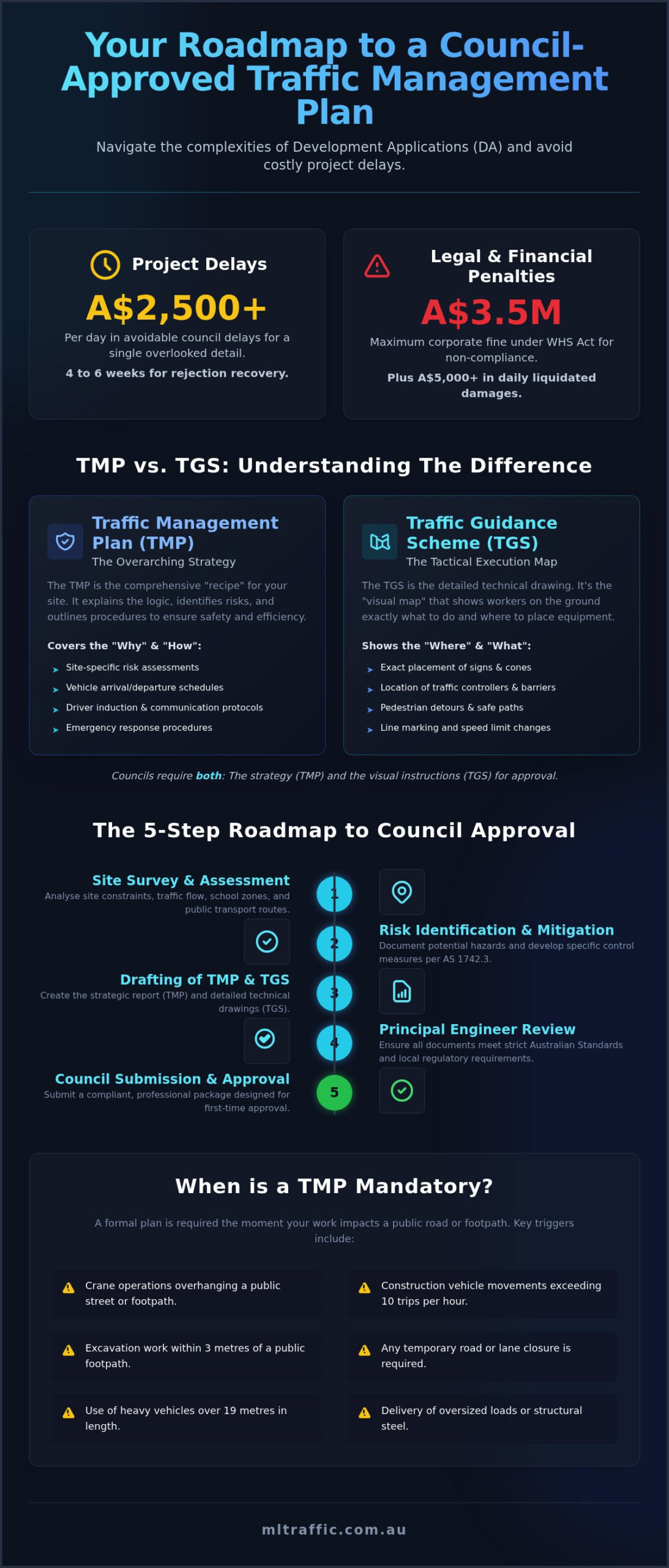
Many developers get confused between these two terms, but they serve distinct roles. Think of the traffic management plan as the overarching strategy or the "recipe" for your site’s safety. It explains the "why" and "how" of your traffic logic, covering things like arrival times and driver inductions. In contrast, a Traffic Guidance Scheme (TGS) is the "visual map" or the picture of the finished dish. It’s a technical drawing showing exactly where signs, bollards, and controllers stand. If the TMP is the strategy, the TGS is the tactical execution. Councils usually demand both because one provides the logic and the other provides the visual instruction for workers on the ground.
When is a TMP Legally Required?
You’ll need a formal plan the moment your work impacts the public road reserve or pedestrian pathways. Common triggers include the use of heavy vehicles over 19 metres, crane operations that overhang the street, or any activity requiring a temporary road closure. If your project sits near state-managed roads, you’ll face even stricter Transport for NSW (TfNSW) or Department of Transport (VIC) requirements. Since 2023, local councils have increased their audit rates by 22% to ensure sites comply with these standards. You should expect to provide a plan for:
- Construction vehicle movements exceeding 10 trips per hour.
- Excavation work within 3 metres of a public footpath.
- Any activity requiring a "Permit to Stand Plant" on a public roadway.
- Projects involving the delivery of oversized loads or structural steel.
The non-delegable duty of care serves as the legal foundation for every traffic management plan written in 2026.
Decoding the Core Components of a Compliant Traffic Management Plan
Every local council in Australia, from the City of Sydney to the Brisbane City Council, expects a professional report that goes far beyond a simple map. A compliant traffic management plan acts as a blueprint for safety and efficiency. It isn’t just a hurdle for your Development Application; it’s a legal safeguard. You can’t rely on generic "one-size-fits-all" templates because every site has unique constraints like narrow laneways, school zones, or steep gradients. In fact, using a template instead of site-specific data is the primary reason for council rejections, which can delay projects by 4 to 6 weeks.
Risk assessments are the engine room of the entire document. They identify potential hazards before they become costly accidents. This process follows the principles found in the Workplace Traffic Management Guide, ensuring that every interaction between vehicles and people is controlled. You need to consider the plan a living document. A construction site is dynamic. The requirements for the initial excavation phase, which might involve 20 truck movements per day, differ significantly from the final fit-out stage. Your plan must evolve as the project reaches these new milestones.
The Role of the Traffic Guidance Scheme (TGS)
The TGS is the technical diagram that site crews use on the ground. It shows the exact placement of every sign, cone, and barricade. All schemes must comply with AS 1742.3, the Australian Standard for uniform traffic control devices. We use professional software like AutoTURN to conduct a swept path analysis within these schemes. This ensures that a 19-metre semi-trailer can actually make a turn into your site without hitting a power pole or mounting a kerb. It’s about precision, not guesswork.
Vehicle Movement Plans (VMP) and Pedestrian Management
A VMP focuses on how heavy plant machinery enters and exits the site without causing a gridlock. It maps out travel routes that minimize noise for residents and avoid peak hour congestion. Equally important is the focus on "vulnerable road users." You must have clear strategies to keep pedestrians and cyclists safe from heavy vehicles. This often involves dedicated spotters or temporary fencing to separate foot traffic from the work zone. If you’re unsure about the specific requirements for your next project, getting professional traffic engineering advice early can save you from expensive revisions later.
A high-quality plan also addresses the environmental impact on the neighborhood. This includes specifying work hours and identifying "no-go" zones for truck idling. When you present a plan that considers the 50 residents living next door as much as the 10 trucks entering the site, council approval becomes a much smoother process. Meticulous planning ensures that your site remains productive while staying fully compliant with state and local regulations.
Why "DIY" Templates Often Lead to Council Rejection
It’s tempting to think you’ll save A$2,000 by downloading a free template from the internet. You might see the Construction Work Traffic Management Guide from SafeWork Australia and assume a few "fill-in-the-blank" boxes will satisfy your local council. This is a high-risk strategy that usually backfires. Council engineers review hundreds of applications monthly; they can spot a generic, unconsidered report in seconds. When they see a plan that doesn’t account for specific local variables, it’s often rejected immediately without a second look.
Red flags for council assessors include generic diagrams that don’t match the actual street geometry or failing to mention specific local parking restrictions. They look for "cut and paste" errors where a developer forgets to change the street names or project details. Most importantly, they look for the lack of a professional engineering stamp. In Queensland, an RPEQ (Registered Professional Engineer of Queensland) certification is often mandatory, while NSW councils require specific accredited certifications. Without these, your traffic management plan lacks the legal and technical weight required for approval.
The true cost of a "DIY" failure isn’t just the A$150 template fee. It’s the cost of delay. A single rejection can stall a A$5 million project for three to four weeks as you wait for a new review cycle. If your site is sitting idle while you pay A$10,000 per week in equipment hire and holding costs, that "free" template becomes the most expensive document in your project file. Expert intervention ensures you get it right the first time. Before committing to any consultant, review our professional traffic engineer services for Sydney and national civil projects checklist to ensure your partner has the technical credentials and site-specific experience to deliver a compliant plan on the first submission.
The Complexity of Site-Specific Constraints
No two construction sites are identical. A project in a narrow inner-city lane in Sydney or Melbourne faces vastly different hurdles than one in a suburban cul-de-sac. You have to account for peak hour traffic flows, clearways, and the proximity of school zones where work hours are strictly limited. Generic templates don’t calculate the vehicle swept paths for a 12.5-metre heavy rigid vehicle turning into a tight site. This is why ML Traffic’s principals personally oversee these complex assessments. We ensure every constraint is mapped before the council even sees the plan.
Navigating Local Council Nuances
Every council across Australia has its own set of "pet peeves" and formatting requirements. One council might obsess over pedestrian sight-lines, while another focuses entirely on heavy vehicle noise mitigation after 6:00 PM. Our 15+ years of experience allows us to pre-empt these objections before they are raised. We know the specific technical language and data points each engineer expects to see. A professional traffic management plan is an investment in your project’s timeline, not an expense. It provides the assurance that your site will remain compliant and, more importantly, that your construction schedule will stay on track without bureaucratic interruptions.
- Expert Certification: Councils trust RPEQ and specialized NSW certifications more than unverified DIY documents.
- Site Accuracy: Professional plans include precise CAD drawings and swept path analysis for your specific site.
- Risk Mitigation: Proper planning reduces the likelihood of site accidents and subsequent WorkSafe investigations.
- Time Efficiency: Avoid the 21-day "re-submission loop" by passing the first council review.
Your 5-Step Roadmap to a Council-Approved Traffic Management Plan
Securing a permit for your construction project in the 2026 regulatory environment requires more than a basic sketch of road cones. It is a technical negotiation between your project goals and the strict safety requirements of local government and state authorities. This process is collaborative. We work alongside developers to ensure the traffic management plan facilitates construction efficiency while meeting every clause of Australian Standard 1742.3. A critical part of this journey is the pre-lodgement phase. By identifying site-specific hurdles before formal submission, we often eliminate the 20 to 30 day delays caused by avoidable Council rejections.
Step 1: Site Assessment and Data Collection
We begin by gathering hard data. Accurate site measurements and current traffic volume counts are non-negotiable for a successful application. We don’t rely on outdated maps. Instead, we assess the physical reality of your site, including driveway gradients and existing street furniture. A core part of this step is the swept path analysis. This digital simulation uses CAD software to prove that your specific delivery vehicles, such as a 12.5-metre Heavy Rigid Vehicle (HRV), can navigate the turns without hitting kerbs or encroaching on opposing lanes. ML Traffic utilizes a database of over 10,000 sites to benchmark your data against similar successful projects, ensuring your design is grounded in real-world performance.
Steps 2-5: Drafting, Risk Assessment, and Final Lodgement
The transition from data collection to approval involves a structured hierarchy of safety and compliance. We move through these four stages to ensure the final document is bulletproof.
- Step 2: Hazard Identification and Hierarchy of Control. We identify every potential point of conflict between plant equipment, motorists, and pedestrians. We apply the Hierarchy of Control to mitigate these risks. This means we first attempt to eliminate the risk, such as scheduling deliveries outside of school zone hours, before relying on lower-level controls like signage.
- Step 3: Drafting the TGS and VMP. We develop the Traffic Guidance Scheme (TGS), which details the physical layout of signs and barriers. Simultaneously, we create the Vehicle Movement Plan (VMP). The VMP is essential for showing Council exactly how trucks arrive, queue, and depart without causing gridlock on local collector roads.
- Step 4: Internal Quality Review. Accountability is a hallmark of our firm. At ML Traffic, the consultant who provides your quote is the person who does the technical work. This ensures that the promises made during the initial consultation are reflected in the engineering drawings. There is no hand-off to junior staff who lack project context.
- Step 5: Council Submission and RFI Management. We lodge the traffic management plan through the relevant planning portal. In the current 2026 landscape, most Councils issue a Request for Further Information (RFI) within 14 days. We manage these technical queries on your behalf to secure the final stamp of approval.
Timelines for approval currently range from 4 to 8 weeks for standard sites, though complex CBD projects can take 12 weeks or longer. Engaging early allows us to factor in these lead times so your excavators aren’t sitting idle while waiting for paperwork. We focus on getting the technical details right the first time to minimize the back-and-forth with Council engineers.
If you are ready to move your project from the planning phase to the construction phase, our team is ready to assist. You can contact our senior engineers today for a direct quote on your site-specific requirements.
Partnering with ML Traffic Engineers for Your Next Project
Choosing the right consultant for your development can be the difference between a project that moves and one that stalls. ML Traffic Engineers Pty Ltd has been the specialist choice for private developers across Australia since 2005. With a track record spanning over 10,000 sites, we’ve seen every possible hurdle a local council or road authority can present. We don’t just provide documents; we provide approvals. Our "get it right the first time" philosophy is built on nearly two decades of technical precision and a deep understanding of Australian Standards, including AS 2890.1.
One of the biggest frustrations in the industry is the "gatekeeper" model. At many large firms, a senior partner signs the contract, but a junior graduate with limited field experience actually writes the report. We do things differently. We operate on a Direct Access to Principals model. When you engage us, you work directly with Michael Lee or Benny Chen. They each bring between 30 and 40 years of experience to your project. The expert who provides your quote is the same person who performs the technical assessment and defends it to the council. This accountability ensures that your traffic management plan is technically sound and practically viable.
Our services go far beyond simple layouts. We offer a comprehensive suite of traffic engineering solutions that support your broader development goals. This includes detailed Traffic Impact Assessments (TIA), Car Park Demand Assessments, and Vehicle Swept Path Assessments. By integrating these services, we ensure that every driveway ramp grade and sight-line assessment is perfect before the first shovel hits the ground. This holistic approach prevents the expensive mid-construction redesigns that plague less prepared projects.
Expertise Across All Land-Use Types
Our portfolio is as diverse as the Australian property market itself. We’ve successfully delivered traffic solutions for over 500 childcare centres, numerous medical clinics, and complex high-rise residential apartments. We’ve even handled niche sites like temples, bars, and massive industrial warehouses. This broad experience helps us anticipate sector-specific traffic issues before they arise. For a medical clinic, we focus on patient set-down safety; for high-rises, we solve the puzzles of basement circulation and waste vehicle access. You can see our expertise in action by viewing ML Traffic Engineers Pty Ltd’s video resources for more technical insights.
Get a Professional Quote Today
Efficiency is the cornerstone of a successful development. We’ve spent 15 years refining our processes to ensure we deliver high-quality work without unnecessary delays. We invite you to reach out for a no-obligation discussion about your specific site requirements. Whether you’re dealing with a challenging RPEQ certification or a complex driveway grade issue, we have the seniority to handle it. Don’t let traffic management be the bottleneck in your development. It’s time to work with consultants who prioritize your timeline and your budget. Contact Michael Lee or Benny Chen at ML Traffic Engineers Pty Ltd today and let’s get your traffic management plan moving in the right direction.
Secure Your Council Approval with an Expert Traffic Strategy
Securing a council-approved traffic management plan doesn’t have to be a bottleneck for your development. You’ve seen how generic templates lead to immediate rejections and why technical rigor, like AS 2890 compliance, is non-negotiable for Australian projects. At ML Traffic Engineers, we’ve spent 15 years assessing over 10,000 sites across the country, so we know exactly what local authorities require to green-light your application. Our team specializes in complex driveway ramp grades and sight-line assessments that keep projects moving forward without delay.
When you work with us, you aren’t passed off to a junior staffer or a middleman. The senior principal who quotes your job is the same expert who performs the Swept Path Analysis and signs off on the final report. This direct accountability ensures your project meets every technical requirement from the very first draft. Don’t risk your timeline or your budget on guesswork. Partner with specialists who bring between 30 and 40 years of individual experience to your site. We’re ready to help you navigate the bureaucracy and get your project off the ground.
Get your Traffic Management Plan quoted by our senior engineers today
We look forward to helping you achieve a seamless approval for your next development.
Frequently Asked Questions
How much does a Traffic Management Plan cost in Australia?
A professional traffic management plan typically costs between A$500 and A$3,000 depending on project complexity. Small residential projects like driveway crossovers sit at the lower end, while major arterial road works involving multiple TGS diagrams exceed A$2,500. We provide fixed quotes so you don’t deal with hidden fees during the council RFI process.
What is the difference between a TMP and a Construction Management Plan?
A TMP focuses exclusively on road safety and vehicle flow, whereas a Construction Management Plan (CMP) covers all site operations including noise, dust, and waste. The traffic management plan acts as a technical subset of the CMP. Most Australian councils require both documents for any development valued over A$1 million to ensure public safety.
How long does it take for a council to approve a Traffic Management Plan?
Most Australian councils take 10 to 20 business days to review and approve a plan. If your project involves State Roads managed by Transport for NSW or VicRoads, the approval window often extends to 30 days. We recommend lodging your application at least 4 weeks before your scheduled start date to avoid expensive site delays.
Can I prepare my own Traffic Management Plan?
You can’t legally prepare your own plan unless you hold specific state-recognised certifications and professional indemnity insurance. Councils and road authorities reject any documentation that isn’t signed off by a qualified designer. Using an uncertified plan leaves you personally liable for any onsite incidents and will likely void your insurance policy.
What qualifications does a person need to design a TGS or TMP?
Designers must hold a ‘Prepare Work Zone Traffic Management Plan’ (PWZTMP) certification or be a Registered Professional Engineer of Queensland (RPEQ) for northern projects. At ML Traffic Engineers, our senior staff bring over 35 years of engineering experience to every design. This level of expertise ensures your plan meets AS 1742.3 standards and passes council audits the first time.
Do I need a new TMP for every stage of my construction project?
Yes, you need a revised plan whenever your site footprint or vehicle access points change. A typical four stage development requires four distinct Traffic Guidance Schemes to remain compliant with safety regulations. Operating under an outdated plan is a breach of the Work Health and Safety Act and carries heavy penalties for site supervisors.
What happens if I operate without an approved Traffic Management Plan?
Operating without approval triggers immediate site shutdown orders and fines starting at A$2,200 per day. WorkSafe inspectors have the power to issue ‘Prohibition Notices’ that stop all activity until a compliant plan is produced. In the event of an accident, directors face personal liability and fines reaching A$600,000 under the Heavy Vehicle National Law.
How do I know if I need a Traffic Impact Assessment (TIA) instead of a TMP?
You need a TIA for the Development Application phase if your project adds 50 or more vehicle trips per hour to the local network. A TIA evaluates long term traffic growth and parking demand, while a TMP manages the short term safety of the construction site itself. We handle both types of assessments to ensure your project moves from planning to completion without friction.
Which areas do you cover?
We are traffic engineers servicing Melbourne, Sydney, Brisbane, Gold Coast, Hobart, Perth, Adelaide, Darwin, Canberra and surrounding areas.

Disclaimer
The content on www.mltraffic.com.au, including all technical articles, guides, and resources, is provided for general informational and educational purposes only. It is not intended to constitute professional advice in traffic engineering, transportation planning, development approvals, or any other technical or legal field.
While ML Traffic Engineers makes every reasonable effort to ensure the accuracy, completeness, and timeliness of the information published, we do not provide any warranties or representations (express or implied) regarding its reliability, suitability, or availability for any particular purpose. Any reliance you place on the content is strictly at your own risk.
In no event shall ML Traffic Engineers, its directors, employees, authors, or affiliates be liable for any direct, indirect, incidental, special, consequential, or punitive damages (including, without limitation, loss of profits, data, or business opportunities) arising out of or in connection with the use of, or inability to use, any information provided on this website.
The articles and guides on this site are not a substitute for engaging a qualified, registered professional traffic engineer (such as an NPER or RPEQ engineer) to assess your specific project requirements. For tailored advice, compliance assessments, or traffic engineering services, please contact a competent professional.
This disclaimer may be updated from time to time without notice. By accessing or using this website, you agree to be bound by the most current version of this disclaimer.
