

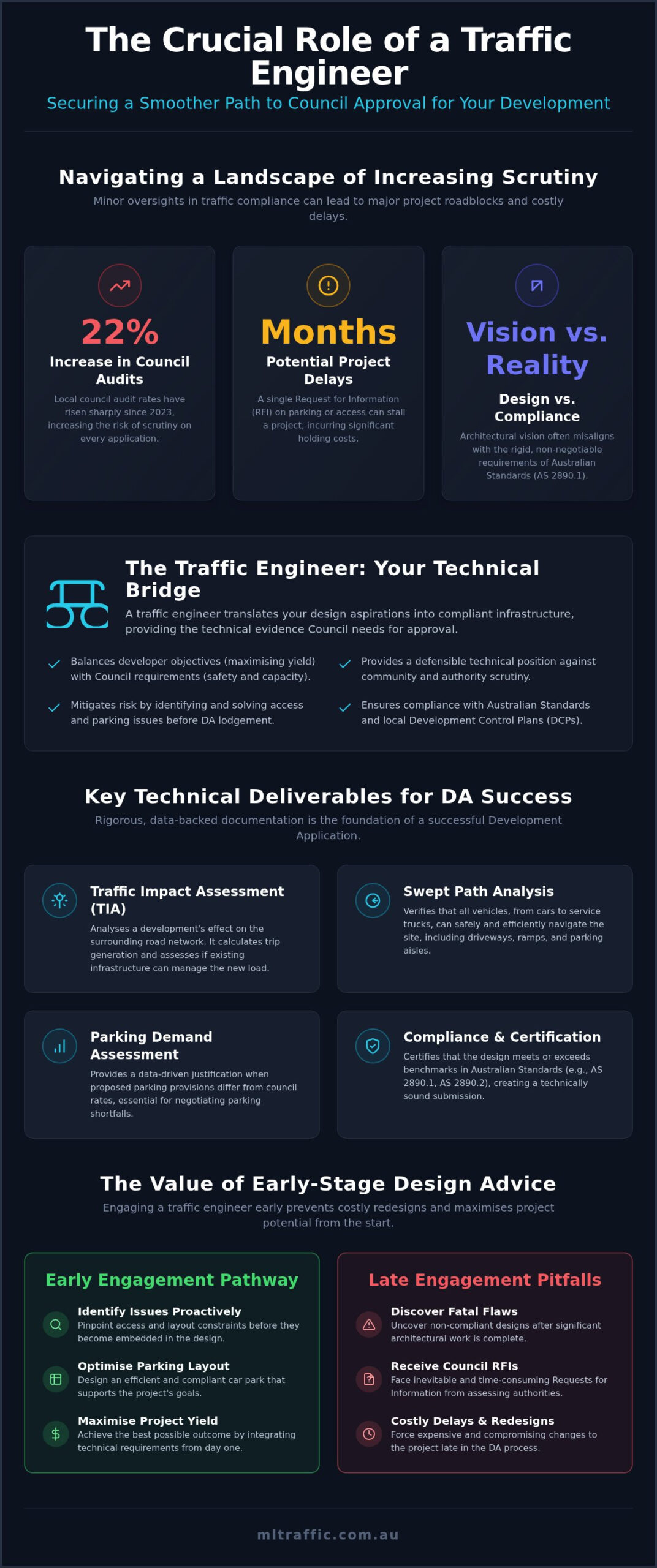
With local council audit rates increasing by 22% since 2023, a minor oversight in site access can lead to an immediate project standstill. Many developers realise too late that their architectural vision doesn’t align with the rigid requirements of AS 2890.1 or the latest Austroads Guide to Road Design. The role of traffic engineer in development applications is not merely to provide a report at the end of the process; they act as a technical bridge between your design aspirations and the strict safety standards required for Council approval.
It’s a common reality that a Request for Information (RFI) regarding parking yield or driveway safety can stall a project for months. These delays are often the result of design choices that overlook technical compliance. This article demonstrates how technical precision in traffic engineering de-risks your development and secures a smoother path to approval. You’ll discover how expert assessments in swept path analysis, parking demand, and regulatory compliance turn potential roadblocks into approved, high-yield infrastructure.
Key Takeaways
- Understand how the role of traffic engineer in development applications serves as a technical bridge between architectural design and regulatory compliance.
- Identify critical technical deliverables, including Traffic Impact Assessments and Swept Path Analysis, required for a successful DA submission.
- Learn why early-stage design advice is essential for identifying access issues and optimising parking layouts to maximise project yield.
- Discover how data-driven parking demand assessments can be used to negotiate parking shortfalls and address Council objections effectively.
- Ensure your project meets mandatory Australian Standards, such as AS 2890, to provide a defensible position against community and authority scrutiny.
Defining the Role: More Than Just a Traffic Report
A traffic engineer is a specialised consultant responsible for managing the safe and efficient movement of people and vehicles within and around a project site. While some view the profession as simply producing a report, the actual role of traffic engineer in development applications involves complex technical planning and risk mitigation. They provide the evidentiary basis that allows a local Council or road authority to determine if a development is sustainable from a transport perspective. This discipline draws upon the core principles of traffic engineering to ensure that new infrastructure doesn’t adversely affect the existing road network.
Success in a Development Application (DA) requires balancing a developer’s objective to maximise site yield with a Council’s requirement for public safety and network capacity. Traffic engineers act as technical liaisons. They translate high-level urban planning goals into specific, measurable infrastructure requirements. This includes assessing trip generation, intersection performance, and pedestrian safety. Without this expert oversight, projects often face immediate rejection due to foreseeable access conflicts or insufficient parking provisions. For a full list of technical assessments required for your project, view our traffic engineering services.
The Bridge Between Architecture and Engineering
Architectural designs often prioritise aesthetics and spatial efficiency. However, a visually appealing plan is worthless if it’s functionally impossible for a vehicle to navigate. Traffic engineers work alongside architects to ensure that “aesthetic” designs don’t compromise safety. They translate architectural concepts into compliant transport layouts by:
- Reviewing driveway locations to ensure they don’t conflict with street furniture or intersections.
- Adjusting internal aisle widths to facilitate smooth two-way traffic flow.
- Collaborating with town planners to ensure the traffic findings support the Statement of Environmental Effects.
- Ensuring that service vehicle access, such as waste collection, is integrated without disrupting car parking areas.
Regulatory Compliance and Australian Standards
Compliance isn’t optional. Every development must adhere to national benchmarks, specifically the AS 2890 series for parking and off-street facilities. A core part of the role of traffic engineer in development applications is interpreting these standards alongside local Council Development Control Plans (DCPs). These documents often contain conflicting requirements. The engineer’s job is to certify that the final design meets or exceeds these safety benchmarks. This certification provides a defensible technical position during the assessment period, reducing the likelihood of costly redesigns after the DA is lodged.
Key Technical Deliverables for DA Success
The role of traffic engineer in development applications is defined by the production of rigorous, data-backed documentation. These deliverables act as the technical evidence required by road authorities to approve a project. Central to this process is adherence to Australian Standards, primarily AS 2890.1 and AS 2890.2. These standards serve as the “bible” for all parking and access designs. If a submission fails to meet these benchmarks, it’s likely to receive an immediate Request for Information (RFI) or a flat refusal. Technical precision at the lodgement stage prevents these costly delays.
Beyond the primary reports, engineers must design and certify driveway ramp grades and sight distances. Incompatible driveway grades discovered too late can render a basement car park useless or require expensive structural remediation. A Car Parking Demand Assessment is also crucial when a project’s proposed parking provision differs from statutory requirements. By providing a data-driven justification, engineers can often secure approval for lower parking rates while maintaining site functionality. If you need technical certification for your project, you can contact our senior principals directly for a preliminary review of your site plans.
Traffic Impact Assessment (TIA) Reports
A Traffic Impact Assessment (TIA) or a Traffic Statement is the primary document used to analyse a development’s effect on the surrounding road network. This report calculates trip generation based on land-use intensity and specific land-use categories. For projects in the north, Queensland’s Guide to Traffic Impact Assessment provides the standard methodology for these calculations. The report identifies whether the existing infrastructure can manage the increased load or if specific intersection upgrades and traffic control measures are required to maintain safety and flow.
Swept Path Analysis and Vehicle Access
Vehicle access is verified through Swept Path Analysis. Using specialised software like AutoTURN, engineers simulate the movement of specific design vehicles, such as the B85 or B99 car. This process confirms that vehicles can enter and exit the site in a forward direction without striking curbs or structural columns. It’s particularly critical for waste trucks and heavy service vehicles that must navigate tight urban environments. Understanding the importance of swept path analysis for Council approval is vital for any developer wanting to avoid late-stage design changes that reduce saleable area.
Early-Stage Design Advice: Mitigating Risk and Cost
Engaging a traffic engineer after the architectural plans are finalised is a common, yet costly, mistake. At this late stage, fundamental issues with site access or parking layouts are often “baked in,” making them difficult and expensive to rectify. The strategic role of traffic engineer in development applications is most effective when utilised during the initial concept phase. This early involvement allows for the identification of “deal-breaker” traffic issues that could otherwise lead to project refusal or a significant loss of saleable area.
A primary focus of early advice is the optimisation of car park layouts. Yield is often the most critical metric for a developer. A senior traffic engineer identifies opportunities to maximise the number of spaces provided while ensuring strict adherence to AS 2890. This involves more than just fitting cars into boxes; it requires a deep understanding of aisle widths, column placements, and blind-aisle turnarounds. By identifying these constraints before the architect finalises the drawings, developers avoid the significant costs associated with redesigning structural columns or basement levels later in the process.
Feasibility and Concept Design
Evaluating site constraints early is essential for project viability. Steep topography or limited road frontage can severely restrict driveway locations and ramp grades. Using the Guide to Traffic Impact Assessment framework, engineers determine if the proposed density is supported by the existing road capacity. This feasibility check is a core component of professional traffic engineer services, designed to de-risk the initial investment before significant capital is committed. We assess whether the proposed access points avoid conflict with public infrastructure like power poles, bus stops, or existing intersections.
Servicing and Waste Management
Integrating servicing and waste management into the building footprint is another area where early advice pays dividends. Many Councils now require waste collection to occur on-site and in a forward-entry, forward-exit manner. Designing for the “worst-case” vehicle, such as a Heavy Rigid Vehicle (HRV), ensures long-term operational functionality. This proactive approach significantly reduces the likelihood of receiving a Council RFI regarding operational logistics. By positioning the role of traffic engineer in development applications as a design partner, developers ensure that internal circulation works for residents and delivery vehicles alike from day one.
Negotiating with Council and Road Authorities
Lodging a Development Application (DA) is rarely the final step in the approval process. The role of traffic engineer in development applications becomes especially critical during the post-lodgement negotiation phase. Once a submission is under review, Council officers often issue technical queries that require immediate, data-backed responses. A seasoned engineer manages these interactions by providing the technical justification needed to keep the project moving forward without compromising the developer’s yield or the site’s functionality.
Negotiating parking shortfalls is a primary focus during this stage. When a project cannot meet the statutory parking rates dictated by a local Development Control Plan, the engineer conducts a data-driven demand analysis. By using empirical evidence from similar land-use types, they can often justify a lower parking provision. This prevents the need for expensive basement expansions that could render a project financially unviable. If you’ve received an RFI or need expert representation for a planning tribunal, you can speak directly with our senior principals to discuss a technical strategy.
For developments located on major arterials, coordination with state road authorities is mandatory. Traffic engineers manage these high-level consultations to ensure proposed access points don’t disrupt regional traffic flow. If an application proceeds to a tribunal, such as NCAT or VCAT, the engineer provides expert witness testimony. This testimony offers a defensible, technical perspective that carries significant weight in legal proceedings, often neutralising anecdotal community objections with hard data.
Addressing the Request for Information (RFI)
The technical response to an RFI follows a structured, evidence-based process designed to satisfy Council requirements quickly:
- Step 1: Review. We scrutinise the Council officer’s specific traffic or parking objections to identify the core technical concern.
- Step 2: Data Collection. We conduct additional site surveys or SIDRA modelling to provide fresh, factual data that addresses the specific query.
- Step 3: Technical Rebuttal. We refine the site design or provide a formal technical rebuttal to resolve the objection and secure support for the DA.
Public Infrastructure and Community Impact
Community concerns regarding increased traffic congestion often lead to project delays. Traffic engineers mitigate these risks by proposing specific management measures, such as Traffic Management Plans (TMPs), which outline how the site will operate without adversely affecting the public road network. These plans are essential for demonstrating that the developer is taking all reasonable steps to manage safety and flow. For a more detailed look at these requirements, refer to our comprehensive guide on Traffic Management Plans.
Why Professional Traffic Engineering is Crucial for Project Approval
Professional traffic engineering is more than a box-ticking exercise; it’s a comprehensive risk management strategy. The role of traffic engineer in development applications is to provide the technical authority that Councils require to approve a project. Reports backed by 15 years of industry experience offer a defensible position that withstands the scrutiny of both assessors and community objectors. Technical data serves as the only objective measure in a planning environment that’s often influenced by subjective opinions or local politics. This national capability ensures that whether the project is in Sydney, Perth, or Brisbane, the same high standard of technical rigour is applied.
Senior-level involvement is a critical factor in how road authorities perceive a submission. Reports prepared or overseen by senior principals carry a level of weight that junior-produced documents lack. This professional standing, combined with a commitment to personnel continuity, ensures that the expert who starts the project retains all technical history through to the final approval. There’s no loss of information between departments or “hand-offs” that lead to errors. This accountability results in fewer technical queries and a more efficient path to a successful determination.
The Value of Senior Expertise
Having a principal engineer directly involved in your project leads to faster approvals. At ML Traffic Engineers Australia, we maintain a “no-gatekeepers” approach. This means developers have direct access to leadership throughout the entire DA process. When technical issues arise during Council meetings or site inspections, having an expert who’s intimately familiar with the project history allows for immediate, authoritative resolution. This level of senior oversight is essential for navigating the complex bureaucratic requirements of modern Australian infrastructure projects. It’s about being hands-on and accountable for every technical detail.
Securing Your DA with Confidence
A traffic engineer acts as the guardian of both public safety and project yield. By aligning architectural design with the rigid requirements of road authorities, they de-risk the development from the concept stage. Early engagement is the most effective way to avoid the significant costs associated with late-stage redesigns or project refusals. Whether your project involves a simple residential subdivision or a complex commercial centre, professional engineering provides the certainty required to proceed with confidence. We invite you to view the full range of ML Traffic Engineers Australia services to see how our technical precision can support your next application.
Securing Your Project’s Future with Technical Precision
Navigating the complexities of Australian planning frameworks requires more than just a standard report. The strategic role of traffic engineer in development applications is to de-risk the project from the concept stage through to final approval. By integrating technical compliance with design aspirations, you ensure that access points, parking layouts, and traffic impacts satisfy both safety standards and commercial requirements. This proactive approach eliminates the friction of unexpected Council RFIs and prevents the need for costly structural redesigns late in the process.
Securing a smooth DA approval process depends on the quality and authority of your technical evidence. ML Traffic Engineers Australia brings over 15 years of specialist experience to every project, offering national service coverage. We provide direct access to senior principals, ensuring that technical work is handled by seasoned experts who understand the bureaucratic landscape. Contact ML Traffic Engineers Australia today for expert DA support and move your project forward with total confidence. Technical excellence is the most reliable path to a successful determination.
Frequently Asked Questions
Why do I need a traffic engineer for a small residential development?
You need a traffic engineer for a small residential development to ensure absolute compliance with the AS 2890.1 standard for off-street car parking. Local Councils often require professional certification for driveway ramp grades and sight distances to guarantee safe vehicle access. Small-scale projects, such as dual occupancies or townhouses, still face rigid regulatory scrutiny. Providing a technical assessment upfront prevents delays caused by non-compliant access designs that could otherwise stall your approval.
What is the difference between a Traffic Impact Assessment and a Traffic Statement?
The primary difference lies in the scale of the development and its projected trip generation. A Traffic Impact Assessment (TIA) is a comprehensive report for high-impact developments that includes detailed intersection modelling and network analysis. A Traffic Statement is a concise document for lower-impact projects that focuses on parking provision and site access. The role of traffic engineer in development applications is to determine which level of reporting is required by your local road authority.
How much parking am I required to provide for my commercial project?
Statutory parking requirements are dictated by your local Council’s Development Control Plan (DCP) based on land-use type and gross floor area. However, these rates are often conservative and may not reflect actual demand. If your project cannot meet the statutory requirement, a traffic engineer can conduct a Car Parking Demand Assessment. This study uses empirical data to justify a lower parking provision, ensuring your project remains viable without compromising the functionality of the surrounding road network.
Can a traffic engineer help if Council has already rejected my DA?
Yes, a traffic engineer can assist by providing a technical rebuttal to Council’s objections or representing you at a planning tribunal. If your DA was rejected due to traffic or parking concerns, we review the officer’s report to identify if the objections are technically sound. We then provide data-backed evidence or design modifications to resolve the dispute. This professional representation is often the only way to overturn a refusal based on anecdotal traffic concerns.
What Australian Standards govern car park design and access?
Car park design and access are governed by the AS 2890 series of Australian Standards. Specifically, AS 2890.1 covers off-street car parking, while AS 2890.2 focuses on off-street commercial vehicle facilities. These standards dictate everything from bay dimensions and aisle widths to ramp grades and headroom clearances. Adherence to these benchmarks is mandatory for achieving DA approval. Our engineers ensure every design meets these technical requirements before submission to the road authority.
How long does it typically take to prepare a traffic report for a DA?
Preparation times for a traffic report typically range from one to three weeks depending on the complexity of the project. A standard Traffic Statement for a small development can often be completed quickly. Conversely, a full Traffic Impact Assessment requiring intersection modelling and SIDRA analysis takes longer to finalise. Engaging an engineer early in the design process ensures that technical documentation is ready for lodgement alongside your architectural plans, avoiding unnecessary project delays.
Do I need a traffic engineer for a public infrastructure project?
You absolutely need a traffic engineer for public infrastructure projects to manage complex traffic flow and safety requirements. The role of traffic engineer in development applications for public works involves coordinating with multiple state and local authorities. We provide essential deliverables such as Traffic Guidance Schemes and Intersection Analysis to ensure the new infrastructure integrates seamlessly with the existing network. Professional oversight is critical for maintaining public safety and operational efficiency.
What is AutoTURN and why is it used in traffic engineering?
AutoTURN is a specialised CAD-based software used to perform Vehicle Swept Path Analysis. It allows engineers to simulate the movement of specific design vehicles, such as waste trucks or B99 cars, to ensure they can navigate a site safely. We use this tool to prove that vehicles can enter and exit in a forward direction without striking structural elements. This simulation is a mandatory requirement for most Councils to verify the functional layout of a development car park.

Disclaimer
The content on www.mltraffic.com.au, including all technical articles, guides, and resources, is provided for general informational and educational purposes only. It is not intended to constitute professional advice in traffic engineering, transportation planning, development approvals, or any other technical or legal field.
While ML Traffic Engineers makes every reasonable effort to ensure the accuracy, completeness, and timeliness of the information published, we do not provide any warranties or representations (express or implied) regarding its reliability, suitability, or availability for any particular purpose. Any reliance you place on the content is strictly at your own risk.
In no event shall ML Traffic Engineers, its directors, employees, authors, or affiliates be liable for any direct, indirect, incidental, special, consequential, or punitive damages (including, without limitation, loss of profits, data, or business opportunities) arising out of or in connection with the use of, or inability to use, any information provided on this website.
The articles and guides on this site are not a substitute for engaging a qualified, registered professional traffic engineer (such as an NPER or RPEQ engineer) to assess your specific project requirements. For tailored advice, compliance assessments, or traffic engineering services, please contact a competent professional.
This disclaimer may be updated from time to time without notice. By accessing or using this website, you agree to be bound by the most current version of this disclaimer.
