

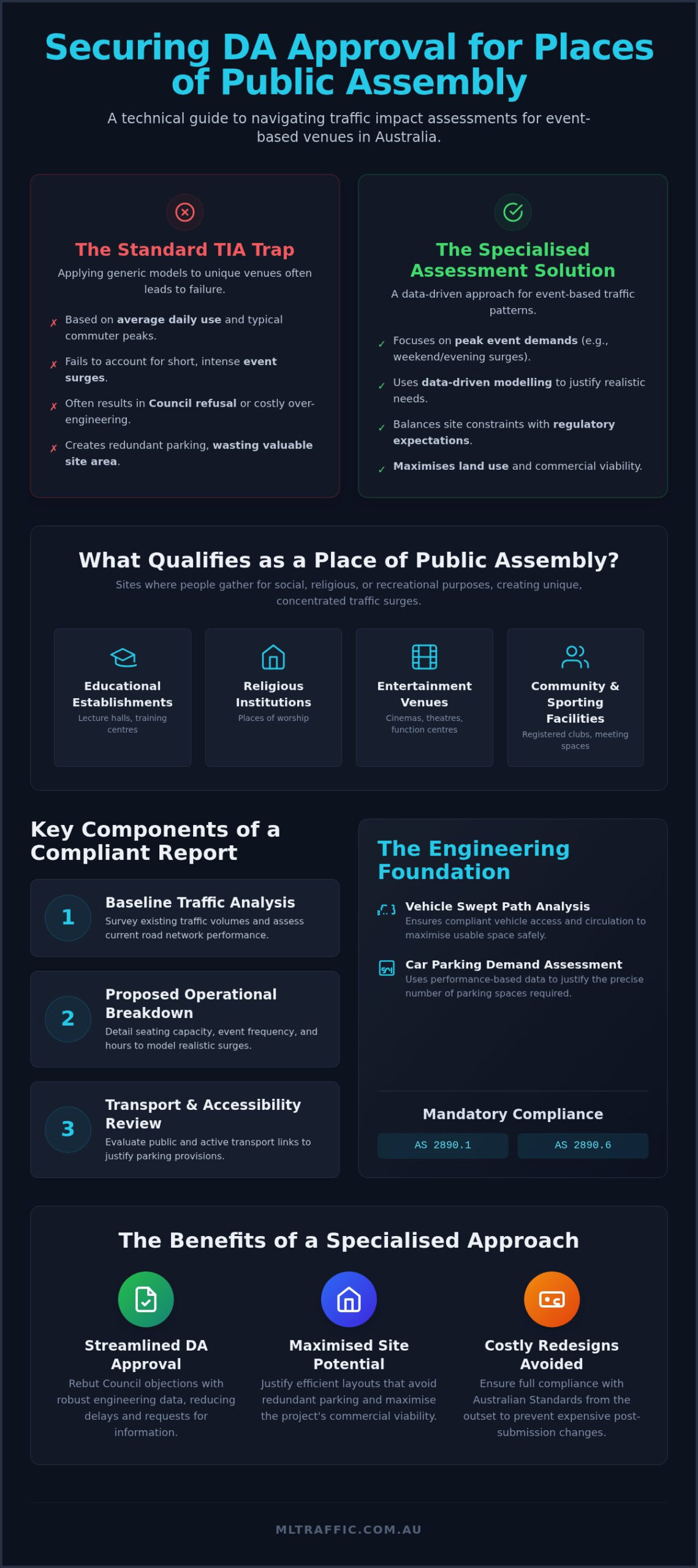
A standard traffic report based on average daily use will almost certainly result in a Council refusal or an over-engineered, costly car park that wastes valuable site area. When you’re planning a community centre, place of worship, or function hall, the usual traffic metrics simply don’t apply. You’re dealing with concentrated surges that occur for only a few hours a week, yet local authorities often demand infrastructure suited for constant high-volume use. Securing a successful traffic impact assessment for a place of public assembly requires a technical approach that balances these peak event demands with practical site constraints and regulatory expectations.
We understand that navigating complex council requirements is often the most frustrating part of the DA process, frequently leading to expensive delays. You shouldn’t be forced to sacrifice development potential for redundant parking spaces that sit empty most of the time. This guide provides a clear path to approval by showing how to address event-based surges and parking compliance through rigorous engineering data. You’ll learn how to leverage performance-based solutions, ensure your design meets AS 2890.1:2004 standards, and use vehicle swept path analysis to create a compliant layout that maximises your project’s commercial viability.
Key Takeaways
- Identify why a specialised traffic impact assessment for a place of public assembly is required to address unique peak-hour surges rather than standard daily averages.
- Ensure full compliance with Australian Standards, including AS 2890.1 for off-street parking and AS 2890.6 for accessible spaces, to avoid costly redesigns.
- Utilise vehicle swept path analysis and specialised car parking demand assessments to justify efficient site layouts that maximise land use.
- Learn how to use technical engineering data as evidence to rebut council objections and streamline the Development Application (DA) approval process.
- Discover the benefits of working with senior principals who provide hands-on expertise and continuity throughout the entire traffic planning phase.
Understanding Traffic Impact Assessments for Places of Public Assembly
A Traffic Impact Assessment (TIA) is a technical study required for any development that significantly alters local traffic patterns or increases demand on existing infrastructure. For developers, this report is a critical component of the Development Application (DA) process. Councils mandate these assessments to confirm that the surrounding road network can accommodate the additional load without compromising safety or efficiency. A traffic impact assessment for a place of public assembly is a specialised study of event-based traffic surges. It falls under the broader umbrella of Transportation planning, focusing specifically on how concentrated crowds arrive and depart within narrow timeframes.
What Qualifies as a Place of Public Assembly?
Under Australian planning schemes, a place of public assembly includes any site where people gather for social, religious, or recreational purposes. These developments present unique challenges due to their high-density occupancy. This category encompasses a wide range of project environments, each with distinct operational hours and visitor profiles. Typical examples include:
- Educational establishments, including lecture halls and training centres.
- Religious institutions and places of worship.
- Entertainment venues such as cinemas, theatres, and function centres.
- Registered clubs, community meeting spaces, and sporting facilities.
Our experience at ML Traffic Engineers Australia spans over 15 years, during which we’ve handled technical reports for everything from small community halls to large-scale entertainment precincts.
Why Standard TIAs Don’t Fit Public Assembly Sites
Standard traffic reports for retail or residential projects usually focus on the traditional morning and afternoon peaks when commuters are on the road. However, public assembly sites don’t follow these patterns. They often experience their highest demand on weekends or weekday evenings, times when the surrounding road network might actually have more capacity. The surge nature of these arrivals and departures is the primary concern for council engineers. Instead of a steady flow over several hours, a function centre or church might see hundreds of vehicles arrive within a 30-minute window.
This requires a specific type of intersection analysis to ensure that queues don’t spill back onto main roads or block local access. Applying a generic residential traffic model to these scenarios often leads to inaccurate results. This can result in either a rejected DA or a requirement for excessive infrastructure contributions. A dedicated traffic impact assessment for a place of public assembly uses data-driven modelling to justify realistic parking and access requirements. By focusing on the actual event schedule rather than theoretical averages, we help developers avoid the trap of being forced to provide unnecessary parking spaces that waste valuable site area.
Key Components of a Compliant Public Assembly TIA Report
A compliant traffic impact assessment for a place of public assembly must go beyond standard traffic volume counts. It requires a comprehensive site description and a clear breakdown of proposed land-use operations, including maximum seating capacity and event frequency. We begin by establishing a baseline through a rigorous analysis of existing traffic conditions and road network capacity. This involves surveying current traffic volumes and assessing how the local infrastructure performs before any new development is introduced. A high-quality report must also evaluate public transport accessibility and active transport links, such as walking paths and cycleways, to provide a complete picture of visitor movement.
Councils scrutinise these reports to ensure that a new development won’t create gridlock. If a venue is located near a train station or major bus interchange, our engineers can often justify a reduction in the required number of parking spaces based on high public transport usage. This integrated approach ensures the development aligns with modern urban planning goals while protecting the developer’s interest in maximising site use. This level of technical detail is why many developers contact our senior principals during the initial planning phase to identify potential roadblocks before they cause delays.
Peak Event Trip Generation and Distribution
Calculating trip generation for assembly sites requires a “worst-case scenario” model based on maximum venue capacity. We don’t just look at average attendance; we model the peak load when every seat is filled. Distribution modelling determines where these visitors originate, allowing us to map their precise route through the road network. When standard trip rates from authorities are unavailable or don’t fit the specific use, we use empirical data from similar sites to provide a realistic and defensible forecast. This ensures the traffic impact assessment for a place of public assembly stands up to council scrutiny.
Assessing Intersection Performance and Road Network Capacity
The sudden arrival or exit of hundreds of vehicles can significantly impact nearby signalised intersections and local streets. Our reports use advanced modelling software to ensure the development does not reduce the “Level of Service” (LoS) for existing road users. We identify if specific interventions, such as dedicated turn lanes or signal timing adjustments, are required to manage the surge. If the network cannot handle the load, we provide technical recommendations for road upgrades that satisfy council requirements while remaining cost-effective for the project. This meticulous approach prevents the fear of being forced to provide excessive infrastructure that doesn’t match the actual site demand.
Managing Car Parking Demand and Access Design (AS 2890 Compliance)
Parking demand is often the deciding factor in whether a development is viable on a specific site. A traffic impact assessment for a place of public assembly must prove that the proposed layout can handle peak vehicle volumes without causing external queuing. If cars back up onto public roads, Council will likely refuse the application. We focus on designing efficient internal circulation that manages high-density arrivals and departures safely. Compliance with Australian Standards is non-negotiable. Our engineers ensure every design adheres to AS/NZS 2890.1:2004 for off-street car parking and AS 2890.2 for commercial vehicle facilities. Learn more about our car park design services to ensure your project meets these technical requirements from the outset.
Adherence to the latest standards for accessible parking is equally critical. For all new developments, we apply AS 2890.6:2022, which requires a 2.4-metre wide parking bay paired with a 2.4-metre wide shared zone. Failure to incorporate these dimensions early in the design phase can lead to significant loss of parking capacity during the DA review. Securing a traffic impact assessment for a place of public assembly that accurately reflects these spatial requirements is essential for project viability. We provide precise technical drawings that satisfy both regulatory bodies and functional site needs.
Calculating Parking Demand for High-Occupancy Events
Councils often apply generic parking rates that don’t account for the unique operational hours of a community hall or religious centre. We balance these conservative requirements with actual anticipated demand based on your specific event schedule. This often involves:
- Exploring “shared parking” opportunities where different land uses peak at different times.
- Justifying parking shortfalls through robust transport management plans that encourage carpooling or public transport use.
- Utilising empirical data from similar developments to prove that lower parking provision is sustainable.
Vehicle Swept Path Analysis for Emergency and Service Access
Every public assembly site must accommodate heavy vehicles, including fire brigades, ambulances, and waste collection trucks. We use Swept Path Analysis to simulate vehicle movements and prove that these services can enter and exit the site in a forward direction. This analysis is vital for verifying that car park ramps, turns, and height clearances meet Australian Standards for all expected vehicle types. We don’t guess. Our senior engineers perform these technical simulations to ensure your driveway and internal road designs are both compliant and functional, minimising the risk of Council-mandated redesigns.
Navigating the Planning Approval Process with Local Councils
The planning approval process for assembly sites is often fraught with community and council resistance. A traffic impact assessment for a place of public assembly serves as your primary technical evidence to rebut objections regarding local congestion. Without this data, councils often default to conservative, restrictive conditions that can stifle a project’s potential. We prioritise proactive communication with council engineers early in the assessment phase. This allows us to identify their specific concerns and address them with technical solutions before the formal DA review. A professional traffic engineer acts as a dedicated advocate for the developer, translating complex traffic modelling into a clear, persuasive narrative that justifies the proposed development.
Engaging with the council early helps to desensitise potential issues before they become formal grounds for refusal. By presenting a rigorous traffic impact assessment for a place of public assembly, we provide the technical foundation needed to negotiate infrastructure contributions or parking variations. This evidence-based approach is critical for maintaining project timelines and avoiding the costly delays associated with multiple requests for further information (RFIs).
Addressing Council Concerns Regarding Amenity and Congestion
Amenity impacts are a major hurdle for public assembly projects, particularly when sites are adjacent to residential areas. Council engineers often raise concerns about “over-spill” parking where visitors might park in surrounding streets, potentially blocking driveways or causing local frustration. Our assessments provide empirical evidence to mitigate these fears. We design site entries that minimise conflict with through-traffic and ensure that peak event times do not coincide with existing local road peaks. By addressing specific amenity issues like noise from car doors or the impact of headlights on residential windows, we provide a more robust and defensible application.
Developing Effective Traffic Management and Mitigation Strategies
For projects that involve major annual events or irregular high-capacity gatherings, a standard report may not be enough. We often recommend implementing specialised Traffic Management Plans to manage these specific peak surges. These plans outline operational strategies such as using signage and wayfinding to distribute traffic flow efficiently across the network. In some cases, we may suggest minor road improvements or intersection modifications to offset the development’s impact. This proactive approach shows Council that the developer is committed to long-term safety and network efficiency. For expert assistance with your development application, contact our senior principals today to ensure your project stays on track.
Expert Traffic Engineering for Your Public Assembly Project
Selecting a qualified traffic engineering consultancy is the final and most critical step in securing your development’s future. A traffic impact assessment for a place of public assembly involves technical complexities that generalist firms often overlook. These projects require a deep understanding of event-based surges, specific council triggers, and the practical application of Australian Standards. ML Traffic Engineers Australia provides this specialised focus, delivering reports that are technically sound, meticulous, and council-ready. We don’t just provide a document; we provide a professional resume of capability that acts as your primary evidence during the DA process.
Our approach is direct and results-oriented. We understand that developers face immense pressure from complex council requirements and the fear of being forced to provide excessive parking infrastructure. By choosing an expert partner, you ensure that your traffic impact assessment for a place of public assembly is defensible and designed to minimise unnecessary infrastructure costs. Contact our senior principals today to discuss your project requirements and establish a clear path to approval.
Over 15 Years of National Consultancy Experience
We bring over 15 years of specialised traffic engineering experience to every project environment. ML Traffic Engineers Australia maintains a proven track record across an exhaustive range of land-use categories, including:
- Religious institutions and places of worship.
- Community centres and meeting halls.
- Function centres, theatres, and cinemas.
- Educational establishments and lecture halls.
- Registered clubs and sporting facilities.
- Large-scale entertainment precincts.
This extensive experience provides us with a deep understanding of regulatory requirements across all Australian jurisdictions. We ensure every report adheres to national standards, including AS/NZS 2890.1:2004 and AS 2890.6:2022. Our commitment to results-oriented engineering supports development viability by ensuring car park designs are compliant while maximising the functional use of your site.
Direct Access to Senior Principals for Every Report
A key signature of our service is the personnel continuity promise. We do not use gatekeepers or junior staff to handle your critical traffic data. The senior principal who initiates the client relationship is the same expert who performs the technical work at ML Traffic Engineers Australia. This hands-on philosophy ensures meticulous attention to detail in every TIA report and Vehicle Swept Path Analysis. Read more about our expert team and our commitment to deep-seated expertise. This “no-gatekeepers” approach provides you with a direct line to the experts, ensuring accountability and technical precision from project inception to final council approval. We dislike unnecessary bureaucracy and focus entirely on delivering the technical evidence required to streamline your DA process.
Secure Council Approval for Your Public Assembly Development
A successful development application for a community or religious site requires a technical strategy that addresses event-based traffic surges. Standard traffic models fail to capture the unique operational patterns of assembly venues, often leading to unnecessary council objections or excessive infrastructure costs. Focusing on empirical data and rigorous intersection analysis allows you to justify realistic parking provisions while ensuring your site layout remains efficient and compliant.
ML Traffic Engineers Australia provides the technical evidence required to navigate complex council requirements. With over 15 years of industry experience and national expertise in Australian Standards compliance, we deliver reports that are meticulous and defensible. You receive direct access to senior principals who perform the technical work, ensuring accountability and precision throughout the process. This hands-on approach is essential for a high-quality traffic impact assessment for a place of public assembly.
Get a Professional Traffic Impact Assessment for Your Project and progress your development with confidence.
Frequently Asked Questions
Is a traffic impact assessment required for a small community hall?
Yes, a traffic impact assessment for a place of public assembly is typically required regardless of the building’s footprint. Councils focus on the intensity of use and the potential for sudden traffic surges during events. Even a small hall can generate significant short-term demand that exceeds the capacity of local residential streets. Our engineers evaluate the specific operational hours and visitor numbers to provide a defensible report that matches the actual scale of your project.
How does council determine the number of parking spots required for a place of worship?
Councils determine parking requirements based on specific rates defined in their local planning schemes. These are often calculated using metrics like the number of seats in the main auditorium or the total gross floor area. However, these generic rates may not reflect your actual needs. We conduct a car parking demand assessment to justify variations from these standards, ensuring your design complies with AS 2890.1:2004 while preventing an over-provision of spaces that wastes site area.
Can we use off-site parking to meet our DA requirements?
Off-site parking can sometimes be used to satisfy DA requirements if it’s within a reasonable walking distance and has legally secured access. This often involves shared parking arrangements with neighbouring businesses that have different peak demand times. A robust transport management plan must accompany this proposal to prove to Council that visitors can safely access the venue. We use technical data to justify these shortfalls and ensure the development remains viable despite site constraints.
What happens if the road network is already at capacity?
If the surrounding road network is near capacity, an intersection analysis is required to determine the specific impact of your development. We use specialised modelling software to identify if the added load will reduce the Level of Service for other road users. In these cases, we may suggest mitigation strategies such as minor road widening, dedicated turning lanes, or operational management plans that stagger event start times to distribute traffic more evenly across the day.
How much does a Traffic Impact Assessment for a public assembly site cost?
The cost of a TIA depends entirely on the complexity of the project and the level of modelling required by the local council. Factors such as the need for intersection analysis, parking demand surveys, and extensive swept path analysis will influence the final fee. While basic reports are less intensive, large-scale public assembly sites requiring detailed network modelling involve more technical work. We recommend contacting our senior principals to receive a specific fee proposal tailored to your project’s unique requirements.
What is the difference between a TIA and a Traffic Management Plan (TMP)?
A TIA addresses the permanent, operational traffic impacts of a development to secure a Development Application (DA). In contrast, a Traffic Management Plan (TMP) or Traffic Guidance Scheme (TGS) usually focuses on temporary impacts, such as those occurring during the construction phase or for a one-off major event. While the TIA proves your site can function long-term, the TMP outlines how traffic and pedestrians are safely managed during specific high-risk periods.
How long does it take to prepare a TIA for a public event space?
Preparing a traffic impact assessment for a place of public assembly usually takes between two to four weeks, depending on the availability of existing traffic data. If new traffic counts or parking surveys are required, this timeline may extend to accommodate the collection of field data during representative periods. Our senior engineers perform all technical work directly, which ensures a streamlined process and high-quality report that is ready for council submission without unnecessary delays.
Do we need a swept path analysis if we only have a small car park?
Yes, swept path analysis is essential even for small car parks to prove that emergency and service vehicles can safely access the site. Councils require evidence that fire brigades, ambulances, and waste collection trucks can enter and exit in a forward direction. We use specialised software to simulate these movements, ensuring your driveway and internal circulation meet Australian Standards. This prevents the risk of being forced into expensive redesigns after your DA has been lodged.

Disclaimer
The content on www.mltraffic.com.au, including all technical articles, guides, and resources, is provided for general informational and educational purposes only. It is not intended to constitute professional advice in traffic engineering, transportation planning, development approvals, or any other technical or legal field.
While ML Traffic Engineers makes every reasonable effort to ensure the accuracy, completeness, and timeliness of the information published, we do not provide any warranties or representations (express or implied) regarding its reliability, suitability, or availability for any particular purpose. Any reliance you place on the content is strictly at your own risk.
In no event shall ML Traffic Engineers, its directors, employees, authors, or affiliates be liable for any direct, indirect, incidental, special, consequential, or punitive damages (including, without limitation, loss of profits, data, or business opportunities) arising out of or in connection with the use of, or inability to use, any information provided on this website.
The articles and guides on this site are not a substitute for engaging a qualified, registered professional traffic engineer (such as an NPER or RPEQ engineer) to assess your specific project requirements. For tailored advice, compliance assessments, or traffic engineering services, please contact a competent professional.
This disclaimer may be updated from time to time without notice. By accessing or using this website, you agree to be bound by the most current version of this disclaimer.
