

We are traffic engineers involved with traffic management plans in Sydney and surrounding regions.
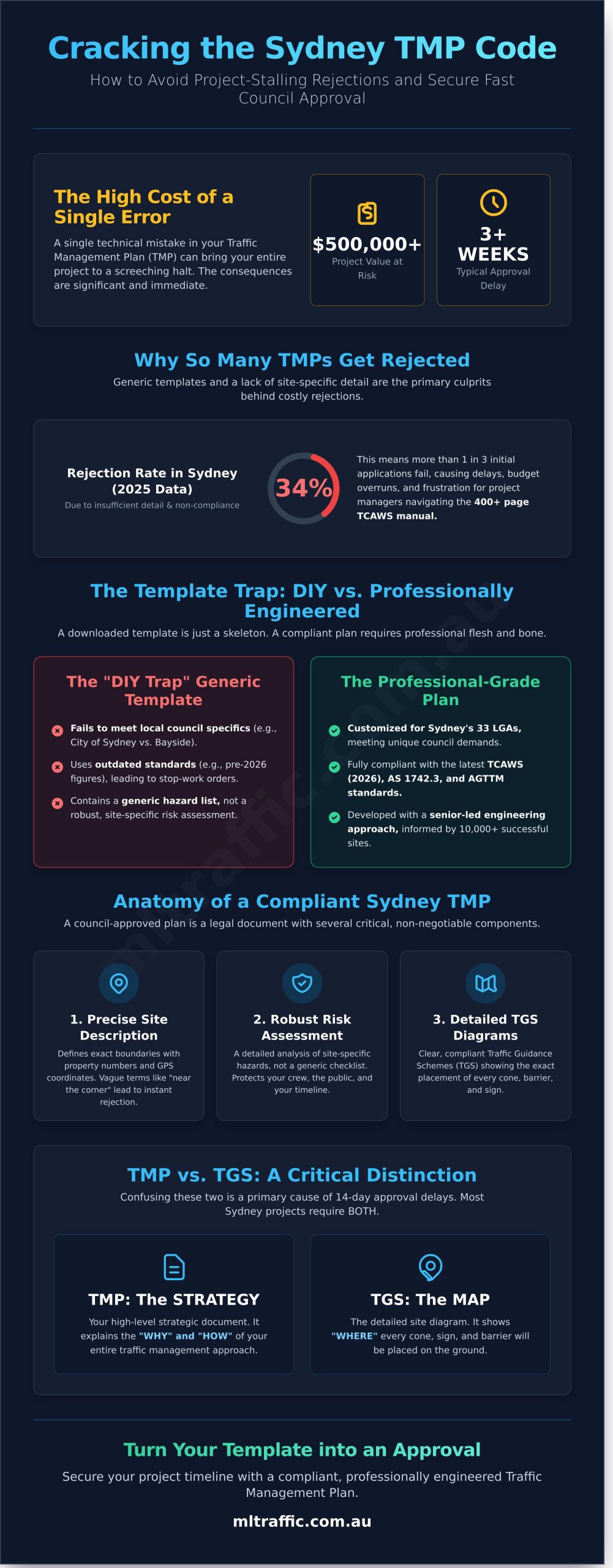
A single technical error in your Traffic Management Plan can stall a $500,000 Sydney construction project for three weeks or more. It’s a common reality for many project managers who find themselves buried under the 400-plus pages of the Transport for NSW TCAWS manual. You’re likely tired of the “alphabet soup” of TGS, TCP, and TMP acronyms that seem designed to cause confusion rather than clarity. We understand the frustration of receiving a Council rejection because a generic document didn’t account for specific local requirements.
This guide shows you exactly where to source a compliant tmp template Sydney councils respect. We’ll share the professional secrets our engineers have used across 10,000 successful sites to turn a standard template into an approved plan. You’ll learn the specific technical requirements for Sydney’s 33 local government areas and gain a clear, reliable path to project approval. We’ve simplified the technical jargon so you can focus on getting your team on-site without the typical administrative delays.
Key Takeaways
- Find out exactly where to source the official TfNSW documents so your tmp template Sydney meets the baseline requirements for the 2026 regulatory environment.
- Stop guessing about compliance by learning how to correctly apply AS 1742.3 and AGTTM standards to your specific site layout.
- Avoid the expensive “DIY trap” by identifying the common red flags that cause Sydney councils to reject generic traffic plans instantly.
- Learn the professional secrets to turning a basic hazard list into a robust, site-specific risk assessment that protects your crew and your project timeline.
- Discover how a senior-led engineering approach transforms a standard template into a high-quality, council-approved plan that gets your project moving.
Table of Contents
- Understanding the TMP Template: Your Starting Point in Sydney
- The Anatomy of a Compliant Sydney Traffic Management Plan
- The Template Trap: Why DIY Often Leads to Council Rejection
- Key NSW Standards Every Template Must Satisfy in 2026
- From Template to Approval: How ML Traffic Secures Your Site
Understanding the TMP Template: Your Starting Point in Sydney
In the 2026 NSW regulatory environment, a Traffic Management Plan (TMP) is a mandatory strategic document required for any project impacting the road network. If you’re searching for a tmp template Sydney developers rely on, you’ll find that Transport for NSW (TfNSW) provides standardized frameworks. However, it’s vital to recognize that a template is merely a skeleton. It provides the structure, but you must populate it with site-specific data to meet the current safety benchmarks. Understanding the basics of road traffic control is your first step before attempting to fill out these complex sections.
To better understand this concept, watch this helpful video:
There’s a significant gap between a “template” and a “compliant submission.” In 2025, data indicated that 34% of initial traffic applications in the Sydney metropolitan area were rejected due to insufficient detail. A template gives you the headings, but a compliant submission includes detailed risk assessments, swept path analysis, and stakeholder engagement strategies. Sydney councils, including the City of Sydney and Bayside, have unique expectations that go beyond the state-wide minimums. For instance, projects within the CBD often require 24-hour pedestrian management protocols that a generic tmp template Sydney contractors download might not include by default.
The Role of the TCAWS Technical Manual
Every Sydney TMP must align with the latest Traffic Control at Work Sites (TCAWS) standards. Think of the TCAWS manual as the “bible” of NSW traffic management for 2026. This manual dictates the exact structure of your template, including the size of signage and the distance of taper lengths. If your template relies on outdated 2022 figures, you risk an immediate stop-work order from council inspectors. The manual ensures that every plan maintains a uniform safety standard across the state, regardless of the project scale.
TMP vs. TGS: Which Template Do You Actually Need?
Confusion between the TMP and the TGS is a primary cause for project delays. The TMP is your high-level strategy; it explains the “why” and “how” of your traffic management approach. The TGS, or Traffic Guidance Scheme, is the actual map showing where every cone and sign is placed. Submitting only a TGS when your Council consent conditions demand a full TMP is a common error that leads to 14-day delays in approval. You must identify which document your specific development application (DA) requires before you start drafting. For most medium-to-large Sydney developments, you’ll need both to satisfy the City of Sydney or Bayside Council requirements.
Local knowledge is critical because council expectations vary by suburb. Bayside Council often focuses heavily on heavy vehicle routes and residential amenity. Meanwhile, the City of Sydney prioritizes high-volume pedestrian corridors and bicycle lane integrity. Using a generic template without adjusting for these local priorities is a recipe for rejection. You need to ensure your document addresses the specific traffic volume data and local constraints of the street where your site is located. A successful submission is one that treats the template as a guide, not a finished product.
The Anatomy of a Compliant Sydney Traffic Management Plan
A compliant Sydney Traffic Management Plan (TMP) isn’t just a collection of maps; it’s a legal document that ensures the safety of the public and your workforce. While using a tmp template Sydney offers is a smart starting point, the content you input must meet the rigorous 2026 standards set by Transport for NSW (TfNSW) and local councils. Generic plans often fail at the first stage of council review because they lack site-specific data and technical depth. Every plan we develop at ML Traffic Engineers Pty Ltd draws from our experience across 10,000 sites to ensure zero ambiguity during the approval process.
Project Scope and Site Description
Precision is mandatory when describing your site. Vague descriptions like “near the shops” or “on the corner” will lead to immediate rejection by authorities. Your template must define site boundaries using exact property numbers and GPS coordinates. You should classify roads as State, Regional, or Local, as this dictates which authority holds the power of approval. Including local landmarks like the Parramatta Light Rail or specific CBD intersections helps assessors understand the real-world impact of your proposed work zone.
Risk Identification and Mitigation
Effective risk management moves beyond a simple list of hazards. You must categorise risks based on traffic volume, 60km/h or 40km/h speed limits, and the presence of vulnerable road users like cyclists or school children. We apply the hierarchy of controls: first attempting to eliminate the risk through road closures before moving to engineering controls like temporary barriers. For complex Sydney sites, you must integrate Swept Path Analysis results. This technical data proves that a 12.5 metre Heavy Rigid Vehicle can actually make the turn without mounting a kerb or hitting temporary signage.
Stakeholder Consultation
No TMP exists in a vacuum. You must document every contact made with TfNSW, the NSW Police Force, and local council representatives. Your plan needs a dedicated section for community notification strategies, detailing how you’ll inform residents within a 200 metre radius of the works. You can view our about page to see how our principals, Michael Lee and Benny Chen, have managed these complex consultations for over 30 years. This history of direct accountability ensures that the person who quotes your job is the one negotiating with these authorities.
The “Sydney Factor” adds another layer of complexity. In high-density areas like the CBD or Parramatta, emergency vehicle access is a non-negotiable requirement. Your plan must guarantee a minimum 3.5 metre clear width for fire trucks and ambulances at all times. If your project impacts bus lanes or light rail corridors, you’ll need specific “No-Work” periods to avoid peak hour disruptions. Failing to account for these variables doesn’t just delay your start date; it exposes you to significant fines under the Roads Act 1993.
If your project involves complex intersections or high-traffic volumes, seeking professional traffic engineering advice is the most reliable way to ensure your tmp template Sydney submission is approved on the first attempt. We focus on providing direct access to senior engineers who understand the technicalities of AS 1742.3 and the latest TfNSW supplements. This hands-on approach eliminates the bureaucracy often found in larger firms and gets your project moving faster.
The Template Trap: Why DIY Often Leads to Council Rejection
Downloading a free tmp template Sydney might seem like a shortcut to saving a few hundred dollars. In reality, it’s often the most expensive decision a project manager makes. Sydney councils, including Inner West and City of Sydney, have increased their scrutiny of traffic plans significantly since 2024. A rejected application doesn’t just mean a “no”; it results in mandatory resubmission fees that often start at A$480. Worse, your site remains dormant while your crew’s daily rate of A$2,800 continues to burn through your budget.
Assessors spot generic templates instantly. When a document mentions “typical street layouts” instead of naming specific Sydney intersections or accounting for the unique curb geometry of narrow Victorian-era streets, it’s a red flag. Professional TMPs require a signature from a qualified designer. Under current Transport for NSW (TfNSW) guidelines, an untrained person lacks the legal authority to sign off on a Traffic Management Plan. Without the right credentials, your document is legally void before it even reaches the assessor’s desk.
ML Traffic Engineers turns these generic risks into approval-ready assets. We replace vague “placeholder” text with data-driven site specifics. We’ve handled over 10,000 sites since 2005, giving us the local knowledge to anticipate exactly what a council assessor wants to see. We ensure the tmp template Sydney you use is actually a bespoke engineering document that meets every 2026 compliance standard.
Common Mistakes in DIY Traffic Management Plans
Generic templates often fail because they don’t account for the high-density variables of the Sydney metropolitan area. Most DIY attempts miss these three critical elements:
- Incorrect Speed Zone Applications: Using a standard 40km/h buffer when the local council requires a specific transition zone for 60km/h or 70km/h arterial roads.
- Clearway and School Zone Conflicts: Failing to note that a work zone on Military Road is restricted by clearway hours (6:00 AM to 10:00 AM), or ignoring the 8:00 AM to 9:30 AM school zone peak on local streets.
- Swept Path Failures: Neglecting to include a Vehicle Swept Path Assessment. If a 12.5m Heavy Rigid Vehicle cannot physically make the turn into your site without mounting a curb, the council will reject the plan immediately.
The Value of Professional Traffic Engineering
Professional traffic engineering adds a layer of accountability that DIY templates lack. When an RPEQ or NER registered engineer signs your plan, it carries a level of authority that councils trust. This certification tells the assessor that the safety risks have been professionally mitigated according to AS 1742.3 standards. Our senior staff, each with between 30 and 40 years of experience, oversee every detail to ensure your project doesn’t hit a bureaucratic wall.
Our “Quote to Work” promise is simple. The senior traffic consultant who provides your initial quote is the same person who conducts the assessment and signs the final document. There are no junior staff or automated systems handling your compliance. This direct accountability ensures that your project avoids the 20% delay rates common with DIY submissions. We recommend you contact our experts to review your requirements before you risk a submission with a suspect document.
Key NSW Standards Every Template Must Satisfy in 2026
Your tmp template Sydney won’t pass a Transport for NSW (TfNSW) audit if it’s based on outdated 2020 standards. By 2026, the regulatory landscape has shifted toward high-tech integration and stricter safety margins. The core of any compliant plan remains AS 1742.3. For those outside the engineering field, think of this as the “dictionary” for traffic control. It dictates the exact size, color, and reflectivity of every sign. If your template uses a sign with a 600mm diameter where an 800mm version is required for a 70km/h zone, your site is technically non-compliant from day one.
The Austroads Guide to Temporary Traffic Management (AGTTM) works alongside the NSW-specific Traffic Control at Work Sites (TCAWS) manual. While AGTTM provides the broad framework used across Australia, NSW has unique supplements that are non-negotiable. In 2026, these include specific buffer zone lengths that account for modern vehicle braking distances and the increased presence of electric vehicles, which have different weight profiles. You can’t just copy a plan from another state; it has to be calibrated for the NSW 2026 technical specifications.
Sydney’s local government areas (LGAs) have vastly different expectations. In the Sydney CBD, a tmp template Sydney must account for “Peak Period” clearways that often run from 6:00 AM to 10:00 AM. If your plan doesn’t show how you’ll vacate the lane by 5:55 AM, the City of Sydney will reject it. Contrast this with the Western Suburbs, where LGAs like Blacktown or Parramatta focus heavily on heavy vehicle swept paths. If your template doesn’t prove a 19-metre B-Double can still make a left turn during your lane closure, you’ll face significant delays in approval.
Environmental factors are the most common reason for 2026 permit failures. The Protection of the Environment Operations (POEO) Act now requires strict noise mitigation. If your night works exceed 75dB(A) at the nearest residential boundary, your template must include specific noise wall locations or “silent” generator specifications. Basic templates usually skip these details, leading to immediate work-stop orders once the neighbors complain.
TCAWS Compliance Checklist
- Verify that the Traffic Guidance Scheme (TGS) is designed by a person holding the “Prepare Work Zone Traffic Management Plan” (PWZTMP) qualification.
- Ensure the template includes a site-specific risk assessment that addresses “Last Mile” delivery impacts.
- Check that all signage meets the latest Class 1100 retroreflective standards for night visibility.
- Confirm the inclusion of digital monitoring points for sites on “State Roads” to allow for real-time traffic flow adjustments.
- Check that the plan provides a clear “Side-Track” or “Detour” route if the primary carriage way is reduced by more than 50 percent.
Pedestrian and Cyclist Safety
NSW’s “Towards Zero” initiative has a 2050 target for zero road fatalities, and the 2026 TMP requirements reflect this urgency. Your template must prioritize vulnerable road users over vehicle flow. This means providing a minimum 1.5-metre wide clear path for mobility scooters and prams. If you’re working near a dedicated cycleway, your plan must show how cyclists are separated from heavy machinery using T-Top bollards or water-filled barriers. For complex urban environments, you may need a professional safety audit to ensure your TGS doesn’t create “blind spots” at pedestrian crossings.
Don’t risk your project timeline with a generic document that fails to meet local Sydney LGA requirements. Contact our senior engineers for a compliant traffic management plan that gets approved the first time.
From Template to Approval: How ML Traffic Secures Your Site
A tmp template Sydney project managers use is only the starting point. While a template provides the structure, the approval process in NSW requires technical precision that generic forms cannot offer. At ML Traffic Engineers, we bridge the gap between a blank document and a Council-stamped approval. Our approach is senior-led, meaning your project isn’t handed off to a junior graduate. Every plan is overseen by experts who understand the 2026 regulatory shifts.
Our four-step process ensures your site moves from planning to implementation without bureaucratic delays:
- Step 1: Rapid site assessment and data collection. We don’t guess. We analyze the specific road geometry, traffic volumes, and pedestrian movements surrounding your site within 24 to 48 hours of engagement.
- Step 2: Customising the TMP to your specific Council requirements. Sydney’s 30+ local councils each have unique quirks. Whether you’re working in the City of Sydney or Bayside, we tailor the tmp template Sydney standards to meet local expectations, preventing costly revisions.
- Step 3: Liaison with road authorities to smooth the approval path. We manage the dialogue with Transport for NSW (TfNSW) and local government engineers. We speak their technical language to resolve objections before they become formal rejections.
- Step 4: Final certification and implementation support. Once the plan is ready, we provide the necessary certifications. We don’t disappear after approval; we offer support to ensure the on-site setup matches the endorsed plans perfectly.
Why 10,000+ Sites Choose ML Traffic Engineers
We’ve spent 15 years mastering the intricacies of Sydney’s road networks. Our firm has successfully delivered traffic solutions for over 10,000 sites, ranging from small residential builds to massive industrial warehouses. You get direct access to our principals, Michael Lee and Benny Chen. This “no-gatekeepers” approach means the person quoting your job is the one doing the technical work. You can explore our older articles to see how we’ve adapted to changing Sydney traffic laws since 2005.
Get Your Approval-Ready TMP Today
Speed is critical in construction. A delayed permit can cost your project thousands of dollars in idle labor and machinery hire. We provide fast, accurate quotes that reflect the actual complexity of your site. You aren’t just buying a document; you’re investing in guaranteed compliance and the peace of mind that comes with professional indemnity. Don’t let an incomplete template be the reason your project stops at the curb. Contact Michael or Benny today to secure a plan that actually works for your site and the authorities.
Secure Your Sydney Site Approval with Professional Engineering
Using a generic tmp template Sydney is a useful starting point, but it’s rarely enough to satisfy the rigorous 2026 NSW safety standards. Most DIY plans face immediate rejection from local councils because they lack the technical depth required for complex urban environments. Since 2005, ML Traffic Engineers has successfully assessed over 10,000 sites across every Sydney Local Government Area. We know exactly what regulators look for in a compliant Traffic Management Plan.
You shouldn’t leave your project timeline to chance. Our clients get direct access to RPEQ and NER registered senior engineers who take full accountability for every assessment. The consultant who provides your quote is the same expert who performs the work. This hands-on approach eliminates the common errors found in basic templates and ensures your site meets all Australian Standards. Stop worrying about council pushback and let our decades of experience clear the path for your development.
Get an approval-ready Traffic Management Plan from Sydney’s leading experts
We’re ready to help you navigate the technicalities of Sydney traffic engineering and get your project moving on the right foot.
Frequently Asked Questions
Can I use a generic Word document as my TMP for Sydney Council?
You can’t use a standard Word document because it won’t meet the strict technical requirements of Sydney councils. Most local authorities, including City of Sydney and Parramatta, demand plans that align specifically with the AGTTM and the TCAWS Manual. Your document must include site-specific risk matrices and detailed swept path assessments that generic templates simply don’t provide.
Who is legally allowed to prepare a Traffic Management Plan in NSW?
Only professionals holding the Transport for NSW (TfNSW) “Prepare a Work Zone Traffic Management Plan” qualification can legally sign off on these documents. For many complex developments in the Sydney CBD, councils insist on a plan drafted by a qualified traffic engineer listed on the National Engineering Register. This ensures the person designing your site flow understands the legal liabilities and safety standards involved.
How long does it take for a Sydney Council to approve a TMP?
Expect a turnaround time of 10 to 20 business days for most Sydney councils. If you’re working in high-traffic areas like North Sydney or the Inner West, the process can stretch to 28 days during busy construction months. It’s smart to submit your paperwork at least 4 weeks before your intended start date to avoid expensive project delays.
What is the difference between a TMP and a Traffic Guidance Scheme (TGS)?
A TMP is a strategic document while a TGS is a tactical diagram. The TMP explains the “why” and “how” of your traffic strategy, covering risk management and stakeholder consultation. The TGS, which was formerly called a TCP, shows exactly where to place every sign and cone on the street during your active work hours.
Are there specific TMP templates for small residential builds in Sydney?
While a basic tmp template Sydney exists for smaller projects, you still have to tailor it to your specific street. Even a single-dwelling build in a suburb like Marrickville needs to account for local bus routes and narrow clearways. You can’t just submit a blank form; you need to show how you’ll manage deliveries without blocking neighbors’ driveways.
What happens if I operate a work site without a compliant TMP?
Operating without a compliant plan triggers immediate “Stop Work” orders and massive financial penalties. Under the NSW Work Health and Safety Act 2011, corporations can face fines exceeding A$3,000,000 for serious safety violations. Beyond the fines, your insurance is likely void if an accident occurs on an unauthorized site, which leaves you personally liable for damages.
How often does a Traffic Management Plan need to be updated?
You must update your plan whenever the work environment or site access points change significantly. It’s a legal requirement to review the document if a safety incident occurs or if new risks are identified during the construction phase. Most project managers schedule a formal review every 6 months to stay compliant with the latest TCAWS Manual updates.
Does a TMP template include a Pedestrian Management Plan?
A professional tmp template Sydney must include a dedicated section for pedestrian and cyclist safety. You’re required to demonstrate how you’ll keep the public safe, especially if you’re closing a footpath or diverting traffic near a school zone. This section specifies the width of temporary walkways and the exact placement of all required safety signage.
What areas do we cover?
We prepare Traffic Management Plans for developments in every suburb of Sydney such as Abbotsbury, Abbotsford, Acacia Gardens, Agnes Banks, Airds, Alexandria, Alfords Point, Allambie Heights, Allawah, Ambarvale, Angus, Annandale, Annangrove, Arcadia, Arncliffe, Arndell Park, Artarmon, Ashbury, Ashcroft, Ashfield, Asquith, Auburn, Austral, Avalon Beach, Badgerys Creek, Balgowlah, Balgowlah Heights, Balmain, Balmain East, Bangor, Banksia, Banksmeadow, Bankstown, Bankstown Aerodrome, Barangaroo, Barden Ridge, Bardia, Bardwell Park, Bardwell Valley, Bass Hill, Baulkham Hills, Bayview, Beacon Hill, Beaconsfield, Beaumont Hills, Beecroft, Belfield, Bella Vista, Bellevue Hill, Belmore, Belrose, Berala, Berkshire Park, Berowra, Berowra Heights, Berowra Waters, Berrilee, Beverley Park, Beverly Hills, Bexley, Bexley North, Bidwill, Bilgola Beach, Bilgola Plateau, Birchgrove, Birrong, Blackett, Blacktown, Blair Athol, Blairmount, Blakehurst, Bligh Park, Bondi, Bondi Beach, Bondi Junction, Bonnet Bay, Bonnyrigg, Bonnyrigg Heights, Bossley Park, Botany, Bow Bowing, Box Hill, Bradbury, Bradfield, Breakfast Point, Brighton-Le-Sands, Bringelly, Bronte, Brooklyn, Brookvale, Bundeena, Bungarribee, Burraneer, Burwood, Burwood Heights, Busby, Cabarita, Cabramatta, Cabramatta West, Caddens, Cambridge Gardens, Cambridge Park, Camellia, Cammeray, Campbelltown, Camperdown, Campsie, Canada Bay, Canley Heights, Canley Vale, Canoelands, Canterbury, Caringbah, Caringbah South, Carlingford, Carlton, Carnes Hill, Carramar, Carss Park, Cartwright, Castle Cove, Castle Hill, Castlecrag, Castlereagh, Casula, Catherine Field, Cattai, Cecil Hills, Cecil Park, Centennial Park, Chatswood, Chatswood West, Cheltenham, Cherrybrook, Chester Hill, Chifley, Chippendale, Chipping Norton, Chiswick, Chullora, Church Point, Claremont Meadows, Clarendon, Clareville, Claymore, Clemton Park, Clontarf, Clovelly, Clyde, Coasters Retreat, Cobbitty, Colebee, Collaroy, Collaroy Plateau, Colyton, Como, Concord, Concord West, Condell Park, Connells Point, Constitution Hill, Coogee, Cottage Point, Cowan, Cranebrook, Cremorne, Cremorne Point, Cromer, Cronulla, Crows Nest, Croydon, Croydon Park, Curl Curl, Currans Hill, Currawong Beach, Daceyville, Dangar Island, Darling Point, Darlinghurst, Darlington, Davidson, Dawes Point, Dean Park, Dee Why, Denham Court, Denistone, Denistone East, Denistone West, Dharruk, Dolans Bay, Dolls Point, Doonside, Double Bay, Dover Heights, Drummoyne, Duffys Forest, Dulwich Hill, Dundas, Dundas Valley, Dural, Eagle Vale, Earlwood, East Hills, East Killara, East Lindfield, East Ryde, Eastern Creek, Eastgardens, Eastlakes, Eastwood, Edensor Park, Edgecliff, Edmondson Park, Elanora Heights, Elderslie, Elizabeth Bay, Elizabeth Hills, Elvina Bay, Emerton, Enfield, Engadine, Englorie Park, Enmore, Epping, Ermington, Erskine Park, Erskineville, Eschol Park, Eveleigh, Fairfield, Fairfield East, Fairfield Heights, Fairfield West, Fairlight, Fiddletown, Five Dock, Forest Glen, Forest Lodge, Forestville, Frenchs Forest, Freshwater, Gables, Galston, Georges Hall, Gilead, Girraween, Gladesville, Glebe, Gledswood Hills, Glen Alpine, Glendenning, Glenfield, Glenhaven, Glenmore Park, Glenorie, Glenwood, Gordon, Grantham Farm, Granville, Grays Point, Great Mackerel Beach, Green Valley, Greenacre, Greendale, Greenfield Park, Greenhills Beach, Greenwich, Gregory Hills, Greystanes, Guildford, Guildford West, Gymea, Gymea Bay, Haberfield, Hammondville, Harrington Park, Harris Park, Hassall Grove, Haymarket, Heathcote, Hebersham, Heckenberg, Henley, Hillsdale, Hinchinbrook, Hobartville, Holroyd, Holsworthy, Homebush, Homebush West, Horningsea Park, Hornsby, Hornsby Heights, Horsley Park, Hoxton Park, Hunters Hill, Huntingwood, Huntleys Cove, Huntleys Point, Hurlstone Park, Hurstville, Hurstville Grove, Illawong, Ingleburn, Ingleside, Jamisontown, Jannali, Jordan Springs, Kangaroo Point, Kareela, Kearns, Kellyville, Kellyville Ridge, Kemps Creek, Kensington, Kenthurst, Kentlyn, Killara, Killarney Heights, Kings Langley, Kings Park, Kingsford, Kingsgrove, Kingswood, Kirkham, Kirrawee, Kirribilli, Kogarah, Kogarah Bay, Ku-ring-gai Chase, Kurnell, Kurraba Point, Kyeemagh, Kyle Bay, La Perouse, Lakemba, Lalor Park, Lane Cove, Lane Cove North, Lane Cove West, Lansdowne, Lansvale, Laughtondale, Lavender Bay, Leets Vale, Leichhardt, Len Waters Estate, Leppington, Lethbridge Park, Leumeah, Lewisham, Liberty Grove, Lidcombe, Lilli Pilli, Lilyfield, Lindfield, Linley Point, Little Bay, Liverpool, Llandilo, Loftus, Londonderry, Long Point, Longueville, Lovett Bay, Lower Portland, Lucas Heights, Luddenham, Lugarno, Lurnea, Macquarie Fields, Macquarie Links, Macquarie Park, Maianbar, Malabar, Manly, Manly Vale, Maraylya, Marayong, Maroota, Maroubra, Marrickville, Marsden Park, Marsfield, Mascot, Matraville, Mays Hill, McCarrs Creek, McGraths Hill, McMahons Point, Meadowbank, Melonba, Melrose Park, Menai, Menangle Park, Merrylands, Merrylands West, Middle Cove, Middle Dural, Middleton Grange, Miller, Millers Point, Milperra, Milsons Passage, Milsons Point, Minchinbury, Minto, Minto Heights, Miranda, Mona Vale, Monterey, Moore Park, Moorebank, Morning Bay, Mortdale, Mortlake, Mosman, Mount Annan, Mount Colah, Mount Druitt, Mount Kuring-Gai, Mount Lewis, Mount Pritchard, Mount Vernon, Mulgoa, Mulgrave, Narellan, Narellan Vale, Naremburn, Narrabeen, Narraweena, Narwee, Nelson, Neutral Bay, Newington, Newport, Newtown, Nirimba Fields, Normanhurst, North Balgowlah, North Bondi, North Curl Curl, North Epping, North Kellyville, North Manly, North Narrabeen, North Parramatta, North Rocks, North Ryde, North St Marys, North Strathfield, North Sydney, North Turramurra, North Wahroonga, North Willoughby, Northbridge, Northmead, Northwood, Norwest, Oakhurst, Oakville, Oatlands, Oatley, Old Guildford, Old Toongabbie, Oran Park, Orchard Hills, Oxford Falls, Oxley Park, Oyster Bay, Paddington, Padstow, Padstow Heights, Pagewood, Palm Beach, Panania, Parklea, Parramatta, Peakhurst, Peakhurst Heights, Pemulwuy, Pendle Hill, Pennant Hills, Penrith, Penshurst, Petersham, Phillip Bay, Picnic Point, Pitt Town, Pleasure Point, Plumpton, Point Piper, Port Botany, Port Hacking, Potts Hill, Potts Point, Prairiewood, Prestons, Prospect, Punchbowl, Putney, Pymble, Pyrmont, Quakers Hill, Queens Park, Queenscliff, Raby, Ramsgate, Ramsgate Beach, Randwick, Redfern, Regents Park, Regentville, Revesby, Revesby Heights, Rhodes, Richards, Richmond, Riverstone, Riverview, Riverwood, Rockdale, Rodd Point, Rookwood, Rooty Hill, Ropes Crossing, Rose Bay, Rosebery, Rosehill, Roselands, Rosemeadow, Roseville, Roseville Chase, Rossmore, Rouse Hill, Rozelle, Ruse, Rushcutters Bay, Russell Lea, Rydalmere, Ryde, Sackville North, Sadleir, Sandringham, Sandy Point, Sans Souci, Schofields, Scotland Island, Seaforth, Sefton, Seven Hills, Shalvey, Shanes Park, Silverwater, Singletons Mill, Smeaton Grange, Smithfield, South Coogee, South Granville, South Hurstville, South Maroota, South Penrith, South Turramurra, South Wentworthville, South Windsor, Spring Farm, St Andrews, St Clair, St Helens Park, St Ives, St Ives Chase, St Johns Park, St Leonards, St Marys, St Peters, Stanhope Gardens, Stanmore, Strathfield, Strathfield South, Summer Hill, Surry Hills, Sutherland, Sydenham, Sydney, Sydney Olympic Park, Sylvania, Sylvania Waters, Tallawong, Tamarama, Taren Point, Telopea, Tempe, Tennyson Point, Terrey Hills, The Ponds, The Rocks, Thornleigh, Toongabbie, Tregear, Turramurra, Turrella, Ultimo, Varroville, Vaucluse, Villawood, Vineyard, Voyager Point, Wahroonga, Waitara, Wakeley, Wareemba, Warrawee, Warriewood, Warwick Farm, Waterfall, Waterloo, Watsons Bay, Wattle Grove, Waverley, Waverton, Wedderburn, Wentworth Point, Wentworthville, Werrington, Werrington County, Werrington Downs, West Hoxton, West Pennant Hills, West Pymble, West Ryde, Westleigh, Westmead, Wetherill Park, Whalan, Whale Beach, Wheeler Heights, Wiley Park, Willmot, Willoughby, Willoughby East, Windsor, Windsor Downs, Winston Hills, Wisemans Ferry, Wolli Creek, Wollstonecraft, Woodbine, Woodcroft, Woodpark, Woollahra, Woolloomooloo, Woolooware, Woolwich, Woronora, Woronora Heights, Yagoona, Yarrawarrah, Yennora, Yowie Bay, Zetland.
