

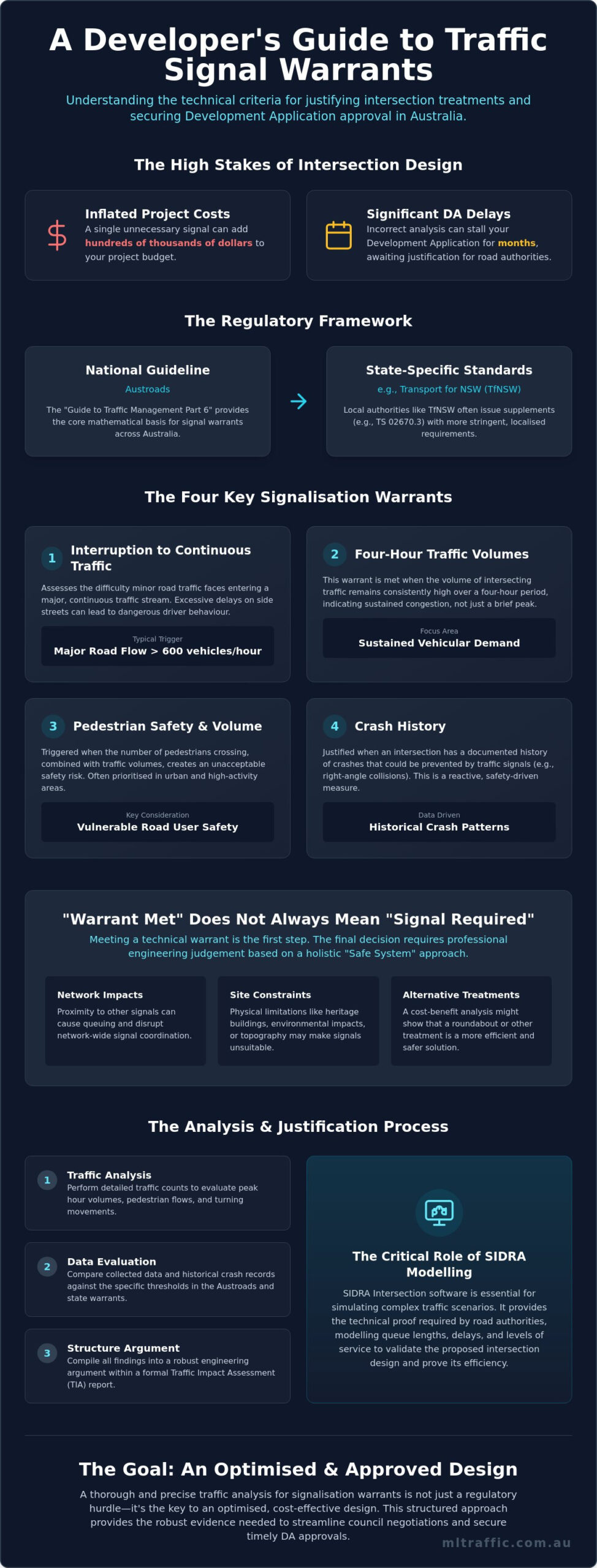
A single unnecessary traffic signal installation can inflate project costs by hundreds of thousands of dollars and stall your development application for months. Professionals often struggle to balance site-specific safety requirements with rigid regulatory frameworks. Conducting a precise traffic analysis for signalised intersection warrants is the only way to prove to road authorities that your proposed treatment is both necessary and optimised for the local network. Whether you are dealing with the Austroads Guide to Traffic Management Part 6 or the recent TfNSW TS 02670.3 standard effective from March 2026, the technical burden of proof remains high.
You likely find that navigating these warrants feels like a moving target, especially when pedestrian safety and Safe System principles come into play. This guide provides the technical clarity you need to master the criteria used to determine when a development requires signalisation. We will break down the specific volume thresholds, crash history justifications, and the critical role of SIDRA modelling in securing a successful DA approval with an optimised intersection design.
Key Takeaways
- Identify the core regulatory frameworks, including Austroads and state-specific standards like TfNSW TS 02670.3, used to justify intersection treatments.
- Learn how to perform a detailed traffic analysis for signalised intersection warrants by evaluating peak hour volumes, pedestrian flows, and historical crash data.
- Discover the essential role of SIDRA Intersection modelling in simulating traffic scenarios and providing the technical proof required by road authorities.
- Evaluate the cost-benefit ratio of signalisation against alternative treatments, such as roundabouts, to ensure an optimised and efficient design.
- Understand how to structure a robust engineering argument within your Traffic Impact Assessment to streamline Council negotiations and DA approvals.
Understanding Signalised Intersection Warrants in Australia
A traffic signal warrant is a technical set of criteria used by road authorities to determine if an intersection requires signalisation. It serves as a standardised benchmark to ensure that infrastructure investments are justified by data rather than subjective observation. Proper traffic analysis for signalised intersection warrants is a mandatory component of the Traffic Impact Assessment (TIA) Report. This report identifies specific triggers, such as peak hour volumes, pedestrian safety risks, or frequent crash patterns, that necessitate a change in intersection control.
Road authorities use these standardised warrants to maintain network consistency and manage driver expectations. If signals were installed arbitrarily, it would lead to increased travel times, higher maintenance costs for the public, and potential safety risks due to frustrated motorists. In Australia, the primary governing body for these standards is Austroads. Their “Guide to Traffic Management Part 6: Intersections, Interchanges and Crossings” provides the mathematical basis for most state-based regulations, ensuring that every new signalised treatment contributes to a predictable and efficient road network.
To better understand how these warrants are applied in a practical setting, watch this technical overview:
The Legal and Regulatory Framework
Adherence to Australian Standards is not optional for developers. While Austroads provides the foundation, local road authority supplements, such as those from Transport for NSW (TfNSW) or VicRoads, often include more stringent requirements. For example, TfNSW recently introduced the “TS 02670.3” standard in March 2026 to supersede older manuals. Council planners use this warrant analysis as a primary tool to assess Development Applications (DAs). If the data shows a warrant is met, the developer may be conditioned to provide the treatment. ML Traffic Engineers Australia provides the professional traffic engineering required to justify deviations from standard warrants when site-specific conditions don’t suit a generic signalised layout.
Why “Warranted” Does Not Always Mean “Required”
It’s a common misconception that meeting a warrant makes signalisation a certainty. In reality, meeting a technical warrant is merely the first step in the process. The final decision is an engineering one that considers the “Safe System” approach. Factors such as heritage constraints, environmental impacts, or the proximity of adjacent intersections can make signals inappropriate. For instance, if two signalised intersections are too close, it can disrupt Signal timing and cause significant queuing across the network. A site-specific assessment provides the nuance that generic traffic counts miss. This level of traffic analysis for signalised intersection warrants ensures that the final design is the most efficient solution for both the developer and the community.
Key Technical Criteria for Signalisation Warrants
The determination of whether an intersection requires signalisation depends on a rigorous application of technical thresholds defined by Austroads and state supplements. Traffic analysis for signalised intersection warrants categorises these requirements into four primary areas: interruption to continuous traffic, four-hour traffic volumes, pedestrian safety, and crash history. While traffic volume is the most common driver, safety-based warrants often take precedence in high-risk urban environments where conflict points between vehicles and vulnerable road users are frequent. Engineers must evaluate how major road flow impacts minor road delay, as excessive queuing on side streets can lead to dangerous gap-acceptance behaviour by drivers.
Traffic Volume Thresholds (Warrants 1 and 2)
Warrant 1, often referred to as the “Interruption to Continuous Traffic” rule, focuses on the difficulty minor road traffic faces when attempting to enter or cross a major stream. This is typically triggered when major road flow exceeds 600 vehicles per hour in both directions and minor road flow exceeds 200 vehicles per hour for at least four hours of an average day. Warrant 2 examines the “Four-Hour Volume” to ensure that the demand is sustained rather than just a momentary peak. When calculating these ratios, the percentage of heavy vehicles is a critical variable. In Western Australia, for instance, high proportions of road trains require adjusted equations to account for the longer gaps needed for these vehicles to clear an intersection safely. For a global perspective on these technical benchmarks, the Signalized Intersection Informational Guide provides extensive comparative data on how these thresholds maintain network efficiency.
If your project involves complex heavy vehicle movements or high-volume corridors, a professional Intersection Analysis is necessary to ensure your data meets these specific regulatory benchmarks.
Pedestrian and Cyclist Safety Warrants
Pedestrian volumes are a major consideration in modern traffic analysis for signalised intersection warrants, particularly near schools, hospitals, or major transport hubs. A signalised crossing is generally warranted when pedestrian flow exceeds 250 persons per hour while vehicular flow stays above 600 vehicles per hour in each direction for four one-hour periods. Safety warrants can also be triggered by restricted sight distances that cannot be remediated through vegetation removal or civil works. In these scenarios, the physical layout must be meticulously planned. Using Swept Path Analysis allows engineers to confirm that the proposed signalised intersection can accommodate the turning circles of the largest expected vehicles without compromising pedestrian refuge islands or signal hardware placement. This ensures the design is not only warranted but physically viable within the existing site constraints.
The Traffic Analysis Methodology for Intersection Design
Methodology is the bridge between identifying a potential warrant and proving its necessity to a road authority. A robust traffic analysis for signalised intersection warrants relies on empirical data rather than estimations. This process begins by establishing a 10-year design horizon. Engineers must account for existing traffic, known future developments in the area, and an annual background growth rate. This ensures the intersection remains functional long after the initial development is complete. Road authorities typically require a Level of Service (LoS) of D or better during peak periods, with a Degree of Saturation (DoS) remaining below 0.90 for signalised treatments. If the DoS exceeds this threshold, the intersection is considered to be operating near capacity, which often justifies the transition from a priority-controlled or roundabout configuration to traffic signals.
Data Collection and Traffic Surveys
High-quality data collection is the foundation of any successful Traffic Impact Assessment. Turning movement counts (TMCs) are essential and must be conducted during the morning and afternoon peaks, typically between 7:00 am to 9:00 am and 4:00 pm to 6:00 pm. It’s critical to avoid surveying during school holidays or local events that might skew results. If the site is near a major shopping centre or industrial hub, weekend or late-night peak surveys may also be required. This granular data allows engineers to identify the specific movements causing delays, which is a key trigger for signalisation warrants.
SIDRA Modelling and Performance Metrics
SIDRA Intersection software is the industry standard for simulating various intersection treatments. The modelling process starts with a base model that must be validated against existing on-site conditions to ensure accuracy. Once validated, engineers simulate the “worst-case scenario” for the design year. This involves:
- Analysing queue lengths for minor road movements to prevent blockage of upstream intersections.
- Evaluating the average delay per vehicle to determine the LoS grade.
- Comparing the performance of a signalised intersection against a roundabout to find the most efficient solution.
This software-driven approach provides the objective evidence needed to convince Council planners that a signalised treatment is the superior option for network safety and efficiency.
Comparing Signalisation with Alternative Treatments
Selecting the correct intersection treatment requires a rigorous cost-benefit analysis. While a traffic analysis for signalised intersection warrants might show that specific thresholds are met, a roundabout or priority control could provide a better operational outcome for certain sites. Roundabouts facilitate constant traffic flow and reduce the risk of high-speed impacts. Signals use phase-based control, which is often superior for managing heavy pedestrian volumes and complex turning movements in constrained urban corridors. The decision impacts not only the initial construction budget but also the long-term efficiency of the local road network.
Maintenance and long-term liability are critical factors for any developer. Public road signals are typically handed over to the state road authority, such as TfNSW or VicRoads, whereas internal private intersections remain the developer’s asset. External intersection design must also integrate seamlessly with internal car park layouts. Ensuring AS2890.1 compliance is essential to prevent internal queuing from spilling back into the public signalised network. If you need to determine the most cost-effective treatment for your site, contact us for a detailed Intersection Analysis.
Signals vs. Roundabouts: A Developer’s Perspective
Land take is often the deciding factor from a commercial standpoint. Roundabouts require significant lateral space to accommodate large vehicle swept paths and central islands. Traffic signals have a smaller physical footprint, which can preserve developable land. However, safety profiles differ. Roundabouts are excellent for speed reduction and managing “T-bone” accidents. Signals are generally preferred for pedestrian protection and managing heavy vehicle movements in industrial areas. Council preferences also play a role, as many local transport strategies favour roundabouts for their natural speed-calming effects and lower energy costs compared to powered signal hardware.
Priority Control and Auxiliary Lanes
Priority control, such as “Stop” or “Give Way” signs, remains the most appropriate solution for lower-volume sites. Strategic upgrades can often manage traffic effectively without the high capital cost of full signalisation. The role of dedicated turn lanes, such as Channelised Right-Turn (CHR) or Auxiliary Left-Turn (AUL) lanes, is to improve gap acceptance and safety. A “Seagull” intersection configuration is another effective treatment for three-way junctions on high-speed roads. These treatments can successfully defer the need for a full traffic analysis for signalised intersection warrants by resolving specific conflict points and reducing minor road delays through improved civil design rather than electronic control.
Expert Traffic Engineering for DA Approval Success
Successful DA approval requires a transition from raw data collection to strategic advocacy. A thorough traffic analysis for signalised intersection warrants must be presented as a defensible engineering argument that anticipates the specific concerns of road authorities. Councils often scrutinise the justification for signals because of the long-term maintenance burden and energy requirements they place on public assets. ML Traffic Engineers Australia ensures that your report provides the technical clarity needed to navigate these bureaucratic requirements without unnecessary delays or costly redesigns.
Our firm brings over 15 years of Australian consultancy experience to every project. We ensure that every model and certification meets the most current Austroads and state-specific standards. Our no-nonsense approach means you work directly with the senior principals who perform the technical work. This continuity ensures accountability and a deeper understanding of the site-specific nuances that often decide an approval outcome. We don’t hide behind junior staff; the expert you speak with is the one performing the modelling and defending the results.
Navigating the DA Process with Confidence
Councils frequently issue a Request for Further Information (RFI) regarding traffic impacts and intersection performance. If your initial Intersection Analysis lacks technical depth or fails to address local network priorities, these requests can stall a project for months. ML Traffic Engineers Australia prepares reports that are fully defensible at planning panels and local government hearings. By providing reliable data and clear warrant interpretations, we help developers avoid unnecessary signalisation costs. Expert analysis can often demonstrate that a modified priority intersection or a roundabout satisfies safety requirements without the need for a multi-million dollar signalised treatment.
Why Choose ML Traffic Engineers Australia?
We specialise in navigating the complex regulatory requirements of Australian road authorities. Our team brings deep-seated expertise in SIDRA modelling and Austroads compliance to every project. We maintain a focus on results and meticulous data accuracy to ensure your project moves through the approval pipeline efficiently.
- 15+ years of experience in Australian traffic and transport planning.
- Direct principal involvement in all technical assessments and traffic analysis for signalised intersection warrants.
- Meticulous adherence to national and state-specific regulatory standards.
- Accountability through personnel continuity from the initial count to final certification.
- Proven track record in diverse project environments, from residential subdivisions to major industrial hubs.
Contact our senior traffic engineers today to discuss your intersection warrant requirements and ensure your next project is supported by expert technical analysis.
Securing Your Project with Technical Precision
The decision to signalise an intersection represents a significant long-term commitment for both developers and road authorities. As established throughout this guide, a successful traffic analysis for signalised intersection warrants balances raw traffic volumes with the broader Safe System approach and network efficiency. While technical benchmarks like the 11.1 and 11.2 Austroads warrants provide the framework, the final engineering justification relies on the accuracy of your SIDRA modelling and the technical defensibility of your final report during the DA process.
ML Traffic Engineers Australia provides the professional oversight required to navigate these complex requirements. With over 15 years of experience and direct senior principal involvement in every technical assessment, we ensure nationwide compliance expertise. Our principal-led approach means your project benefits from meticulous data validation and a “no-gatekeepers” communication style, ensuring your development progresses without unnecessary delays or inflated infrastructure costs. We ensure every treatment is optimised for both safety and commercial viability.
Get an Expert Traffic Analysis for Your DA Approval and ensure your intersection design is both cost-effective and fully compliant. We are ready to assist you in achieving a seamless approval process and a robust design outcome.
Frequently Asked Questions
What is the primary warrant for a signalised intersection in Australia?
The primary warrants are defined by the Austroads Guide to Traffic Management Part 6, which provides the technical criteria used by all Australian road authorities. These warrants are categorised into traffic volume thresholds, pedestrian safety requirements, and historical crash data. A signalised treatment is only considered justified when one or more of these specific technical benchmarks are met and verified through empirical data.
How much traffic volume is required to trigger a signalisation warrant?
Signalisation is typically warranted when the major road flow exceeds 600 vehicles per hour in both directions and the minor road flow exceeds 200 vehicles per hour in one direction. These volumes must be sustained for at least four one-hour periods of an average day. These thresholds ensure that signals are only installed where traffic demand is high enough to justify the interruption to the main road flow.
Can a developer refuse to install a signalised intersection if it is warranted?
A developer cannot simply refuse a warranted treatment if it is a condition of the Development Application approval. However, meeting a warrant does not automatically mandate signals. Professional traffic engineering can often demonstrate that alternative treatments, such as a roundabout or a seagull intersection, provide equivalent safety and operational outcomes. This negotiation requires a robust engineering argument based on site-specific constraints and cost-benefit analysis.
What is SIDRA modelling and why is it required for intersection analysis?
SIDRA Intersection is the industry-standard software used to simulate and evaluate the performance of different intersection types. It is required because it provides objective metrics, such as the Level of Service and Degree of Saturation, which road authorities use to assess a design. The software allows engineers to prove that a proposed signalised intersection can handle future traffic growth without causing excessive queuing or delays on the public network.
How do pedestrian volumes affect traffic signal warrants?
Pedestrian volumes can trigger a signalisation warrant independently of vehicular traffic, especially near schools or transport hubs. A signalised crossing is generally warranted when pedestrian flow exceeds 250 persons per hour and vehicular flow exceeds 600 vehicles per hour in each direction for four one-hour periods. This ensures that vulnerable road users can safely cross high-volume corridors where gaps in traffic are insufficient.
What happens if an intersection meets safety warrants but not volume warrants?
Safety warrants can override volume warrants if an intersection has a documented history of severe crashes that cannot be remediated through priority control. If a detailed traffic analysis for signalised intersection warrants identifies persistent conflict points or restricted sight distances, road authorities may mandate signals as a safety intervention. This “Safe System” approach prioritises the reduction of fatal and serious injuries over vehicle throughput.
How long does a traffic analysis for intersection warrants usually take?
A comprehensive traffic analysis for signalised intersection warrants generally takes between two to four weeks to complete. This timeline includes the time required to organise turning movement counts during peak periods, validate the data, and perform the SIDRA modelling. The duration can vary depending on the complexity of the intersection and the specific requirements of the local Council or State Road Authority.
Do all signalised intersections require approval from the State Road Authority?
All signalised intersections on state-managed roads require formal approval and concurrence from the relevant State Road Authority, such as TfNSW or VicRoads. While local Councils manage municipal roads, they often refer to state standards for signalisation projects. Any new signals that impact the broader regional network must be certified by state engineers to ensure they integrate correctly with existing signal timing and coordination programmes.

Disclaimer
The content on www.mltraffic.com.au, including all technical articles, guides, and resources, is provided for general informational and educational purposes only. It is not intended to constitute professional advice in traffic engineering, transport planning, development approvals, or any other technical or legal field.While ML Traffic Engineers makes every reasonable effort to ensure the accuracy, completeness, and timeliness of the information published, we do not provide any warranties or representations (express or implied) regarding its reliability, suitability, or availability for any particular purpose. Any reliance you place on the content is strictly at your own risk.In no event shall ML Traffic Engineers, its directors, employees, authors, or affiliates be liable for any direct, indirect, incidental, special, consequential, or punitive damages (including, without limitation, loss of profits, data, or business opportunities) arising out of or in connection with the use of, or inability to use, any information provided on this website.The articles and guides on this site are not a substitute for engaging a qualified, registered professional traffic engineer (such as an NPER or RPEQ engineer) to assess your specific project requirements. For tailored advice, compliance assessments, or traffic engineering services, please contact a competent professional.This disclaimer may be updated from time to time without notice. By accessing or using this website, you agree to be bound by the most current version of this disclaimer.
