
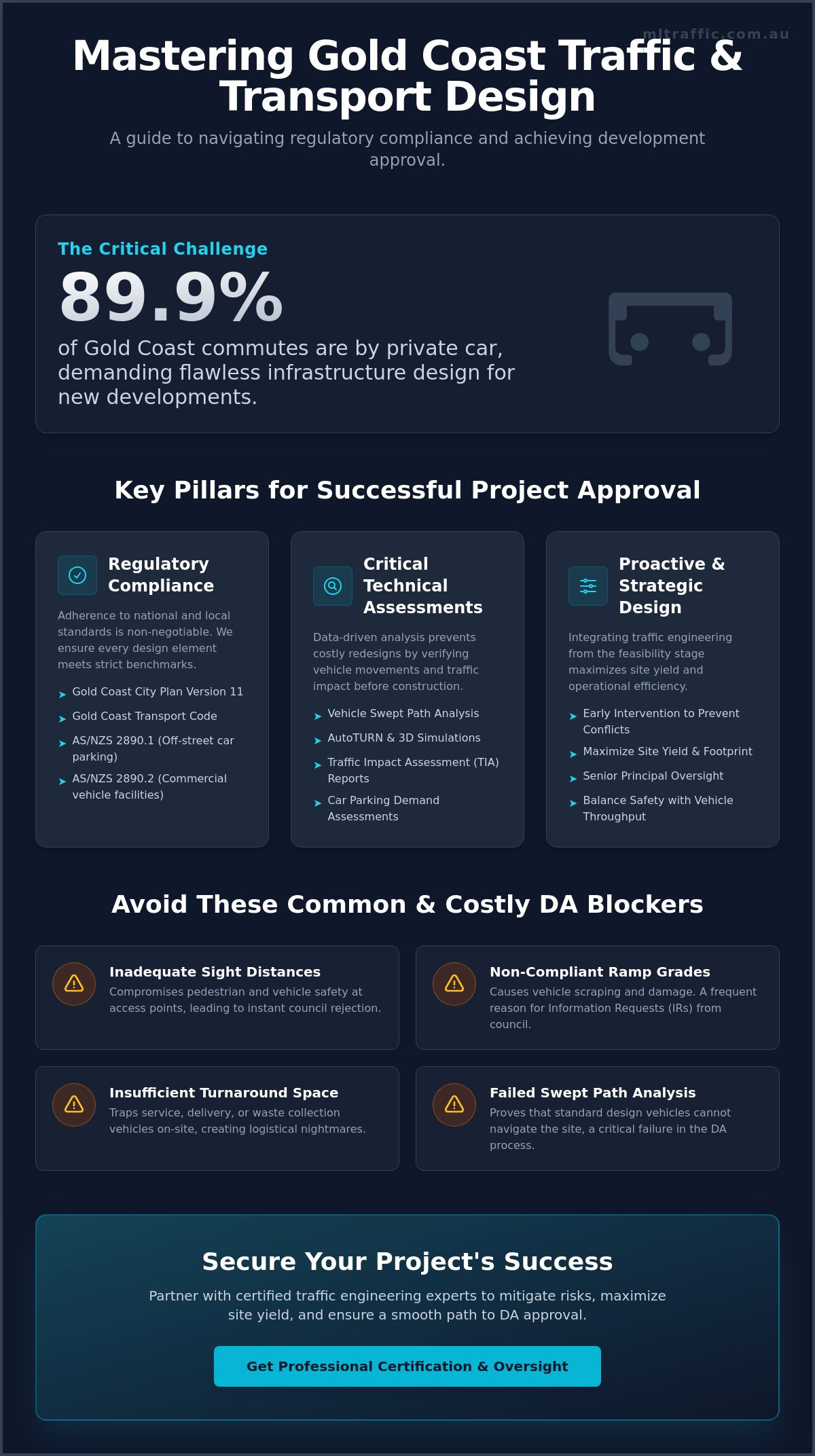
With 89.9% of Gold Coast commutes currently made by private car, the demand for functional, compliant infrastructure has never been more critical. You likely recognize that navigating the Gold Coast City Plan Version 11 and the Gold Coast Transport Code is a rigorous and often frustrating process. A single error in a driveway ramp grade or a failed vehicle swept path analysis leads to expensive redesigns and delayed DA approvals. Expert traffic and transport facilities design gold coast is the only way to mitigate these risks while maximizing your site’s total yield.
We understand that regulatory compliance shouldn’t come at the expense of project efficiency. This professional guide provides a direct roadmap for navigating Australian Standards and the specific transport codes governing the region. We will detail how to align your project with AS/NZS 2890.1 and AS/NZS 2890.2 requirements. By the end of this article, you’ll have a clear understanding of the technical assessments needed to secure council approval and optimize your transport facility layout.
Key Takeaways
- Understand the technical integration of civil engineering and urban planning required for traffic and transport facilities design gold coast.
- Learn how to apply AS 2890.1 and AS 2890.2 benchmarks to ensure off-street parking and commercial service areas meet national standards.
- Discover how Vehicle Swept Path Analysis and AutoTURN simulations prevent costly redesigns by verifying vehicle movements within constrained sites.
- Identify the core components of a Traffic Impact Assessment (TIA) report necessary for successful development application (DA) approval.
- Gain insights into why professional traffic engineering certification and direct senior principal oversight are essential for maintaining regulatory compliance.
Fundamentals of Traffic and Transport Facilities Design
Transport facility design isn’t just about allocating space; it’s a precise application of the Fundamentals of Traffic and Transport Facilities Design. In modern Australian developments, this scope encompasses every aspect of how vehicles and pedestrians interact with a site. It requires a technical synthesis of civil engineering principles and urban planning objectives to meet strict regulatory benchmarks. Professionals must account for the physical constraints of a site while ensuring the movement of people and goods remains seamless.
Effective traffic and transport facilities design gold coast begins at the feasibility stage. Waiting until the architectural plans are finalized is a common mistake that often results in reduced site yield. Early intervention ensures that driveway locations, loading docks, and parking modules are integrated into the building footprint without compromising compliance or operational efficiency. This proactive approach identifies potential conflicts before they become expensive structural problems.
To better understand how these infrastructure designs support the broader movement network, watch this overview of transport integration on the Gold Coast:
The Strategic Role of Traffic Engineering
Modern developments require more than basic car park layouts. They need integrated transport solutions that balance pedestrian safety with high vehicle throughput. Professional design minimizes the risk of community objections during the DA process by demonstrating that the development won’t negatively impact local traffic flow. We focus on creating layouts that are intuitive for users while strictly adhering to safety standards. This approach moves beyond simple compliance; it transforms transport design into a strategic asset for the property. By involving senior experts early, you ensure the design accounts for complex maneuvers and high-frequency use cases that junior designers might overlook.
Regulatory Frameworks for Australian Developments
Securing approval requires understanding the hierarchy of planning instruments. This includes State planning policies and local council transport codes, such as the Gold Coast City Plan. Specific development triggers often mandate a comprehensive Traffic Impact Assessment (TIA) Report or a specialized Car Parking Demand Assessment. Data-driven design is the only reliable way to secure planning approvals in increasingly dense urban environments where every square meter of site yield is vital. Professional certification in these assessments is a requirement for most local governments.
Common pitfalls that trigger Council Information Requests (IRs) include:
- Inadequate sight distances at access points that compromise safety.
- Non-compliant driveway ramp grades that lead to vehicle scraping.
- Insufficient provision for service vehicle turnarounds within the site boundary.
- Failed swept path analysis for standard waste collection or delivery vehicles.
Technical precision in these areas prevents costly redesigns during the construction phase. It ensures the site remains viable from the initial concept through to final construction. Our methodology focuses on identifying these risks before they become bureaucratic obstacles, providing a clear path to successful development application approval.
Navigating Australian Standards for Car Parking and Access (AS 2890)
National standards form the backbone of every successful traffic and transport facilities design gold coast. While local council codes provide specific regional requirements, the AS 2890 series establishes the technical benchmarks for safety and functionality. These standards aren’t suggestions. They’re mandatory design parameters that dictate exactly how vehicles enter, move within, and exit a site. Failing to adhere to these specifications doesn’t just risk a Council Information Request; it creates permanent operational flaws that compromise safety and increase legal liability for developers and designers alike.
AS 2890.1: Off-Street Car Parking Design
AS 2890.1:2004 serves as the primary standard for the design of off-street parking facilities for both residential and commercial land uses. It specifies critical dimensions for parking bays and circulation aisles based on the expected user group and vehicle type. For instance, high-turnover retail sites require wider bays and aisles than long-term residential parking. Designers must precisely calculate driveway ramp grades to prevent vehicle scraping, particularly at transitions between different slopes. To ensure your project meets these technical requirements from the outset, refer to our guide on AS 2890.1 Explained.
Commercial Access and Loading Requirements (AS 2890.2)
Commercial developments must accommodate much larger vehicles than private cars. AS 2890.2 governs the design of service areas, specifically for waste collection vehicles and delivery trucks. These designs must manage the inherent conflict between heavy transport and private vehicles. This includes verifying overhead clearances in loading docks and ensuring ramp gradients don’t exceed the physical capabilities of heavy vehicles. A common design failure is underestimating the space required for a 12.5m Heavy Rigid Vehicle (HRV) to maneuver safely without encroaching on pedestrian zones or opposing traffic lanes.
Non-compliance leads to severe consequences. Beyond the immediate risk of DA rejection, a poorly designed facility creates lifelong safety hazards. These errors often require expensive retrofitting or, in extreme cases, the loss of valuable parking spaces to fix circulation issues. When Integrating Traffic Impact Assessments into Development Applications, every dimension must be verified against the latest standards to protect the project’s viability. If you’re concerned about the compliance of your current layout, our car park design services provide a comprehensive audit of all dimensions and grades before you submit to council.
Vehicle Swept Path Analysis in Modern Facility Design
Vehicle Swept Path Analysis is a technical requirement for any successful traffic and transport facilities design gold coast. It involves plotting the precise path a vehicle takes while turning to ensure it remains within the designated pavement area. Councils require this analysis for DA approval to guarantee that the largest vehicles expected on-site can maneuver without conflict. This includes waste trucks, delivery vans, and emergency service vehicles. Identifying these “pinch points” during the design phase is far more cost-effective than attempting to rectify structural issues after the concrete is poured. Our senior engineers perform these simulations to ensure every maneuver is compliant with local requirements.
The Value of Digital Simulation
We use AutoTURN software to create detailed simulations of vehicle movements within constrained site boundaries. This technology allows for the visualization of truck turning paths in complex environments, such as multi-level loading docks or tight urban infill sites. These technical diagrams serve as proof of site accessibility for council assessment managers, removing ambiguity from the approval process. By simulating realistic driver behavior and vehicle dimensions, we provide a level of accuracy that manual calculations cannot match. For more information on how this applies to your project, see our Swept Path Analysis: A Complete Guide.
Common Swept Path Challenges
Modern developments often push the limits of site density, leading to significant spatial constraints. Basement car parks are particularly prone to tight radius turns that can lead to vehicle collisions if not analyzed correctly. We also focus on ensuring two-way flow on narrow driveways to maintain site efficiency and prevent queuing onto public roads. Rigorous swept path analysis prevents property damage and operational failure by identifying design flaws before construction begins. Our assessments focus on the following critical areas:
- Confirming forward-gear entry and exit for heavy rigid vehicles (HRV) as required by most council codes.
- Calculating clearance requirements for waste collection maneuvers to ensure bins can be serviced on-site.
- Ensuring delivery vehicles don’t obstruct primary access routes or pedestrian crossings.
- Verifying that structural columns and fire services don’t interfere with standard parking maneuvers.
- Analyzing the impact of driveway gradients on the swept path of low-clearance vehicles.
By identifying these challenges early, we protect the project’s yield and operational integrity. This meticulous approach ensures your development meets both national standards and local council expectations. We don’t just provide diagrams; we provide design solutions that resolve conflicts between architectural vision and transport reality. This level of detail is essential for securing a smooth approval process and avoiding the delays associated with council information requests.
Integrating Traffic Impact Assessments into Development Applications
A Traffic Impact Assessment (TIA) report is the primary document used to communicate technical engineering findings to council planners. It translates complex data into a structured argument for a development’s viability. For projects involving traffic and transport facilities design gold coast, the TIA must address both internal site functionality and external network impacts. This report is essential for developments that trigger specific thresholds under the Gold Coast City Plan. It ensures that new traffic doesn’t overwhelm existing infrastructure or degrade the level of service at key intersections.
The core components of a TIA report typically include:
- Analysis of existing traffic conditions and road network capacity.
- Estimated trip generation based on industry-standard rates or empirical data.
- Trip distribution modeling to identify which routes vehicles will use.
- Detailed intersection analysis using SIDRA software to evaluate delays and queuing.
- Assessment of site access safety, including sight distance and driveway configurations.
Car Parking Demand vs. Provision
Determining the correct amount of parking is a balance between statutory council requirements and actual site needs. Many modern developments face site constraints that make meeting full council parking rates difficult. In these scenarios, we justify parking shortfalls through specialized Car Parking Demand Assessments. We use empirical data and surveys from similar land-use types to prove that the proposed provision is sufficient for the development’s peak needs. This evidence-based approach is vital for maximizing site yield while remaining compliant. You can check ML Traffic Engineers Australia for information on specific assessment types.
Site Servicing and Waste Management Plans
Site servicing must be integrated into the initial traffic and transport facilities design gold coast to avoid operational conflicts. A Waste Management Plan (WMP) details how refuse collection vehicles will access the site, maneuver, and exit in a forward gear. Traffic engineers certify these layouts by verifying that all swept paths and vertical clearances meet council standards. This certification provides council planners with the technical assurance that the site will function safely for all vehicle types. We ensure that loading docks and bin storage areas are positioned to minimize conflict with pedestrian movements and private vehicle circulation.
If your project requires a compliant Traffic Impact Assessment Report to support your DA, contact ML Traffic Engineers Australia to discuss your site-specific requirements.
Professional Traffic Engineering for National Compliance
Professional certification acts as the final gatekeeper for any traffic and transport facilities design gold coast. It’s not merely a procedural step; it’s the technical verification that a design is safe, functional, and legally defensible. We leverage over 15 years of practical experience across a vast range of project environments to ensure every report withstands the scrutiny of council assessment managers. This tenure allows us to anticipate regulatory hurdles before they impact your development timeline. Our senior principals apply their deep-seated expertise to every assessment, ensuring that all infrastructure meets the benchmarks of the Gold Coast City Plan and relevant Australian Standards.
Choosing the Right Traffic Consultant
The quality of your technical assessments depends entirely on the expertise of the individual performing the work. Many large engineering firms utilize senior principals for business development but delegate the actual design and analysis to junior staff. This often leads to technical oversights and an increased frequency of Council Information Requests. The ML Traffic Engineers Australia difference is that we provide direct access to senior principals on every project. This ensures personnel continuity from the initial quote to the final report delivery. You won’t be passed off to a junior designer; the expert who starts your project is the one who performs the technical work. This approach ensures total accountability and meticulous attention to detail.
Streamlining Your Approval Process
Expert reports significantly reduce the volume of Council Information Requests (IRs) by addressing potential issues before submission. Accurate first-time designs protect your development schedule and prevent the need for costly post-submission revisions. Our senior engineers specialize in providing data-driven justifications for complex site layouts that maximize yield without compromising safety. We provide a comprehensive range of certified services, including:
- Site-specific Car Parking Demand Assessments to justify provision departures.
- Precise Driveway Ramp Grade Assessments to prevent vehicle scraping.
- Rigorous Vehicle Swept Path Analysis for all service vehicle types.
- Detailed Waste Management Plans that meet strict council access codes.
Our approach prioritizes technical precision in all aspects of traffic and transport facilities design gold coast. This methodology ensures that your development application is supported by the highest standard of professional traffic engineering. To secure a project-specific assessment and speak directly with a senior expert, contact ML Traffic Engineers Australia today. We provide the technical certainty required to navigate the complexities of modern transport infrastructure design.
Optimising Site Viability Through Technical Precision
Securing development approval requires a strategic alignment with both national standards and local council codes. Professional traffic and transport facilities design gold coast ensures your project avoids the costly delays of redesigns and failed swept path analyses. By prioritising AS 2890 compliance and integrating traffic engineering at the feasibility stage, you protect your site’s total yield and operational safety.
ML Traffic Engineers Australia provides the technical certainty required to navigate these complex regulatory environments. We specialise in AS 2890 compliance and advanced AutoTURN analysis to deliver accurate first-time designs. Our clients benefit from direct access to senior principals who manage every technical assessment personally. This level of accountability eliminates the errors often found in junior-led assessments and streamlines the council approval process. We’re ready to help you secure a successful project outcome.
Get Expert Traffic Engineering Support for Your Project and ensure your development is built on a foundation of professional technical certainty.
Frequently Asked Questions
When is a professional traffic report mandatory for a development application?
A professional traffic report is mandatory when a development exceeds the trip generation thresholds established in the Gold Coast City Plan. Local council assessment managers require these reports for projects that impact the safety or efficiency of the surrounding road network. This includes material changes of use or developments that introduce new access points onto arterial or sub-arterial roads.
What is the difference between AS 2890.1 and AS 2890.2?
AS 2890.1 focuses on off-street parking for light vehicles, whereas AS 2890.2 covers the requirements for heavy and commercial vehicles. These standards are distinct in their technical parameters. AS 2890.1 specifies bay dimensions for private cars; however, AS 2890.2 dictates the much larger swept paths and vertical clearances necessary for delivery trucks and waste collection vehicles.
How does swept path analysis help in car park design?
Swept path analysis identifies the exact spatial requirements for turning vehicles to prevent collisions with structural elements. By simulating the movement of specific vehicle types, designers can verify that aisles and access points are functional before construction. This technical assessment is a core component of traffic and transport facilities design gold coast, ensuring that high-density sites remain operational for all users.
Can a traffic engineer help justify a parking space shortfall?
Traffic engineers justify parking shortfalls by conducting a Car Parking Demand Assessment based on empirical data. We analyze peak usage periods and local transport options to prove that a development requires fewer spaces than the standard council code mandates. This evidence-based approach is often the only way to maximize site yield while maintaining compliance with planning objectives.
What are the most common reasons for transport facility design rejection?
Transport designs are frequently rejected due to non-compliant driveway ramp grades or inadequate sight distances at site access points. Other common failures include insufficient maneuvering space for heavy vehicles and non-adherence to AS 2890 bay dimensions. These technical errors often trigger Council Information Requests, leading to significant project delays and the need for expensive structural redesigns.
How much does a Traffic Impact Assessment (TIA) typically cost?
The investment required for a Traffic Impact Assessment (TIA) depends on the scale of the development and the complexity of the required technical modeling. High-density projects or those affecting major intersections often require more intensive analysis than smaller residential subdivisions. We recommend contacting a senior principal to discuss your project specifics and receive a technical scope tailored to your site’s unique requirements.
What information is needed to start a transport facility design assessment?
To initiate a comprehensive assessment, we require a current land survey, architectural site plans, and a clear definition of the proposed land use. Detailed information regarding existing site access and the anticipated scale of the development is also essential. This data allows us to perform accurate vehicle swept path analysis and determine the necessary scope for a compliant Traffic Impact Assessment report.
Does ML Traffic provide services for both residential and commercial projects?
ML Traffic provides comprehensive traffic and transport facilities design gold coast for a vast range of project environments. Our expertise covers residential subdivisions, multi-level apartment complexes, commercial retail sites, and industrial developments. We ensure that every project, regardless of its land-use category, receives direct oversight from a senior principal to guarantee adherence to national standards and local council codes.

Disclaimer
The content on www.mltraffic.com.au, including all technical articles, guides, and resources, is provided for general informational and educational purposes only. It is not intended to constitute professional advice in traffic engineering, transportation planning, development approvals, or any other technical or legal field.
While ML Traffic Engineers makes every reasonable effort to ensure the accuracy, completeness, and timeliness of the information published, we do not provide any warranties or representations (express or implied) regarding its reliability, suitability, or availability for any particular purpose. Any reliance you place on the content is strictly at your own risk.
In no event shall ML Traffic Engineers, its directors, employees, authors, or affiliates be liable for any direct, indirect, incidental, special, consequential, or punitive damages (including, without limitation, loss of profits, data, or business opportunities) arising out of or in connection with the use of, or inability to use, any information provided on this website.
The articles and guides on this site are not a substitute for engaging a qualified, registered professional traffic engineer (such as an NPER or RPEQ engineer) to assess your specific project requirements. For tailored advice, compliance assessments, or traffic engineering services, please contact a competent professional.
This disclaimer may be updated from time to time without notice. By accessing or using this website, you agree to be bound by the most current version of this disclaimer.
