

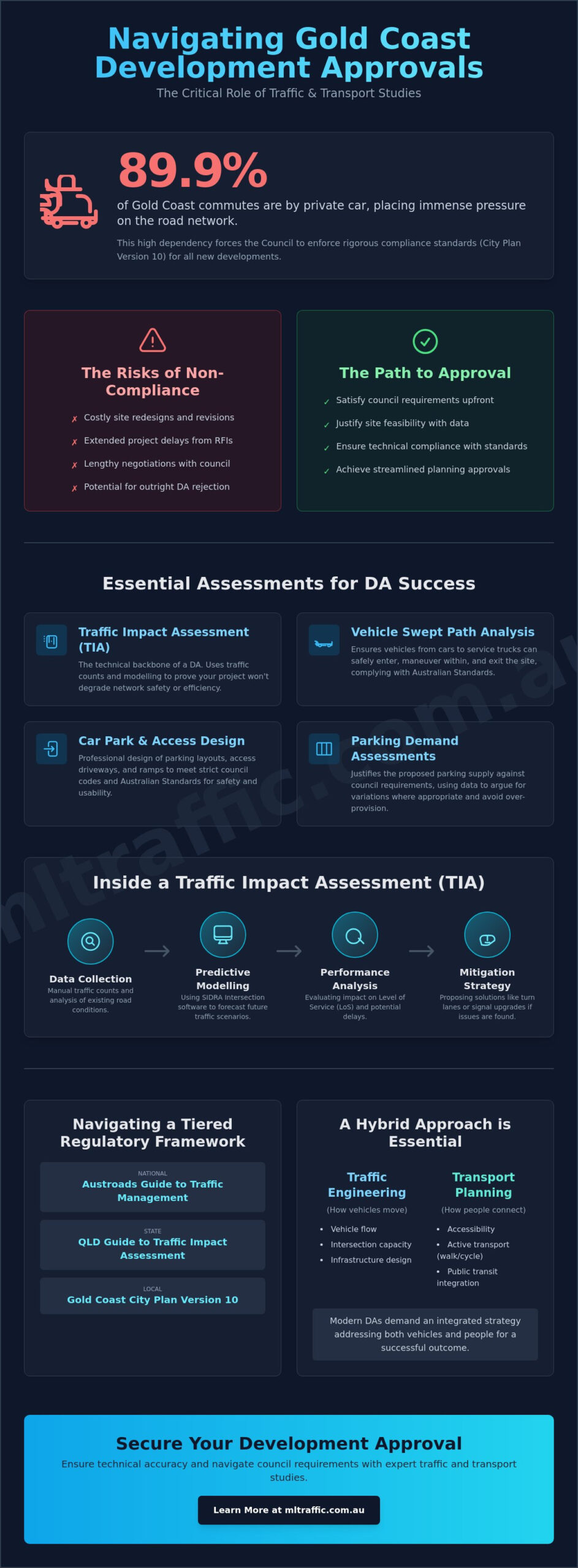
89.9% of all commutes on the Gold Coast are made by private car, placing immense pressure on the local road network. This high dependency explains why the Council of the City of Gold Coast enforces such rigorous compliance standards for new developments under the City Plan Version 10. You’ve likely experienced the frustration of balancing site yield with strict parking requirements or facing project delays because a technical report didn’t meet specific benchmarks. Non-compliance often leads to costly redesigns and extended negotiations with council planning officers.
Securing a successful development application requires more than just meeting basic criteria; it demands professional traffic and transport studies gold coast that address both local and state-controlled road impacts. By utilizing technical assessments like Traffic Impact Assessment (TIA) reports and vehicle swept path analysis, you can satisfy council requirements and avoid expensive site revisions. This article outlines the essential transport studies needed for planning approval, including parking demand assessments and driveway ramp grade analysis. We also examine how to maintain project viability under the 2025 Charges Resolution and the latest Queensland Guide to Traffic Impact Assessment.
Key Takeaways
- Understand why professional traffic and transport studies gold coast are mandatory for development applications and how they evaluate a project’s impact on the existing road network.
- Learn how a Traffic Impact Assessment (TIA) uses intersection performance analysis and traffic counts to justify site feasibility to planning authorities.
- Ensure technical compliance with Australian Standards through vehicle swept path analysis and professional car park design to avoid costly site revisions or council rejection.
- Navigate tiered regulatory environments by adhering to Austroads guidelines and local council requirements to secure streamlined planning approvals.
- Discover the strategic advantage of direct senior leadership involvement in your transport studies to ensure technical accuracy and accountability throughout the DA process.
Defining Traffic and Transport Studies in the Australian Planning Context
Traffic and transport studies are technical assessments required to quantify a project’s impact on existing infrastructure. These reports are mandatory for the majority of development applications (DA) where land-use intensity increases. The primary objective is to prove a site can safely manage vehicle, pedestrian, and cyclist movements without degrading the safety or efficiency of the surrounding network. Professional traffic and transport studies gold coast provide the empirical data council officers require to evaluate a proposal’s viability.
All reports must strictly adhere to local government planning schemes while referencing national standards. The broader context of Road transport in Australia dictates the regulatory framework for these assessments. These studies ensure that developers meet the Austroads Guide to Traffic Management, providing a data-driven basis for council approval. Failure to provide a compliant study often results in requests for further information (RFI), which can stall a project for months.
To see the practical implications of traffic incidents on major Gold Coast corridors, watch this update:
When is a Formal Transport Study Required?
Thresholds for requiring a study depend on the scale of the development. New residential complexes, commercial hubs, or industrial sites often trigger the need for traffic and transport studies gold coast. Key indicators include a significant increase in daily trip generation or a modification to site access points. The Statement of Environmental Effects (SEE) typically identifies the scope of these studies. If a project exceeds trip generation benchmarks set by the council, a formal assessment becomes a non-negotiable component of the DA package.
The Distinction Between Traffic and Transport Planning
Traffic engineering focuses on technical details: vehicle flow, intersection capacity, and physical infrastructure design. It’s about how cars move. Transport planning takes a wider view, assessing accessibility, active transport, and public transit integration. Modern DAs require a hybrid approach. Council criteria now demand that developers address not just how cars enter a site, but how pedestrians and cyclists interact with the broader urban environment. Integrating professional car park design with active transport strategies is now essential for satisfying comprehensive planning requirements.
The Technical Framework of a Traffic Impact Assessment (TIA)
A Traffic Impact Assessment (TIA) Report is the technical backbone of a development application. It provides the empirical evidence required to justify a project’s feasibility to planning authorities. Professional traffic and transport studies gold coast rely on the TIA to bridge the gap between architectural intent and existing infrastructure capacity. These assessments involve rigorous data collection, including manual traffic counts and detailed intersection performance analysis. Without this data, council officers cannot verify that a development won’t compromise the safety or efficiency of the local road network.
Engineers utilize SIDRA Intersection modelling software to predict future road conditions. This modelling accounts for both existing background traffic growth and the additional trips generated by the proposed development. If the analysis reveals a drop in the Level of Service (LoS) or unacceptable delays, the TIA must propose specific mitigation strategies. These might include intersection upgrades, dedicated turn lanes, or signal timing adjustments. Engaging a senior principal for a Traffic Impact Assessment Report ensures that these technical complexities are managed with professional accountability and technical accuracy.
Key Components of a Compliant TIA Report
A compliant TIA must include detailed trip generation and distribution modeling. This process uses industry-standard rates, often sourced from the RTA Guide to Traffic Generating Developments or the latest ITE manuals, to estimate how much traffic a site will produce. Intersection capacity analysis is equally critical. It evaluates the LoS for all surrounding road networks to ensure they can handle the projected volumes. Additionally, engineers must perform a sight distance assessment at all proposed site access points. This ensures that vehicles can enter and exit the site safely, adhering to the requirements of AS 2890.1:2021 for off-street car parking and site access.
Integrating Active Transport and Public Transit
Modern traffic and transport studies gold coast must move beyond motorized vehicle flow. Evaluating pedestrian connectivity and cyclist infrastructure within the site precinct is now a standard requirement. Developers can often justify reduced parking demand by providing high-quality end-of-trip facilities and demonstrating proximity to public transit. Major infrastructure projects, such as the Gold Coast Light Rail Stage 4 planning, significantly influence these assessments by shifting the focus toward multi-modal accessibility. For a deeper technical breakdown, see our Traffic Impact Assessment: The Definitive Guide for Australian Developers.
Vehicle Access and Car Park Design: Achieving Technical Compliance
Technical compliance in car park design is non-negotiable for securing development approval. Traffic and transport studies gold coast must prioritize adherence to Australian Standards to prevent costly site revisions or project rejection. AS/NZS 2890.1:2021 dictates the specific requirements for off-street parking, including bay dimensions, aisle widths, and blind aisle extensions. Failure to meet these precise engineering benchmarks often leads to council planning officers issuing requests for further information (RFI), which stalls the construction timeline. Professional design ensures that every square metre of the site is utilized effectively while remaining fully compliant.
Driveway ramp grades are a critical technical focus. We perform a Driveway Ramp Grade Assessment to calculate transition points and gradients with extreme precision. This prevents vehicle scraping for B85 and B99 vehicle classes, ensuring safe and functional access. Additionally, a Car Parking Demand Assessment is used to justify the proposed number of spaces based on specific land-use categories. This data-driven approach allows developers to balance council requirements with the commercial need to maximize site yield. Technical accuracy at the design stage eliminates the risk of expensive structural modifications later in the project lifecycle.
The Importance of Swept Path Analysis
Vehicle Swept Path Analysis is the primary tool used to verify that vehicles can navigate a site safely. We utilize AutoTURN software to simulate the turning movements of cars, delivery trucks, and waste collection vehicles. This analysis is mandatory for proving that the largest expected vehicle can enter, circulate, and exit the site in a forward direction. For commercial and industrial developments, compliance with AS 2890.2 for service and loading areas is essential. For a breakdown of the technical methodology we apply, see Swept Path Analysis: A Developer’s Guide to Council Approval.
Optimising Car Park Layouts for Site Yield
Maximizing parking capacity requires a meticulous balancing of aisle widths and bay configurations. Traffic and transport studies gold coast must address specialized requirements, including accessible parking spaces under AS 2890.6 and modern bicycle storage facilities. We optimize layouts to ensure that waste management access doesn’t compromise parking volume. A professional Waste Management Plan integrates with the car park design to facilitate seamless service vehicle movements. This structured approach ensures that the design satisfies both the functional needs of the end-user and the regulatory demands of the Gold Coast City Plan.
Managing Regulatory Complexity in Transport Planning
Successful development applications on the Gold Coast require navigating a tiered regulatory environment. Developers must satisfy requirements from both the local council and state authorities, such as the Department of Transport and Main Roads (TMR). Professional traffic and transport studies gold coast are the primary mechanism for demonstrating this compliance. Adherence to the Austroads Guide to Traffic Management is a fundamental requirement for every project in Australia. This national framework ensures that infrastructure design meets rigorous safety and efficiency benchmarks. The regulatory landscape is further complicated by the Council of the City of Gold Coast Charges Resolution (No. 1) of 2025, which influences infrastructure charges and development feasibility.
Standardized compliance extends to off-street parking through AS 2890.1. This standard governs the physical dimensions and access requirements for residential and commercial sites. Engaging a senior traffic engineer early in the design phase allows for the identification of showstopper issues before a DA is lodged. Problems such as non-compliant driveway gradients or insufficient intersection sight distances can be addressed during initial site planning. This proactive approach prevents costly delays during the council assessment period. If you are facing complex council requirements, contact our senior principals for direct expert guidance.
Navigating Local Council Planning Schemes
Local planning schemes, such as the Gold Coast City Plan Version 10, introduce specific overlays that impact site-specific requirements. These codes often dictate parking rates that may not align with the actual demand of a specialized development. Justifying a departure from these standard rates requires empirical data from a Car Parking Demand Assessment. Senior-led engineering oversight is essential during these negotiations to provide the technical authority council officers respect. Our reports provide the data-driven justification needed to support these departures while maintaining network integrity.
National Standards and Best Practices
Strict adherence to Australian Standards is the only way to ensure long-term legal and safety compliance. As urban environments evolve, traffic and transport studies gold coast must now incorporate e-mobility and future-proofing for electric vehicles (EVs). This includes assessing the electrical load requirements and spatial needs for charging bays. For a comprehensive overview of these technical requirements, read our article on Traffic Engineering: The Definitive Guide for Australian Developments. Our approach ensures that every assessment is performed by the same expert who initiates the client relationship, providing continuity and accountability throughout the project lifecycle.
Professional Traffic Engineering for National Development Approvals
ML Traffic Engineers Australia provides authoritative traffic and transport studies gold coast for diverse project environments across Australia. Our consultancy delivers technical assessments that satisfy the most rigorous regulatory standards enforced by local councils and state authorities. We focus on results that facilitate smooth DA approvals, drawing on over 15 years of professional experience in the civil engineering and urban planning fields. Every assessment, from a standard Vehicle Swept Path Analysis to a complex TIA, is overseen by a senior principal. This involvement ensures that technical accuracy and professional accountability are maintained from the project’s inception to its final approval.
Our firm specializes in navigating the specific bureaucratic requirements of the Australian planning context. We provide the empirical data and technical justification necessary to secure development approval without unnecessary delays. By balancing site yield with parking requirements and compliance benchmarks, we help developers maintain project viability. Our expertise covers a vast range of practical experience, ensuring that your traffic and transport studies gold coast meet the specific benchmarks of the Gold Coast City Plan and national Austroads guidelines.
The ML Traffic Engineering Australia Advantage
We operate with a “no-gatekeepers” approach to consultancy. Clients have direct access to senior leadership, ensuring that technical questions are answered by experienced experts immediately. Our personnel continuity promise is a core signature of our firm; the expert who initiates your project relationship is the same individual who performs the technical work. This hands-on, accountable philosophy distinguishes our brand from larger, more impersonal firms where projects are often passed to junior staff. We maintain a proven track record in the following sectors:
- Residential developments, including low-density subdivisions and high-rise apartments.
- Commercial projects, such as retail centres, office complexes, and mixed-use hubs.
- Industrial sites, including warehouses, logistics facilities, and manufacturing plants.
- Specialized land-use categories, including childcare centres, medical clinics, and educational institutions.
- Infrastructure projects involving intersection analysis and traffic guidance schemes.
Next Steps for Your Development Application
Securing planning approval requires a meticulous approach to transport documentation. Our team provides the technical justification needed to navigate complex council regulations and state-controlled road requirements. To begin the process, contact our experts for a preliminary review of your site’s traffic and parking requirements. We identify potential “showstopper” issues early, allowing for design adjustments before the DA is lodged. Request a comprehensive fee proposal for our technical services, including TIA reports, Swept Path Analysis, or professional Car Park Design. Explore our full range of Traffic Engineering Services to support your project’s success.
Secure Your Development Approval with Technical Precision
Technical accuracy is the deciding factor in securing planning approval for complex developments. Professional traffic and transport studies gold coast provide the empirical evidence needed to satisfy the Gold Coast City Plan and national Austroads guidelines. By integrating precise Vehicle Swept Path Analysis and compliant car park design early in the planning phase, you eliminate the risk of costly redesigns and council rejections. These technical assessments transform regulatory hurdles into strategic design tools that protect your site yield and project timeline.
ML Traffic Engineers Australia offers over 15 years of specialist traffic engineering experience with a focus on senior-led project management and technical execution. We provide national coverage across all Australian jurisdictions, ensuring that the expert who starts your project is the one who completes the technical work. This direct access to leadership guarantees accountability and technical precision for every assessment. Contact ML Traffic Engineers Australia for expert transport studies and DA support to facilitate a smooth approval process. We look forward to supporting your next successful development.
Frequently Asked Questions
What is a Traffic Impact Assessment (TIA) report?
A Traffic Impact Assessment (TIA) report is a comprehensive technical document required for development applications to evaluate the impact on the surrounding road network. It analyzes existing traffic conditions, models future trip generation, and assesses intersection performance. Professional traffic and transport studies gold coast utilize TIAs to demonstrate that a project won’t compromise safety or efficiency. These reports provide the empirical evidence council officers need to approve a development’s feasibility.
When do I need a swept path analysis for my development?
You need a swept path analysis when a development must accommodate specific vehicle classes, such as waste collection trucks or delivery vans. This assessment uses AutoTURN software to simulate vehicle movements within the site. It verifies that the largest expected vehicle can enter, circulate, and exit in a forward direction. This is a mandatory requirement for proving compliance with AS 2890.2 for commercial loading and service areas.
How much does a professional traffic and transport study cost?
The cost of traffic and transport studies gold coast depends entirely on the project’s scale and the complexity of the council’s requirements. Factors influencing the fee include the number of intersections requiring analysis and the volume of data collection needed. A multi-residential high-rise requires a different level of technical assessment than a small commercial subdivision. We provide tailored fee proposals based on the specific scope of each development application.
Does my project need to comply with AS 2890.1 for parking?
Most projects involving off-street parking for residential or commercial use must comply with AS 2890.1. This Australian Standard defines the mandatory dimensions for parking bays, aisle widths, and driveway access points. Adherence ensures that vehicles can park and maneuver safely without causing congestion or property damage. Non-compliance with these standards is a frequent cause of project delays and requests for further information during the council assessment process.
Can a traffic engineer help reduce the required number of parking spaces?
A traffic engineer can justify a reduction in parking spaces by conducting a professional Car Parking Demand Assessment. This study uses empirical data and industry-standard rates to prove that the actual parking needs are lower than the standard council planning scheme requirements. By demonstrating proximity to public transport or providing high-quality active transport facilities, engineers can often successfully negotiate reduced parking requirements while maintaining site functionality.
What is the difference between a Traffic Management Plan and a Traffic Guidance Scheme?
A Traffic Management Plan (TMP) is a strategic document outlining the overall approach to managing traffic, while a Traffic Guidance Scheme (TGS) is a specific technical diagram. The TGS shows the exact placement of signs, barriers, and personnel required for works on or near a road. While the TMP provides the broad safety framework, the TGS is the practical plan used by implementers to manage vehicle and pedestrian flow.
How long does it take to prepare a traffic report for council?
Preparing a traffic report typically takes between one and three weeks, depending on the scope of data collection and technical modelling. Simple swept path analyses are completed quickly, but comprehensive TIAs require more time for manual traffic counts and complex intersection performance analysis. Early engagement ensures that the report is ready for the DA lodgement date. Timelines also vary based on the technical scope and the depth of council negotiations required.
Why is professional engineering oversight required for DA approval?
Professional engineering oversight is required because councils only accept technical reports from qualified experts who can certify compliance with national standards. Professional engineers ensure that every assessment meets the rigorous benchmarks of the Austroads guidelines and Australian Standards. This oversight provides the accountability and technical accuracy necessary for public safety. It also minimizes the risk of costly site revisions and ensures a more streamlined path to development approval.

Disclaimer
The content on www.mltraffic.com.au, including all technical articles, guides, and resources, is provided for general informational and educational purposes only. It is not intended to constitute professional advice in traffic engineering, transportation planning, development approvals, or any other technical or legal field.
While ML Traffic Engineers makes every reasonable effort to ensure the accuracy, completeness, and timeliness of the information published, we do not provide any warranties or representations (express or implied) regarding its reliability, suitability, or availability for any particular purpose. Any reliance you place on the content is strictly at your own risk.
In no event shall ML Traffic Engineers, its directors, employees, authors, or affiliates be liable for any direct, indirect, incidental, special, consequential, or punitive damages (including, without limitation, loss of profits, data, or business opportunities) arising out of or in connection with the use of, or inability to use, any information provided on this website.
The articles and guides on this site are not a substitute for engaging a qualified, registered professional traffic engineer (such as an NPER or RPEQ engineer) to assess your specific project requirements. For tailored advice, compliance assessments, or traffic engineering services, please contact a competent professional.
This disclaimer may be updated from time to time without notice. By accessing or using this website, you agree to be bound by the most current version of this disclaimer.
