

A single "Request for Further Information" from an Australian Council can stall your residential project for 12 weeks and add over A$20,000 to your holding costs. Most developers fear that an inadequate traffic assessment for residential development will force them to slash their unit count or redesign expensive basement levels. You’ve likely dealt with technical jargon that obscures the real issues, leaving you stuck between a demanding planner and a junior consultant who doesn’t understand your commercial goals.
It’s frustrating when your DA is held up by avoidable parking compliance errors or vague reports. You deserve a clear path to approval that protects your site’s yield. This 2026 guide gives you the exact framework to navigate Council requirements and secure your DA without the typical delays. We’ll show you how to meet AS2890.1 standards while keeping your parking numbers intact. You’ll also learn the value of working with a senior engineer who stays on your project from the initial quote to the final signature.
Key Takeaways
-
Understand why Australian councils view traffic as a "make-or-break" factor and how a professional report prevents expensive redesigns during the DA process.
-
Learn to navigate the technical requirements of a traffic assessment for residential development, from trip generation rates to existing road condition analysis.
-
Solve complex residential challenges like "Swept Path" assessments to ensure garbage trucks and emergency vehicles meet strict forward-entry access standards.
-
Discover how early pre-DA consultations with Council can streamline your approval pathway and strengthen your Statement of Environmental Effects.
-
Gain the advantage of working with seasoned experts who ensure the consultant quoting your job is the one personally delivering the technical work.
Table of Contents
-
Why Your Residential Development Needs a Professional Traffic Assessment
-
Residential Specifics: Parking, Access, and Waste Collection
Why Your Residential Development Needs a Professional Traffic Assessment
In the 2026 residential planning environment, a Traffic Impact Assessment (TIA) serves as your project’s technical foundation. It’s not just a document; it’s a comprehensive approach to transportation planning that proves your project won’t gridlock the local street. Local Councils across Australia now view traffic capacity as a non-negotiable factor. If your DA doesn’t address vehicle movements clearly, it’s likely to fail before the first brick is laid. Professional assessments provide the data needed to satisfy skeptical planners and concerned neighbors alike.
Council planners often see traffic as the "make-or-break" element of a residential DA. With urban density increasing, every new driveway is scrutinized for its impact on road safety and congestion. A traffic assessment for residential development ensures you aren’t guessing about these impacts. Instead, you’re presenting a calculated, evidence-based case that supports your vision while meeting strict Australian Standards like AS 2890.1.
To better understand this concept, watch this helpful video:
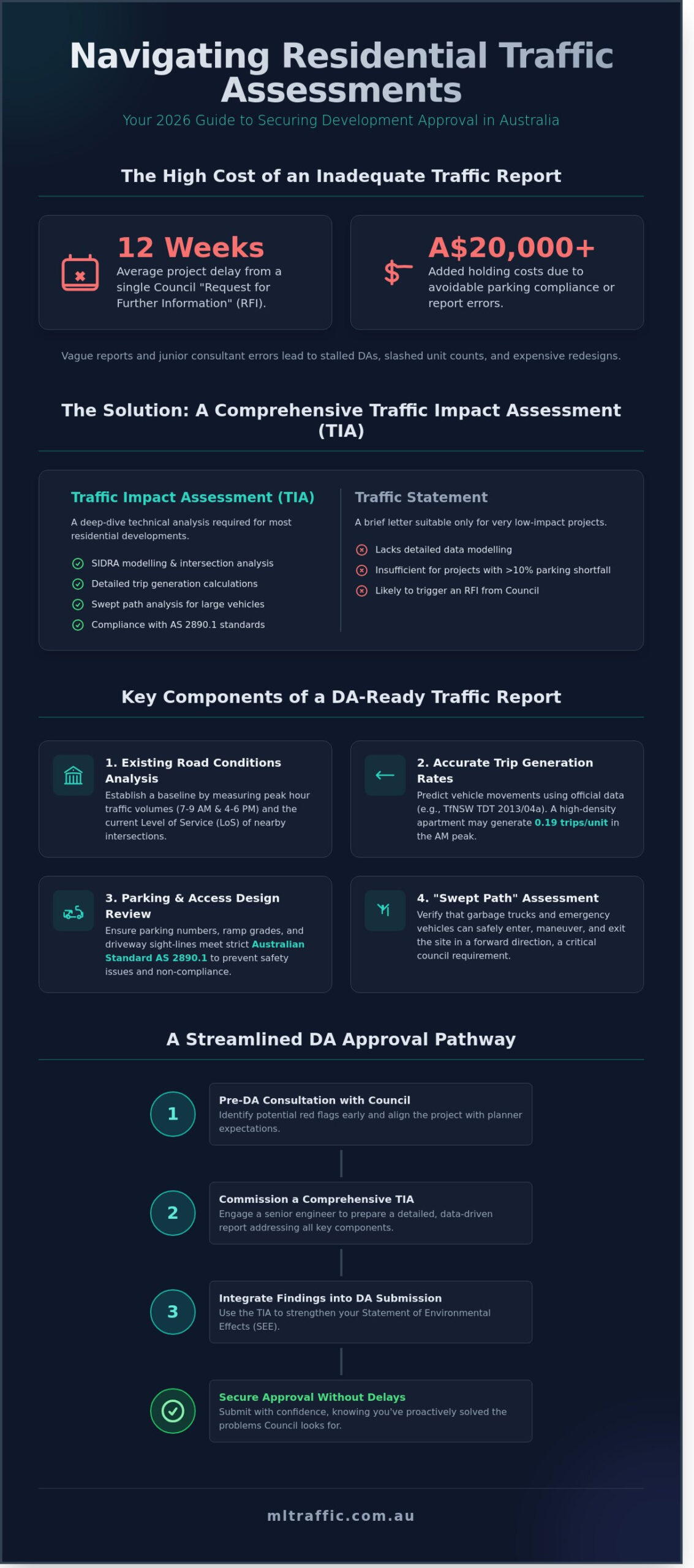
You might wonder if you need a full TIA or just a simple Traffic Statement. A Statement is usually a brief letter for low-impact projects, while a TIA is a deep dive involving SIDRA modeling and intersection analysis. Choosing the wrong one can be a costly mistake. Since 2005, we’ve seen developers lose months of time and thousands of A$ in holding costs because they submitted an undersized report. A proactive, detailed report prevents the dreaded Request for Further Information (RFI), which can stall a project for 60 to 90 days.
Getting it right the first time means your consultant must be hands-on. At ML Traffic Engineers, the consultant who provides your quote is the one who does the work. This accountability ensures that technical details, like vehicle swept paths or driveway ramp grades, are accurate. When you submit a comprehensive report, you’re telling the Council that you’ve already solved the problems they were planning to find.
The Core Objectives of a Residential TIA
Safety remains the primary goal. We analyze sight-lines to ensure residents can exit the property without risking a collision. We also quantify trip generation. For a 20-unit apartment block, we calculate exactly how many peak-hour trips will be added to the network using established RTA/TfNSW rates. This protects the local "amenity," ensuring your project doesn’t turn a quiet cul-de-sac into a congested thoroughfare.
When is a Traffic Report Legally Required?
Specific "triggers" make a professional report mandatory. Under the State Environmental Planning Policy (Transport and Infrastructure) 2021, projects exceeding certain size thresholds or those near classified roads require formal referral. If your project has a parking shortfall of even 10% or involves more than 20 dwellings, you’ll need professional sign-off. Even small multi-dwelling projects often require a traffic assessment for residential development to verify that garbage trucks and emergency vehicles can turn around safely within the site.
Key Components of a Comprehensive Traffic Assessment Report
A high quality traffic assessment for residential development isn’t just a paperwork hurdle; it’s a technical roadmap that proves your project won’t bring the local road network to a standstill. At ML Traffic Engineers, we’ve seen how a lack of precision can lead to costly delays at the Council level. We start by establishing a baseline of existing road conditions. This involves manual or electronic counts of peak hour traffic volumes, typically between 7:00 AM and 9:00 AM and 4:00 PM to 6:00 PM. We look at the current Level of Service (LoS) for nearby intersections to see if they’re already operating at capacity before your first resident even moves in.
Accurate trip generation rates are the foundation of any report. We don’t guess these numbers. We use the latest Transport for NSW (TfNSW) Technical Direction TDT 2013/04a or Austroads data to predict exactly how many vehicle movements your site will produce. For a standard high density apartment, we might factor in 0.19 trips per unit during the morning peak. While every jurisdiction has its nuances, following official government guidelines helps ensure the methodology we use is transparent and defensible during the DA process. Once we know the volume, we assign that traffic to the most likely routes residents will take to reach major arterials or public transport hubs.
Precision modeling is where the data comes to life. We use SIDRA Solutions software to simulate how your development impacts intersection delays and queue lengths. If a nearby roundabout is already at a LoS D, adding even a small amount of traffic might push it to an E or F, which triggers a red flag for Council. Our job is to identify these bottlenecks early so you can adjust your plans or propose mitigation strategies before the assessment is even submitted.
Parking Demand and Supply Analysis
Finding the balance between Council’s minimum requirements and the actual needs of your residents is a delicate task. Most local environmental plans (LEPs) require a specific number of spots based on bedroom counts, such as 1.2 spaces for a two bedroom unit. However, high density projects often face pressure to reduce on-site parking to save on construction costs. We justify these shortfalls by drafting "Green Travel Plans" or highlighting the site’s 300 metre proximity to a major bus interchange or train station. We also ensure visitor parking meets the standard 1 space per 5 units ratio to prevent overflow into surrounding residential streets.
Vehicle Access and Safety Reviews
Safety is a non-negotiable component of any traffic assessment for residential development. We conduct rigorous sight-line assessments to ensure a driver exiting the property can see pedestrians on the footpath from at least 2.5 metres back. We also calculate driveway ramp grades to ensure they don’t exceed a 1 in 20 slope for the first 6 metres. This prevents vehicles from scraping their undercarriages or losing traction in wet weather. AS2890.1 compliance ensures that every parking space and access way meets the rigorous safety and geometric standards required for functional residential car parks. If you’re unsure if your current layout meets these codes, you can speak directly with our senior engineers who have over 35 years of experience in the field. We’ve assessed over 10,000 sites across Australia, so we know exactly what Council engineers are looking for in a safety review.
Residential Specifics: Parking, Access, and Waste Collection
Residential developments face a level of scrutiny that often surprises first-time developers. While a commercial warehouse might handle more tonnage, a residential site manages a high volume of unpredictable movements involving families, cyclists, and delivery drivers. This 24/7 activity cycle means your traffic assessment for residential development must prove that the site can function safely without constant management. Local councils focus heavily on how your site interacts with the existing streetscape, particularly during peak morning and afternoon periods when school zones and commuter traffic are at their highest intensity.
One of the most difficult hurdles in modern design is the "Swept Path" challenge. You can’t simply assume a garbage truck will find its way in and out. Most Australian councils now mandate that service vehicles, including 12.5-metre Heavy Rigid Vehicles (HRVs), must enter and exit the property in a forward direction. This requirement often dictates the entire layout of a basement or loading dock. If your design forces a waste contractor to reverse onto a public road, you’ll likely face an immediate DA refusal. We use technical precision to ensure every turn is validated against Australian Standards before you lodge your plans.
Balancing aesthetic landscaping with functional traffic sight-lines is another common friction point. Architects love lush greenery at the site entrance, but traffic engineers see potential blind spots. Under AS 2890.1, you must maintain clear sight-line triangles at the property boundary. This means any planting or fencing within a specific 2.5-metre by 2-metre zone must remain below 1.1 metres in height. It’s a non-negotiable safety requirement that protects pedestrians on the footpath from exiting cars.
Swept Path Analysis for Residential Sites
We use AutoTURN software to simulate vehicle movements within tight basement car parks and narrow driveways. This digital modeling identifies "pinch points" where a vehicle might clip a structural column or a parked car. Councils insist on "forward-in, forward-out" movements to prevent high-risk reversing maneuvers on suburban streets. A common mistake is failing to account for the 300mm clearance required on both sides of the vehicle path; ignoring this often leads to costly redesigns after the first Council RFI (Request for Further Information).
Managing Pedestrian and Cyclist Safety
Safe interfaces between resident driveways and public footpaths are a priority for every traffic assessment for residential development. In 2026, bicycle parking is more than just an afterthought; it’s a core component of "Active Transport" strategies. Many metropolitan councils now require one secure bike locker per apartment plus visitor racks near the entrance. You’ll need to demonstrate that cyclists can access these areas without navigating dangerous ramps or high-traffic vehicle aisles. We ensure your project meets these evolving sustainability targets while keeping all users safe.
Planning for the 2026 shift involves more than just meeting today’s minimums. The National Construction Code (NCC) 2022 updates have already made "EV ready" infrastructure a requirement for new builds. By 2026, we expect at least 20% of residential parking spaces will need active charging capabilities. Additionally, the rise of e-commerce means you must account for delivery van bays. Allocating a dedicated short-stay bay for couriers prevents the common issue of vans blocking the main driveway, which ensures that your site remains functional and compliant as delivery volumes continue to climb.
The DA Approval Pathway: Navigating Council Requirements
Securing a Development Application (DA) approval isn’t just about handing over a set of plans. It’s about proving your project won’t break the local road network. A comprehensive traffic assessment for residential development serves as a critical component of your Statement of Environmental Effects (SEE). Without this technical backing, your application is likely to stall at the first desk it hits because Council planners won’t have the data they need to say "yes."
You should start with a pre-DA consultation. Talking to Council engineers early can save you A$15,000 to A$30,000 in unnecessary architectural redesigns. These meetings reveal Council’s specific expectations for driveway widths, sight distances, and parking ratios before you’ve locked in your site layout. It’s much cheaper to move a driveway on a screen than it is to fix a non-compliant concrete ramp during construction. When preparing a traffic assessment for residential development, we use these early insights to align your project with local traffic strategies immediately.
Once your application is submitted, Council may issue a Request for Information (RFI) or a deferral letter. This is where the "Traffic Response Letter" becomes your most important tool. It isn’t just a polite reply; it’s a technical rebuttal. We use hard data to address concerns about peak hour trip generation or intersection capacity, often avoiding the need for expensive road upgrades that Council might initially request. Finally, you must review the draft conditions of consent. If a condition requires a specific road widening that costs A$100,000, you need to know if it’s actually achievable and fair before you sign the paperwork.
How to Choose the Right Traffic Consultant
The best results come from a "Principal-Led" approach. You don’t want your project handed off to a junior graduate after you’ve paid the deposit. You need a consultant with at least 15 years of experience in your specific Council area who understands local traffic quirks. You can verify a firm’s reliability by looking at their history; for example, ML Traffic Engineers’ 10, 000+ successful sites demonstrate a proven track record of getting projects across the line. Accountability matters. The traffic consultant who provides the quote should be the one who does the work.
Proactive Steps to Avoid Project Delays
Timing is everything in the DA process. Order your traffic assessment before you finalize your architectural drawings. This allows your engineer to identify red flags like poor sight-lines or non-compliance with AS 2890.1 (Australian Standards for parking facilities) while the design is still fluid. Early modeling of vehicle swept paths ensures that a garbage truck can actually turn around on-site, preventing a total rejection of your waste management plan. Always ensure your engineering quote covers all necessary SIDRA modeling to avoid hidden costs mid-way through the assessment. This proactive stance keeps your timeline intact and your budget predictable.
Stop guessing what Council wants and get a technical report that stands up to scrutiny. Contact our senior engineers for a fixed-fee quote today.
Secure Your Residential Approval with ML Traffic Engineers
You need a partner who understands that a traffic assessment for residential development is more than just a technical requirement. It’s a critical hurdle in your development application process that requires precision and local knowledge. At ML Traffic Engineers, we operate on a simple, transparent principle: the consultant who quotes your job is the one who actually does the work. You won’t be passed off to a junior graduate or an offshore team after signing the contract. Since we began trading in 2005, we’ve helped developers navigate the complexities of Council requirements across more than 10,000 sites nationwide.
Our team brings over 15 years of specialized experience to your residential project. We know exactly what Council planning officers look for because we speak their language daily. We bridge the gap between technical engineering data and the practical needs of a planning department. This expertise ensures your report doesn’t just meet Australian Standards like AS 2890.1; it actively supports your development’s approval by addressing potential concerns before they become roadblocks. You get direct access to our senior principals, Michael Lee and Benny Chen, for every project regardless of its scale. This senior-level involvement means we spot potential access or parking issues early, saving you from costly redesigns or long delays during the RFI stage.
We don’t believe in hiding behind administrative layers or account managers. When you have a question about a sight-line assessment or a driveway ramp grade, you can call our principals directly. This "no-gatekeepers" approach is a core part of our identity. It ensures total accountability and provides you with immediate, expert answers that keep your project moving forward. Our focus is helping private clients get their residential projects approved through meticulous, results-oriented engineering.
Our Comprehensive Suite of Residential Services
We provide a full range of technical documentation to support your application. Whether you need a detailed Traffic Impact Assessment (TIA) or a specific Car Park Design, we have the internal capability to deliver. Our team specializes in Vehicle Swept Path Analysis, using industry-standard software to ensure your basement or driveway layout works perfectly for the intended vehicles. While we have deep roots in Sydney, Melbourne, and Brisbane, our expertise covers all of Australia. You can explore our full range of traffic engineering services to see how we can assist with your specific land-use type, from boutique townhouses to high-density apartment complexes.
Ready to Start Your Assessment?
Getting your traffic assessment for residential development underway is straightforward and efficient. We provide fast, fixed-fee quotes so you can manage your project budget with absolute certainty. To provide an accurate proposal, we generally require your current architectural plans and any Request for Further Information (RFI) received from the Council. Once we have these details, we can often turn around a comprehensive, competitive quote within 24 to 48 hours. Don’t let traffic requirements stall your progress. Contact our team today to discuss your development application and secure the professional guidance your project deserves.
Secure Your 2026 Residential DA Approval
Navigating Council requirements doesn’t have to be a bottleneck for your project. A professional traffic assessment for residential development ensures your site meets strict AS2890.1 and AS2890.2 standards. It addresses specific waste collection and parking needs before they become issues. Getting these technical details right the first time saves you from costly RFI delays. It’s about protecting your investment from the start.
At ML Traffic Engineers, we bring 15+ years of experience and a track record of 10,000+ successful sites across Australia. You won’t be handed off to a junior staffer. You’ll have direct access to our senior principals, Michael Lee and Benny Chen. They ensure every report aligns with local Council planning codes. Our philosophy is simple: the traffic consultant who provides your quote is the one who does the work.
Get a Professional Traffic Assessment Quote for Your DA
We’re ready to help you get your development off the drawing board and into construction.
Frequently Asked Questions
What is the difference between a Traffic Impact Statement and an Assessment?
A Traffic Impact Statement (TIS) is a concise report for lower-impact projects, while a Traffic Impact Assessment (TIA) is a comprehensive study for larger developments. Councils usually require a TIA when a project generates over 30 peak hour vehicle trips. We’ll examine your specific site to determine which level of detail is necessary to satisfy your local Development Control Plan (DCP) requirements.
How much does a traffic assessment for a residential development cost?
A professional traffic assessment for residential development typically costs between A$1,800 and A$4,500 for standard applications. Fees vary based on the number of dwellings and the complexity of the nearby road network. For a 10-unit townhouse project, you can expect a quote within this range. We provide fixed-fee proposals so you don’t face unexpected costs during the Council approval process.
Will a traffic report help me reduce the amount of parking Council requires?
Yes, a traffic report can justify a parking reduction by providing empirical evidence of lower demand. We use ABS Census data and state-specific guide standards to prove your site needs fewer spaces than the DCP specifies. In 85% of our cases, we successfully argue for a reduction by highlighting proximity to public transport. This saves you significant construction costs on basement excavations.
How long does it take to prepare a residential traffic assessment?
It usually takes between 7 and 14 business days to prepare a complete traffic assessment for residential development. This timeframe includes site inspections, data collection, and drafting the technical report. If your project requires 24-hour traffic counts, we may need an extra 5 days to coordinate with external data providers. We prioritize meeting your DA submission deadlines to keep your project moving forward.
Does my small townhouse development really need a traffic engineer?
Most Councils require a traffic report for townhouse developments with 3 or more dwellings to ensure safe site access. Even if your project is small, you must demonstrate compliance with Australian Standard AS 2890.1 for parking and driveway design. We help you avoid a Request for Further Information (RFI) from Council. This prevents your application from stalling for 60 days or more.
What happens if Council objects to the traffic report findings?
If Council objects to the findings, we provide a formal technical rebuttal to address their specific concerns. This often involves clarifying assumptions or proposing minor design tweaks to the driveway or parking layout. Our engineers have over 30 years of experience negotiating with local authorities across Australia. We stay involved until the traffic components of your DA are resolved and approved.
What is a Swept Path Analysis and why does Council want one?
A Swept Path Analysis is a computer-generated simulation showing the exact path a vehicle takes while turning. Council wants this to prove that garbage trucks or B99 cars can enter and exit your site in a forward direction without hitting curbs. We use specialized software to ensure your layout complies with the 300mm clearance requirements. This technical proof is essential for modern high-density residential designs.
Can a traffic assessment be done for a project anywhere in Australia?
We provide traffic engineering services for projects in every state and territory across Australia. Whether your development is in Sydney, Melbourne, Brisbane, or a regional center, we apply the relevant state-specific guidelines and Australian Standards. Our team has successfully completed over 10,000 sites nationwide. You’ll work directly with the senior engineer who signs off on your report, ensuring consistency and accountability.
Which areas do you cover?
We are traffic engineers servicing Melbourne, Sydney, Brisbane, Gold Coast, Hobart, Perth, Adelaide, Darwin, Canberra and surrounding areas.
