

What if a traffic control drawing shows how vehicles will move around a closure, but doesn’t explain the closure’s wider effects? A traffic assessment for road closure can help fill that gap by examining access, pedestrian movements, diversion routes and potential impacts on the surrounding road network. It provides technical evidence for consideration, but it isn’t an approval or a substitute for traffic control.
It’s understandable to be unsure what to prepare, particularly when the road manager and submission requirements depend on the project and its jurisdiction. A traffic impact assessment, a traffic guidance scheme and a formal road-closure application serve different purposes. Treating them as interchangeable can leave important questions unanswered.
This article explains what a traffic assessment may contribute, what project information to gather before engaging a traffic engineer, and when other specialist advice may be useful. It also explains why you should confirm the required scope with the relevant authority before commissioning work. That clarity helps focus the assessment on the access, safety and network issues decision-makers need to consider.
Key Takeaways
- Define the purpose and scope of a traffic assessment for road closure against the proposal and the relevant road manager’s requirements.
- Identify affected users, access points, intersections and diversion routes, then focus the assessment on relevant impacts.
- Distinguish technical impact analysis from construction traffic planning and legal or land-administration advice.
- Prepare closure limits, timing, staging, access needs, plans and available traffic data before briefing a traffic engineer.
- Check a consultant’s relevant experience, proposed scope and deliverables, and confirm which approvals or other advice remain necessary.
What a traffic assessment for road closure can and cannot do
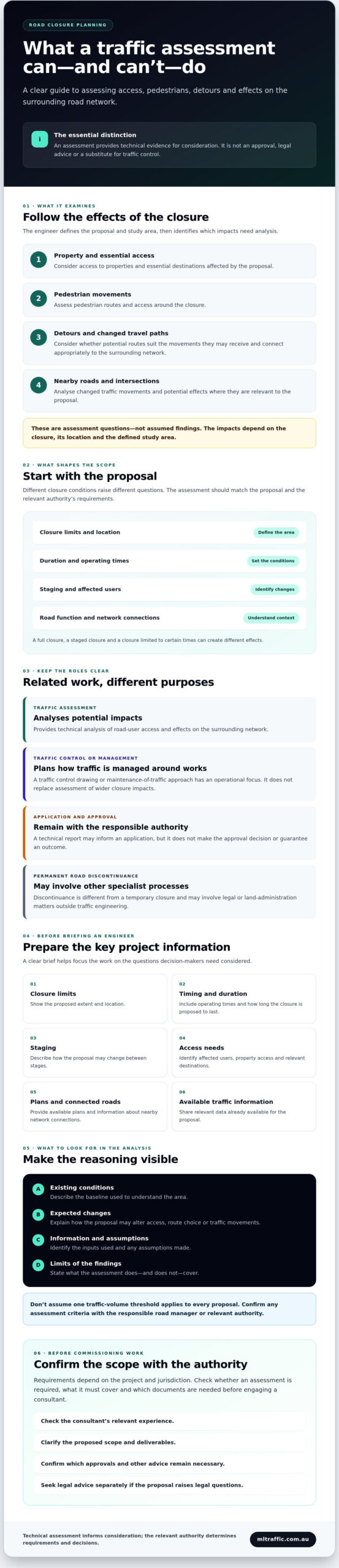
A traffic assessment for road closure is a technical analysis of how a proposed closure may affect road users and the surrounding network. It can examine vehicle movements, property access, pedestrian routes and potential detours, providing evidence for consideration by the relevant authority.
The scope depends on the proposal, the affected road’s function and the authority’s current requirements. Start by defining the closure limits, duration and assessment area. A short closure on a local access road raises different questions from one that changes travel paths through nearby intersections.
To see an example of preparing a base map for a traffic control plan, watch this LaneMarker AI Studio demonstration. It illustrates a planning task, not an approval process or a substitute for project-specific engineering advice.
What does a road-closure traffic assessment examine?
It considers how the closure could change movement through and around the affected area. Depending on the proposal, this may include:
- Vehicle access to properties and essential destinations.
- Pedestrian movements and access around the closure.
- Detour routes, changed travel paths and conditions on nearby roads.
- Effects on surrounding intersections where altered traffic movements may be relevant.
These are issues to assess, not assumed findings. The engineer needs a clear proposal and defined study area to identify which impacts require analysis. A Maintenance of traffic (MOT) reference concerns managing traffic around a work zone. That operational focus is distinct from assessing the wider impacts of a proposed closure.
Is a road closure the same as road discontinuance?
No. A temporary road closure and permanent road discontinuance are different proposals. A traffic engineer can provide technical analysis of road-user and network effects, but discontinuance may also involve legal and land-administration processes outside traffic engineering. Confirm the applicable process, required documents and assessment scope with the responsible authority. Seek legal advice separately if the proposal raises legal questions.
A technical report can inform an application, but it doesn’t make the approval decision, provide legal advice or put traffic control in place on the road. Requirements vary by jurisdiction and proposal, so this article explains assessment support, not a guarantee of approval or a complete application service. Confirm whether an assessment is required and what it must cover before commissioning one.
What a road-closure traffic assessment should analyse
The assessment scope should reflect the closure’s location, duration, operating conditions and affected users. A full closure, a staged closure and one limited to certain times can create different effects. The engineer should define the proposal and study area, then identify which impacts need analysis against the relevant authority’s requirements.
A traffic assessment for road closure may consider changes to road capacity, property access, route choice and traffic movements at nearby intersections. The analysis should distinguish existing conditions from the changes expected under the proposal. It should also identify the information used, any assumptions and the limits of the findings.
How are detours, access and network impacts assessed?
Potential detours are assessed for suitability, not simply drawn as alternative lines on a map. Relevant considerations may include the road’s function, its connections to the surrounding network, access to adjoining properties and whether the proposed route can accommodate the movements it may receive. The engineer can also consider how changed travel paths may affect nearby intersections.
Useful inputs include closure plans, staging and operating times, available traffic information, access locations and details of connected roads. There’s no single traffic-volume threshold that should be assumed to apply to every proposal. Confirm any assessment criteria with the responsible road manager or other relevant authority.
Which road users and safety issues should be considered?
Assess impacts on people walking and cycling as well as general traffic. Where relevant, consider affected public transport movements and access for emergency services. Site-specific topics may include safe access, sightlines, conflict points and changes to pedestrian or cycling routes during the closure. Verify the required considerations with the authority for the project.
A traffic assessment is not a Road Safety Audit and shouldn’t be presented as one. It can identify traffic and access effects within its agreed scope, but it doesn’t replace a separate audit if one is required. The Temporary Traffic Control Plans reference describes an approach to work-zone traffic control outside Australia. Use it for context only, not as an Australian approval requirement, and check the applicable local requirements.
Assessment inputs and impact areas at a glance:
- Proposal: closure location, limits, duration, staging and operating conditions.
- Network: road capacity, route changes, detours and nearby intersections.
- Access and users: adjoining properties, pedestrians, cyclists and, where applicable, public transport and emergency services.
Once the authority’s requirements are clear, a suitably scoped traffic impact assessment service can help document relevant network and access effects.
Traffic assessment, traffic management plan or discontinuance advice?
These documents can relate to the same project, but they answer different questions. A traffic assessment for road closure examines potential effects on road users and the wider network. A construction traffic plan focuses on managing movements and pedestrian access during works. Legal or land-administration advice addresses processes that traffic engineering alone can’t resolve.
| Document or advice | Primary purpose | What it doesn’t establish |
|---|---|---|
| Traffic impact assessment | Analyses potential network, access and road-user effects to inform a proposal. | It doesn’t grant authority to close a road or provide legal advice. |
| Traffic management plan | Sets out construction-phase arrangements for managing traffic and pedestrians, where required. | It doesn’t itself authorise the closure. |
| Legal or land-administration advice | Addresses legal processes or land matters, which may be relevant to discontinuance. | It isn’t a technical traffic impact analysis. |
A single generic “traffic plan” may not meet every application requirement. The authority may request a particular assessment, operational document or separate supporting material. Confirm the required document type, scope and format in writing before commissioning work. The Temporary Traffic Control Plans reference illustrates work-zone traffic control planning outside Australia. It’s not an Australian approval requirement, so check the relevant local guidance.
When is a traffic impact assessment relevant to a closure?
An authority may seek technical evidence where a proposed closure could affect wider network performance, access to properties or travel routes. The report type and level of detail depend on the proposal, application pathway and jurisdiction. For broader context on the purpose and scope of this analysis, read the Traffic Impact Assessment guide.
When might a traffic management plan or legal advice also be needed?
Construction activity may call for separate arrangements to manage traffic and pedestrians around the work area. ML Traffic Engineers Australia prepares Traffic Guidance Schemes and Management Plans for construction activities. These technical documents don’t provide legal authority to close a road, and the consultancy doesn’t provide legal services. See the traffic management plan guide for a closer look at its distinct purpose.
Before engaging a consultant, obtain the responsible authority’s written requirements and clarify which documents are needed. A suitably scoped traffic impact assessment service can support the technical evidence, while approvals and legal advice remain separate matters.
How to prepare a traffic assessment brief for a road closure
A clear brief helps the traffic engineer match the assessment to the proposal and the responsible authority’s requirements. Before commissioning a traffic assessment for road closure, work through these steps:
- 1. Confirm the proposal. Describe the closure, its purpose, limits, expected duration and whether it will be full, partial or staged.
- 2. Request the authority’s requirements. Ask the relevant road manager or approval authority which assessment, plans and supporting documents it expects. Check whether requirements differ for temporary closure or discontinuance.
- 3. Assemble current plans and project information. Provide a site plan and available project details. Flag missing, preliminary or outdated information instead of treating it as confirmed.
- 4. Identify potential impacts. Explain which property accesses, connected roads and pedestrian movements may be affected, along with known detours or changed travel paths.
- 5. Agree the scope before work starts. Record the assessment area, scenarios, assumptions, exclusions, deliverables and submission formats in the consultant brief.
What information should you provide to the traffic engineer?
Share the information you have and identify any gaps. A useful brief can include:
- A site plan showing the proposed closure limits, adjoining roads, access points and relevant work areas.
- Known construction staging, closure duration, operating hours and vehicle types.
- Pedestrian access needs and any known changes to property access or travel routes.
- Authority correspondence, available traffic counts and relevant background studies, with dates and limitations noted.
Plans that don’t reflect the current proposal may affect the assessment scope or require clarification. Confirm which version is current, and tell the engineer about unresolved design or timing details.
How should you confirm scope and submission requirements?
Ask the authority what it expects before setting the technical brief. Agree the assessment boundaries, scenarios to examine, data sources, assumptions, exclusions and deliverable format with the engineer. Also clarify how the technical report relates to other application documents. These steps help prevent a mismatch between the commissioned work and submission requirements, but they can’t guarantee approval.
ML Traffic Engineers Pty Ltd provides traffic engineering consultancy, including Traffic Impact Assessments and Statements. Review its traffic engineering services to identify relevant technical capabilities, then confirm the project scope against the authority’s requirements.
For advice on a project-specific assessment scope, contact ML Traffic Engineers Pty Ltd. The consultancy can provide technical input, but the responsible authority determines approval requirements and decisions.
Choosing traffic assessment support and moving to the next step
Select a traffic engineer whose experience and proposed deliverables match the questions your authority needs answered. For a traffic assessment for road closure, a clear scope matters as much as relevant technical experience. The proposal should show what will be assessed, what information the work depends on and how the findings will support the application. Technical advice can inform a decision, but approval remains with the responsible authority.
What should a traffic assessment proposal make clear?
Review the proposal for a defined assessment area, agreed scenarios, assumptions, exclusions and specific deliverables. Check how it will address the closure proposal and its relevant access or network effects. Clarify information dependencies, such as whether current plans or traffic data must be supplied before the assessment can proceed.
Ask what’s included and what needs to be scoped separately. This may include consultation, revisions following authority feedback or related construction traffic planning documents. Confirming these boundaries early helps you understand what the report will and won’t provide. You can read about ML Traffic Engineers Pty Ltd’s experience and approach before deciding whether its consultancy services suit your project.
How can you discuss your road-closure assessment needs?
Prepare a concise project description, available plans and any written requirements from the road manager or approval authority. Include known closure limits, timing, staging and access needs, and identify information that’s preliminary or not yet available. This gives the engineer a practical starting point for discussing a suitable technical scope.
ML Traffic Engineers Pty Ltd is an Australian traffic engineering and transport planning consultancy with over 15 years of experience. Its relevant services include Traffic Impact Assessments and Statements. That experience is a useful point of reference, not a promise of approval. The consultancy provides technical input; it doesn’t decide applications, provide legal services or deliver physical traffic control.
Before proceeding, check that the proposed scope aligns with the authority’s current requirements and ask who is responsible for any separate approvals or advice. To discuss your project information and potential assessment scope, contact ML Traffic Engineers Pty Ltd about a traffic assessment brief.
Set your road-closure assessment up for a clear next step
A well-scoped traffic assessment for road closure gives decision-makers technical evidence about relevant network and access effects. Its scope should reflect the proposal and the responsible authority’s requirements. It’s also important to distinguish the assessment from construction traffic planning, approval decisions and any legal advice the project may need.
Before engaging an engineer, gather the available plans and authority correspondence, then confirm the assessment area, assumptions and deliverables. ML Traffic Engineers Pty Ltd has over 15 years of traffic engineering and transport planning experience, with Traffic Impact Assessments and Statements among its primary services. This is technical consultancy, not approval authority or physical traffic control, and experience can’t guarantee an application outcome.
Have a proposal or authority requirements ready? Discuss your road-closure traffic assessment requirements with ML Traffic Engineers Pty Ltd to consider a suitable technical scope. A clear brief is a practical step towards addressing the right questions and progressing with confidence.
Frequently Asked Questions
What is a traffic assessment for a road closure?
A traffic assessment for a road closure is a technical analysis of how a proposed closure may affect road users and the surrounding network. Depending on the project, it can examine vehicle movements, property access, pedestrian routes, detours and nearby intersections. The scope should match the closure proposal and the responsible authority’s requirements. The assessment provides evidence for consideration; it doesn’t grant approval or put traffic controls in place.
Is a traffic assessment required for every road closure?
No single requirement can be assumed to apply to every road closure. Whether an assessment is needed depends on the proposal, the road manager, the approval pathway and the requirements in that jurisdiction. Before commissioning work, ask the responsible authority whether a traffic assessment is required, what type of report it expects and what information it needs. Check the current submission requirements for your specific proposal rather than relying on a generic checklist.
Can a traffic assessment support a road discontinuance application?
Yes. A traffic assessment can provide technical evidence about potential effects on access, road users and the surrounding network where that information is relevant to a discontinuance application. However, discontinuance may involve legal and land-administration processes beyond traffic engineering. Confirm with the responsible authority what technical documents it requires, and seek legal advice separately if needed. A traffic report supports consideration of traffic impacts; it doesn’t determine the discontinuance outcome.
What information should I provide for a road-closure traffic assessment?
Provide a current site plan showing the proposed closure limits, adjoining roads, access points and relevant work areas. Include the expected timing, duration, staging, operating hours, vehicle types and pedestrian access needs, if known. Share available traffic counts or background studies and any written correspondence from the authority. Identify plans that are preliminary, outdated or incomplete so the engineer can clarify assumptions and information gaps before agreeing the assessment scope.
What is the difference between a traffic assessment and a traffic management plan?
A traffic assessment analyses potential impacts of a proposal on road users, access and the surrounding network. A traffic management plan focuses on operational arrangements for managing traffic and pedestrians during construction activities. One doesn’t automatically replace the other, and a plan doesn’t itself authorise a road closure. ML Traffic Engineers Pty Ltd prepares Traffic Guidance Schemes and Management Plans for construction activities. Confirm the documents required for your project with the relevant authority.
Does a traffic assessment guarantee road-closure approval?
No. A traffic assessment is technical evidence, not an approval decision or a guarantee of an outcome. The responsible authority determines the application and may consider the assessment alongside other required information. A report that addresses the agreed scope can help explain likely traffic, access or network effects, but it can’t ensure approval. Confirm the authority’s current requirements, provide accurate project information and seek any other specialist advice the proposal may need.
Does ML Traffic Engineers provide road-closure traffic control?
No. ML Traffic Engineers Pty Ltd provides traffic engineering and transport planning consultancy, not physical traffic control. Its relevant work includes Traffic Impact Assessments and Statements, and Traffic Guidance Schemes and Management Plans for construction activities. These are technical services and don’t mean the consultancy installs or operates traffic-control equipment on the road. Confirm separately who is responsible for any on-road implementation required for your project.

Disclaimer
The content on www.mltraffic.com.au, including all technical articles, guides, and resources, is provided for general informational and educational purposes only. It is not intended to constitute professional advice in traffic engineering, transportation planning, development approvals, or any other technical or legal field.
While ML Traffic Engineers makes every reasonable effort to ensure the accuracy, completeness, and timeliness of the information published, we do not provide any warranties or representations (express or implied) regarding its reliability, suitability, or availability for any particular purpose. Any reliance you place on the content is strictly at your own risk.
In no event shall ML Traffic Engineers, its directors, employees, authors, or affiliates be liable for any direct, indirect, incidental, special, consequential, or punitive damages (including, without limitation, loss of profits, data, or business opportunities) arising out of or in connection with the use of, or inability to use, any information provided on this website.
The articles and guides on this site are not a substitute for engaging a qualified, registered professional traffic engineer (such as an NPER or RPEQ engineer) to assess your specific project requirements. For tailored advice, compliance assessments, or traffic engineering services, please contact a competent professional.
This disclaimer may be updated from time to time without notice. By accessing or using this website, you agree to be bound by the most current version of this disclaimer.
