

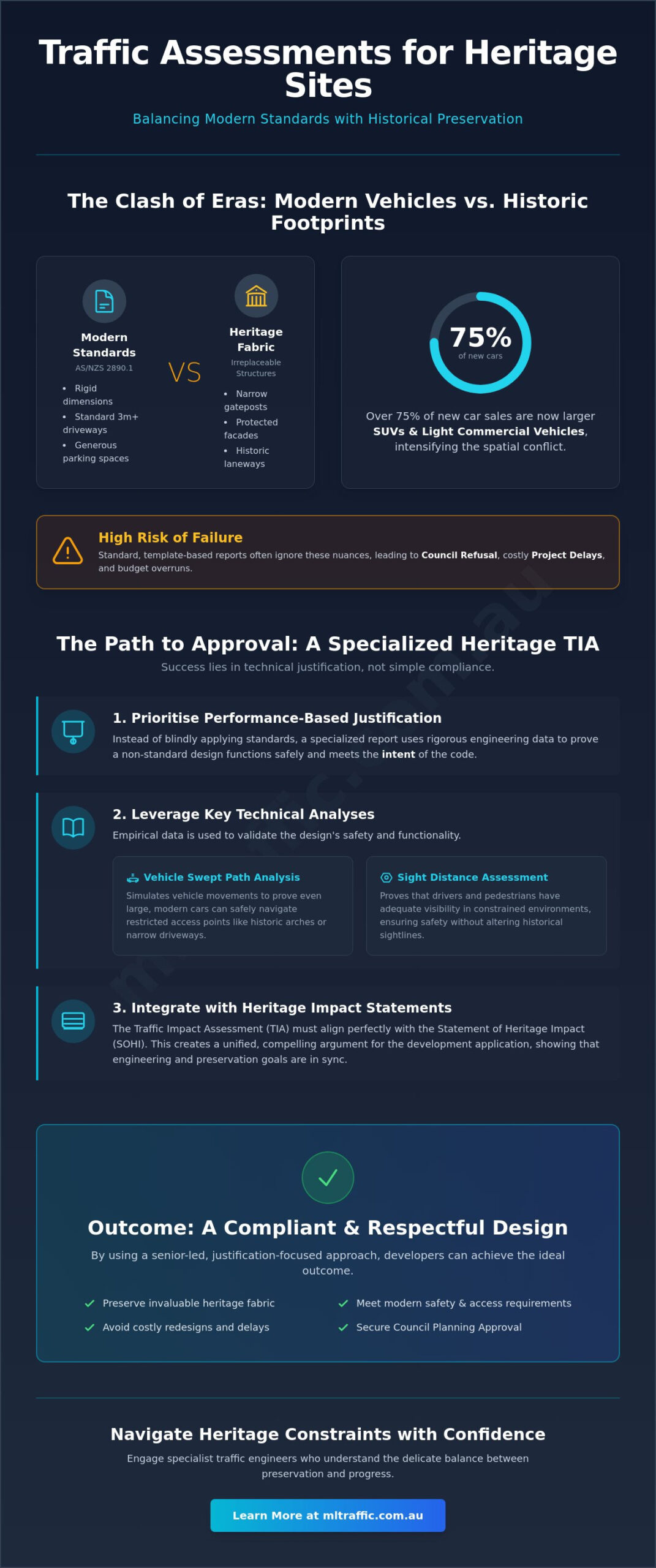
Is it possible to satisfy modern traffic engineering standards without destroying the heritage fabric that makes your site valuable? Conducting a traffic assessment for sites with heritage constraints requires a precise balance between rigid standards and historical preservation. You’ve likely found that the requirements of AS/NZS 2890.1:2021 frequently collide with narrow historical access points and restricted footprints. It’s a common challenge for developers. Council refusal is a high risk when standard parking layouts won’t fit within a protected structure. Since SUVs and light commercial vehicles now account for over 75% of new car sales, the pressure to meet updated dimensions is higher than ever.
This guide explains how to secure approval by prioritizing technical justification over simple compliance. You’ll learn how to manage the intersection of engineering and preservation to achieve a compliant result. We’ll examine how to use vehicle swept path analysis and expert engineering arguments to validate non-standard designs that respect heritage values while meeting safety requirements.
Key Takeaways
- Learn how to justify non-standard driveway widths and parking layouts when original gateposts or historical facades must be preserved.
- Discover how a technical traffic assessment for sites with heritage constraints utilizes Vehicle Swept Path Analysis to simulate safe movements through restricted historical arches.
- Understand the necessity of aligning your Traffic Impact Assessment findings with the Statement of Heritage Impact (SOHI) to ensure a unified development application.
- Secure planning approval by leveraging senior-led engineering justifications and expert car parking demand assessments tailored for restricted footprints.
Table of Contents
-
Understanding Traffic Assessment for Sites with Heritage Constraints
-
Technical Mitigation: Swept Path Analysis and Innovative Design
-
Integrating the TIA with the Statement of Heritage Impact (SOHI)
-
Securing Planning Approval with ML Traffic Engineers Australia
Understanding Traffic Assessment for Sites with Heritage Constraints
A traffic assessment for sites with heritage constraints is a specialized technical report. It evaluates how a proposed development interacts with the existing road network while strictly adhering to the preservation of historical elements. Unlike standard greenfield sites, heritage conservation areas often feature rigid physical boundaries that cannot be altered. These include original stone walls, narrow laneways, and restricted curb cuts. A specialized TIA must prove that the development is viable without compromising the site’s historical integrity.
To better understand the different types of analyses involved in these studies, watch this helpful video:
The primary challenge lies in the friction between modern safety requirements and fixed historical footprints. Traffic engineers must find creative ways to meet AS/NZS 2890.1:2021 standards when a driveway cannot be widened due to a protected gatepost. Effectively conducting a traffic assessment for sites with heritage constraints requires a deep understanding of both engineering principles and the core concepts of Understanding Historic Preservation. The engineer acts as a technical advocate, using empirical data to justify deviations from standard design codes where necessary.
The Scope of a Heritage-Sensitive Traffic Report
A heritage-sensitive TIA identifies specific "heritage fabric" that limits vehicle access or parking. This includes evaluating if increased traffic volume will degrade historical streetscapes or damage fragile infrastructure. Pedestrian safety is another critical factor. Many heritage zones have original, narrow footpaths that weren’t designed for high-density foot traffic. The report must assess how new residents or visitors will move safely through these restricted spaces without requiring modern interventions that ruin the area’s character. Engineers often use Sight Distance Assessments to prove safety in these constrained environments.
Why Generalist Traffic Reports Often Fail for Heritage Sites
Generalist reports often rely on generic templates and standard dimensions. This approach is high-risk for heritage sites. Applying AS/NZS 2890.1:2021 blindly to a 19th-century warehouse conversion usually results in a design that is physically impossible to build without demolition. With SUVs and light commercial vehicles now accounting for over 75% of new car sales in Australia, fitting modern vehicles into historical footprints is a technical challenge. When a report ignores these nuances, local councils typically issue a Request for Further Information (RFI). This delays the project and increases costs. Successful developers engage traffic engineers who collaborate early with heritage consultants to ensure the TIA is grounded in reality.
Navigating the Conflict Between AS 2890 and Heritage Fabric
AS/NZS 2890.1:2021 provides the technical baseline for off-street parking, but its rigid dimensions often clash with historical reality. For developers, the friction usually centers on driveway widths and parking quotas. A standard 3-meter driveway might be physically impossible if original 19th-century gateposts define the only entry point. In these cases, a traffic assessment for sites with heritage constraints shifts from a checklist exercise to a merit-based justification. You must prove that the non-compliant design functions safely without damaging the site’s heritage value.
Councils generally accept performance-based solutions if they’re backed by rigorous engineering data. This approach aligns with the principles found in Navigating Section 4(f) Requirements, where the impact on historic sites is weighed against project necessity. The goal is to provide a solution that achieves the same safety outcome as the standard, even if the physical dimensions differ. Successful applications rely on proving that the "intent" of the code is met through alternative means.
Addressing Driveway and Access Constraints
When original stone walls or arches restrict access, widening the entry is rarely an option. We often implement managed access solutions to bypass rigid width requirements. This can include automated traffic signals that manage one-way alternating flow through a narrow passage. Alternatively, internal passing bays can be strategically placed to prevent vehicle queuing on the public road. A Sight Distance Assessment is vital here. It proves that despite the narrow access, drivers have sufficient visibility to enter and exit safely. If you’re facing these physical restrictions, a professional technical review can determine the most viable mitigation strategy.
Managing Car Parking Demand and Compliance
Fitting the required number of parking bays into a restricted historical footprint is frequently impossible. Traditional layouts consume too much space. Developers should first consult an AS 2890.1 Explained guide to understand the absolute minimum requirements. If these still can’t be met, we conduct empirical Car Parking Demand Assessments. These studies use local data to prove that the actual parking need is lower than the Council’s Development Control Plan (DCP) suggests. For sites with high-value interiors, mechanical car stackers can provide the necessary density within the existing building shell. This preserves the external heritage fabric while meeting modern demand.
Technical Mitigation: Swept Path Analysis and Innovative Design
Technical mitigation provides the empirical evidence needed to bridge the gap between historical preservation and modern engineering requirements. In a traffic assessment for sites with heritage constraints, the burden of proof rests on the developer to show that vehicles can navigate restricted spaces without damaging the physical fabric. We use advanced simulation software, such as AutoTURN, to model specific vehicle movements against digital site surveys. This level of precision is essential when working with narrow historical arches or original masonry that cannot be altered.
Proving safety for service vehicles, particularly waste collection trucks, is often the most difficult hurdle in heritage site redevelopments. These vehicles require substantial turning radii and overhead clearance that historical footprints rarely provide. By modeling the exact dimensions of local council waste fleets, we can design car park layouts that avoid structural heritage elements while maintaining functional access. This often involves creating custom loading zones that utilize existing open spaces without requiring new curb cuts or structural removals. Our goal is to ensure that a traffic assessment for sites with heritage constraints provides a workable solution that satisfies both the heritage consultant and the council engineer.
The Power of Swept Path Simulations
Visualizing wheel paths is the most effective way to ensure zero impact on heritage walls. A comprehensive Swept Path Analysis allows us to justify tight turning circles that fall outside standard AS 2890.1 templates. We provide Council with 2D and 3D maneuvering evidence that clearly demonstrates vehicle clearance at every critical point. This data-driven approach replaces subjective debate with technical certainty. It shows exactly how a vehicle interacts with the site’s constraints, proving that preservation and access can coexist.
Alternative Access and Loading Strategies
When physical constraints prevent standard two-way access, we implement alternative operational strategies. Implementing left-in, left-out restrictions can manage narrow entries by eliminating the need for complex right-turn maneuvers. In dense historical precincts, shared zones and pedestrian-priority designs offer a way to integrate vehicle access without traditional road markings that clash with the heritage character. We also recommend scheduling deliveries to avoid peak traffic periods. This minimizes the risk of congestion in constrained zones and ensures that large service vehicles can operate safely when pedestrian and commuter volumes are lowest.
Integrating the TIA with the Statement of Heritage Impact (SOHI)
A successful development application requires a unified narrative between technical disciplines. In a traffic assessment for sites with heritage constraints, the findings must directly support the Statement of Heritage Impact (SOHI). Councils often view traffic and heritage as opposing forces, but your application should present them as a single, coordinated strategy. The traffic engineer provides the empirical data on vehicle movements, while the heritage consultant assesses whether these movements threaten the site’s significance. This collaboration ensures that proposed access points or parking layouts don’t just meet engineering codes but also respect the heritage fabric.
Council planners frequently raise concerns regarding vibration impact from heavy vehicle traffic, such as waste trucks or delivery vans. A specialized TIA addresses this by calculating trip frequencies and proposing speed-calming measures that minimize structural stress on fragile historical buildings. We document how specific traffic solutions minimize harm by diverting heavy loads away from sensitive areas or using lighter vehicle fleets for site servicing. This integrated approach proves to the consent authority that the development’s operational needs won’t degrade the asset over time. It’s essential to reference the latest NSW "Guidelines for preparing a statement of heritage impact" (June 2023) to ensure the TIA addresses all required environmental effects.
Aligning Traffic Solutions with Conservation Management Plans
Engineers must review the site’s Conservation Management Plan (CMP) before finalizing any car park design. This ensures that every technical intervention is compatible with the site’s long-term preservation goals. Key considerations include:
-
Pavement Selection: Choosing materials that are rated for vehicle loads but match the historical aesthetic, such as stabilized gravel or heritage-style pavers.
-
Visual Clutter: Minimizing the impact of modern signage, bollards, and traffic signals. We use minimal markings that satisfy safety requirements without dominating the visual landscape.
-
Structural Integrity: Designing driveway ramps and parking bays that avoid the need for underpinning or intrusive modifications to original foundations.
Justifying the "Lesser of Two Evils" in Traffic Planning
Traffic planning for heritage sites often involves choosing between two imperfect options. For example, providing zero on-site parking might preserve a courtyard but lead to local street congestion. Conversely, structural modification might allow for parking but damage the heritage fabric. We use traffic data to prove that adaptive reuse is the most effective way to preserve a site. A functional, occupied building is better for heritage longevity than a vacant one. Our executive summaries often state: Ensuring safe vehicle access is the primary driver for the economic viability and long-term conservation of the heritage asset.
If you need an integrated strategy for your project, contact our senior principals to discuss a tailored Traffic Impact Assessment.
Securing Planning Approval with ML Traffic Engineers Australia
ML Traffic Engineers Australia has established a 15-year history of delivering technical solutions for complex Traffic Engineering projects across the country. We recognize that heritage sites present unique challenges that standard templates cannot address. A traffic assessment for sites with heritage constraints requires more than just a basic understanding of road rules. It demands a meticulous approach to data and a deep knowledge of Australian Standards. Our senior principals are involved in every project, ensuring that your development application is backed by multi-decade expertise and a thorough understanding of local council requirements.
We offer a full range of technical services to support heritage-sensitive redevelopments. Our reports are designed to be robust and defensible during the planning process. We provide the following specialized assessments:
-
Comprehensive Traffic Impact Assessment (TIA) Reports
-
Precision Vehicle Swept Path Analysis using AutoTURN software
-
Evidence-based Car Parking Demand Assessments to justify reduced parking rates
-
Driveway Ramp Grade Assessments for restricted historical levels
-
Intersection Analysis to evaluate local network impacts
-
Sight Distance Assessments for narrow access points
-
Professional Car Park Design tailored to historical footprints
Our Hands-On Approach to Heritage Constraints
Our firm operates on a principle of direct accountability. We promise that the same expert who initiates your consultation will be the one performing the technical engineering work. This continuity prevents the loss of critical site details often seen in larger, impersonal firms. We’ve managed diverse project environments, from industrial warehouse conversions to sensitive residential conservation areas. Our track record includes securing DAs for sites where restricted access initially seemed like a deal-breaker. A traffic assessment for sites with heritage constraints must be meticulous, and our hands-on methodology ensures every constraint is addressed with a technical solution.
Contact Our Senior Experts Today
Don’t let heritage constraints stall your development. You can discuss your specific project requirements directly with our principal engineers. We understand the bureaucratic requirements of local councils and the technicalities of the Environmental Planning and Assessment Regulation 2021. We provide the expert engineering justification needed to support heritage-led design choices. Request a fee proposal for a comprehensive Traffic Impact Assessment by contacting ML Traffic Engineers Australia. We ensure your submission is compliant, robust, and ready for Council review. Our goal is to provide a clear path to approval through demonstrated knowledge and professional reliability. Reach out to us via our contact page to begin your assessment.
Advancing Your Heritage Development with Technical Precision
Successfully managing a traffic assessment for sites with heritage constraints depends on the quality of technical justification provided to Council. You’ve seen how integrating Swept Path Analysis and Car Parking Demand Assessments can overcome the rigid physical limitations of AS/NZS 2890.1:2021. By aligning your traffic engineering strategy with the Statement of Heritage Impact, you create a cohesive argument for adaptive reuse that prioritizes both functional safety and historical preservation.
ML Traffic Engineers Australia brings over 15 years of traffic engineering experience to these complex redevelopments. We offer national coverage across all Australian jurisdictions and guarantee direct principal involvement in every project. Our senior experts ensure your technical reports are defensible, accurate, and ready for regulatory scrutiny. This hands-on approach eliminates the friction between modern standards and historical fabric. Contact ML Traffic Engineers Australia for a specialized Heritage Traffic Assessment to discuss your site’s specific physical requirements. We look forward to helping you achieve a compliant and successful project outcome.
Frequently Asked Questions
What is a traffic assessment for a heritage site?
A traffic assessment for a heritage site is a specialized technical report that evaluates how a development’s vehicle movements interact with preserved historical elements. It focuses on identifying physical constraints, such as original masonry or narrow entry points, that limit standard access. The report proves that the development can operate safely without requiring the demolition or modification of significant heritage fabric.
Do heritage constraints exempt me from AS 2890.1 parking standards?
Heritage constraints don’t provide an automatic exemption from AS/NZS 2890.1:2021. Instead, they trigger a merit-based assessment where a traffic engineer justifies deviations from the standard. A traffic assessment for sites with heritage constraints uses empirical data to prove that a non-compliant design achieves the same safety and functional outcomes as a standard layout. This allows for narrower driveways or tighter turns while maintaining regulatory safety levels.
How does Swept Path Analysis help with heritage council approval?
Swept Path Analysis provides the technical evidence that Council planners need to approve restricted access designs. By using AutoTURN software, we simulate exact vehicle movements against the site’s surveyed heritage boundaries. This visual data proves that vehicles can navigate narrow arches or gateposts without causing physical damage. It’s a critical tool in a traffic assessment for sites with heritage constraints because it replaces subjective opinion with mathematical certainty.
What happens if my heritage driveway is too narrow for a fire truck?
If a driveway cannot be widened due to heritage protection, you must implement an alternative fire safety strategy. This usually involves a performance-based solution negotiated with the local fire authority and Council. We provide the technical vehicle maneuvering data to support these negotiations. Common solutions include upgraded internal fire suppression systems or additional hydrant placement to compensate for the lack of direct truck access to the building’s rear.
Can I reduce the number of required parking spots on a heritage-listed site?
Yes, reducing parking rates is often necessary when a historical building footprint leaves no room for standard parking bays. We conduct a Car Parking Demand Assessment to prove that the actual parking requirement is lower than the Council’s generic rates. This study uses local data and considers the site’s proximity to public transport. Proving a lower demand helps avoid the need for intrusive structural modifications to the heritage asset.
Is a traffic management plan different for heritage conservation areas?
A Traffic Guidance Scheme (TGS) for a heritage conservation area must be more precise than a standard plan. It accounts for narrow streetscapes, fragile curb heights, and limited visibility common in older precincts. The plan focuses on managing construction or delivery vehicles to ensure they don’t impact original street trees or historical stone walls. We design these schemes to minimize the visual impact of signage while maintaining high safety standards.
How much does a heritage-sensitive traffic assessment cost?
The cost of a heritage-sensitive traffic assessment depends on the complexity of the site and the specific reports required by Council. A project requiring multiple Swept Path Analysis simulations and a detailed Car Parking Demand Assessment will involve more engineering hours than a simple site review. Developers should request a detailed fee proposal that outlines the specific technical tasks required for their individual heritage constraints. This ensures the TIA is robust enough to avoid costly Requests for Further Information (RFI).
Which areas do you cover?
We are traffic engineers servicing Melbourne, Sydney, Brisbane, Gold Coast, Hobart, Perth, Adelaide, Darwin, Canberra and surrounding areas.

Disclaimer
The content on www.mltraffic.com.au, including all technical articles, guides, and resources, is provided for general informational and educational purposes only. It is not intended to constitute professional advice in traffic engineering, transportation planning, development approvals, or any other technical or legal field.
While ML Traffic Engineers makes every reasonable effort to ensure the accuracy, completeness, and timeliness of the information published, we do not provide any warranties or representations (express or implied) regarding its reliability, suitability, or availability for any particular purpose. Any reliance you place on the content is strictly at your own risk.
In no event shall ML Traffic Engineers, its directors, employees, authors, or affiliates be liable for any direct, indirect, incidental, special, consequential, or punitive damages (including, without limitation, loss of profits, data, or business opportunities) arising out of or in connection with the use of, or inability to use, any information provided on this website.
The articles and guides on this site are not a substitute for engaging a qualified, registered professional traffic engineer (such as an NPER or RPEQ engineer) to assess your specific project requirements. For tailored advice, compliance assessments, or traffic engineering services, please contact a competent professional.
This disclaimer may be updated from time to time without notice. By accessing or using this website, you agree to be bound by the most current version of this disclaimer.
