

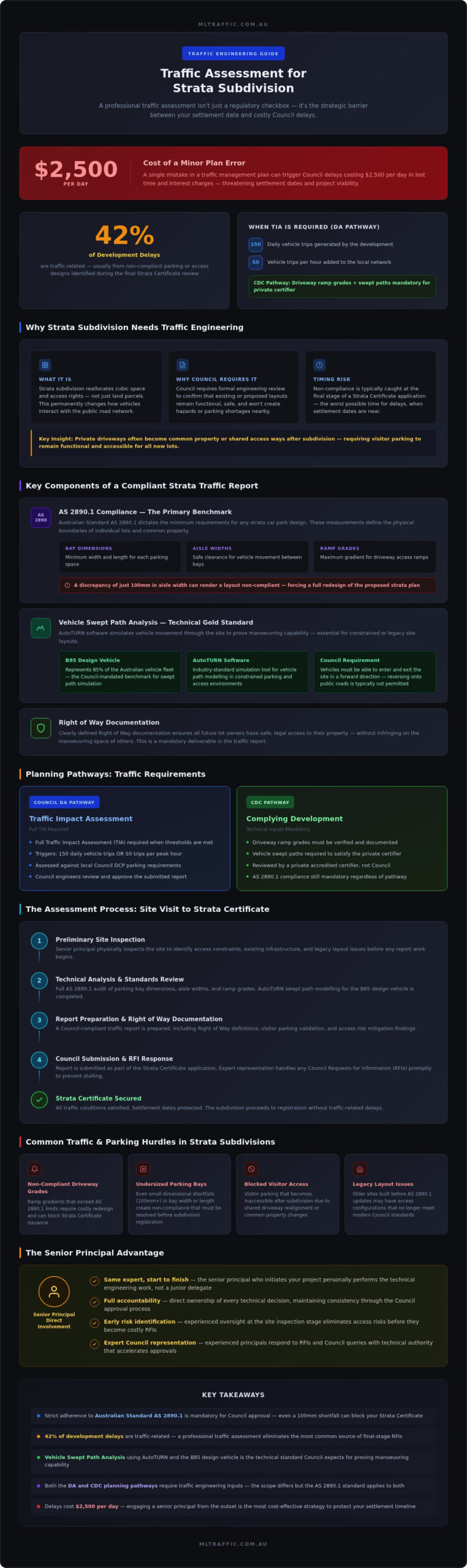
A minor error in a traffic management plan can lead to Council delays costing a project $2,500 per day in lost time and interest. For many developers, the final hurdle of a project isn’t the physical build, but securing a Strata Certificate from a local authority that demands absolute technical precision. Obtaining a professional traffic assessment for strata subdivision is more than a regulatory checkbox. It’s a strategic necessity to prevent the Council Requests for Information (RFIs) that frequently stall developments during the final stages of the subdivision process.
You’ve worked hard to reach the finish line, and it’s frustrating when non-compliant driveway grades or parking layouts threaten your settlement dates. We recognise that the transition from a Development Application to a Strata Certificate requires meticulous attention to technical details and strict adherence to Australian Standards. This guide explains how a professional traffic assessment secures your approval by ensuring every parking space and access point is Council-compliant. We’ll examine the essential requirements for parking design, the role of swept path analysis, and how expert representation provides a seamless path to your Strata Certificate.
Key Takeaways
- Understand why strict adherence to Australian Standard AS 2890.1 is mandatory for securing Council approval and a final Strata Certificate.
- Learn how a technical traffic assessment for strata subdivision identifies access risks early to eliminate costly Requests for Information (RFIs) and project delays.
- Explore the use of Vehicle Swept Path Analysis and specialised AutoTURN software to validate functional manoeuvring in constrained or legacy site layouts.
- Gain insights into the end-to-end assessment process, from preliminary site inspections to the final delivery of a Council-compliant traffic report.
- Discover the advantages of senior principal involvement, ensuring the expert who initiates your project performs the technical engineering work.
Understanding the Role of Traffic Engineering in Strata Subdivision
Strata subdivision is frequently misunderstood as a purely legal or administrative task. In reality, it represents a significant shift in transport planning within a site’s boundaries. A traffic assessment for strata subdivision provides the technical validation required to ensure that physical infrastructure supports the new legal titles. While a standard subdivision divides land, a strata subdivision reallocates cubic space and access rights. This change requires a formal engineering review to confirm that the existing or proposed layout remains functional and safe.
Industry research indicates that 42% of development delays are traffic-related. These bottlenecks usually occur when Council identifies non-compliant parking or access designs during the final review of a Strata Certificate application. Understanding Traffic Engineering is essential for developers because the subdivision of space creates permanent changes to how vehicles interact with the public road network. Council requires these assessments to manage long-term traffic impacts and ensure that the development doesn’t create safety hazards or parking shortages in the surrounding area.
Reallocating Access Rights and Common Property
Subdivision changes the legal and physical use of driveways and parking areas. What was once a private driveway often becomes common property or a shared access way. A professional traffic report must verify that visitor parking remains functional and accessible for all new lots. If parking layouts are non-compliant with AS 2890.1, Council will likely refuse the Strata Certificate. Clearly defined “Right of Way” documentation ensures that all future lot owners have safe, legal access to their property without infringing on the manoeuvring space of others. Our senior principals personally oversee these reviews to ensure every vehicle movement is technically sound.
DA vs Complying Development: The Traffic Requirement
The requirements for traffic engineering vary depending on the chosen planning pathway. For the Complying Development (CDC) pathway, specific technical inputs like driveway ramp grades and vehicle swept paths are mandatory to satisfy the private certifier. In contrast, a full Traffic Impact Assessment (TIA) is often required for Council Development Applications (DAs). This is particularly true if the project meets thresholds such as generating 150 daily vehicle trips or adding 50 vehicle trips per hour to the local network. ML Traffic Engineers Australia provides the precise documentation needed for both pathways. We ensure that the expert who initiates your project is the same professional who performs the technical work, maintaining accountability throughout the Council approval process.
Key Components of a Compliant Strata Traffic Report
A compliant traffic assessment for strata subdivision requires more than a cursory review of site plans. It demands a rigorous technical breakdown of how every vehicle interacts with the built environment. Council engineers look for specific evidence that the development adheres to national standards and local planning codes. Without these technical markers, an application will likely face immediate rejection or a protracted RFI process. Technical precision is the only way to guarantee a smooth path to approval.
The Importance of AS 2890.1 Compliance
Adherence to Australian Standard AS 2890.1 is the primary benchmark for any strata car park design. This standard dictates the minimum bay dimensions, aisle widths, and ramp grades required for safe off-street parking. In a strata context, these measurements are critical because they define the physical boundaries of individual lots and common property. A discrepancy of even 100mm in aisle width can render a parking layout non-compliant, forcing a redesign of the proposed strata plan. For a detailed breakdown of these requirements, refer to our AS 2890.1 Explained guide.
Swept Path Analysis for Strata Lots
Vehicle Swept Path Analysis is the technical gold standard for proving manoeuvring capability. Using specialised AutoTURN software, we simulate the movement of a B85 vehicle through the site. This vehicle represents 85% of the Australian vehicle fleet. Council typically mandates that vehicles must enter and exit the property in a forward direction. This is often challenging in tight basement parking environments or legacy buildings where space is at a premium. Our Swept Path Analysis Guide details how these simulations prevent property damage and ensure resident safety.
Beyond internal manoeuvring, we must assess sight distances at the property boundary. This ensures that exiting drivers have a clear view of pedestrians and oncoming traffic. These calculations must align with the methodologies found in the official Council Compliance Guide. Internal circulation must also account for waste collection and emergency vehicle access where applicable. If you require technical validation for your project, our senior principals at ML Traffic Engineers Australia can conduct a comprehensive site review to identify potential compliance hurdles before they reach Council. Contact our technical team for more information.
Overcoming Common Traffic and Parking Hurdles in Subdivisions
Many developers mistakenly believe that existing parking and access arrangements are automatically protected under “grandfathering” rules when applying for a strata scheme. This is rarely the case. A traffic assessment for strata subdivision frequently identifies that while a building was compliant when constructed, it fails to meet the rigorous standards required for a new legal subdivision. Councils scrutinise these applications to ensure that the increased density doesn’t exacerbate local parking shortages or create safety hazards. We navigate these hurdles by providing technical justifications that balance commercial objectives with regulatory safety.
Visitor parking remains a significant point of contention during the subdivision process. Councils typically require a specific ratio of visitor spaces to be held as common property rather than being sold as part of a private lot. Our role is to ensure these spaces are positioned correctly to allow for safe manoeuvring without infringing on private lot boundaries. If a site lacks the physical space to meet standard ratios, we can conduct a Car Parking Demand Assessment to justify a reduced provision based on the site’s proximity to public transport or historical usage data.
Narrow Access and Manoeuvring Constraints
Older developments often feature driveways that don’t meet the minimum 3-metre width required by modern standards. Engineering solutions like passing bays or convex mirrors can mitigate traffic flow issues on constrained sites. We often justify departures from standard dimensions by using expert engineering merit to prove that the specific site conditions don’t compromise safety. Our senior principals use their 15+ years of experience to represent these technical arguments directly to Council, ensuring your project isn’t stalled by legacy site constraints. If your site has unique access challenges, contact our experts for a technical review.
Heritage and Environmental Sensitivities
Working with protected facades or significant trees requires a collaborative approach between engineering and planning disciplines. We coordinate with town planners and arborists to ensure that driveway ramp grades or parking layouts don’t damage root systems or heritage structures. A Statement of Environmental Effects incorporates traffic data to prove that the proposed subdivision provides safe vehicle access without negatively impacting the site’s environmental or historical significance. This coordinated approach ensures that even the most constrained sites can achieve a compliant Strata Certificate through meticulous engineering validation.
The Assessment Process: From Site Visit to Strata Certificate
The path to securing a Strata Certificate follows a linear, technical workflow designed to satisfy bureaucratic requirements through engineering proof. This process begins with a comprehensive review of architectural plans to identify potential compliance gaps before they reach Council. This initial consultation allows us to align the proposed subdivision with the physical constraints of the site. We focus on identifying conflicts between the legal boundaries of the new strata lots and the practical requirements for vehicle movement and parking access. As part of this administrative workflow, developers often require legal documentation to be witnessed or certified; in these instances, Notary Public Victoria can assist with same-day notarisation in Melbourne.
Physical verification is a mandatory component of our engineering process. We conduct site inspections to measure driveway ramp grades against the strict requirements of AS 2890.1. These measurements must be exact. A grade that is too steep leads to vehicle scraping and immediate Council rejection. During the survey, we verify the location of existing street furniture, utility services, and signage that might impact sight lines. This data forms the foundation of a robust traffic assessment for strata subdivision, ensuring the theoretical design matches the practical reality of the built environment. We also assess the current road network capacity to ensure the subdivision doesn’t negatively impact local traffic flow.
Responding to Council RFIs (Requests for Information)
The importance of accurate site intelligence is a common thread across many technical disciplines. In the resources sector, for example, The Wild Tradesman Exploration & Discovery LLC provides specialised AI-driven site scouting and military-grade field reports to support complex exploration projects.
Council engineers typically issue a Request for Information (RFI) within 14 days of submission if they identify technical ambiguities. An expert report pre-emptively addresses common concerns regarding intersection capacity or parking demand to avoid these delays. If an RFI is issued, our senior principals act as your technical representative in negotiations. We provide the technical evidence required to resolve disputes and keep the project moving forward. This direct involvement ensures the expert who performed the technical work is the one defending it. To begin your compliance review and prevent costly delays, contact ML Traffic Engineers Australia for a professional consultation.
The final phase involves technical analysis and swept path modelling. We consolidate all site data into a formal Traffic Assessment Report. This document provides the engineering proof that the development is safe, functional, and compliant with all relevant Australian Standards. It serves as the final piece of technical evidence Council requires before the issuance of a Strata Certificate. Our results-oriented approach ensures the final report is meticulous, dependable, and ready for immediate submission.
Why Partner with ML Traffic Engineers for Your Subdivision
ML Traffic Engineers provides a level of technical accountability that larger, multi-disciplinary firms cannot match. When you engage our firm for a traffic assessment for strata subdivision, you are securing the expertise of senior principals with over 15 years of experience in the field. We understand that the subdivision process is often the most critical phase of a development. Our team is committed to delivering meticulous technical reports that withstand the scrutiny of Council engineers and private certifiers. We prioritise technical accuracy over volume, ensuring that every swept path analysis and parking demand assessment is performed to the highest professional standard.
A No-Gatekeepers Approach to Engineering
We operate with a flat structure that ensures direct access to our senior technical leads. This “no-gatekeepers” approach eliminates the bureaucracy and communication breakdowns often found in impersonal firms. A core signature of our service is the personnel continuity promise. The expert who performs your initial site visit and consultation is the same professional who completes the technical engineering work and defends the report during Council negotiations. This accountability saves time and money by preventing the loss of project knowledge during the transition between assessment phases. You can learn more about our leadership and philosophy on our About ML Traffic page.
National Expertise, Local Results
Our firm provides national service coverage, meaning we are well-versed in the diverse regulatory environments across Australia. We stay current with legislative changes, such as the 2026 updates to strata legislation and evolving TIA guidelines. Whether your project is governed by state-specific transport impact requirements or local Development Control Plans, we ensure every traffic assessment for strata subdivision meets the mandatory benchmarks. We maintain deep expertise in AS 2890.1 and AS 2890.2, providing the technical validation needed for car park designs and driveway ramp grades. This breadth of experience across diverse project environments allows us to navigate complex Council requirements with precision.
Our track record includes successful outcomes for thousands of projects across various land-use categories, including:
- Residential strata subdivisions and multi-dwelling housing
- Commercial and industrial business parks
- Mixed-use developments with complex shared access
- Retail centres and hospitality venues
- Childcare centres and educational facilities
- Medical centres and healthcare infrastructure
- Industrial warehouse and logistics sites
We deliver dependable, results-oriented engineering that secures your Strata Certificate. Contact ML Traffic Engineers for a quote on your strata subdivision traffic assessment to ensure your project remains on schedule and compliant.
Securing Your Strata Certificate with Engineering Precision
Securing a Strata Certificate requires absolute adherence to Australian Standards and Council planning codes. We’ve explored how technical validation through swept path analysis and parking demand assessments eliminates the risk of costly project delays. A professional traffic assessment for strata subdivision ensures that your development’s access and parking layouts are not just functional, but fully compliant with AS 2890.1. By identifying potential hurdles early, you prevent the bureaucratic bottlenecks that frequently stall final approvals.
ML Traffic Engineers provides 15+ years of specialised traffic engineering experience to guide your project through the Council review process. You’ll have a direct line to senior principals who perform the technical work themselves, ensuring accountability from the initial site visit to the final report. Our comprehensive national coverage means we’re equipped to navigate any regulatory environment in Australia. Request a Quote for Your Strata Traffic Assessment today to secure your project’s future. Taking the right technical steps now ensures a seamless path to settlement.
Frequently Asked Questions
Is a traffic assessment mandatory for every strata subdivision?
A formal assessment is generally required for most subdivisions that create three or more new residential lots. While smaller projects might only require a simplified Traffic Impact Statement, any development that alters the legal use of shared access ways must be validated. Council requires this documentation to ensure the new strata scheme remains compliant with safety standards and does not negatively impact the local road network.
Can I use an old traffic report for a new strata subdivision application?
Councils rarely accept reports older than 12 months because traffic volumes and regulatory requirements change frequently. A fresh traffic assessment for strata subdivision is necessary to account for the latest Australian Standards and any local planning updates, such as the 2026 strata legislation changes. Using current data ensures your application reflects the real-world conditions Council engineers will use during their technical review.
What is the difference between a Traffic Impact Assessment and a Traffic Statement?
The primary difference is the scale of the projected vehicle trip generation. A Traffic Impact Statement is a simplified report typically used for developments generating between 10 and 100 peak-hour trips. A Traffic Impact Assessment is a more comprehensive engineering analysis required for larger projects that add 50 or more vehicle trips per hour to the network or involve complex intersection analysis.
How long does it take to prepare a traffic assessment for a strata project?
Technical preparation usually takes between 5 and 10 business days depending on site complexity and the availability of architectural plans. This period includes the initial consultation, site survey, and swept path modelling. After submission, most Councils take 10 to 20 business days to complete their review, though this can extend to 30 days if the project involves State Roads or requires an RFI response.
Does the traffic engineer need to visit the site in person?
Yes, a physical site inspection is mandatory to verify “as-built” conditions that plans might not accurately reflect. We measure actual driveway ramp grades, aisle widths, and sight distances at the boundary. This hands-on approach ensures the technical data used in your report is based on real-world dimensions. Verifying these physical constraints is essential for producing a dependable assessment that withstands rigorous Council scrutiny.
What happens if my existing driveway doesn’t meet current Australian Standards?
We develop technical justifications or mitigation strategies to manage non-compliant site features. If a driveway is too narrow for modern standards, we might propose passing bays or mirrors to ensure safe traffic flow. Our senior principals use their 15+ years of experience to negotiate these departures with Council, proving through engineering merit that the specific site constraints do not compromise the safety of residents.
Can a traffic assessment help reduce the number of visitor parking spots required?
Yes, a Car Parking Demand Assessment can provide the evidence needed to justify a lower parking provision. If your development is situated near high-frequency public transport or within a walkable centre, we use empirical data to prove that standard Council rates are excessive. This expert transport planning can reclaim up to 8% of land that might otherwise be wasted on inefficient or underutilised parking layouts.
How much does a professional traffic assessment for a strata subdivision cost?
The cost is determined by the project’s scale, the number of proposed lots, and the complexity of the required technical analysis. Variables such as the need for intersection modelling or extensive swept path analysis for tight basement parking will influence the scope of work. We recommend requesting a formal quote to receive a fixed-price assessment tailored to the specific engineering requirements and constraints of your subdivision project.

Disclaimer
The content on www.mltraffic.com.au, including all technical articles, guides, and resources, is provided for general informational and educational purposes only. It is not intended to constitute professional advice in traffic engineering, transportation planning, development approvals, or any other technical or legal field.
While ML Traffic Engineers makes every reasonable effort to ensure the accuracy, completeness, and timeliness of the information published, we do not provide any warranties or representations (express or implied) regarding its reliability, suitability, or availability for any particular purpose. Any reliance you place on the content is strictly at your own risk.
In no event shall ML Traffic Engineers, its directors, employees, authors, or affiliates be liable for any direct, indirect, incidental, special, consequential, or punitive damages (including, without limitation, loss of profits, data, or business opportunities) arising out of or in connection with the use of, or inability to use, any information provided on this website.
The articles and guides on this site are not a substitute for engaging a qualified, registered professional traffic engineer (such as an NPER or RPEQ engineer) to assess your specific project requirements. For tailored advice, compliance assessments, or traffic engineering services, please contact a competent professional.
This disclaimer may be updated from time to time without notice. By accessing or using this website, you agree to be bound by the most current version of this disclaimer.
