

A vague development application is a direct invitation for “risk pricing” and unnecessary project delays. When developers ask what information is needed for a traffic assessment quote, they’re usually trying to avoid the endless back-and-forth emails that stall a DA. You’ve likely experienced the frustration of receiving a quote that feels like a placeholder, only to watch the scope creep and costs climb as the council requests additional specialised reports you weren’t prepared for.
At ML Traffic Engineers Australia, we understand that project certainty is your priority. This guide outlines exactly which documents and project details are required to secure an accurate, fixed-fee traffic engineering quote for your development application. By providing the right data upfront, including site plans and specific land-use details, you’ll receive a proposal with a clear scope of work. We’ll examine the essential requirements for 2026, including the impact of the latest ITE Trip Generation data, to ensure your consultant understands your specific regulatory needs from day one.
Key Takeaways
- Avoid “risk pricing” and expensive variations by providing comprehensive project data at the start of the quoting phase.
- Identify the essential architectural site plans and floor plans required for a compliant car parking demand assessment.
- Determine exactly what information is needed for a traffic assessment quote to account for specific land-use requirements and GFA calculations.
- Streamline the proposal process by including previous Council RFIs to ensure the scope of work covers all regulatory requirements.
- Ensure project continuity and technical accuracy by engaging a firm where senior engineers manage the project from the initial quote to final delivery.
Understanding the Scope: Why Detailed Project Data is Essential for a Traffic Quote
Securing a price for engineering services requires more than just a site address. When developers ask what information is needed for a traffic assessment quote, they’re essentially asking how to define their project’s legal and planning boundaries. A professional quote is a technical roadmap. It ensures your development application (DA) aligns with specific local government expectations and national standards.
Providing vague details often results in “ballpark” figures that lead to expensive variations later. If an engineer doesn’t have your full architectural plans, they must account for unknown risks. This “risk pricing” protects the consultant but leaves you with uncertain project costs. An accurate analysis of traffic flow and intersection capacity depends on precise inputs. Without them, the quote is merely a placeholder rather than a commitment.
The Difference Between a TIA and a Traffic Statement
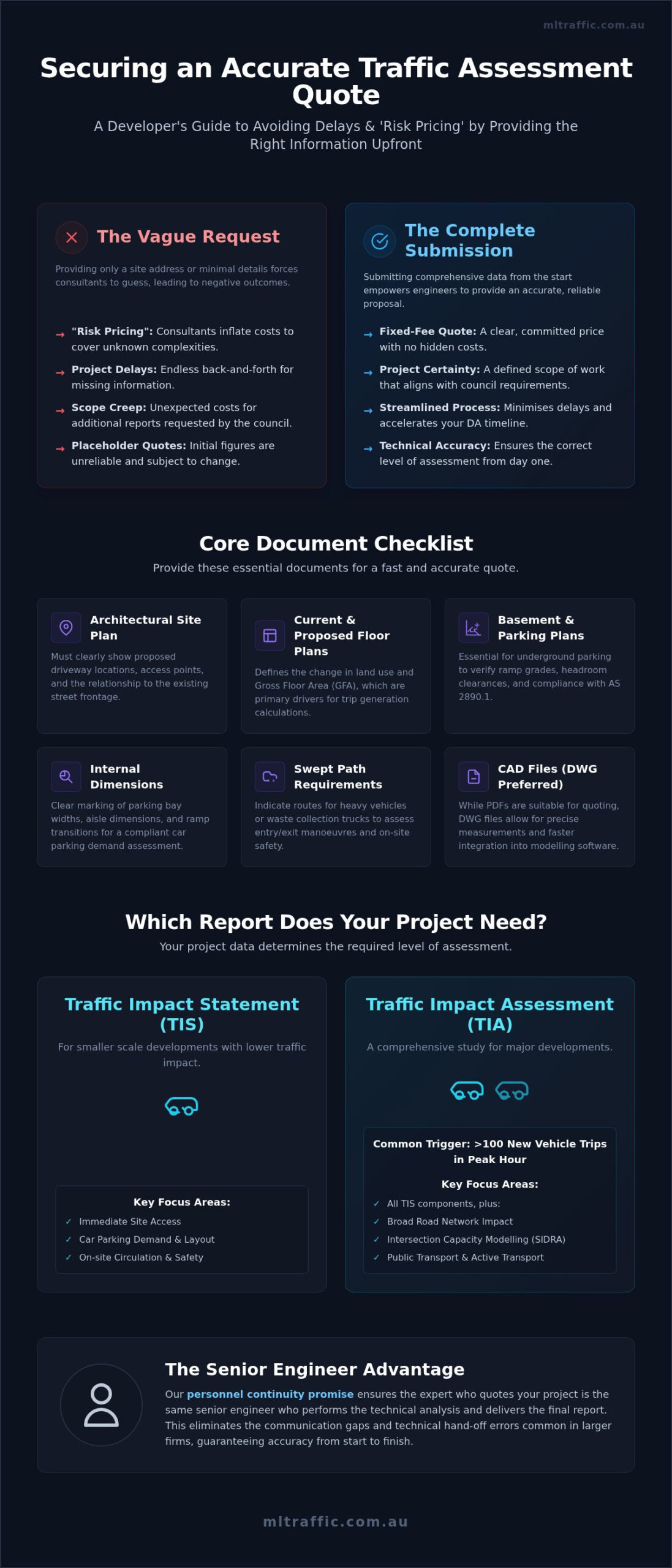
Your project data determines the specific level of reporting the council will demand. A Traffic Impact Assessment (TIA) is a comprehensive study for major developments. While thresholds vary by jurisdiction, a common trigger is the generation of 100 or more new vehicle trips during peak hours. Smaller projects may only require a Traffic Impact Statement (TIS). A TIS is less intensive and focuses on immediate site access and parking rather than broad network impacts. The difference in technical hours between these two reports is significant. Clear data allows our senior engineers to categorise your project correctly from the first email.
Fixed-Fee vs. Variable Quotes in Traffic Engineering
We provide fixed-fee proposals that include site visits, SIDRA modelling, and full technical reporting. This transparency is only possible when we have the right documents upfront. When senior engineers review your request, they identify potential hurdles like driveway ramp grades or complex swept path requirements early. This meticulous approach prevents the scope creep that often plagues projects with incomplete initial data.
Our personnel continuity promise ensures the expert who quotes your work is the one who performs the technical analysis. This eliminates the communication gaps found in larger firms where junior staff might handle the execution of a senior-signed quote. You can view our full range of specialised traffic services to see how we tailor our scope to your specific land-use requirements.
The Core Document Checklist: What Every Traffic Engineer Needs
A precise engineering proposal is built on high-quality data. To avoid the delays associated with information requests, developers must provide a standard set of technical documents at the outset. When determining what information is needed for a traffic assessment quote, think of your architectural drawings as the foundation. Without these, an engineer cannot calculate parking yields, assess driveway safety, or model the impact on the local road network.
Digital files are the industry standard for rapid analysis. While PDF files are suitable for initial quoting, providing CAD files (DWG format) allows for precise measurements and faster integration into modelling software like SIDRA or AutoTURN. This technical clarity ensures your quote reflects the actual complexity of the site rather than a generalised estimate.
Architectural Plans and Site Layouts
Every quote request must include a comprehensive site plan. This document should clearly illustrate the proposed driveway locations and their relationship to the existing street frontage. For developments featuring underground parking, basement level plans are essential. These allow our engineers to verify AS 2890.1 compliance, specifically regarding ramp grades and headroom clearances. We also require:
- Current and Proposed Floor Plans: These define the change in land use, which is the primary driver of trip generation rates.
- Internal Dimensions: Clear marking of parking bay widths and aisle dimensions is necessary for a compliant car parking demand assessment.
- Swept Path Requirements: Indications of where heavy vehicles or waste collection trucks will enter and exit the site.
Site Location and Contextual Data
The geographic context of your development dictates the level of intersection analysis required by the council. Simply providing a suburb is insufficient. We need the exact street address and total site area in square metres to calculate gross floor area (GFA) metrics. Identifying existing land uses is equally vital. Councils often allow “parking credits” if the new development replaces a high-intensity use with a lower one. Mentioning nearby sensitive zones, such as school crossings or major signalised intersections, helps us identify potential “red flags” that might necessitate a more detailed TIA.
If you have your site plans ready, you can submit your documents directly to our senior engineers for a technical review and a fixed-fee proposal.
Land Use and Operational Specifics: How Project Type Influences the Quote
The scale and nature of a development directly dictate the engineering hours required for a compliant report. A five-unit townhouse development requires vastly different modelling than a fifty-unit apartment complex or a regional distribution centre. When developers ask what information is needed for a traffic assessment quote, they must look beyond the building’s footprint to its operational intensity. Each land-use category carries specific trip generation rates defined by the ITE Trip Generation Manual 12th Edition, and the complexity of these calculations influences the final consultancy fee.
Gross Floor Area (GFA) is the primary metric for commercial and industrial projects. For residential developments, the total number of dwellings and the bedroom mix are the critical variables. Providing these specifics allows our senior engineers to estimate the volume of traffic your project will contribute to the local network during peak periods. Without this data, we cannot determine if your project requires simple driveway assessments or complex intersection modelling.
Residential vs. Commercial Traffic Generation
High-density residential projects require detailed trip distribution modelling to show how residents enter and exit the site during morning and evening peaks. Commercial uses, such as child care centres, medical clinics, or hospitality venues, introduce unique operational challenges. These sites often have “staggered” peaks that do not align with traditional road network rush hours. For instance, a child care centre requires a specific analysis of “drop-off” and “pick-up” durations. If you are proposing a mixed-use development, we need the exact breakdown of each use to ensure the cumulative impact is accurately captured in the quote.
Loading and Service Vehicle Requirements
Operational logistics are a major component of the traffic engineering scope. We must know the largest vehicle expected to access the site, whether it is a Small Rigid Vehicle (SRV), Medium Rigid Vehicle (MRV), or Heavy Rigid Vehicle (HRV). This information is vital for performing a Swept Path Analysis. If the development includes onsite waste collection or a loading dock, the time required for AutoTURN modelling increases.
- Vehicle Frequency: How many deliveries occur daily?
- Waste Management: Will collection happen on-street or via an internal loading bay?
- Access Constraints: Are there height limits in the basement that restrict certain vehicle classes?
Clear communication regarding these service requirements prevents the need for costly redesigns after the DA has been lodged. Our meticulous review process ensures that your loading areas are functional and compliant from the outset.
Council Requirements and Planning Context: Navigating Regulatory Expectations
Every local government area in Australia operates under a distinct set of Development Control Plans (DCPs) and parking codes. These local regulations often override general industry averages. When determining what information is needed for a traffic assessment quote, you must include any formal correspondence from the relevant planning authority. This context allows our engineers to pinpoint the exact technical hurdles that could otherwise cause your application to stall during the assessment phase.
Transparency regarding the planning history of your site is essential for a fixed-fee proposal. If you have already lodged an application and received a Request for Further Information (RFI), that document is the single most important piece of data for your engineer. It defines the specific problem we are hired to solve. Ignoring previous council feedback leads to generic reports that fail to address the specific concerns of the assessing officer. Providing a comprehensive RFI history is the best way to clarify what information is needed for a traffic assessment quote that remains fixed and accurate.
Council Correspondence and RFI History
Sharing “refusal” or “deferral” letters is a critical diagnostic tool. These documents often specify exactly which intersections require SIDRA modelling or where the council has concerns regarding on-street parking overspill. Providing this history enables us to offer a targeted assessment. This is more cost-effective than a standard TIA because it focuses technical resources on the council’s specific objections. We also recommend providing pre-DA meeting minutes. These records often contain concessions or specific instructions that can significantly narrow the scope of our work.
State-Specific Standards and National Compliance
While local councils set the parking rates, all designs must adhere to the Australian Standards, specifically the AS 2890 series. Our Traffic Engineering expertise ensures that every quote includes a review for compliance with these national codes. This includes driveway gradients, sight distance requirements, and aisle widths. Every proposal we issue is overseen by NPER or RPEQ registered engineers. This provides the professional certification required for legal and planning accountability.
The Statement of Environmental Effects (SEE) also provides valuable context for the traffic report. It outlines the broader project goals and any community impacts. If you have these documents ready, you can request a professional fee proposal to ensure your traffic report meets every regulatory benchmark from day one.
Requesting Your Traffic Engineering Quote: The ML Traffic Advantage
Our streamlined quoting process begins the moment you submit your architectural plans. When we receive a request, a senior engineer reviews the site specifics to ensure the proposal reflects the technical reality of the project. Knowing exactly what information is needed for a traffic assessment quote, such as Gross Floor Area, unit counts, and previous council RFIs, allows ML Traffic Engineers Australia to eliminate the ambiguity that leads to cost variations. We don’t use sales staff or administrative gatekeepers. Your inquiry goes directly to the experts who will perform the technical work.
With over 15 years of experience and more than 10,000 sites transformed, we’ve developed a meticulous approach to fee proposals. Our personnel continuity promise is a core pillar of our service. The engineer who reviews your documents and prepares your quote is the same professional who will conduct the modelling and author the final report. This ensures that the technical nuances identified at the start of the project are carried through to the final DA submission. If you’re ready to start, contact ML Traffic Engineers Australia for a fixed-fee proposal.
Direct Access to Senior Principals
Speaking directly with Benny Chen or Michael Lee adds immediate value to your quoting process. Our senior principals bring over 30 years of combined expertise to every initial consultation. This direct access eliminates the “middle-man” delays common in larger, more impersonal firms. By discussing your project with a principal at the first point of contact, you receive authoritative advice on whether your development requires a simple parking assessment or a complex intersection analysis using SIDRA software. This high-level oversight ensures your quote is technically robust and compliant with national regulatory standards.
Next Steps After Receiving Your Quote
Once you receive your fixed-fee proposal, the next step is to formalise the engagement through a written authorisation. This allows ML Traffic Engineers Australia to lock in your project on our technical schedule. Typical lead times for Traffic Impact Assessments depend on the complexity of the required modelling and the availability of current traffic count data. After engagement, we move quickly into the data collection phase. This often involves:
- Site Inspections: A physical review of the site to assess sight distances and existing road conditions.
- Traffic Counts: Organising manual or tube counts if current data is unavailable from the local council.
- Technical Modelling: Commencing AutoTURN swept path analysis or SIDRA intersection modelling based on your finalised architectural plans.
Our goal is to provide a seamless transition from the initial quote to the final delivery of a council-ready report. This meticulous attention to detail ensures your development application moves through the assessment process without unnecessary delays or requests for further information.
Securing Project Certainty for Your 2026 Development
A successful development application relies on technical precision from the very first consultation. By providing comprehensive architectural plans and a clear history of council correspondence, you eliminate the ambiguity that leads to scope creep and hidden costs. Understanding exactly what information is needed for a traffic assessment quote ensures your project begins with a transparent, fixed-fee proposal that addresses every regulatory requirement.
ML Traffic Engineers Australia offers the reliability of over 15 years of experience and more than 10,000 completed projects nationwide. Every quote request is reviewed by our senior principals, ensuring that the expert who starts your project is the one who finishes it. This hands-on approach removes the uncertainty of “middle-man” delays and provides the professional certification required for complex planning approvals. You can Request a Fixed-Fee Traffic Assessment Quote today to secure an accurate, senior-led analysis for your site. We look forward to helping you move your development forward with confidence.
Frequently Asked Questions
Can I get a traffic assessment quote without architectural plans?
You can’t secure a fixed-fee proposal without preliminary architectural plans. These documents define the gross floor area and dwelling counts essential for trip generation modelling. While a high-level estimate is possible, a formal quote requires at least a basic site layout and floor plans. This ensures the scope covers necessary items like vehicle swept path analysis and driveway ramp grade assessments without future cost variations or hidden surprises.
How long does it take to receive a formal fee proposal?
We typically provide a formal fee proposal within 24 to 48 hours of receiving all necessary project documents. This rapid turnaround is possible because our senior principals review every inquiry directly. Providing clear details on what information is needed for a traffic assessment quote at the outset prevents delays. Once we’ve received your site plans and council requirements, we can immediately define the technical hours required for your report.
Do I need a different quote for a Swept Path Analysis?
A vehicle swept path analysis is often included as a core component of a comprehensive Traffic Impact Assessment (TIA). However, if you only require this specific technical diagram for a driveway or loading bay redesign, we can provide a standalone quote. Our proposals clearly list each service as a separate line item. This transparency ensures you only pay for the specific technical certifications required for your development application and parking compliance.
Why does the quote price vary between different traffic consultants?
Quote variations usually reflect the level of engineer seniority and the depth of the proposed scope. Some firms provide low-cost figures that exclude essential SIDRA modelling or site visits. Our fixed-fee proposals include direct principal involvement and 15 years of technical expertise. This ensures the report is robust enough to withstand council scrutiny, reducing the risk of expensive requests for further information after the initial lodgement of your application.
What happens if council asks for more information after the report is finished?
If a council issues a Request for Further Information (RFI), we review the specific technical objections to determine the next steps. Our reports are designed to be comprehensive from the start to minimise this risk. If the RFI relates to the original scope of our report, we provide the necessary clarifications. If the council introduces new requirements or requests changes to the site layout, we’ll provide a transparent and fair variation quote.
Is a site visit always included in the traffic assessment quote?
A physical site visit is a standard inclusion for all comprehensive Traffic Impact Assessment reports. Our engineers must personally assess sight distances, existing road conditions, and nearby traffic infrastructure to ensure accuracy. While some desktop-only assessments exist for very minor projects, most councils require the engineer to have inspected the site. This field data is critical for validating the theoretical modelling performed in software like SIDRA and AutoTURN for your project.
Does the quote include the cost of traffic volume or parking occupancy surveys?
Our quotes specify whether traffic volume or parking occupancy surveys are included or handled as a separate disbursement. Data collection often requires third-party sub-consultants to install tube counters or perform manual counts. We manage this entire process to ensure data integrity. When you ask what information is needed for a traffic assessment quote, we’ll identify if current council data is sufficient or if fresh surveys are required to satisfy the assessing officer.
Can you provide a quote for a retrospective DA for an existing business?
We frequently provide quotes for retrospective development applications where an existing business requires traffic and parking certification. These projects often focus on car parking demand assessments to prove that the current operation doesn’t negatively impact local street parking. We’ll analyse your existing operational data, such as staff numbers and customer turnover, to provide a factual report that supports your ongoing land-use compliance with local council standards and national engineering requirements.

Disclaimer
The content on www.mltraffic.com.au, including all technical articles, guides, and resources, is provided for general informational and educational purposes only. It is not intended to constitute professional advice in traffic engineering, transportation planning, development approvals, or any other technical or legal field.
While ML Traffic Engineers makes every reasonable effort to ensure the accuracy, completeness, and timeliness of the information published, we do not provide any warranties or representations (express or implied) regarding its reliability, suitability, or availability for any particular purpose. Any reliance you place on the content is strictly at your own risk.
In no event shall ML Traffic Engineers, its directors, employees, authors, or affiliates be liable for any direct, indirect, incidental, special, consequential, or punitive damages (including, without limitation, loss of profits, data, or business opportunities) arising out of or in connection with the use of, or inability to use, any information provided on this website.
The articles and guides on this site are not a substitute for engaging a qualified, registered professional traffic engineer (such as an NPER or RPEQ engineer) to assess your specific project requirements. For tailored advice, compliance assessments, or traffic engineering services, please contact a competent professional.
This disclaimer may be updated from time to time without notice. By accessing or using this website, you agree to be bound by the most current version of this disclaimer.
