
A traffic objection is most useful when it’s treated as a question to test, not a claim to dismiss. A traffic assessment to address DA objections can clarify whether concerns about congestion, parking, access or vehicle movements are supported by project-specific evidence. It also gives decision-makers a clearer basis for considering the proposal’s likely effects.
Community concerns deserve a direct response, but broad statements don’t always identify what needs investigating. The practical first step is to distinguish a specific, assessable traffic issue from a general concern, then match it with relevant analysis. The scope depends on the proposal and applicable planning requirements, which vary across Australia.
This guide explains how to turn objections into practical assessment questions, identify useful evidence and consider proportionate responses. It covers traffic generation, access, intersection performance, parking, sight distance and vehicle movements where relevant to a development. You’ll also learn how a project-specific Traffic Impact Assessment can support a clear, evidence-based response without promising a particular planning outcome.
Key Takeaways
- Use a response register to connect each objection with the evidence, finding, action and relevant document reference.
- A traffic assessment to address DA objections should focus on the concerns raised and the development’s likely transport effects.
- Separate traffic generation, site access, intersection operation, parking and servicing so each issue can be assessed on its own merits.
- Match the level of analysis to the proposal, the concern and the information available, then identify proportionate design options where relevant.
- Specialist analysis of access, intersections, parking and vehicle movements can help you prepare a clearer DA response.
Why traffic assessment matters when community objections affect a DA
Traffic objections can point to a genuine issue, but they don’t all identify the same effect or require the same investigation. A project-specific traffic assessment examines likely transport effects using information relevant to the proposal, such as its scale, access arrangements and expected vehicle movements. It can turn a submission into a focused question that can be examined, rather than treating every concern as either proven or unfounded.
For example, “the development will make the road unsafe” is too broad to test on its own. A more useful question is whether drivers entering or leaving the site can see approaching traffic clearly, or whether the proposed access could affect vehicle movements at a particular point. Framing the concern this way helps identify the evidence needed and keeps the response connected to what was raised.
What community traffic objections may be about
Submissions may raise concerns about access, additional traffic, intersection operation, parking or pedestrian movement. Some identify a specific location or movement; others express a general objection to development. These are different kinds of feedback. A concern about queues at a named intersection may call for a different investigation from a general statement that local roads are already busy.
Review each submission for the issue it actually raises. Look for details such as a road, access point, time of day, direction of travel or type of road user. A specific observation can help define an assessment question. A broad concern may still provide useful context, but it doesn’t automatically establish a technical impact or mean every topic needs a separate analysis.
What a traffic assessment can and cannot establish
A traffic assessment can test defined assumptions and examine potential effects using relevant project information and available evidence. Depending on the issue, this may include expected traffic generation, access arrangements, vehicle paths, parking demand or intersection performance. Findings should state what was assessed, what information informed the analysis and any limitations that affect how the results should be interpreted.
That distinction matters. Community consultation records people’s views and local experience. A technical assessment examines specific transport questions. The two processes inform one another, but one doesn’t replace the other: a technical finding doesn’t determine whether a concern is important to a submitter, and a submission alone doesn’t establish the scale of a traffic effect.
For a traffic assessment to address DA objections, the useful outcome is a clear, evidence-based explanation of what the analysis supports, what remains uncertain and whether a design response should be considered. The assessment informs the planning authority’s decision; it doesn’t decide the application, guarantee approval or ensure submitters agree with the outcome. DA processes and relevant assessment criteria vary across Australia, so prepare the response in the context of the applicable planning requirements.
How a traffic assessment tests concerns raised during consultation
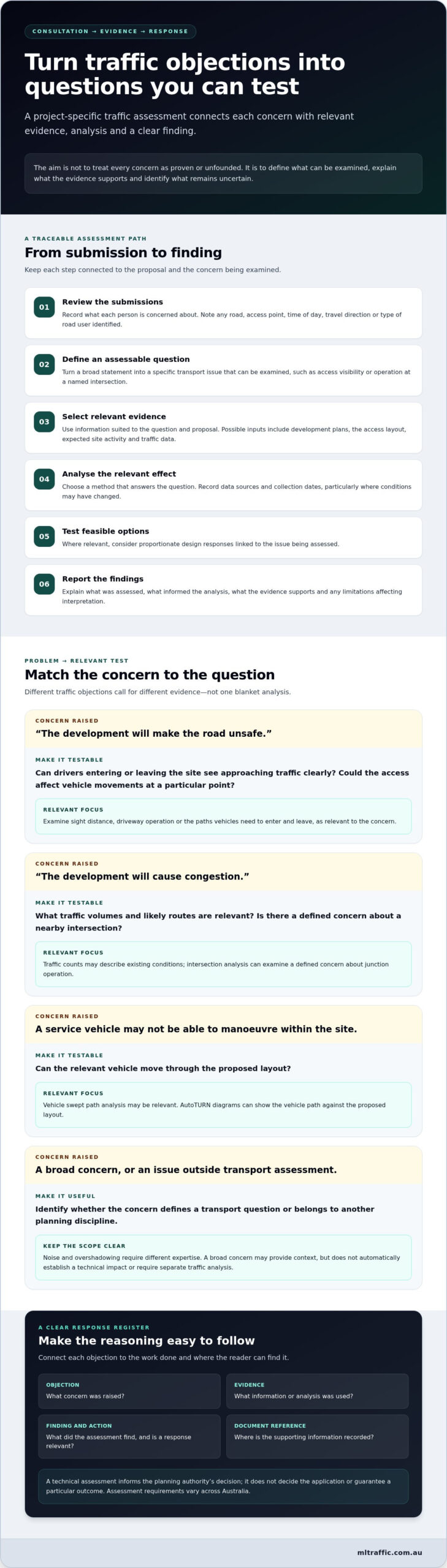
A useful assessment follows a traceable sequence: review the submissions, define the traffic questions, select evidence, analyse the relevant effects, test feasible options and report the findings. Each step should connect to the development proposal and the concern being examined. This keeps the work focused and makes it easier to explain how a conclusion was reached.
Turning submissions into assessable traffic questions
Start by recording each concern in plain language, then identify what would need to be known to evaluate it. A claim that a development will cause congestion might prompt questions about expected traffic volumes, likely routes or operation at a nearby intersection. A concern about site access could relate to sight distance, driveway operation or the paths vehicles need to enter and leave.
Not every submission calls for traffic analysis. Note whether an issue falls within the transport assessment’s scope or belongs to another planning discipline. For example, concerns about noise or overshadowing require different expertise. Sorting issues this way helps avoid using traffic evidence to answer a question it can’t resolve.
Choosing evidence and analysis proportionate to the concern
The assessment scope should reflect the proposal, the question and the information available. Depending on the issue, useful inputs may include development plans, the proposed access layout, expected site activity and traffic data. Record the source and collection date of data, especially where conditions may have changed since it was gathered.
Choose analysis to match the question, not simply because a method is available. Traffic counts may help describe existing conditions; intersection analysis can examine a defined concern about junction operation. If the issue is whether a service vehicle can manoeuvre within a site, vehicle swept path analysis may be relevant. AutoTURN diagrams can show the vehicle path against the proposed layout, making a spatial issue easier to review.
Government guidance can help establish an appropriate assessment approach within its jurisdiction. The Queensland Guide to Traffic Impact Assessment provides guidance for assessing traffic impacts from development proposals. Requirements and guidance differ across Australia, so apply the relevant state, territory and local planning context rather than treating one document as a national rule.
Be explicit about assumptions and limitations. State which plans or traffic inputs informed the work, the dates of any counts and any material information gaps. Modelling results depend on their inputs and assumptions; they don’t guarantee future conditions. When testing an option, explain what changed and whether the analysis indicates a different outcome. If the available evidence is insufficient to answer a concern, identify the gap instead of presenting an uncertain result as definitive.
A project-specific Traffic Impact Assessment can bring these steps together for a development application. ML Traffic Engineers Australia prepares assessments that examine defined traffic issues using relevant evidence. Where useful, its traffic assessment services can address related access, intersection, parking and vehicle movement considerations in the same project context.
Which DA traffic objections can design changes or analysis address?
Different objections call for different evidence. A concern about extra traffic isn’t answered by a parking assessment, just as a concern about a service vehicle turning on site isn’t resolved by trip estimates alone. The table below links common issues with relevant analysis and possible responses. These are options to investigate, not automatic solutions. Test any design change against the proposal and the specific effect identified.
| Concern | Evidence to examine | Possible response | Limitations |
|---|---|---|---|
| More traffic or congestion | Expected trip generation, likely routes and relevant traffic data | Revise site access or traffic distribution assumptions where supported by evidence | Trip estimates don’t establish that every nearby road or intersection will be affected in the same way |
| Intersection operation | Traffic volumes and intersection analysis for the relevant location and movements | Adjust access arrangements or investigate an intersection-related design response | Findings depend on the data, assumptions and assessment criteria used |
| Driveway access or visibility | Access layout, sight distance and vehicle movement requirements | Revise the driveway location or geometry, where feasible | A drawing or assessment addresses the defined access issue, not every road safety or planning consideration |
| Parking supply or turnover | Proposed parking provision and a project-specific parking demand assessment | Review the parking layout or supply against the identified demand | Assessment doesn’t resolve broader transport choices or guarantee a particular parking outcome |
| Servicing or pedestrian movement | Relevant service vehicle paths and site movement arrangements | Adjust the layout to better accommodate vehicle manoeuvring or pedestrian routes | Only issues related to the proposal and supported by available evidence can be tested |
Traffic volume, congestion and intersection concerns
For a claim that a development will add traffic to a particular road, examine the expected trips and how they may be distributed across the surrounding network. If the objection identifies a specific intersection or movement, intersection analysis may help assess the operational question. The assessment should explain its inputs and limitations. Don’t apply a universal trip threshold: confirm the criteria relevant to the proposal and its planning jurisdiction.
Access, parking, servicing and pedestrian concerns
Access concerns can be investigated through the proposed driveway arrangement, sight distance and vehicle paths. Where manoeuvring is material, swept path analysis can show whether a relevant vehicle can move through the proposed layout. A car parking demand assessment is appropriate when the objection specifically concerns parking supply or turnover. Assess servicing and pedestrian movement where they relate to the development and the evidence available.
A design response should follow the finding, not precede it. For example, changing an access location may address a defined visibility or vehicle movement issue, but its effect needs project-specific assessment. Traffic analysis also has boundaries. It can inform transport effects, but it doesn’t by itself determine broader amenity, noise or planning merit. A traffic assessment to address DA objections should state what each analysis establishes, what remains outside its scope and how any proposed change relates to the concern raised.
How to organise responses to community traffic concerns
A clear response lets a reviewer trace each traffic concern from the original submission through to the evidence and any action taken. A response register provides that audit trail. It also helps the project team identify issues that need more investigation, rather than relying on a general statement that traffic has been considered.
Build a traceable concern-and-response register
Record each issue separately, using neutral wording that reflects the submitter’s concern without exaggerating or dismissing it. Then connect it to the relevant assessment, finding and document reference. A practical register can include:
- Concern: a concise, neutral summary of the issue raised.
- Assessment: the method, evidence and relevant report section used to examine it.
- Finding: what the analysis establishes, including any assumptions or limitations.
- Action: a design revision, further investigation or reason no change is proposed.
- Reference and status: the drawing or report location, and whether the matter is resolved or remains open.
Prioritise entries by their connection to the proposal, the evidence needed to assess them and their potential implications for the design. A concern that identifies a particular access arrangement may warrant targeted technical review. A broad objection may be recorded and considered, but it shouldn’t automatically trigger analysis unrelated to the issue raised.
If a concern remains unresolved, explain why. Identify the information gap and what further evidence may help clarify it. If the layout or operating assumptions change, record the revision and assess whether the earlier finding still applies. A changed access point, for instance, may affect the relevance of previous access analysis. Keep a clear link between the updated design, the assessment and the response.
Coordinate traffic findings with the wider DA material
Check that traffic conclusions align with the development description, site plans, access details and any revised drawings. A response that refers to an earlier layout can undermine confidence in otherwise sound analysis. Use consistent plan versions and identify the relevant drawing reference wherever a finding depends on a particular design feature.
Coordinate the traffic response with the planning team so transport findings inform the broader DA material without duplicating other technical reports. Traffic analysis can explain transport effects; it shouldn’t be presented as resolving matters such as amenity or overall planning merit. Make clear which discipline addresses each issue and where supporting evidence can be found.
DA procedures and submission requirements vary across Australia. Follow the process that applies to the application, including how supplementary material should be prepared and lodged. A well-organised traffic assessment to address DA objections makes the reasoning easier to follow, but it doesn’t guarantee agreement or a particular planning outcome.
A project-specific assessment connects traffic concerns with relevant evidence. ML Traffic Engineers Pty Ltd provides traffic assessment services for development applications.
How specialist traffic assessment supports a more considered DA response
Community submissions can raise several transport questions at once. A traffic engineer can help define which issues need technical investigation, what evidence is relevant and how the assessment should relate to the development plans. This makes the response more useful than a general rebuttal: each conclusion can be tied to the proposal, the concern and the analysis completed.
For a traffic assessment to address DA objections, the scope should fit the actual issues raised. A concern about an intersection may call for different analysis from a concern about driveway visibility or parking demand. Scoping the work carefully keeps the report proportionate and makes its methods and limitations easier for the project team and decision-makers to understand.
What project-specific traffic engineering support can cover
ML Traffic Engineers Pty Ltd has more than 15 years of experience in traffic engineering and transport planning. Its Traffic Impact Assessments and Statements support development applications by examining a proposal’s potential effects on the surrounding transport network. The relevant scope depends on the concerns and project details, rather than applying every analysis to every DA.
Where the issue warrants it, the assessment may consider intersection operation, sight distance, parking demand or vehicle movement. Swept path analysis, for example, can assess vehicle manoeuvring using AutoTURN. The report should set out the method, inputs, assumptions and findings so readers can see what the analysis supports and where its conclusions are qualified. Explore ML Traffic Engineers Pty Ltd’s traffic engineering services to understand how these technical assessments can support a development proposal.
Prepare the next step for your DA response
Before scoping an assessment, organise the material that defines both the proposal and the concerns. Useful items may include:
- Current site, access and parking plans, with drawing references or revision details.
- Relevant community submissions, grouped by the traffic issue raised.
- Existing traffic information or previous assessment material available for the project.
- A short summary of any design revisions or operating assumptions being considered.
This material helps establish what needs to be tested and whether existing information is suitable for the question. If the plans have changed, identify the current version. If a submission refers to a particular access point, intersection or movement, mark that location clearly. The scope can then be tailored to the proposal and issues being examined, with any information gaps identified before findings are relied on.
Specialist assessment can clarify traffic effects and support a more considered DA response, but it can’t guarantee approval or agreement from submitters. The planning authority remains responsible for assessing the application under the applicable process.
Move your DA response forward with clear evidence
Turn the traffic findings into a response that is easy to assess. Before lodging supplementary material, check that the final plans, assessment and response register refer to the same design version. Make clear which concerns have been investigated, what the evidence shows and where uncertainty remains. This final coordination can prevent mismatched documents from obscuring the technical work.
A traffic assessment to address DA objections is most useful when its scope reflects the actual proposal and the questions raised. If submissions have highlighted transport issues that aren’t yet clearly defined, a focused discussion can help establish what evidence is relevant and what assessment is proportionate. It won’t predetermine the planning authority’s decision, but it can help you present a considered, transparent response.
ML Traffic Engineers Pty Ltd can discuss the traffic assessment needs of your DA and the technical work relevant to your proposal. Discuss your DA traffic assessment and take the next step with a clearer basis for your response.
Frequently Asked Questions
Do community objections automatically stop a development application?
No. An objection doesn’t automatically stop a DA, though it may be considered as part of the assessment process. The relevant authority assesses the application under the planning framework and procedures that apply to the proposal. An objection may draw attention to a matter requiring further information or design consideration, but its effect depends on the issue raised and the applicable assessment process. Follow the authority’s guidance for the application’s specific requirements.
Can a traffic assessment guarantee that a DA will be approved?
No. A traffic assessment can provide technical evidence about transport effects, but it can’t guarantee a planning outcome. A DA may raise other matters that require consideration, and the decision rests with the relevant authority. For example, an assessment may find that a particular access arrangement performs as proposed, but that finding doesn’t determine the application’s overall planning merits or whether other concerns are resolved.
What should a community objection about traffic include to be useful?
A clear, specific description helps the issue be understood. Where possible, identify the road, access point or intersection involved, the movement of concern and when the issue occurs. For example, note whether the concern relates to turning vehicles during school drop-off or limited visibility when leaving a driveway. Supporting details, such as an explanation of what was observed, can help distinguish a location-specific issue from a general view about development.
Is a Traffic Impact Assessment the same as a response to community submissions?
No. A Traffic Impact Assessment is a technical report examining a proposed development’s transport effects. A response to submissions is a separate document or part of the DA material that addresses issues raised during consultation. It may refer to the report’s relevant findings, but should also identify where each response can be found and whether the proposal or supporting material has changed. The authority’s submission process determines how supplementary responses are provided.
Can a revised design address traffic concerns raised during consultation?
Yes, a design revision may address a concern if it changes the feature causing the identified effect. For instance, moving a driveway could alter vehicle access or visibility. Assess the revised layout on its own details rather than assuming a change has solved the issue. Update relevant drawings and supporting analysis so the response refers to the current design, and explain any effects that remain or require separate consideration.
Does every traffic objection require new traffic modelling?
No. New modelling may be unnecessary if the concern can be answered using existing, relevant information or a more targeted technical check. For example, a question about a vehicle’s ability to manoeuvre within a site may call for swept path analysis rather than network modelling. A traffic assessment to address DA objections should use a method suited to the issue and clearly state when available evidence is insufficient to support a firm finding.

Disclaimer
The content on www.mltraffic.com.au, including all technical articles, guides, and resources, is provided for general informational and educational purposes only. It is not intended to constitute professional advice in traffic engineering, transportation planning, development approvals, or any other technical or legal field.
While ML Traffic Engineers makes every reasonable effort to ensure the accuracy, completeness, and timeliness of the information published, we do not provide any warranties or representations (express or implied) regarding its reliability, suitability, or availability for any particular purpose. Any reliance you place on the content is strictly at your own risk.
In no event shall ML Traffic Engineers, its directors, employees, authors, or affiliates be liable for any direct, indirect, incidental, special, consequential, or punitive damages (including, without limitation, loss of profits, data, or business opportunities) arising out of or in connection with the use of, or inability to use, any information provided on this website.
The articles and guides on this site are not a substitute for engaging a qualified, registered professional traffic engineer (such as an NPER or RPEQ engineer) to assess your specific project requirements. For tailored advice, compliance assessments, or traffic engineering services, please contact a competent professional.
This disclaimer may be updated from time to time without notice. By accessing or using this website, you agree to be bound by the most current version of this disclaimer.
