

What if the key to challenging a traffic contribution isn’t disputing the total, but testing the evidence behind it? A traffic assessment for infrastructure contributions can help show how a proposed development’s trips relate to identified transport impacts and the works being requested.
It’s reasonable to question whether a contribution reflects your development’s impact, particularly when the proposed works appear to address wider network needs. But challenging a figure without clear technical evidence can complicate discussions with the planning authority and may delay an application. The assessment needs to examine the assumptions, impact assessment and scope of works, not just the amount.
This guide explains what traffic evidence may support a contribution, where gaps can arise in the calculation or impact assessment, and how to prepare a constructive, evidence-led response. Contribution policies and submission requirements must be checked with the relevant authority for each project. A Traffic Impact Assessment can inform the discussion, but it doesn’t guarantee a lower contribution or planning approval.
Key Takeaways
- Check the applicable state, territory or local planning framework before relying on a contribution rate or submission process.
- A traffic assessment for infrastructure contributions can help test how trip-generation and network-impact assumptions affect the case for a contribution.
- Compare the stated traffic impacts with the proposed works and calculation method to identify gaps that need clarification.
- Build a clear response by gathering the relevant documents, asking focused questions and supporting concerns with project-specific evidence.
- Consider an independent traffic engineer’s review where assumptions are disputed, impact links are unclear or intersection effects are complex.
What traffic-related infrastructure contributions cover, and why the basis matters
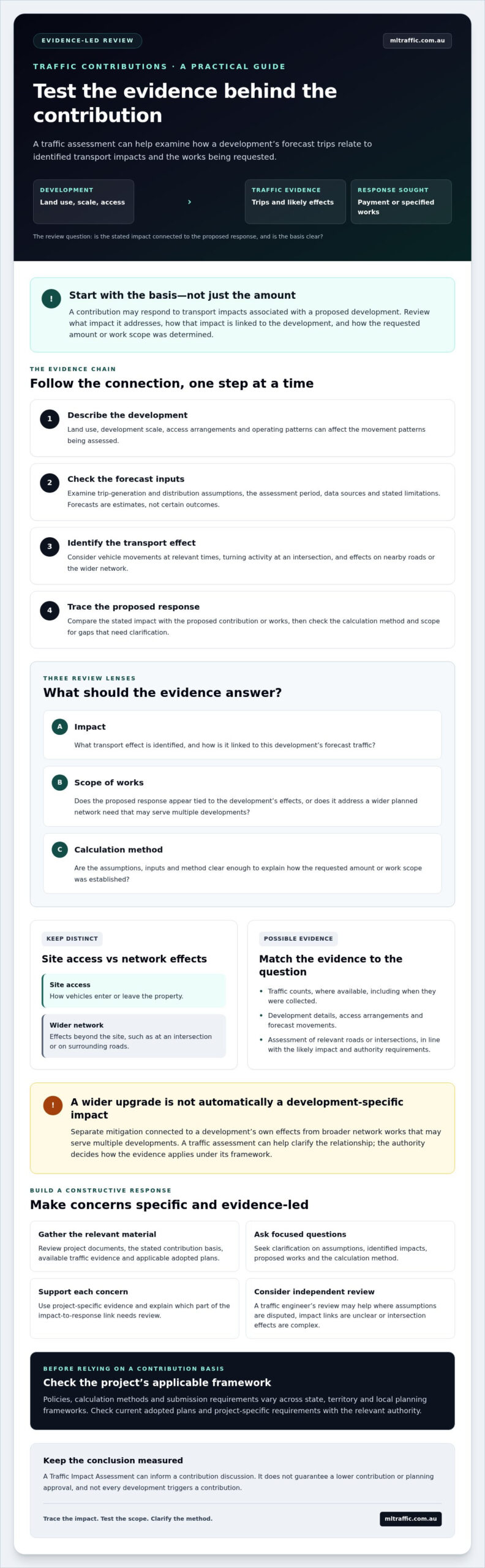
A traffic-related infrastructure contribution is funding or works an authority may seek in response to transport impacts associated with a proposed development. Depending on the applicable framework, this could involve a payment towards infrastructure or delivery of specified works. Consider the contribution alongside its stated purpose: which impact it addresses, how that impact is linked to the development, and how the requested amount or work scope has been determined.
The term can cover different arrangements. For a general explanation of impact fees and their use in funding public services, including roads, see Development impact fees. This is background reading, not a guide to Australian requirements. Contribution policies, calculation methods and submission processes vary across state, territory and local planning frameworks. Check the current adopted plans and project-specific requirements with the relevant authority.
How a development can create transport impacts
Transport effects depend on the development’s land use, scale, access arrangements and operating patterns. A proposal may generate vehicle movements at particular times, change turning activity at an intersection or affect traffic on the surrounding road network. The assessment period and forecast assumptions matter because different uses and operating hours can produce different movement patterns.
Separate the site’s access needs from wider network effects. A driveway issue may relate to how vehicles enter or leave the site, while an intersection or road-network effect may occur beyond its boundary. Not every development triggers a contribution. Confirm whether one is proposed and the basis for it under the relevant framework and authority requirements.
What a traffic-related contribution may fund
Depending on the applicable plans and assessment method, proposed measures may include road or intersection works, access improvements or active-transport infrastructure. These examples aren’t a universal list of eligible works. Check the authority’s adopted plans and the stated method for the project before assuming a particular item can be funded through a contribution.
A key distinction is between mitigation tied to a development’s own effects and a broader network upgrade that may serve multiple developments. A traffic assessment for infrastructure contributions can document the development’s forecast traffic and examine its likely effects. It can also help clarify whether the proposed scope appears connected to those effects or addresses a wider planned need. The authority decides how the evidence applies under its framework. An assessment informs that decision but doesn’t determine it.
Keep the basis visible. Identify the stated impact, the proposed response and the method used to establish the contribution. This gives you a practical starting point for reviewing the evidence in the next section.
How a traffic assessment for infrastructure contributions builds evidence for a review
A Traffic Impact Assessment (TIA) can provide a structured account of existing traffic conditions, the development’s expected vehicle movements and likely effects on nearby roads and intersections. Its value in a contribution review lies in tracing the connection between a forecast impact and the response being requested, rather than treating a forecast as proof that every proposed work is necessary.
Forecasts rely on assumptions. Land use and development scale influence trip generation; distribution assumptions indicate the routes vehicles may take; and the assessment period affects which traffic conditions are examined. If those inputs don’t match the proposal or the authority’s brief, the results may not answer the relevant question. A TIA should make its data sources, assumptions and limitations clear.
Which traffic evidence may be relevant
The appropriate evidence depends on the development and the authority’s requirements. It may include traffic counts, development details, access arrangements and forecast movements, where available. Check when counts were collected and whether they represent the conditions being assessed. Forecasts are estimates, not certain outcomes, so their limitations should be stated clearly.
The assessment scope should match the likely impact. A site access review can examine how vehicles enter and leave the property. Intersection analysis can test effects at specific junctions and help identify whether a forecast constraint is connected to development traffic or reflects existing conditions. Confirm the required scope and data against the authority’s brief.
How to make the assessment useful in discussions
Make each link explicit: identify the location, movement or network constraint, explain the development’s expected contribution to it, then compare that effect with the proposed work. A useful comparison sets out the no-development case and the proposed-development case using consistent, transparent assumptions. This can help distinguish an effect attributable to the proposal from a wider planned upgrade.
Australian contribution requirements and assessment methods depend on the relevant planning framework. Check the authority’s current adopted plans and project-specific requirements, and ask how the stated traffic impact relates to the proposed work and calculation method.
For further background, consult a Traffic Impact Assessment guide for Australian developers. ML Traffic Engineers Australia provides Traffic Impact Assessments and intersection analysis. Review the available traffic engineering services to identify technical services relevant to your project.
Is the proposed traffic contribution justified? Test the impact, scope and calculation
A requested contribution needs a traceable, project-relevant basis. Review the authority’s stated traffic impact, the works or funding sought, and the method used to calculate the development’s share. A traffic assessment for infrastructure contributions can help test whether those elements align, but it doesn’t establish an error or determine the authority’s decision on its own.
Start with the connection between impact and proposed works. Ask which development-generated movements or capacity effects each item is intended to address, and where those effects occur. If an intersection upgrade is proposed, check whether the assessment identifies development traffic affecting that intersection. If the work also responds to existing deficiencies or broader planned growth, ask how those needs are distinguished and allocated.
Check the connection between impact and proposed works
Use the available traffic evidence to identify what is supported, unclear or not yet explained. Treat gaps as questions for the authority or a technical adviser, not as established errors. An upgrade may address a development impact and wider network needs at the same time, so the basis for the work’s scope and the development’s share should be clear.
| Category | What to check |
|---|---|
| Project mitigation | Is the work linked to a specific access, movement or network effect identified for the proposal? |
| Shared infrastructure | Does the adopted plan explain how costs or delivery are allocated across developments? |
| Needs clarification | Are the purpose, calculation inputs, scope or relationship to forecast impacts unclear? |
Review assumptions, allocation and scope
Confirm that the assessment reflects the proposal’s current land use, scale, access arrangements and traffic assumptions. Check that the calculation method refers to the same development details and assessment period. Where the applicable plan describes how shared works are apportioned, compare that method with the calculation provided. Don’t assume an equal share, or any other allocation, without checking the relevant documents.
Contribution frameworks differ across Australia. Check the current adopted contribution plan, applicable methodology and submission requirements with the relevant authority for your project. Confirm that the documents you’re relying on apply to the development and that any calculation reflects the authority’s stated method.
Keep your review evidence-led. Record each concern against the relevant document, assumption or work item, then ask a focused question or request clarification. Avoid declaring a contribution unlawful or negotiable without first checking the governing framework and project documents. A clear record helps move the discussion from a disputed figure to the evidence behind its impact, scope and calculation.
How to negotiate traffic-related development contributions with a clear evidence trail
Constructive discussions start with an organised record, not a disputed figure in isolation. Use this workflow to prepare for a meeting or written response. A traffic assessment for infrastructure contributions can help you test the technical basis, but the relevant authority’s process and adopted documents will shape what can be considered.
- Gather the record. Collect the contribution request, planning correspondence, applicable traffic assessments, development plans and any calculation or scope documents provided.
- Check the applicable plan. Confirm which contribution framework applies, how it describes the relevant works and what it says about allocation, timing and delivery.
- Test the evidence. Compare the request with the traffic assumptions, forecast impacts and locations identified in the assessment. Note any mismatch or missing explanation.
- Clarify the gaps. Ask focused questions about development scale, trip assumptions, work scope, allocation across developments, timing and responsibility for delivery.
- Submit a reasoned response. Set out the evidence, the issue it raises and the clarification or review you’re seeking. Keep the tone factual and specific.
Keep correspondence, assessment versions and authority responses together in the application record. Record dates and identify which version of a plan or assessment each discussion refers to. This makes it easier to track whether assumptions, scope or next steps have changed.
Prepare a focused submission or meeting agenda
Start with a short summary of the requested contribution, the relevant traffic evidence and the points needing clarification. Separate technical questions, such as forecast movements or intersection effects, from planning, commercial or legal questions that may require other advisers. At the end of a meeting, confirm the agreed actions and request written confirmation of any revised assumptions, scope or next steps.
For technical background, consult a Traffic Impact Assessment guide and The Role of a Traffic Engineer in Developments. These topics can help frame questions about the assessment’s role without implying that traffic evidence determines the contribution outcome.
Compare practical response options
Depending on the evidence, a reasonable next step may be to seek clarification, request updated analysis, discuss an alternative mitigation measure or accept that the current basis supports no change. Timing and delivery options depend on the governing plan and authority process. Negotiation doesn’t guarantee that a contribution will be reduced, deferred or removed.
If you need technical input to review a Traffic Impact Assessment or intersection effects, consider ML Traffic Engineers’ Traffic Impact Assessment services. An assessment can inform your response, but it can’t guarantee a particular contribution outcome or planning approval.
When a traffic engineer can help, and what to do next
A traffic engineer may be useful when the contribution relies on disputed traffic assumptions, the link between forecast impacts and proposed works isn’t clear, or intersection effects are complex. A technical review can help identify what the available evidence supports and which questions need clarification. It can inform discussions with the authority, but it can’t guarantee a reduced contribution, a particular decision or planning approval.
The appropriate scope depends on the issue. A Traffic Impact Assessment can document development traffic and likely network effects. Intersection analysis can examine how forecast movements relate to a specific junction. For a traffic assessment for infrastructure contributions, the aim is to provide relevant technical evidence, not legal advice or a substitute for checking the applicable contribution framework.
What to provide for an initial technical discussion
Gather the material that explains both the proposal and the authority’s request. This may include:
- A development description and current plans, including land use, scale and access arrangements.
- The contribution notice or request, plus any applicable planning or contribution documents you have.
- Existing traffic reports, available transport data and correspondence with the authority.
Share what’s available and identify anything you don’t have. Ask the consultant to confirm the proposed assessment scope, which questions it can address and what further information may be required. This helps keep the technical work focused on the decision in front of you.
Choose support that fits the decision in front of you
Match the assessment to the concern. If the request relies on estimated development traffic, a Traffic Impact Assessment may be relevant. If the main question concerns a junction, intersection analysis may help clarify the forecast effect. Ask the authority to confirm its assessment requirements, and check the applicable plans and process for current project-specific requirements.
ML Traffic Engineers provides Traffic Impact Assessments and intersection analysis, alongside other traffic engineering services. Review the traffic engineering services to see which listed technical services may fit your project. ML Traffic Engineers has more than 15 years of experience supporting development applications across Australia. Its assessment work can support an evidence-led discussion, but the relevant authority determines the outcome under the framework that applies.
To discuss your project, have the development details, authority request and existing traffic material ready.
Build your response on clear traffic evidence
A fair review starts with the evidence, not the contribution figure alone. Check whether the traffic impacts, proposed works and calculation method are clearly connected to your development. A traffic assessment for infrastructure contributions can help identify where assumptions need clarification and support a measured discussion with the relevant authority.
Contribution requirements vary between planning frameworks, so confirm the applicable plan and process for your project. Keep your documents and correspondence organised, and seek technical advice if the impact links are unclear, assumptions are disputed or intersection effects are complex.
ML Traffic Engineers brings more than 15 years of traffic engineering and transport planning experience. Its services include Traffic Impact Assessments and intersection analysis, which can provide relevant technical evidence for development discussions. An assessment can inform your response, but it can’t guarantee a contribution outcome or planning approval.
Have your development details, authority request and existing traffic material ready. Discuss your traffic assessment requirements and take the next step with a clearer evidence base.
Frequently Asked Questions
What is a traffic-related infrastructure contribution?
A traffic-related infrastructure contribution is funding or specified works an authority seeks to address transport impacts associated with a development. It may relate to expected vehicle movements, access effects or pressure on nearby intersections, depending on the proposal and applicable framework. Requirements, calculation methods and processes differ across Australian state, territory and local planning systems. Check the current authority requirements and project documents rather than assuming one national approach.
Can a traffic assessment reduce a development contribution?
A traffic assessment may inform a review, but it can’t guarantee a reduced contribution or any change. A Traffic Impact Assessment can document existing conditions, forecast development traffic and assess likely network effects. Compare that evidence with the authority’s stated impact, proposed works and calculation method. If assumptions or links need explanation, raise specific questions with supporting material. The relevant authority decides how the evidence applies under its framework.
How do I assess whether a traffic contribution is proportionate?
Assess whether a proposed traffic contribution is proportionate by tracing the link between forecast development impacts and the requested works or amount. Review the assessment assumptions, including land use, trip generation, routes and assessment period, then compare them with the proposal. Check how the applicable contribution method calculates any share of shared infrastructure. If inputs, scope or allocation aren’t explained, request clarification before drawing conclusions.
What information should I provide when challenging a traffic-related contribution?
Provide the authority’s request, the applicable contribution plan or planning documents, and a clear description of the proposed development. Include relevant traffic reports, available transport data and the assumptions used in forecasts, such as trip generation and traffic distribution. Add correspondence already received, noting any points the authority has clarified or left unresolved. Organise documents by date and version so reviewers can follow the evidence behind each question.
Who determines traffic-related development contributions in Australia?
The relevant planning authority applies the contribution framework for the project, but responsibilities and processes vary between Australian jurisdictions and local planning systems. Depending on the framework, state or territory policies and local plans may both be relevant. There isn’t one national process or calculation method to assume applies everywhere. Check the current adopted plan, authority request and submission requirements for the development before preparing a response.
When should I engage a traffic engineer to review a contribution request?
Consider technical advice if traffic assumptions are unclear or disputed, the connection between forecast impacts and proposed works is difficult to follow, or intersection effects are complex. A review may also help where the work scope or calculation inputs aren’t explained. A traffic engineer can examine relevant traffic evidence and identify technical questions for the authority. Confirm the proposed review scope and information needed before proceeding.
Does a Traffic Impact Assessment guarantee planning approval or a lower contribution?
No. A Traffic Impact Assessment provides technical evidence about a development’s traffic effects; it doesn’t guarantee planning approval, a lower contribution or a changed authority decision. The authority considers the application and assessment under the requirements that apply to the project. A clear report can help explain traffic assumptions and impacts, but the outcome depends on the authority’s review of the complete application and relevant planning framework.

Disclaimer
The content on www.mltraffic.com.au, including all technical articles, guides, and resources, is provided for general informational and educational purposes only. It is not intended to constitute professional advice in traffic engineering, transportation planning, development approvals, or any other technical or legal field.
While ML Traffic Engineers makes every reasonable effort to ensure the accuracy, completeness, and timeliness of the information published, we do not provide any warranties or representations (express or implied) regarding its reliability, suitability, or availability for any particular purpose. Any reliance you place on the content is strictly at your own risk.
In no event shall ML Traffic Engineers, its directors, employees, authors, or affiliates be liable for any direct, indirect, incidental, special, consequential, or punitive damages (including, without limitation, loss of profits, data, or business opportunities) arising out of or in connection with the use of, or inability to use, any information provided on this website.
The articles and guides on this site are not a substitute for engaging a qualified, registered professional traffic engineer (such as an NPER or RPEQ engineer) to assess your specific project requirements. For tailored advice, compliance assessments, or traffic engineering services, please contact a competent professional.
This disclaimer may be updated from time to time without notice. By accessing or using this website, you agree to be bound by the most current version of this disclaimer.
