
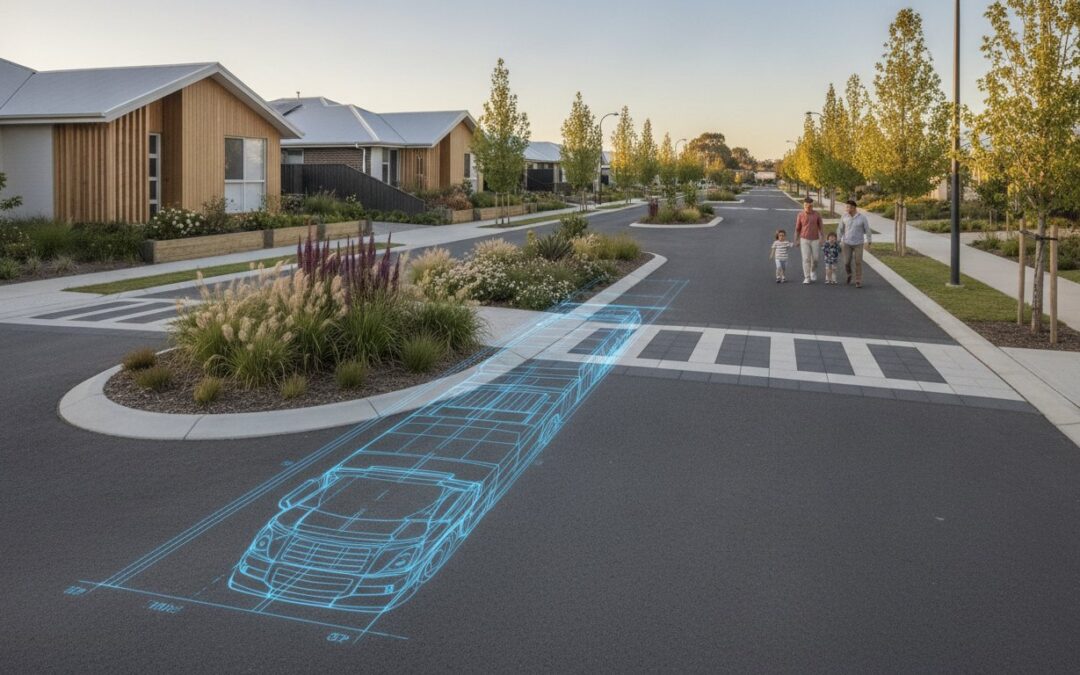
The profitability of a new development is often decided at the intersection of road safety and lot yield. Implementing the right traffic calming measures for residential subdivisions is no longer optional; it is a fundamental requirement for securing Council approval and ensuring long-term resident safety. Research published in 2026 indicates that well-designed physical calming measures can reduce road incidents by over 41%, yet many developers still struggle with designs that are either rejected for being inadequate or dismissed for being over-engineered and unnecessarily costly.
We recognise the frustration of having a Development Application stalled because of traffic safety concerns or road widths that don’t accommodate heavy vehicle movements. This guide outlines how to implement compliant, effective traffic calming strategies that satisfy both Austroads requirements and Australian Standards. You’ll discover how to utilise senior-led technical assessments and swept path analysis to create a DA-ready traffic management strategy. We will examine specific treatments that reduce vehicle speeds without compromising access for waste trucks or emergency services, ensuring your project remains safe, accessible, and commercially viable.
Key Takeaways
- Understand why Councils mandate Local Area Traffic Management (LATM) and how these features protect pedestrian safety in new developments.
- Identify the specific engineering requirements for various traffic calming measures for residential subdivisions, including vertical deflections, horizontal shifts, and psychological treatments.
- Learn to balance effective speed reduction with the functional requirements of Vehicle Swept Path Analysis to ensure access for waste and emergency vehicles.
- Discover how a professionally prepared Traffic Impact Assessment (TIA) justifies your design and accelerates the Council DA approval process.
- Optimise project costs by selecting the most effective treatments that naturally enforce safety without resorting to over-engineered or obstructive road designs.
The Role of Traffic Calming in Modern Residential Subdivision Design
Traffic calming in the Australian context is a core component of Local Area Traffic Management (LATM). It involves using physical and perceptual cues to influence motorist behaviour and improve the safety of the road environment. For developers, the inclusion of traffic calming measures for residential subdivisions is a mandatory requirement to secure Development Application (DA) approval. Councils prioritise these features to protect pedestrian safety and maintain the intended function of local access roads within new communities.
The modern design philosophy focuses on “self-explaining streets.” This concept suggests that the road environment itself should dictate driver behaviour. When a street is wide and straight, motorists naturally accelerate. By introducing constraints like narrowed carriageways or horizontal shifts, the design forces a reduction in speed. The primary objectives are straightforward: eliminate through-traffic seeking shortcuts and maintain the 85th percentile speed at a safe, residential level, usually 40km/h or 50km/h.
Balancing Safety and Resident Amenity
Well-planned traffic calming increases the market value of a subdivision by creating “quiet” streets. High-speed traffic is a significant detractor for potential home buyers, particularly families. Designers must address the conflict between vehicle speed and child safety without compromising overall accessibility. It is essential to maintain efficient emergency vehicle access while slowing passenger cars. We utilise Vehicle Swept Path Analysis to ensure that larger vehicles, including fire trucks and waste collection services, can navigate these safety features without obstruction or delay. This meticulous approach prevents the “over-engineering” that often leads to resident complaints regarding noise or access difficulties.
Regulatory Framework: Austroads and Australian Standards
Adherence to national standards ensures that traffic treatments are safe, predictable, and legally defensible. The key regulatory documents include:
- AS 1742.13: The Australian Standard for Local Area Traffic Management, providing uniform requirements for signs and markings.
- Austroads Guide to Traffic Management Part 8: This guide offers comprehensive advice on managing local street networks and selecting appropriate treatments.
- Council Development Control Plans (DCPs): Local government authorities often have specific mandates that supplement national guides, dictating preferred materials or specific spacing for treatments.
Failing to account for these standards during the initial design phase often leads to Council rejecting the DA. Professional consultancy ensures that every proposed measure is compliant and technically sound, reducing the risk of costly redesigns or delays during the approval process.
The Traffic Calming Toolbox: Engineering Solutions for Safer Streets
Engineering effective traffic calming measures for residential subdivisions requires a selection of treatments categorised by their physical impact on vehicle movement. These are generally divided into vertical deflection, horizontal shifts, and psychological or visual treatments. Every measure must be “Council-ready,” meaning it adheres to the design parameters set out in the Traffic Calming ePrimer and relevant Australian Standards. Selecting the correct tool involves balancing speed reduction goals with the need for low-maintenance infrastructure that doesn’t burden local government budgets.
Vertical Deflection Measures
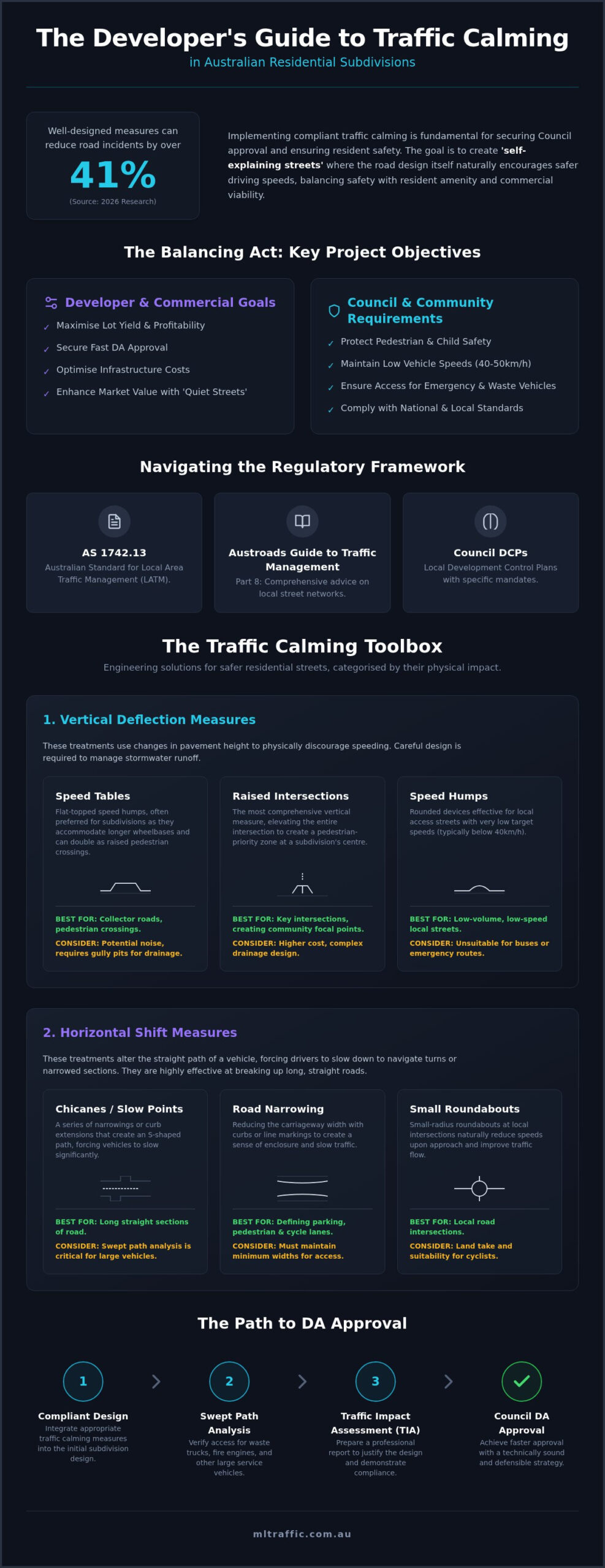
Vertical treatments use changes in pavement height to discourage speeding. Standard speed humps are effective for local access streets with very low speed limits. However, speed tables (flat-top humps) are often preferred for subdivisions because they accommodate longer wheelbases and can serve as raised pedestrian crossings. Raised intersections are the most comprehensive vertical measure, creating a pedestrian-priority zone at the subdivision’s centre. Designers must carefully plan gully pit placement and stormwater runoff around these features to avoid localised flooding or ponding.
Horizontal Shift and Narrowing
Horizontal treatments reduce velocity by forcing a change in the driver’s path or narrowing the visual field. Chicanes and lateral shifts create a winding path that naturally lowers speeds. Kerb extensions, or bulb-outs, are highly effective at intersections; they shorten pedestrian crossing distances and prevent vehicles from cornering at high speeds. Centre islands and median treatments narrow the available carriageway, which prevents overtaking and signals to drivers that they are entering a high-activity residential environment.
Physical and Visual Closures
Limiting traffic volume is as critical as limiting speed. Cul-de-sacs remain a staple for reducing cut-through traffic, while diagonal diverters prevent internal loops from becoming thoroughfares. Entry thresholds, which use varied pavement textures or colours, act as a psychological cue. These signal to motorists that they are transitioning from a higher-speed collector road into a shared residential space.
Regardless of the chosen treatment, developers must perform a Vehicle Swept Path Analysis for every proposed measure. This ensures that while passenger cars are slowed, essential services like waste collection and emergency vehicles maintain unhindered access. Ensuring these traffic calming measures for residential subdivisions don’t impede heavy vehicles is vital for DA approval. If you are unsure which treatments suit your site constraints, our team can provide a detailed Traffic Impact Assessment to justify your design choices to Council.
Evaluating Effectiveness: Choosing the Right Measure for Your Site
Selecting the appropriate traffic calming measures for residential subdivisions requires a precise analysis of the specific road hierarchy. Access Streets, designed for low-volume residential traffic, allow for more aggressive calming treatments than Collector Roads, which must maintain higher throughput for the broader network. On-street parking often acts as a natural speed deterrent by narrowing the effective carriageway. Strategic placement of parking bays reduces the perceived road width, which encourages lower speeds without always requiring expensive physical infrastructure.
The choice of treatment also depends on the specific problem the developer is trying to solve. If the goal is to prevent the subdivision from being used as a high-speed shortcut, the engineering focus shifts from simple speed reduction to volume management. This requires a holistic view of the internal street network to ensure that measures implemented on one street don’t create new safety issues elsewhere.
Speed Management vs. Volume Control
Vertical deflection measures, such as speed tables, are superior for managing vehicle velocity. In contrast, horizontal treatments like chicanes or narrowed entries are more effective at reducing overall traffic volumes by making the route less attractive to through-traffic. Designers must account for the “diversion effect,” where excessive calming on one street inadvertently increases traffic on adjacent residential links. We utilise traffic modelling to predict how residents and visitors will navigate the subdivision, ensuring safety is distributed evenly across the site.
The “Swept Path” Constraint
Council approval hinges on the ability of service vehicles to navigate the street network safely. A common reason for DA rejection is a design that inhibits a 12.5-metre Heavy Rigid Vehicle (HRV), such as a waste collection truck or fire appliance. Swept Path Analysis is the critical check for all horizontal traffic calming measures, providing a digital simulation of vehicle movements to verify that proposed radii and narrowings are functional. If a 12.5m HRV cannot clear a chicane without mounting a kerb or encroaching on pedestrian zones, the design will fail to meet Australian Standards. This assessment is non-negotiable for any subdivision design seeking to include horizontal shifts.
Cost-effectiveness should be evaluated from a long-term civil construction perspective. Simple measures like painted median strips or prefabricated rubber speed humps offer low initial costs but often require more frequent replacement. Permanent concrete treatments, while requiring a higher upfront investment, provide better long-term durability and more consistent speed reduction. Every project requires a bespoke balance of these factors to ensure the final design is both safe for the community and commercially viable for the developer.
Navigating the Council Approval Process for Subdivision Traffic Schemes
Securing approval for traffic calming measures for residential subdivisions requires a rigorous, evidence-based approach. Councils do not approve traffic schemes based on aesthetic preference; they require technical justification that proves the design will maintain safety without impeding essential services. A professionally prepared Traffic Impact Assessment (TIA) serves as the primary instrument for this justification. It bridges the gap between the developer’s lot yield goals and the local government’s safety mandates.
Council planners often raise objections based on potential noise from vertical deflections or future resident complaints. Addressing these concerns early through data-driven design is essential. By providing clear evidence of expected speed reductions and noise mitigation, you can streamline the approval process and avoid costly Requests for Information (RFIs) that stall your project timeline.
Step-by-Step Approval Workflow
The path to a DA-ready traffic scheme follows a structured sequence. Skipping these steps often results in delays or design rejections during the assessment phase.
- Initial site assessment: We conduct traffic generation modelling to determine expected volumes and identify potential hotspots for speeding or shortcutting.
- Drafting the scheme: Based on the modelling, we select specific calming locations and treatments that align with the road hierarchy and site constraints.
- Swept Path Analysis: We run digital simulations to verify that the proposed measures accommodate 12.5m heavy rigid vehicles, as established in the previous analysis.
- Final TIA submission: The complete technical report is compiled, providing the engineering rationale for every sign, line, and physical treatment.
Managing Liability and Compliance
Compliance with Australian Standards is the only way to mitigate long-term liability. Every treatment must adhere to AS 1742.13 regarding signage, line marking, and visibility. Designers have a specific duty of care to all road users, including motorcyclists, who are particularly vulnerable to poorly designed vertical deflections or slippery pavement textures. Using non-standard or creative treatments without a robust engineering basis can expose the developer to significant legal risk if an incident occurs. Professional traffic engineering certification ensures that your plans meet these national benchmarks and are defensible under regulatory scrutiny.
A well-certified plan gives Council the confidence to approve your development without demanding over-engineered and expensive road treatments. If you need to finalise your subdivision’s safety strategy, contact our senior principals today for a compliant, DA-ready assessment.
Integrating Traffic Calming into Your Traffic Impact Assessment (TIA)
ML Traffic Engineers Australia incorporates traffic calming measures for residential subdivisions directly into the Traffic Impact Assessment (TIA) report. We don’t treat road safety as an isolated design element; it’s a core component of the site’s functional layout. By embedding calming strategies within the TIA, we provide Councils with a unified technical document that addresses traffic generation, vehicle velocity, and pedestrian safety simultaneously. This integrated approach ensures the proposed road network is safe for vulnerable road users while remaining fully accessible for residents and service providers.
Our methodology focuses on engineering precision. We avoid the common pitfall of “over-calming,” which often leads to excessive tyre noise, resident frustration, and inflated civil construction costs. A senior-led assessment ensures that every treatment is justified by empirical data and traffic modelling. We analyse the synergy between individual driveway access, internal Car Park Design, and the broader subdivision streetscape. This ensures that vehicles exiting private property enter a road environment that naturally enforces safe speeds through physical and visual cues.
The ML Traffic Engineers Australia Advantage
Engaging our firm provides direct access to the senior principals who perform the technical work themselves. We don’t delegate critical safety assessments to junior staff. We bring over 15 years of Australian consultancy experience to every project, with a deep understanding of specific Council requirements across all states and territories. Our involvement spans the entire project lifecycle, from initial concept design to final Council sign-off. This personnel continuity promise ensures that the expert who initiates the client relationship is the same one performing the technical work and defending the design to regulatory authorities.
Ensuring DA Success
A well-documented traffic calming plan is the most effective tool for reducing the risk of costly Requests for Further Information (RFIs). We ensure every physical measure is cross-referenced with Australian Standards, including AS 2890.1 for parking facilities and AS 1742.13 for local area traffic management. This level of technical detail demonstrates to Council that the development has been designed with a rigorous duty of care. Our comprehensive suite of services includes:
- Traffic Impact Assessment (TIA) Reports: Full technical justification for subdivision layouts.
- Vehicle Swept Path Analysis: Verification for waste trucks and emergency vehicles.
- Intersection Analysis: Ensuring safe entry and exit points for the development.
- Waste Management Plans: Coordinating collection routes with calming treatments.
Securing a compliant and efficient traffic design is essential for the commercial viability of your subdivision. To discuss your project requirements with a seasoned expert, contact ML Traffic Engineers Australia today. We provide the authoritative technical advice required to navigate the Council approval process and deliver a safe, functional residential community.
Secure Your Subdivision Approval with Expert Traffic Design
Successful property development requires a strategic approach to road safety that satisfies both regulatory bodies and future residents. Implementing effective traffic calming measures for residential subdivisions is not just about slowing cars; it’s about creating a functional, self-explaining environment that accommodates heavy vehicle access through precise Swept Path Analysis. By choosing the correct engineering treatments early in the design phase, you avoid the high costs of over-engineered solutions and the delays of Council RFIs.
ML Traffic Engineers Australia provides over 15 years of expert traffic engineering consultancy. We offer direct principal-led service for every subdivision project, ensuring a senior expert handles your technical work from inception to final sign-off. As specialists in Australian Council DA approvals, we deliver the authoritative documentation required to move your project forward. Contact ML Traffic Engineers Australia for a compliant Traffic Impact Assessment to ensure your subdivision meets all safety and compliance benchmarks. We look forward to helping you deliver a safe and successful community.
Frequently Asked Questions
What are the most common traffic calming measures used in Australian subdivisions?
Common traffic calming measures for residential subdivisions in Australia include speed tables, chicanes, and kerb extensions. Designers also frequently utilise entry thresholds and median islands to narrow the visual field for motorists. These treatments are selected based on the specific road hierarchy and the target 85th percentile speed for the local area.
Do traffic calming measures affect property values in new estates?
Effective traffic calming typically has a positive impact on property values by enhancing residential amenity. Streets with lower traffic volumes and reduced vehicle speeds are highly prioritised by owner-occupiers, particularly families. By creating a “quiet” street environment, developers can market the subdivision as a safer and more desirable community, which often translates to higher lot yields.
How do I ensure waste trucks can still access streets with chicanes or speed humps?
Heavy vehicle access is ensured through the application of Vehicle Swept Path Analysis during the design process. This digital simulation verifies that a 12.5m heavy rigid vehicle, such as a waste collection truck, can navigate chicanes and tight radii without mounting kerbs. Accurate modelling prevents the design of obstructive features that would otherwise lead to Council rejection.
Is a Traffic Impact Assessment (TIA) required for every new residential subdivision?
A Traffic Impact Assessment is almost always a mandatory requirement for securing a Development Application (DA) for a new subdivision. Council planners use the TIA to evaluate how the proposed development will influence the existing road network. The report also serves to justify the internal road widths and the placement of safety features to ensure the estate meets Australian Standards.
What is the difference between a speed hump and a speed table?
A speed hump is a short, curved vertical deflection designed for aggressive speed reduction on very low-speed local streets. In contrast, a speed table is longer and features a flat top. Speed tables are often preferred in subdivisions because they provide a smoother crossing for emergency vehicles and can be integrated with pedestrian crossings to create a priority zone.
Can traffic calming measures be used to reduce through-traffic in my development?
Yes, horizontal shifts and physical closures are highly effective at discouraging cut-through traffic. By implementing chicanes or diagonal diverters, you make the internal route less direct and slower than the surrounding collector roads. This “diversion effect” ensures that the subdivision streets are utilised primarily by residents rather than motorists seeking a shortcut.
How does AS 1742.13 influence the design of traffic calming schemes?
AS 1742.13 provides the national standards for Local Area Traffic Management (LATM) devices, including their physical dimensions, signage, and line marking. Adherence to this standard is essential for ensuring that traffic calming measures for residential subdivisions are recognisable and safe for all road users. Failure to meet these requirements can result in significant legal liability for the developer.
What happens if the Council rejects my proposed traffic calming plan?
If Council rejects your traffic scheme, you must address their specific safety or access concerns through a redesign. This process requires providing additional technical evidence, such as a revised Swept Path Analysis or intersection analysis, to prove the design’s functionality. Engaging a senior traffic engineer ensures that the revised plan is technically sound and meets all regulatory benchmarks for approval.

Disclaimer
The content on www.mltraffic.com.au, including all technical articles, guides, and resources, is provided for general informational and educational purposes only. It is not intended to constitute professional advice in traffic engineering, transportation planning, development approvals, or any other technical or legal field.
While ML Traffic Engineers makes every reasonable effort to ensure the accuracy, completeness, and timeliness of the information published, we do not provide any warranties or representations (express or implied) regarding its reliability, suitability, or availability for any particular purpose. Any reliance you place on the content is strictly at your own risk.
In no event shall ML Traffic Engineers, its directors, employees, authors, or affiliates be liable for any direct, indirect, incidental, special, consequential, or punitive damages (including, without limitation, loss of profits, data, or business opportunities) arising out of or in connection with the use of, or inability to use, any information provided on this website.
The articles and guides on this site are not a substitute for engaging a qualified, registered professional traffic engineer (such as an NPER or RPEQ engineer) to assess your specific project requirements. For tailored advice, compliance assessments, or traffic engineering services, please contact a competent professional.
This disclaimer may be updated from time to time without notice. By accessing or using this website, you agree to be bound by the most current version of this disclaimer.
