
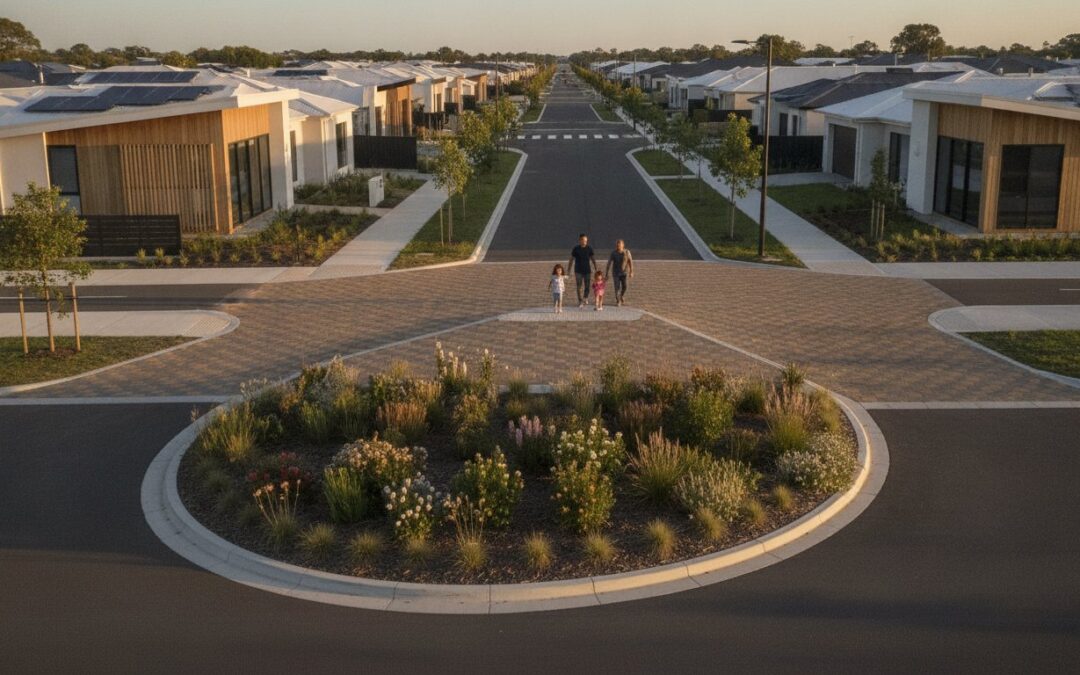
The most expensive traffic calming measure isn’t a raised intersection or a landscaped chicane; it’s the one you’re forced to retrofit after Council rejects your initial road network design. Most developers understand the tension between maintaining efficient traffic flow and meeting the high expectations for resident safety. Securing a successful traffic impact assessment for residential subdivision projects in 2026 requires more than just meeting minimum road widths. It demands a technical approach that satisfies current Australian guidelines and local authority requirements across the nation.
This guide provides the framework to design and implement compliant traffic calming measures that secure Council approval the first time. You’ll learn how to move beyond basic speed humps toward “self-explaining roads” that naturally dictate driver behaviour and speed. We will examine the technical requirements for intersection analysis, vehicle swept path assessments, and sight distance to ensure your estate is compliant, safe, and attractive to buyers.
Key Takeaways
- Learn to implement “self-explaining” road designs that use physical and psychological measures to naturally regulate vehicle speeds.
- Discover how a comprehensive traffic impact assessment for residential subdivision identifies high-speed straights where horizontal or vertical deflection is mandatory for safety.
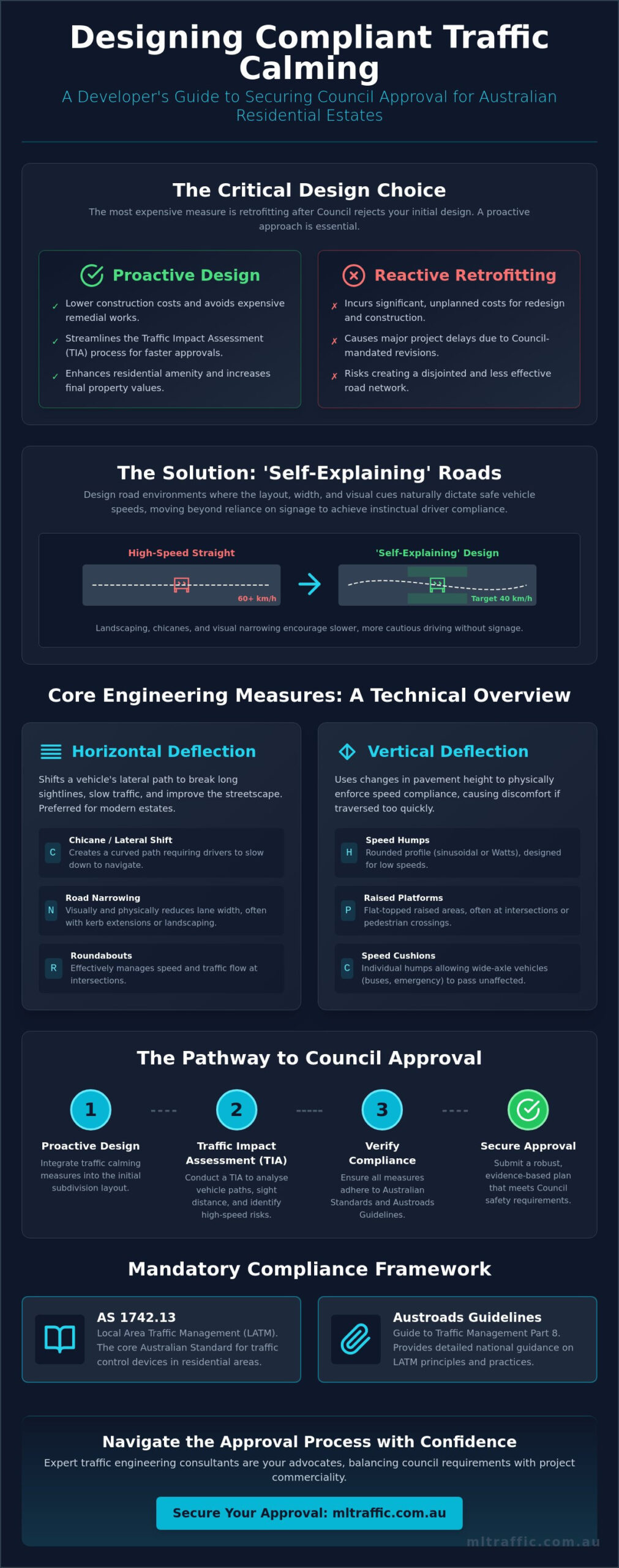
- Ensure full compliance with AS 1742.13 and Austroads Guide to Traffic Management Part 8 to secure Council approval and avoid the high cost of retrofitting.
- Understand the technical differences between horizontal and vertical interventions and how they impact vehicle paths and pavement height.
- Gain insights into using expert traffic engineering consultants as advocates to balance local government safety preferences with project commerciality.
Defining Traffic Calming for Modern Australian Residential Estates
Effective Traffic calming incorporates a combination of physical engineering and psychological cues designed to regulate driver behaviour. In the context of a new development, the primary objective is to create a “self-explaining” road environment. This means the layout, width, and visual cues of the street network dictate safe vehicle speeds rather than relying solely on signage. For any traffic impact assessment for residential subdivision, demonstrating a proactive approach to speed management is essential for securing DA approval. It moves the focus from enforcement to natural compliance, ensuring drivers instinctively understand the appropriate speed for the environment.
The physics of road safety are clear. Reducing vehicle speeds significantly lowers the kinetic energy involved in potential collisions. This is particularly vital in residential areas where pedestrians, children, and cyclists are frequent. Proactive engineering during the design phase is far more cost-effective than retrofitting measures after a project is finished. Once a subdivision is constructed, installing chicanes or speed humps to satisfy Council safety concerns becomes an expensive exercise in remedial works. Effective planning ensures the road network functions correctly from day one. It also avoids the administrative delays associated with Council-mandated revisions that often occur when safety margins are deemed insufficient by planning officers.
The Core Objectives of Speed Management
Modern estate design targets a design speed of 30-40 km/h for local residential loops and cul-de-sacs. This speed threshold is critical for maintaining “residential amenity.” High-quality streetscapes increase property values and buyer appeal by creating a quieter, safer environment. We focus on ensuring the estate remains accessible for all transport modes. This includes integrating active transport paths for walking and cycling while maintaining the necessary clearances for service vehicles and waste collection. Balancing these requirements ensures the network is functional without compromising the safety of vulnerable road users.
Why Councils Demand Calming in a TIA
Local government authorities evaluate a traffic impact assessment for residential subdivision based on strict safety and efficiency criteria. Councils must adhere to state-based residential street design codes, such as the NSW Guide to Transport Impact Assessment or Victoria’s Road Management Regulations. A detailed Traffic Impact Assessment must prove that the proposed internal road network will not become a liability. By implementing robust calming measures, developers reduce the long-term risk of road safety incidents. This is a key priority for local planning departments during the assessment process, as it minimizes future maintenance and safety intervention costs for the local government.
Core Engineering Measures: Horizontal and Vertical Interventions
Physical interventions in residential road design are categorised into horizontal and vertical deflections. Each serves a specific technical role within a traffic impact assessment for residential subdivision, providing the empirical evidence required by Council that the proposed network will maintain safe operating speeds. Horizontal measures focus on shifting the vehicle’s lateral path to break long sightlines. Vertical measures use height changes to enforce physical speed compliance. Selecting the correct combination requires a detailed understanding of the local road hierarchy, intended land use, and the psychological impact of the streetscape on driver behaviour.
The selection process must also account for psychological measures. These use visual cues, such as narrowing the perceived road width through landscaping or different pavement textures, to influence driver psychology without physical obstruction. This layered approach creates a “self-explaining” road where the design itself dictates the speed. However, engineers must balance these measures with the need for efficient drainage and the placement of underground utilities. A poorly positioned speed hump can obstruct stormwater flow or interfere with access to essential service lines.
Horizontal Deflection Techniques
Horizontal deflection is frequently the preferred method for modern Australian residential estates because it integrates well with landscaping and avoids the noise issues sometimes associated with vertical ramps. These measures include:
- Chicanes and kerb extensions: These pinch points narrow the road at strategic intervals. They force drivers to steer through a series of curves, which naturally lowers speed.
- Central median islands: These provide essential pedestrian refuges and prevent dangerous overtaking manoeuvres on local residential loops.
- Roundabouts: These are highly effective at internal intersections for managing flow and reducing conflict points. They ensure that vehicles entering the intersection do so at a controlled, predictable speed.
Vertical Deflection and Pavement Design
Vertical measures provide a direct physical limit to speed. Their application must be meticulous to ensure they don’t impede emergency services or cause excessive noise for residents.
- Speed cushions vs. speed humps: Speed cushions are generally preferred for residential collector roads. Their design allows wide-axle emergency vehicles to pass with minimal delay while still slowing standard passenger cars.
- Raised platform intersections: These are ideal for high-pedestrian zones, such as areas adjacent to local parks or community centres. They signal a clear transition to a priority zone for vulnerable road users.
- Threshold treatments: These are installed at estate entries. They use different pavement textures or colours to signify the transition from a higher-speed external road to a low-speed residential zone.
To ensure these designs are functional for all users, conducting a Vehicle Swept Path Analysis is a critical step in the design process. This ensures that while cars are slowed, essential service vehicles like waste trucks and fire engines can still navigate the estate without obstruction.
Integrating Calming with Traffic Impact Assessments (TIA) for Subdivisions
A traffic impact assessment for residential subdivision must provide a dual-purpose analysis. It evaluates the impact of development traffic on the external road network while simultaneously auditing the internal safety of the proposed street layout. Integrating traffic calming measures at this initial stage ensures the road hierarchy is logical and immediately recognisable to new residents. By identifying potential “high-speed” straights through predictive traffic modelling, we can engineer safety into the plan before a single kerb is poured. This proactive approach prevents the common issue of residents complaining about speeding on long, uninterrupted local streets shortly after moving in.
Empirical data from the TIA serves as the primary technical evidence to justify the specific placement of chicanes or speed cushions to Council planning officers. This data-driven justification is essential for overcoming objections related to street parking loss or perceived inconvenience to drivers.
Data-Driven Design Selection
Trip generation rates dictate the appropriate road category and the intensity of calming required for each street within the estate. For example, a local access street with low volumes requires different interventions than a major collector road carrying several thousand vehicles per day. Spacing is a critical technical calculation. Measures must be positioned close enough to prevent drivers from accelerating to unsafe speeds between humps, typically between 80 to 120 metres apart depending on the target speed. We also evaluate the acoustic impact of these measures on adjacent lots. This ensures that speed reduction doesn’t come at the cost of excessive noise or vibration for residents living near vertical deflection hardware.
Swept Path Compliance for Calming Hardware
Every calming measure must be validated through Swept Path Analysis. We must demonstrate that 12.5m heavy rigid vehicles, such as standard Australian waste trucks, can navigate chicanes and pinch points without mounting non-mountable kerbs. Design specifications often include mountable kerbs for emergency vehicle access. This allows fire engines to bypass obstructions while still deterring standard passenger cars from taking a straight line. Finally, it’s vital to ensure that these measures do not interfere with AS 2890.1 compliant driveways. Poorly placed traffic islands or chicanes can restrict the required entry and exit angles for residential car parks. This leads to non-compliance and potential Council rejection during the operational phase of the development.
Adhering to Australian Standards and Austroads Guidelines
Regulatory compliance is the technical foundation of any successful development application. AS 1742.13 (Manual of uniform traffic control devices – Local area traffic management) provides the mandatory framework for the installation of all traffic control hardware. Designers must also apply the engineering principles detailed in the Austroads Guide to Traffic Management Part 8. These documents ensure that every chicane, speed cushion, or threshold treatment follows a uniform national standard. However, national guidelines are frequently supplemented by state-specific regulations. For example, a traffic impact assessment for residential subdivision in New South Wales must satisfy the Guide to Transport Impact Assessment (TS 00085, 2024). In Victoria, the Road Management (General) Regulations 2026 introduce specific requirements for infrastructure works. Failing to cross-reference these local variations often leads to immediate Council refusal.
Standardised Signage and Visibility
Visibility is non-negotiable for night-time safety within a residential estate. All calming hardware requires compliant retro-reflective signage to meet Australian Standards. This includes advisory speed signs and “Speed Hump” warning markers positioned at precise approach distances. Lighting standards are equally critical; calming points must be adequately illuminated to ensure drivers can identify changes in pavement height or road alignment before they reach the obstacle. Pavement marking patterns, such as “dragon’s teeth” or shark-tooth markings, must meet national visibility requirements for horizontal deflections. These visual cues prevent sudden braking and reduce the risk of rear-end collisions on local loops.
Austroads Design Principles for Estates
Austroads emphasises the “Design Speed” concept as a primary safety tool. This involves engineering a road to physically limit speeds to 40 km/h even if the default urban limit is 50 km/h. Achieving this requires meticulous material selection to maintain the estate’s aesthetic while meeting durability requirements. Integrating drainage is a technical necessity that is often overlooked. Speed humps and cushions must be designed so they do not create water ponding or block gutter flow. Engineering drawings must clearly demonstrate how stormwater will bypass the hardware to prevent localised flooding during heavy rain events. This level of detail is essential for a traffic impact assessment for residential subdivision to pass technical review.
Request a technical quote for a compliant Traffic Impact Assessment Report to ensure your subdivision meets all current state and national standards.
Securing Council Approval with Expert Traffic Engineering
Negotiating with local Councils is often the most complex phase of the land development process. Planning officers frequently have unique, localised preferences for traffic calming that can conflict with developer budgets or desired lot yields. A professional traffic engineering consultant acts as your technical advocate during these high-stakes discussions. We use empirical data and historical precedents to provide evidence-based rebuttals to excessive Council requests for intrusive or expensive calming hardware. For a traffic impact assessment for residential subdivision, this technical advocacy ensures that safety requirements are met without compromising the project’s commercial viability. ML Traffic Engineers Australia focuses on providing designs that are both fully compliant and physically constructible, preventing costly on-site modifications during the civil works stage.
The Role of the Traffic Consultant
Direct access to senior principals is a core component of our professional service model. This ensures your project benefits from over 15 years of technical negotiation experience with various Local Government Areas across Australia. We prepare comprehensive reports that pre-empt Council concerns regarding road safety, acoustic impacts, and resident amenity. Our team manages the Request for Further Information (RFI) process meticulously to prevent project bottlenecks. By providing clear, technically sound responses to Council queries, we move the application toward approval more efficiently. This hands-on approach ensures that the same expert who initiates the relationship performs the technical work, maintaining total accountability throughout the approval lifecycle.
The Path to DA Approval
Securing a Development Application (DA) requires integrating traffic calming measures seamlessly into the broader Statement of Environmental Effects (SEE). We work to finalise a road layout that maximises lot yield while strictly adhering to Austroads guidelines and state regulations. This involves balancing the physical footprint of chicanes, medians, or roundabouts with the need for efficient land use and drainage. A well-designed network earns Council approval the first time and creates a safe, liveable estate that naturally attracts premium buyers. Contact ML Traffic Engineers Australia today to discuss the specific traffic requirements and traffic impact assessment for residential subdivision needs for your next development project.
Engineering a Compliant and Safe Residential Future
Designing a residential estate that balances high-yield layouts with rigorous safety standards requires a technical, data-driven approach. Implementing “self-explaining” road networks through horizontal and vertical interventions ensures the design dictates driver behaviour, reducing reliance on signage and enforcement. A comprehensive traffic impact assessment for residential subdivision is the primary instrument used to prove these design choices to local government authorities.
ML Traffic Engineers Australia provides the technical expertise and negotiation experience required to navigate the complexities of modern development applications. Our team offers over 15 years of specialised consultancy in Australian traffic engineering, ensuring every project adheres to the latest Austroads standards and state-specific Council requirements. You receive direct access to senior principals for every assessment, providing a level of accountability and expertise that larger firms cannot match.
Contact ML Traffic Engineers Australia for an expert Traffic Impact Assessment and compliant subdivision design to secure your project’s future. We look forward to helping you deliver a safe, compliant, and commercially successful residential development.
Frequently Asked Questions
What are the most effective traffic calming measures for a new residential estate?
Horizontal deflection measures, such as chicanes and kerb extensions, are highly effective because they integrate with landscaping and avoid the noise issues associated with ramps. Vertical measures, including speed cushions, provide a direct physical limit to vehicle speeds. A combination of these physical interventions with psychological cues, like narrowing the perceived road width, creates the most reliable “self-explaining” road environment for new developments.
Will Council require a Traffic Impact Assessment for a small residential subdivision?
Most Australian Councils require a transport plan for any development creating 3 or more residential lots. A formal traffic impact assessment for residential subdivision is typically triggered when a project generates 100 or more vehicle movements per day in New South Wales, or over 10 peak-hour trips in Western Australia. Developers must consult the local council’s Development Control Plan to confirm the specific triggers for their project area.
How far apart should speed humps or chicanes be placed in a new subdivision?
Effective spacing for traffic calming measures generally ranges between 80 and 120 metres. This distance is calculated to prevent drivers from accelerating to unsafe speeds between interventions while maintaining a target design speed of 40 km/h or lower. Placing measures too far apart reduces their effectiveness, whereas excessive frequency can frustrate residents and lead to unnecessary noise and vibration issues on local residential loops.
Does traffic calming reduce property values in a new residential development?
Well-designed traffic calming generally enhances property values by improving “residential amenity” and overall safety. Buyers prioritize estates where vehicle speeds are naturally regulated, making streets safer for children and pedestrians. By reducing through-traffic and noise, these engineering measures create a quieter, more attractive environment. This often leads to higher market demand compared to subdivisions with long, uninterrupted straights that encourage speeding.
Are there traffic calming measures that do not affect emergency vehicle response times?
Speed cushions and mountable kerbs are specifically engineered to accommodate emergency services. Unlike continuous speed humps, speed cushions allow wide-axle vehicles like fire engines and ambulances to straddle the raised section without slowing significantly. Mountable kerbs on chicanes provide a similar benefit, allowing larger vehicles to bypass the deflection in an emergency while still deterring standard passenger cars from maintaining a straight, high-speed line.
What is the difference between a speed hump and a speed cushion in Australian design?
A speed hump is a continuous raised platform that spans the entire width of the carriageway, forcing all vehicles to reduce speed. A speed cushion consists of several smaller raised platforms with gaps between them. These gaps are designed to allow heavy rigid vehicles and emergency services with wider wheelbases to pass through with minimal disruption, while standard passenger cars must engage the vertical deflection.
Can landscaping be used as a legitimate traffic calming measure for Council approval?
Landscaping is a recognised psychological measure that narrows a driver’s perceived road width, which naturally encourages lower speeds. While it’s a valuable tool for improving estate aesthetics and amenity, Councils rarely accept landscaping as a standalone solution. It’s most effective when used in conjunction with physical hardware, such as central median islands or chicanes, to ensure the road design meets technical safety and compliance standards.
How do I ensure my traffic calming design is compliant with AS 1742.13?
Ensuring compliance involves a meticulous review of the proposed road network against national and state-specific standards. A professional traffic impact assessment for residential subdivision will detail the required signage, lighting, and pavement markings to satisfy AS 1742.13. This technical report serves as your primary evidence that the design is safe, compliant, and ready for Council approval without the need for expensive post-construction modifications or remedial works.

Disclaimer
The content on www.mltraffic.com.au, including all technical articles, guides, and resources, is provided for general informational and educational purposes only. It is not intended to constitute professional advice in traffic engineering, transportation planning, development approvals, or any other technical or legal field. While ML Traffic Engineers makes every reasonable effort to ensure the accuracy, completeness, and timeliness of the information published, we do not provide any warranties or representations (express or implied) regarding its reliability, suitability, or availability for any particular purpose. Any reliance you place on the content is strictly at your own risk. In no event shall ML Traffic Engineers, its directors, employees, authors, or affiliates be liable for any direct, indirect, incidental, special, consequential, or punitive damages (including, without limitation, loss of profits, data, or business opportunities) arising out of or in connection with the use of, or inability to use, any information provided on this website. The articles and guides on this site are not a substitute for engaging a qualified, registered professional traffic engineer (such as an NPER or RPEQ engineer) to assess your specific project requirements. For tailored advice, compliance assessments, or traffic engineering services, please contact a competent professional. This disclaimer may be updated from time to time without notice. By accessing or using this website, you agree to be bound by the most current version of this disclaimer.
