

We are traffic engineers involved with traffic control management plans in Sydney and surrounding regions.
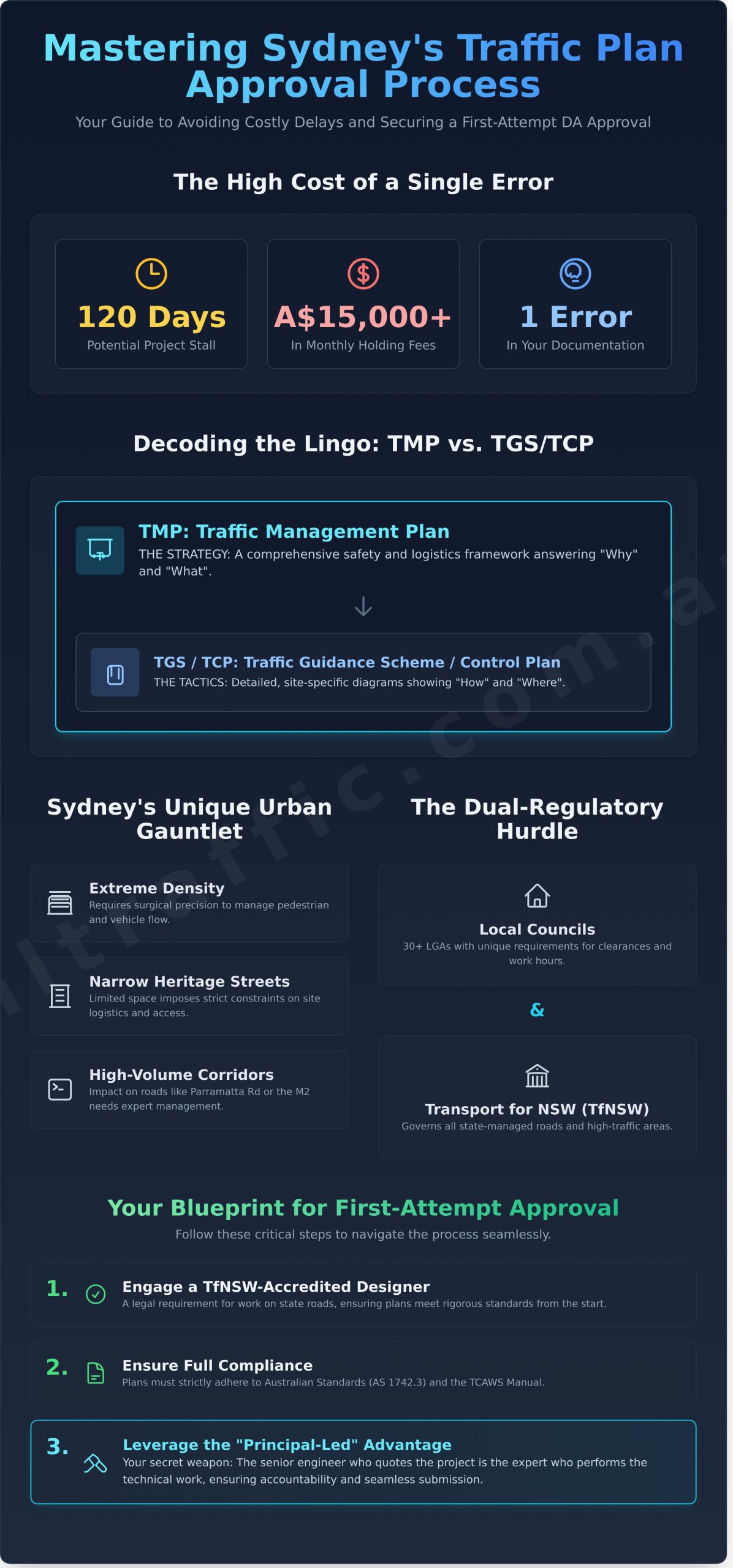
A single documentation error in your traffic control management plan Sydney can stall a multi-million dollar development for 120 days. You’ve likely dealt with the frustration of submitting a DA only to receive a technical objection that sends you back to the drawing board. It’s a common bottleneck that costs developers upwards of A$15,000 in monthly holding fees. We agree that the distinction between a Traffic Management Plan (TMP) and a Traffic Guidance Scheme (TGS) is often unnecessarily complicated by shifting council requirements.
This guide gives you a clear path to mastering the 2026 Sydney approval process and avoiding those expensive bureaucratic delays. You’ll learn the exact steps needed to satisfy council planners and secure your permits on the first attempt. We’ll break down the technical requirements for site logistics and show you how to minimize liability while keeping your construction schedule on track.
Key Takeaways
-
Understand why Sydney’s high-density environment demands a more robust safety and logistics framework than standard Australian developments.
-
Distinguish between strategic TMPs and tactical TGS/TCP designs to ensure your documentation aligns perfectly with specific DA requirements.
-
Navigate the dual requirements of local councils and TfNSW to fast-track your traffic control management plan Sydney and avoid expensive bureaucratic delays.
-
Identify the five critical elements, from vehicle movement to pedestrian protection, that make the difference between a rejected plan and a site-ready approval.
-
Discover the "principal-led" advantage and why having the senior engineer who quotes the project actually do the work is your secret to seamless DA approval.
Table of Contents
-
What is a Traffic Control Management Plan in the Sydney Context?
-
TMP, TGS, and TCP: Deciphering the Acronyms for Your Project
-
Navigating Sydney Council and Transport for NSW (TfNSW) Requirements
What is a Traffic Control Management Plan in the Sydney Context?
A traffic control management plan Sydney is far more than a simple permit application. It’s a comprehensive safety and logistics framework designed to mitigate the risks inherent in urban construction and civil works. Sydney presents unique challenges that you won’t find in other Australian capitals. Our city’s extreme density, narrow heritage streets, and high-volume corridors like the Parramatta Road or the M2 require surgical precision in planning. A TCMP is a strategic document that ensures pedestrian and vehicle safety while maintaining traffic flow during construction.
To better understand this concept, watch this helpful video:
In Sydney’s competitive development environment, these plans are your primary defense against legal and safety liabilities. If an accident occurs on-site or in the surrounding traffic zone, your TCMP is the first document authorities will examine. It proves you’ve applied standard Road traffic control principles to protect the public. Without a rigorous plan, developers face massive exposure to litigation and insurance claims that can derail a multi-million dollar project instantly.
The Legal Necessity for Your Sydney DA
The Environmental Planning and Assessment Act 1979 dictates how development impacts public spaces in New South Wales. For the vast majority of Sydney projects, a traffic control management plan Sydney is a mandatory condition of consent. You can’t turn a sod of soil until the local council or Transport for NSW (TfNSW) approves your traffic strategy. If you attempt to proceed without an approved plan, the consequences are severe. Local councils regularly issue stop-work orders that freeze your project for weeks. Furthermore, under the NSW Work Health and Safety Act, corporations can face fines exceeding A$3 million for serious safety breaches, while individual officers can be held personally liable for negligence.
Who Actually Designs These Plans?
There’s a significant difference between the traffic controllers you see on the street and the engineers who design the frameworks. While controllers execute the daily operations, the actual design must be handled by qualified professionals. For any work affecting state-managed roads or high-traffic areas, you’re legally required to use a TfNSW-accredited designer. These experts ensure that every Vehicle Movement Plan (VMP) and Traffic Guidance Scheme (TGS) complies with the latest Australian Standards, specifically AS 1742.3.
Professional designers understand the nuances of Sydney’s 30-plus local government areas. Each council, from the City of Sydney to the Northern Beaches, has its own specific requirements for pedestrian clearances and work hours. The team at ML Traffic Engineers brings over 35 years of industry experience to this process. We don’t just draw lines on a map; we provide a "no-gatekeepers" approach where the consultant who quotes your job is the one who does the technical work. This ensures your DA submission is meticulous, compliant, and ready for immediate approval.
-
Accreditation: Designers must hold current TfNSW certifications.
-
Compliance: Plans must meet AS 1742.3 and the TCAWS Manual.
-
Accountability: Professional engineers provide the technical weight needed for council approval.
TMP, TGS, and TCP: Deciphering the Acronyms for Your Project
Acronyms in the Sydney construction industry can feel like a secondary language. If you’re applying for a Development Application (DA) or a Road Occupancy Licence (ROL), you’ve likely seen terms like TMP, TGS, and TCP thrown around. Using them interchangeably is a common mistake that leads to council delays. A traffic control management plan Sydney requires specific technical documentation that matches the scale of your project. At ML Traffic Engineers Pty Ltd, we’ve seen hundreds of applications stalled because a developer submitted a simple diagram when
Navigating Sydney Council and Transport for NSW (TfNSW) Requirements
Managing traffic in Sydney requires a clear understanding of a dual-regulatory framework. You aren’t just submitting paperwork to one office. Local councils control the majority of the road network, but Transport for NSW (TfNSW) maintains authority over Classified Roads. If your site borders a state-managed artery, the complexity of your traffic control management plan Sydney increases. For major CBD developments, the Sydney Coordination Office (SCO) also oversees the 2.4 square kilometers of the city center. Since 2015, the SCO has managed the cumulative impact of Tier 1 projects to ensure construction doesn’t paralyze the grid. They require rigorous data on vehicle swept paths and peak-hour impact before granting access to the city’s core.
This "two-headed" regulatory system means your project might need approval from both a local traffic committee and a state-level authority. A failure to recognize which body has jurisdiction over your specific street corner can lead to months of delays. We’ve seen developers lose thousands of dollars in equipment hire costs because they applied to the council for a permit that only TfNSW could grant. Understanding these boundaries is the first step toward a successful application.
Classified Roads and TfNSW Concurrence
When your site sits on a major artery like Parramatta Road or the Pacific Highway, council approval isn’t enough. You need TfNSW concurrence. This involves the Road Occupancy Licensing (ROL) process, requiring precise technical data for the Traffic Management Centre (TMC). ML Traffic Engineers manages this liaison directly. We’ve handled thousands of ROL applications since 2005, ensuring your site meets state safety standards without unnecessary delays.
Local Council Nuances: From North Sydney to the Inner West
Council requirements vary across the 30 plus LGAs in Sydney. A plan for Penrith will likely fail in the Inner West. Inner West Council often requires "Construction Load" assessments to protect narrow heritage streets. North Sydney Council prioritizes resident parking and pedestrian flow. We address these local nuances in your report to prevent the "Request for Information" (RFI) loops that stall projects for weeks.
Local experience is the only way to ensure project approval. Since 2005, ML Traffic Engineers has completed over 10,000 projects across every Sydney LGA. We understand the specific preferences of council engineers because we’ve worked with them for decades. We don’t use junior staff as gatekeepers or middle-men. The consultant who provides your quote, such as Michael Lee or Benny Chen, is the person who does the technical work. This direct accountability ensures your traffic control management plan Sydney is accurate and compliant with Australian Standards like AS 2890.1.
Our senior engineers, with between 30 and 40 years of experience each, personally oversee the liaison with authorities to secure your permits efficiently. We provide the technical expertise to get your project moving without the bureaucratic headache. We’ve worked on every land-use type from apartments and bars to temples and warehouses. This breadth of knowledge means we anticipate council objections before they are even raised, providing a persuasive and data-backed report that facilitates a smooth approval process.
5 Critical Elements of a Successful Traffic Management Plan
A high quality traffic control management plan Sydney councils will actually approve requires more than just standard templates. It demands technical precision to avoid the A$2,500 plus daily costs associated with project delays or site shutdowns. At ML Traffic Engineers, we’ve refined over 10,000 sites by focusing on five core technical pillars that satisfy both Transport for NSW (TfNSW) and local government requirements.
-
Vehicle Movement Plans (VMP): We map the exact arrival and departure routes for specific vehicle classes, such as 12.5m Heavy Rigid Vehicles or 19m semi-trailers. This ensures trucks don’t mount kerbs or get stuck in narrow Sydney side streets; preventing gridlock and potential property damage.
-
Pedestrian Management: In high-density areas like the Sydney CBD or Parramatta, we account for footfall exceeding 600 people per hour during peak periods. Our plans prioritize physical separation and clear signage to keep the public safe without bottlenecking foot traffic.
-
Swept Path Analysis: We use digital simulations to prove that the largest intended vehicle can physically navigate the site. This is a non-negotiable requirement for most Development Applications (DA) in the City of Sydney.
-
Risk Assessment: We identify at least 15 to 20 site-specific hazards, from blind corners to overhead power lines, before any work begins. This document aligns with AS 1742.3 standards to minimize liability for the project manager.
-
Public Transport Integration: Sydney’s Light Rail and B-Line bus corridors have strict "no-go" times and clearance rules. We coordinate with transit authorities to ensure your project doesn’t interrupt the 2-minute frequency of light rail services on George Street.
The Power of Swept Path Analysis
Our engineers use AutoTURN software to create undeniable proof of accessibility for Council reviewers. This technical simulation is the most effective way to solve disputes over driveway width or loading dock design. Since ML Traffic engineers perform these analyses in-house for every major report, you get immediate feedback on whether your architectural layout complies with AS 2890.1. We don’t guess; we provide the geometric proof that your site works.
Addressing the "Work Zone" Challenge
Securing a dedicated work zone is often the difference between finishing on time or falling weeks behind. To get a "yes" from Council, you must justify the removal of local street parking. We calculate the exact impact on parking turnover and offer mitigated solutions, such as off-peak loading schedules. A well-argued report from a senior consultant with 30 years of experience makes the Work Zone application process significantly smoother and faster.
A robust traffic control management plan Sydney authorities can trust is your best insurance policy against compliance fines and construction bottlenecks. We ensure every detail, from sight-line assessments to ramp grades, meets the highest engineering standards.
[Get a professional traffic management plan for your Sydney project today](https://mltraffic.com.au)
Why a Principal-Led Report is Your Secret to DA Approval
At ML Traffic, we operate on a simple principle: the engineer who quotes your project is the one who actually performs the technical assessment. This isn’t common practice in the industry. Larger consultancy firms often use a model where you speak to a senior director during the sales phase, but your traffic control management plan Sydney is handed off to a junior graduate with limited field experience. When that report reaches a Council officer, the lack of depth becomes obvious. Junior-led reports often face multiple rounds of requests for information (RFIs) because they lack the foresight to address complex site constraints before they become problems.
Michael Lee and Benny Chen have been trading as ML Traffic Engineers since 2005. In those 19 years, we’ve handled more than 10,000 sites across New South Wales. We’ve worked on every conceivable land-use type, including apartments, bars, childcare centers, medical clinics, temples, and warehouses. This volume of work means we’ve seen every possible objection a Council might raise. When you choose a principal-led approach, you’re bypassing the gatekeepers and junior staff who act as a barrier to progress. You’re getting direct access to the people who actually sign the documents and stand by the data.
The Accountability Advantage
Accountability shouldn’t be a buzzword. When you call our office, you don’t get a receptionist or a project coordinator; you speak directly to Michael Lee or Benny Chen. This direct line of communication is vital when a project deadline is looming. With between 30 and 40 years of individual experience each, we provide a level of technical certainty that juniors simply can’t match. Our reports carry the weight of RPEQ (Registered Professional Engineer of Queensland) and professional engineering registrations. This provides immediate credibility with local authorities who recognize our names on the cover page.
Seniority translates into speed. We don’t spend hours researching basic Australian Standards because we’ve lived them for decades. We know exactly what a Council officer is looking for in a swept path assessment or a car parking demand analysis. By addressing potential issues like driveway ramp grades or sight-line obstructions in the first draft, we significantly reduce the likelihood of costly delays. You aren’t just paying for a document; you’re paying for a decade and a half of reputation that helps smooth the path to approval.
Get Started with Your Sydney Traffic Plan
Securing your approval shouldn’t be a bureaucratic nightmare. We follow a streamlined four-step process designed for efficiency. First, we provide a fixed-fee quote so you know your exact costs upfront. Second, we conduct a thorough assessment of your site’s specific requirements. Third, we produce a comprehensive report, including your traffic control management plan Sydney, that meets all Australian Standards like AS 2890.1. Finally, we support you through the approval phase to ensure the Council is satisfied with the technical findings.
Our process is transparent and results-oriented. You can view ML Traffic videos to see our engineers explain technical concepts in detail and showcase our approach to complex traffic problems. Don’t let your development application stall in the hands of a junior staffer at a large firm who doesn’t understand the nuances of your specific site. Instead, contact the principals directly for a quote on your Sydney project and put 40 years of engineering expertise in your corner.
Secure Your Sydney Project Approval with Expert Traffic Planning
Navigating the evolving 2026 landscape of Sydney Council and TfNSW requirements demands more than a basic checklist. You need a strategy that addresses the nuances of TGS and TMP documentation while ensuring full compliance with Australian Standards. We’ve seen how a principal-led report is often the deciding factor for a smooth DA process. At ML Traffic Engineers, we operate on a simple promise: the consultant who provides your quote is the expert who completes the work. We’ve successfully assessed over 10,000 sites across Australia, bringing a depth of local knowledge that larger, impersonal firms often lack.
Your project deserves the oversight of senior engineers with more than 35 years of specialized experience. We focus on providing a traffic control management plan Sydney developers use to clear regulatory hurdles without the typical delays. Our team specializes in Sydney Council and TfNSW compliance, ensuring your application doesn’t get stuck in a cycle of revisions. By providing direct access to our principals, we ensure your technical assessments are accurate and authoritative from the first draft. It’s the most reliable way to keep your project on schedule. Get a direct quote from our Principal Engineers for your Sydney project today and get your development moving.
Frequently Asked Questions
How much does a traffic management plan cost in Sydney?
A basic traffic guidance scheme for a standard residential site typically starts between A$300 and A$600. For a complex traffic control management plan Sydney councils require for major developments, costs often range from A$2,000 to A$5,500. These figures depend on the project’s scale and the technical requirements of the specific local government area. Investing in a professional plan prevents expensive council fines and project shutdowns.
How long does it take to get a traffic management plan approved by Council?
Standard approval times in Sydney usually range from 10 to 20 business days. While some councils offer a 5 day fast track service for an extra fee, projects affecting state roads managed by Transport for NSW often require 6 weeks for full processing. You should submit your application at least 30 days before your start date to ensure your project stays on schedule and avoids costly delays.
Do I need a traffic management plan for a small residential build?
You’ll definitely need a plan if your work impacts the public road, footpath, or nature strip in any way. Even simple tasks like placing a skip bin or parking a concrete pump on the street trigger council requirements for a formal plan. Without one, you’re looking at immediate stop-work orders and fines that can exceed A$2,500 for a single day of non-compliance.
What is the difference between a TCP and a TGS in NSW?
A Traffic Guidance Scheme (TGS) is the current technical term for what many still call a Traffic Control Plan (TCP). The TGS is the actual diagram showing sign placement and cone layouts. A comprehensive traffic control management plan Sydney authorities demand is a larger document that includes the TGS alongside risk assessments and written safety strategies. We provide both to ensure your site meets Australian Standard 1742.3.
Can I create my own traffic control plan using a template?
You can’t legally design your own plan unless you hold a SafeWork NSW "Design and Inspect Traffic Control Plans" qualification. Councils will reject any submission that isn’t signed off by a certified professional with a valid ticket number. Templates fail to account for site-specific variables like driveway sight-lines or specific bus stop locations, which leads to immediate rejection and wasted application fees.
Who is authorized to sign off on a traffic management plan in Sydney?
Only individuals holding the "Prepare a Work Zone Traffic Management Plan" (PWZTMP) certification from SafeWork NSW can legally authorize these documents. Our senior engineers have over 30 years of experience and carry the necessary professional indemnity insurance to sign off on high-risk sites. This certification ensures your plan is compliant with both the AGTTM and local council regulations, giving you a clear path to approval.
What happens if my construction site blocks a bus lane in Sydney?
Blocking a bus lane requires a Road Occupancy Licence (ROL) from the Transport Management Centre and involves strict time restrictions. If you obstruct a bus route without a permit and 28 days of prior notice, you’ll face fines starting at A$2,200. You’ll also need to provide a detailed detour strategy and coordinate with operators like Transit Systems to ensure public transport remains functional during your work hours.
Does a traffic management plan include pedestrian safety measures?
Every professional plan must prioritize pedestrian and cyclist safety through dedicated management strategies. This includes mapping out temporary walkways that maintain a 1.5 meter clear width and installing appropriate pram ramps. In busy areas like the Sydney CBD, we often specify the use of accredited traffic controllers to manually manage pedestrian flow during peak periods, ensuring your site remains safe for every member of the public.
What areas do we cover?
We prepare Traffic Control Management Plans for developments in every suburb of Sydney such as Abbotsbury, Abbotsford, Acacia Gardens, Agnes Banks, Airds, Alexandria, Alfords Point, Allambie Heights, Allawah, Ambarvale, Angus, Annandale, Annangrove, Arcadia, Arncliffe, Arndell Park, Artarmon, Ashbury, Ashcroft, Ashfield, Asquith, Auburn, Austral, Avalon Beach, Badgerys Creek, Balgowlah, Balgowlah Heights, Balmain, Balmain East, Bangor, Banksia, Banksmeadow, Bankstown, Bankstown Aerodrome, Barangaroo, Barden Ridge, Bardia, Bardwell Park, Bardwell Valley, Bass Hill, Baulkham Hills, Bayview, Beacon Hill, Beaconsfield, Beaumont Hills, Beecroft, Belfield, Bella Vista, Bellevue Hill, Belmore, Belrose, Berala, Berkshire Park, Berowra, Berowra Heights, Berowra Waters, Berrilee, Beverley Park, Beverly Hills, Bexley, Bexley North, Bidwill, Bilgola Beach, Bilgola Plateau, Birchgrove, Birrong, Blackett, Blacktown, Blair Athol, Blairmount, Blakehurst, Bligh Park, Bondi, Bondi Beach, Bondi Junction, Bonnet Bay, Bonnyrigg, Bonnyrigg Heights, Bossley Park, Botany, Bow Bowing, Box Hill, Bradbury, Bradfield, Breakfast Point, Brighton-Le-Sands, Bringelly, Bronte, Brooklyn, Brookvale, Bundeena, Bungarribee, Burraneer, Burwood, Burwood Heights, Busby, Cabarita, Cabramatta, Cabramatta West, Caddens, Cambridge Gardens, Cambridge Park, Camellia, Cammeray, Campbelltown, Camperdown, Campsie, Canada Bay, Canley Heights, Canley Vale, Canoelands, Canterbury, Caringbah, Caringbah South, Carlingford, Carlton, Carnes Hill, Carramar, Carss Park, Cartwright, Castle Cove, Castle Hill, Castlecrag, Castlereagh, Casula, Catherine Field, Cattai, Cecil Hills, Cecil Park, Centennial Park, Chatswood, Chatswood West, Cheltenham, Cherrybrook, Chester Hill, Chifley, Chippendale, Chipping Norton, Chiswick, Chullora, Church Point, Claremont Meadows, Clarendon, Clareville, Claymore, Clemton Park, Clontarf, Clovelly, Clyde, Coasters Retreat, Cobbitty, Colebee, Collaroy, Collaroy Plateau, Colyton, Como, Concord, Concord West, Condell Park, Connells Point, Constitution Hill, Coogee, Cottage Point, Cowan, Cranebrook, Cremorne, Cremorne Point, Cromer, Cronulla, Crows Nest, Croydon, Croydon Park, Curl Curl, Currans Hill, Currawong Beach, Daceyville, Dangar Island, Darling Point, Darlinghurst, Darlington, Davidson, Dawes Point, Dean Park, Dee Why, Denham Court, Denistone, Denistone East, Denistone West, Dharruk, Dolans Bay, Dolls Point, Doonside, Double Bay, Dover Heights, Drummoyne, Duffys Forest, Dulwich Hill, Dundas, Dundas Valley, Dural, Eagle Vale, Earlwood, East Hills, East Killara, East Lindfield, East Ryde, Eastern Creek, Eastgardens, Eastlakes, Eastwood, Edensor Park, Edgecliff, Edmondson Park, Elanora Heights, Elderslie, Elizabeth Bay, Elizabeth Hills, Elvina Bay, Emerton, Enfield, Engadine, Englorie Park, Enmore, Epping, Ermington, Erskine Park, Erskineville, Eschol Park, Eveleigh, Fairfield, Fairfield East, Fairfield Heights, Fairfield West, Fairlight, Fiddletown, Five Dock, Forest Glen, Forest Lodge, Forestville, Frenchs Forest, Freshwater, Gables, Galston, Georges Hall, Gilead, Girraween, Gladesville, Glebe, Gledswood Hills, Glen Alpine, Glendenning, Glenfield, Glenhaven, Glenmore Park, Glenorie, Glenwood, Gordon, Grantham Farm, Granville, Grays Point, Great Mackerel Beach, Green Valley, Greenacre, Greendale, Greenfield Park, Greenhills Beach, Greenwich, Gregory Hills, Greystanes, Guildford, Guildford West, Gymea, Gymea Bay, Haberfield, Hammondville, Harrington Park, Harris Park, Hassall Grove, Haymarket, Heathcote, Hebersham, Heckenberg, Henley, Hillsdale, Hinchinbrook, Hobartville, Holroyd, Holsworthy, Homebush, Homebush West, Horningsea Park, Hornsby, Hornsby Heights, Horsley Park, Hoxton Park, Hunters Hill, Huntingwood, Huntleys Cove, Huntleys Point, Hurlstone Park, Hurstville, Hurstville Grove, Illawong, Ingleburn, Ingleside, Jamisontown, Jannali, Jordan Springs, Kangaroo Point, Kareela, Kearns, Kellyville, Kellyville Ridge, Kemps Creek, Kensington, Kenthurst, Kentlyn, Killara, Killarney Heights, Kings Langley, Kings Park, Kingsford, Kingsgrove, Kingswood, Kirkham, Kirrawee, Kirribilli, Kogarah, Kogarah Bay, Ku-ring-gai Chase, Kurnell, Kurraba Point, Kyeemagh, Kyle Bay, La Perouse, Lakemba, Lalor Park, Lane Cove, Lane Cove North, Lane Cove West, Lansdowne, Lansvale, Laughtondale, Lavender Bay, Leets Vale, Leichhardt, Len Waters Estate, Leppington, Lethbridge Park, Leumeah, Lewisham, Liberty Grove, Lidcombe, Lilli Pilli, Lilyfield, Lindfield, Linley Point, Little Bay, Liverpool, Llandilo, Loftus, Londonderry, Long Point, Longueville, Lovett Bay, Lower Portland, Lucas Heights, Luddenham, Lugarno, Lurnea, Macquarie Fields, Macquarie Links, Macquarie Park, Maianbar, Malabar, Manly, Manly Vale, Maraylya, Marayong, Maroota, Maroubra, Marrickville, Marsden Park, Marsfield, Mascot, Matraville, Mays Hill, McCarrs Creek, McGraths Hill, McMahons Point, Meadowbank, Melonba, Melrose Park, Menai, Menangle Park, Merrylands, Merrylands West, Middle Cove, Middle Dural, Middleton Grange, Miller, Millers Point, Milperra, Milsons Passage, Milsons Point, Minchinbury, Minto, Minto Heights, Miranda, Mona Vale, Monterey, Moore Park, Moorebank, Morning Bay, Mortdale, Mortlake, Mosman, Mount Annan, Mount Colah, Mount Druitt, Mount Kuring-Gai, Mount Lewis, Mount Pritchard, Mount Vernon, Mulgoa, Mulgrave, Narellan, Narellan Vale, Naremburn, Narrabeen, Narraweena, Narwee, Nelson, Neutral Bay, Newington, Newport, Newtown, Nirimba Fields, Normanhurst, North Balgowlah, North Bondi, North Curl Curl, North Epping, North Kellyville, North Manly, North Narrabeen, North Parramatta, North Rocks, North Ryde, North St Marys, North Strathfield, North Sydney, North Turramurra, North Wahroonga, North Willoughby, Northbridge, Northmead, Northwood, Norwest, Oakhurst, Oakville, Oatlands, Oatley, Old Guildford, Old Toongabbie, Oran Park, Orchard Hills, Oxford Falls, Oxley Park, Oyster Bay, Paddington, Padstow, Padstow Heights, Pagewood, Palm Beach, Panania, Parklea, Parramatta, Peakhurst, Peakhurst Heights, Pemulwuy, Pendle Hill, Pennant Hills, Penrith, Penshurst, Petersham, Phillip Bay, Picnic Point, Pitt Town, Pleasure Point, Plumpton, Point Piper, Port Botany, Port Hacking, Potts Hill, Potts Point, Prairiewood, Prestons, Prospect, Punchbowl, Putney, Pymble, Pyrmont, Quakers Hill, Queens Park, Queenscliff, Raby, Ramsgate, Ramsgate Beach, Randwick, Redfern, Regents Park, Regentville, Revesby, Revesby Heights, Rhodes, Richards, Richmond, Riverstone, Riverview, Riverwood, Rockdale, Rodd Point, Rookwood, Rooty Hill, Ropes Crossing, Rose Bay, Rosebery, Rosehill, Roselands, Rosemeadow, Roseville, Roseville Chase, Rossmore, Rouse Hill, Rozelle, Ruse, Rushcutters Bay, Russell Lea, Rydalmere, Ryde, Sackville North, Sadleir, Sandringham, Sandy Point, Sans Souci, Schofields, Scotland Island, Seaforth, Sefton, Seven Hills, Shalvey, Shanes Park, Silverwater, Singletons Mill, Smeaton Grange, Smithfield, South Coogee, South Granville, South Hurstville, South Maroota, South Penrith, South Turramurra, South Wentworthville, South Windsor, Spring Farm, St Andrews, St Clair, St Helens Park, St Ives, St Ives Chase, St Johns Park, St Leonards, St Marys, St Peters, Stanhope Gardens, Stanmore, Strathfield, Strathfield South, Summer Hill, Surry Hills, Sutherland, Sydenham, Sydney, Sydney Olympic Park, Sylvania, Sylvania Waters, Tallawong, Tamarama, Taren Point, Telopea, Tempe, Tennyson Point, Terrey Hills, The Ponds, The Rocks, Thornleigh, Toongabbie, Tregear, Turramurra, Turrella, Ultimo, Varroville, Vaucluse, Villawood, Vineyard, Voyager Point, Wahroonga, Waitara, Wakeley, Wareemba, Warrawee, Warriewood, Warwick Farm, Waterfall, Waterloo, Watsons Bay, Wattle Grove, Waverley, Waverton, Wedderburn, Wentworth Point, Wentworthville, Werrington, Werrington County, Werrington Downs, West Hoxton, West Pennant Hills, West Pymble, West Ryde, Westleigh, Westmead, Wetherill Park, Whalan, Whale Beach, Wheeler Heights, Wiley Park, Willmot, Willoughby, Willoughby East, Windsor, Windsor Downs, Winston Hills, Wisemans Ferry, Wolli Creek, Wollstonecraft, Woodbine, Woodcroft, Woodpark, Woollahra, Woolloomooloo, Woolooware, Woolwich, Woronora, Woronora Heights, Yagoona, Yarrawarrah, Yennora, Yowie Bay, Zetland.
