

A concrete pour is a high-risk heavy vehicle event that requires engineered precision, not just basic traffic signage. You already know that managing a fleet of heavy agitators in tight urban layouts is a logistical challenge that leaves no room for error. A single non-compliant maneuver can lead to immediate council shutdowns or safety incidents involving pedestrians. With 60 percent of highway construction firms reporting vehicle crashes in their work zones last year, the stakes for site safety are high. Securing a professional traffic control plan for concrete pour operations is the only way to ensure your site remains operational and compliant with the latest standards, such as the CA MUTCD 2026 or AS 1742.3.
This article explains the technical documentation required to manage these movements while maintaining vehicle flow to prevent concrete from curing in transit. You’ll learn how to navigate the permitting process and meet the rigorous review requirements mandated by local authorities. We’ll detail how an engineered site strategy ensures full regulatory compliance and supports a zero-incident execution on your next project. This approach moves beyond simple signage to provide a comprehensive framework for managing heavy vehicle interaction and pedestrian safety.
Key Takeaways
- Understand the critical distinction between a high-level management plan and a site-specific traffic control plan for concrete pour operations to prevent council shutdowns.
- Learn how Vehicle Swept Path Analysis verifies that heavy concrete agitators can safely navigate tight site layouts without compromising pedestrian safety.
- Identify the technical requirements of an engineered Traffic Guidance Scheme, including precise taper lengths and buffer zones tailored for heavy vehicle movements.
- Discover the streamlined process for securing pour permits through rigorous risk assessments and direct collaboration with senior traffic engineering principals.
Why a Specific Traffic Control Plan for Concrete Pouring is Critical
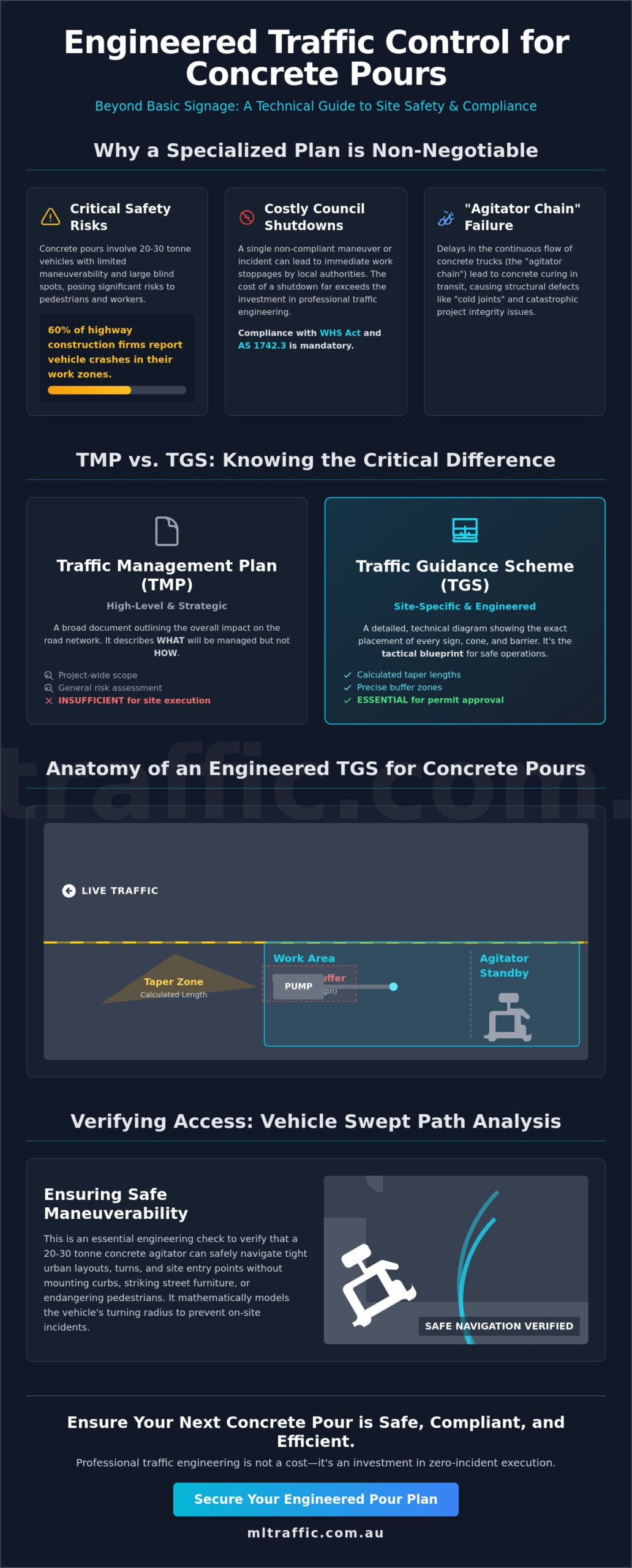
A traffic control plan for concrete pour operations is a specialized Traffic Guidance Scheme (TGS) designed to manage the unique risks of high-frequency, heavy vehicle movements. Unlike standard roadwork, concrete pours involve a time-sensitive “agitator chain” where delays lead to structural integrity issues like cold joints. Effective Road traffic control in this context requires managing 20 to 30 tonne vehicles with significant blind spots and limited maneuverability. These plans are not optional; they are a legal requirement for any site occupying the road reserve or interacting with public transit lanes.
Compliance is mandatory under the WHS Act and Australian Standard AS 1742.3. The high-risk nature of these events is backed by data. In 2024, there were 850 fatalities in work zones globally, and a 2026 industry survey found that 60 percent of highway construction firms reported at least one crash in their work zones. A single non-compliant maneuver can result in immediate council shutdowns. These shutdowns are far more expensive than the cost of professional engineering. A site-specific plan ensures that safety protocols are tailored to the exact layout of your site, protecting workers and the public from heavy vehicle interactions.
To better understand the practical implementation of these safety measures, watch this overview of construction traffic management:
The Logistics of the “Agitator Chain”
Managing a concrete pour requires balancing on-site pump capacity with street-side delivery logistics. You must maintain a continuous flow of trucks. If the chain breaks, the concrete begins to cure in the agitator or the pump, leading to catastrophic project delays. “Winging it” without a formal traffic control plan for concrete pour events results in trucks queuing in live traffic lanes. This creates congestion and safety breaches that invite regulatory intervention. An engineered strategy ensures that each truck has a designated standby area and a clear path to the pump, preventing site gridlock.
Regulatory Compliance and Council Requirements
Obtaining a Road Occupancy Licence (ROL) is the first hurdle for any major pour. Councils require detailed documentation that addresses pedestrian safety, especially in high-density development zones. A professional Traffic Guidance Scheme (TGS) accelerates the permit approval process by demonstrating to authorities that all risks are mitigated. This documentation proves your site meets the rigorous standards of both national and local regulations. It ensures a seamless vehicle flow from start to finish, reducing the likelihood of fines or work stoppages due to non-compliance.
Anatomy of an Engineered Traffic Guidance Scheme (TGS)
Engineering a traffic control plan for concrete pour operations requires a move from general safety concepts to technical site-specific design. Many site managers confuse a Traffic Management Plan (TMP) with a Traffic Guidance Scheme (TGS). A TMP is a strategic document outlining the project’s broad impact on the local road network. In contrast, a TGS is the tactical, engineered diagram that dictates the exact placement of every cone, sign, and barrier. A generic plan doesn’t account for the specific footprint of the pump or the turning requirements of heavy agitators.
Professional Traffic Engineering ensures that these diagrams adhere to calculated safety margins. When creating a traffic control plan for concrete pour events, taper lengths must be precisely calculated based on the prevailing speed limit and lane width. This ensures drivers have sufficient time to transition into the remaining open lanes safely. Longitudinal and lateral buffer zones are also integrated to provide a physical safety margin between live traffic and the work area. These spaces are unoccupied and free of equipment; they exist solely to protect workers if a vehicle enters the work zone accidentally.
Mapping the Work Zone
Concrete pours are classified as “Short-Term Stationary” works. This classification influences the type of delineation required. The work zone must include clearly defined exclusion zones for concrete pumps and their extending boom arms. These zones prevent unauthorized personnel or vehicles from entering high-risk areas where equipment failure or hose blockages could occur. Ensuring clear sightlines is equally vital. Traffic controllers must have an unobstructed view of approaching traffic and the vehicle entry points to manage the agitator chain effectively without causing street-side gridlock.
Signage and Delineation Standards
Required signage for heavy vehicle access includes “Trucks Entering” (W5-22) and “Roadwork Ahead” (T1-1) signs, positioned at intervals compliant with AS 1742.3 or the CA MUTCD 2026. For high-impact pours that require lane closures on major arterials, Variable Message Signs (VMS) are used to provide drivers with real-time updates. These electronic signs reduce driver frustration and improve compliance with temporary speed limits. Every element of the delineation must meet national regulatory standards. This ensures the site remains legally protected and accessible for the heavy agitators. If you require a compliant and site-specific diagram, you can explore our Traffic Guidance Scheme (TGS) design services.
Swept Path Analysis: Ensuring Heavy Vehicle Access
Engineering a traffic control plan for concrete pour events requires more than placing signs; it demands a geometric validation of vehicle movements. Swept Path Analysis is a critical component of this process. It uses specialized AutoTURN software to simulate the exact turning circles of concrete agitators and pump trucks on your specific site layout. This simulation identifies potential ‘pinch points’ where a 20-tonne vehicle might strike existing infrastructure or property. It also verifies that large pump trucks have the necessary lateral clearance to deploy their outriggers safely without encroaching on live traffic lanes or pedestrian footpaths. Without this analysis, you risk physical damage to the site and immediate project delays.
The use of AutoTURN allows our senior principals to test various ‘what-if’ scenarios before the first truck arrives. We can adjust the placement of the concrete pump by centimeters to ensure the entire agitator fleet can cycle through without incident. This level of technical foresight is what distinguishes an engineered plan from a basic sketch. It provides the assurance that the site layout is physically capable of supporting high-volume heavy vehicle movements. When 60 percent of highway construction firms reported work zone crashes in 2026, the value of pre-pour geometric verification cannot be overstated.
Agitator Maneuverability Challenges
Concrete agitators, specifically fully loaded 8×4 configurations, possess a significant turning radius that challenges tight urban sites. A precise traffic control plan for concrete pour activities must account for these dimensions to prevent mid-pour gridlock. Our engineers also conduct a Driveway Ramp Grade Assessment to ensure that heavy trucks don’t bottom out during site entry or exit. Designing efficient reversing maneuvers is another priority. Minimizing the time a truck spends reversing in live traffic reduces the window of risk for both the driver and the public.
Site Access and Egress Strategy
A robust site strategy establishes a logical one-way flow to eliminate congestion. Trucks should enter through a primary access point and exit via a separate egress to keep the agitator chain moving. We also analyze sight distances to ensure that merging trucks have a clear view of oncoming traffic, reducing the likelihood of collisions. Formalizing a designated ‘Wait Zone’ is essential. This prevents arriving trucks from queueing on public roads, which is a common cause of council shutdowns and traffic fines. This structured approach ensures site efficiency and maintains regulatory compliance throughout the pour.
Step-by-Step: Securing Your Pour Permits and Plans
Securing a compliant traffic control plan for concrete pour operations is a multi-stage regulatory process. It starts with a pre-construction consultation. Engaging a traffic engineer during this phase identifies potential roadblocks before they become expensive delays. The engineer performs a site-specific risk assessment to evaluate heavy vehicle interaction with pedestrians and local traffic. This assessment forms the technical foundation for the Traffic Management Plan and the associated Traffic Guidance Scheme (TGS). These documents must be drafted with precision to meet the specific requirements of the local council and road authorities.
Once the technical drawings are finalized, they are submitted for review. This process often involves addressing feedback regarding lane closures or pedestrian detours. A final site briefing is the last line of defense. All contractors, pump operators, and traffic controllers must review the TGS on-site. This ensures every team member understands the exclusion zones and vehicle entry protocols established in the engineered plan. To ensure your documentation meets all regulatory requirements, you should contact our senior principals to discuss your site requirements.
Lead Times and Coordination
Permit applications typically require submission 4 to 6 weeks before the scheduled work. This lead time is necessary for the rigorous review process conducted by local councils or state road authorities. You must coordinate delivery windows with your concrete supplier to ensure they align with the approved permit times. For major infrastructure, “Out of Hours” permits are often required to minimize peak traffic impact. Having a traffic control plan for concrete pour events ready well in advance prevents the project from stalling due to administrative delays.
Stakeholder Communication
Effective communication is a regulatory requirement that supports site safety. You must notify local residents and businesses of temporary road changes via letterbox drops or signage. If the pour requires road closures, liaising with emergency services is mandatory to ensure route continuity for ambulances and fire crews. Our “Personnel Continuity Promise” means the same senior principal who designs your plan is available for site queries during the pour. This direct line of accountability ensures that any real-time adjustments remain compliant with the original engineered strategy. Clear communication reduces driver frustration and improves overall compliance with the temporary traffic arrangements.
The ML Traffic Approach to Concrete Pour Planning
ML Traffic provides engineering-led solutions for developers, builders, and civil contractors. We bring over 15 years of experience to the management of complex construction traffic logistics. Our firm prioritizes technical precision and regulatory compliance to ensure zero-incident execution on every site. Every project we undertake includes direct access to senior principals for the development of every TGS and TIA report. This ensures that your traffic control plan for concrete pour operations is handled by a seasoned expert from inception to completion. We don’t utilize junior staff for critical technical assessments; the person who initiates the relationship performs the actual engineering work.
Our national coverage allows us to support projects in diverse urban and regional environments. We understand the bureaucratic requirements of local councils and road authorities across different jurisdictions. This experience translates into a streamlined approval process for our clients. We focus on creating a seamless vehicle flow that prevents on-site gridlock and protects the structural integrity of your pour. By integrating advanced software with decades of field experience, we deliver strategies that withstand the scrutiny of regulatory audits and site inspections.
Why Engineered Plans Beat Generic Templates
Generic templates often fail to account for the unique physical geometry of a specific site. A traffic control plan for concrete pour events must be customized to include precise swept paths for the exact agitator models used by your supplier. Relying on a non-engineered sketch increases the risk of council-imposed work stop orders and safety breaches. Every Traffic Engineer at ML Traffic understands the specific technical requirements of AS 1742.3 and relevant state supplements. We mitigate risk by identifying potential conflicts between heavy vehicles and pedestrians before the first truck arrives on-site.
Get Your Site Ready for the Next Pour
The assessment process begins with a comprehensive review of your site layout and project timelines. Meticulous documentation is essential for securing Development Application (DA) and Construction Certificate (CC) approvals. Our senior principals ensure that all traffic impact assessments and guidance schemes are robust enough to satisfy the most demanding regulatory bodies. This hands-on approach provides accountability and reliability for high-stakes infrastructure projects. Contact ML Traffic Engineers today for a compliant Traffic Guidance Scheme. We provide the technical expertise required to manage your high-risk heavy vehicle movements with confidence.
Secure Your Site with Engineered Traffic Precision
A successful pour depends on more than just the quality of the mix; it requires a meticulously engineered traffic control plan for concrete pour operations. You’ve seen how integrating technical Swept Path Analysis and site-specific Traffic Guidance Schemes (TGS) eliminates the guesswork that leads to council-imposed shutdowns. Prioritizing these engineering-led solutions ensures your site remains compliant with the latest regulatory standards while maintaining the critical flow of the agitator chain. Professional documentation isn’t just a hurdle for permits; it’s the foundation of site efficiency and public safety.
ML Traffic Engineers brings over 15 years of Australian traffic engineering experience to every project. We specialize in council-compliant TGS and technical assessments that protect your site and the public. With senior principal involvement in every project, you’re guaranteed direct accountability and professional expertise. Don’t leave your site safety to chance on pour day. Request a Technical Traffic Guidance Scheme for Your Project to ensure a seamless, zero-incident execution. We look forward to supporting the success of your next major infrastructure development.
Frequently Asked Questions
Do I need a formal traffic control plan for a single concrete truck?
A formal traffic control plan for concrete pour operations is required if the vehicle occupies any portion of the public road reserve or footway. Regulatory authorities don’t distinguish between a single agitator and a large fleet when it comes to public safety. Any activity that disrupts the normal flow of vehicular or pedestrian traffic necessitates a compliant, engineered plan to mitigate risk and meet legal WHS obligations.
What is the difference between a TCP and a TGS in Australia?
A Traffic Guidance Scheme (TGS) is the technical diagram illustrating the specific arrangement of signs, cones, and bollards. While Traffic Control Plan (TCP) is frequently used as a general industry term, the TGS is the tactical document required for on-site implementation under AS 1742.3. A Traffic Management Plan (TMP) remains the broader strategic document outlining the overall project impact and management policies.
How long does it take to get council approval for a concrete pour road closure?
Council approval for road closures typically requires a lead time of 4 to 6 weeks. This period allows for the rigorous review of technical documentation and coordination with relevant road authorities. Some jurisdictions offer expedited processing for minor occupancies, but major pours involving lane closures on arterial roads require the full assessment period to ensure public safety and network continuity.
Can a traffic engineer help if my site has very limited access for trucks?
Traffic engineers utilize Vehicle Swept Path Analysis to design solutions for sites with restricted footprints. We simulate truck movements using AutoTURN software to identify the most efficient entry and egress points. This process verifies that heavy vehicles can maneuver without striking infrastructure. It’s particularly vital in dense urban environments where traditional access is not feasible for 20-tonne agitators.
What are the penalties for pouring concrete without a valid traffic permit?
Operating without a valid traffic permit results in immediate site shutdowns and significant financial penalties. Local councils and state authorities have the power to issue work stop orders, which can delay projects for weeks. Beyond fines, non-compliance exposes the builder to immense liability in the event of a work zone incident involving heavy vehicle and pedestrian interaction.
Does a traffic control plan include the provision of physical traffic controllers?
No, our services focus exclusively on the engineering and design phase of traffic management. We provide the technical Traffic Guidance Scheme and required impact assessments, but we don’t provide physical traffic control personnel or equipment. You must engage a licensed traffic control company to implement the physical signage and staffing as specified in our engineered plans.
How does swept path analysis assist in the concrete pour planning process?
Swept path analysis provides geometric proof that a specific vehicle can safely navigate the site’s physical constraints. For concrete pours, this validates that agitators can reach the pump and exit the site without reversing into live traffic. This technical foresight prevents physical property damage and ensures the delivery chain remains continuous to avoid cold joints in the slab.
Is a Traffic Management Plan (TMP) required for all construction sites?
A Traffic Management Plan is generally required for any construction site that significantly impacts the local road network or forms part of a Development Application. While smaller sites might only require a TGS for specific tasks, larger developments must provide a TMP. This document demonstrates how the project will manage cumulative traffic impacts, parking demand, and pedestrian safety throughout its lifecycle.

Disclaimer
The content on www.mltraffic.com.au, including all technical articles, guides, and resources, is provided for general informational and educational purposes only. It is not intended to constitute professional advice in traffic engineering, transportation planning, development approvals, or any other technical or legal field.
While ML Traffic Engineers makes every reasonable effort to ensure the accuracy, completeness, and timeliness of the information published, we do not provide any warranties or representations (express or implied) regarding its reliability, suitability, or availability for any particular purpose. Any reliance you place on the content is strictly at your own risk.
In no event shall ML Traffic Engineers, its directors, employees, authors, or affiliates be liable for any direct, indirect, incidental, special, consequential, or punitive damages (including, without limitation, loss of profits, data, or business opportunities) arising out of or in connection with the use of, or inability to use, any information provided on this website.
The articles and guides on this site are not a substitute for engaging a qualified, registered professional traffic engineer (such as an NPER or RPEQ engineer) to assess your specific project requirements. For tailored advice, compliance assessments, or traffic engineering services, please contact a competent professional.
This disclaimer may be updated from time to time without notice. By accessing or using this website, you agree to be bound by the most current version of this disclaimer.
