

A single rejected traffic report can stall a multi-million dollar development for 30 days or more, often resulting in thousands of dollars in unnecessary holding costs. You know that securing a traffic control plan for council approval is rarely a straightforward process. Council planners demand strict adherence to Australian Standards like AS 2890.1 and specific state-based regulations. It’s a technical minefield where a simple confusion between a Traffic Guidance Scheme (TGS) and a Traffic Control Plan (TCP) can trigger an immediate Request for Information (RFI) and weeks of project downtime.
You need a submission that satisfies regulatory scrutiny on the first attempt. This guide provides the technical clarity required to master the submission process and eliminate the high costs of re-submitting non-compliant plans. We provide a definitive roadmap for council success, explain the critical differences between DA and construction requirements, and detail how to identify a traffic engineering partner who delivers RPEQ-certified results without the bureaucratic overhead. By the end of this guide, you’ll have the knowledge to navigate the approval process with confidence and precision.
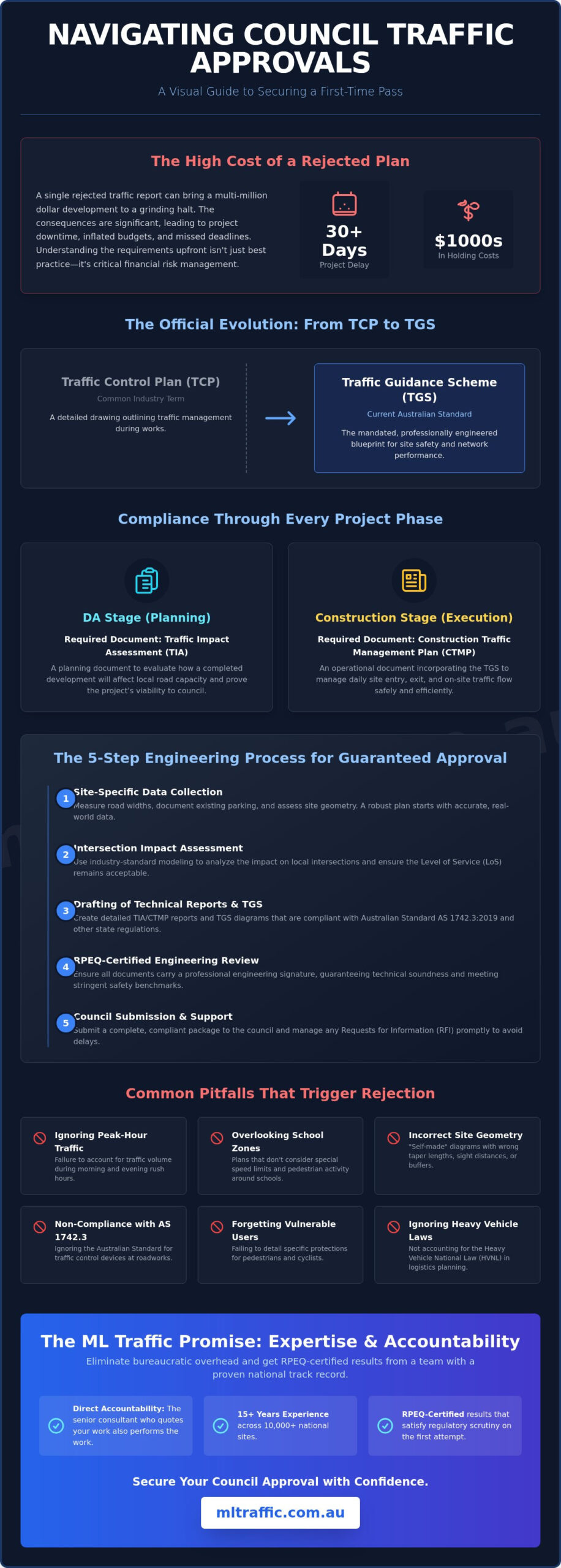
Key Takeaways
- Understand the technical evolution from a Traffic Control Plan (TCP) to a Traffic Guidance Scheme (TGS) to ensure your development meets current Australian safety and road network performance standards.
- Follow a rigorous five-step engineering process, from site-specific data collection to the drafting of technical TIA reports, to streamline your path to project commencement.
- Master the essential components of a traffic control plan for council approval, focusing on accurate site geometry and intersection impact assessments to eliminate submission errors.
- Identify and avoid common rejection pitfalls, such as failing to account for peak-hour traffic windows, school zones, and real-world site constraints that can cause expensive delays.
- Benefit from the “ML Traffic Promise,” where the senior consultant who quotes your work also performs the technical assessment, leveraging 15+ years of experience across 10,000+ national sites.
Table of Contents
What is a Traffic Control Plan for Council Approval?
A Traffic Control Plan (TCP) is a detailed technical drawing that outlines how vehicular and pedestrian traffic will be managed during construction, maintenance, or events. While the term TCP remains common in industry dialogue, it has officially evolved into the Traffic Guidance Scheme (TGS) under updated Australian regulatory frameworks. This document is a mandatory requirement for any developer seeking a traffic control plan for council approval, as it serves as a blueprint for site safety and operational efficiency.
The primary purpose of a TGS is to protect the public and site personnel while maintaining road network performance. It involves the application of fundamental road traffic control principles to ensure that traffic flow is predictable and hazards are minimised. Local councils and state road authorities, such as Transport for NSW or Victoria’s Department of Transport, mandate that these plans carry professional engineering signatures. This requirement ensures that the proposed measures are technically sound and meet stringent safety benchmarks.
To better understand this concept, watch this helpful video:
It’s critical to distinguish between a Traffic Impact Assessment (TIA) and a TGS. A TIA is a planning document used to evaluate how a completed development will affect local road capacity. In contrast, a TGS is an operational document focused on the physical site works. At ML Traffic Engineers, we ensure that the traffic consultant who provides the quote, does the work, providing a direct line of accountability for these technical documents.
The Legal and Safety Framework in Australia
Compliance is anchored in Australian Standard AS 1742.3:2019, which dictates the placement and types of traffic control devices used at roadworks. Additionally, transport planning must account for the Heavy Vehicle National Law (HVNL) to manage logistics safely. Many "self-made" diagrams fail the first round of council review because they ignore specific requirements for taper lengths, sight distances, and lateral buffers. Professional traffic engineering services prevent these delays by ensuring every diagram meets the precise standards required by road authorities.
DA Stage vs. Construction Stage Requirements
The transition from planning to execution involves different levels of documentation. During the Development Application (DA) stage, a Traffic Impact Statement (TIS) is typically required to prove the project is viable. Once the build phase begins, the focus shifts to a Construction Traffic Management Plan (CTMP). The CTMP incorporates the TGS to manage daily site entry and exit. Both documents are essential; they function as a compliance chain that councils use to verify that the project adheres to safety laws before they issue final occupancy certificates.
Key Components of a Compliant Traffic Management Report
A comprehensive traffic management report provides the technical foundation for any traffic control plan for council approval. It’s not merely a set of drawings; it’s a data-driven justification for how a development will interact with the existing transport network. Local councils across Australia require these reports to ensure that new projects don’t compromise road safety or network efficiency.
A compliant report must include a detailed analysis of site-specific geometry. This involves measuring existing road widths, identifying current parking restrictions, and documenting the condition of the pavement and kerbs. We assess the impact on local intersections using industry-standard modelling to ensure the Level of Service (LoS) remains acceptable. If a development adds 50 vehicle movements during peak hours to a saturated intersection, the report must propose viable mitigation strategies.
-
Vulnerable Road Users: Reports must detail specific provisions for pedestrians and cyclists. This includes maintaining clear sight-lines at crossing points and ensuring bicycle lane continuity isn’t disrupted by new driveways.
-
Signage and Devices: Every Traffic Guidance Scheme (TGS) requires a schedule of signage that complies with the Manual of Uniform Traffic Control Devices (MUTCD). This includes the exact placement of regulatory, warning, and guide signs.
-
Emergency Access: Contingency planning is vital. The report must demonstrate that a 12.5m Heavy Rigid Vehicle, such as a fire appliance, can access the site 24/7 without obstruction.
Vehicle Swept Path and Access Assessment
We utilise AutoTURN software to simulate the physical movement of vehicles within the site. This analysis is a mandatory requirement for any development featuring loading docks or basement car parks. It proves that the design vehicle, often a garbage truck or a large delivery van, can enter and exit the property in a forward direction. Without this proof, councils will likely reject the access design due to safety risks. You can find more detail in our Swept Path Analysis: A Complete Guide for Australian Developments.
Car Parking Design and Demand
Parking layouts must strictly adhere to AS 2890.1 for off-street car parking. We calculate parking demand by cross-referencing the proposed land use with local council LEP and DCP requirements. For example, a commercial warehouse has vastly different parking needs than a high-density residential flat building. Our assessments also focus on driveway ramp grades. We ensure these don’t exceed the maximum gradients specified in Australian Standards to prevent vehicle scraping and maintain safe sight-lines for exiting motorists. If you’re currently preparing a Development Application, our traffic engineering services can provide the necessary technical documentation to satisfy council requirements.
The 5-Step Process for Securing Council Traffic Approval
Obtaining approval for a traffic management strategy requires a systematic approach to technical documentation. Council engineers scrutinize every detail to ensure public safety and network efficiency. Following a structured five-step process minimizes the risk of delays and ensures your traffic control plan for council approval meets all regulatory benchmarks.
-
Initial site assessment and data collection: We begin by gathering empirical data on existing traffic volumes and peak flow periods. This includes measuring sight-lines, evaluating driveway ramp grades, and assessing current road geometry.
-
Technical design phase: Our engineers draft the Traffic Guidance Scheme (TGS) or a detailed Traffic Impact Assessment (TIA) report. This stage focuses on creating a traffic control plan for council approval that aligns with AS 1742.3 and relevant state supplements.
-
Internal review and certification: Every document undergoes a rigorous internal audit. A qualified traffic engineer verifies that the proposed vehicle swept paths and parking layouts comply with AS 2890.1.
-
Submission to authorities: We lodge the completed reports with the local council. If the project impacts state-managed infrastructure, we simultaneously coordinate with state road authorities to streamline the process.
-
Post-submission response: It’s common for councils to issue a Request for Further Information (RFI). We provide technical justifications and data-driven responses to resolve these queries quickly.
State Road Authorities vs. Local Council
Determining whether your project impacts a state-classified road is a critical first step. Local councils manage most residential and collector streets, but major arterial roads fall under state jurisdiction, such as Transport for NSW (TfNSW) or the Department of Transport and Main Roads (TMR) in Queensland. If your development site fronts a state road, you must secure a Road Occupancy Licence (ROL) in addition to council permits. Coordinating these multiple governing bodies requires precise technical alignment to avoid conflicting requirements.
Professional Certification Requirements
Councils often mandate that traffic reports be signed off by specific accredited professionals. This includes RPEQ (Registered Professional Engineer of Queensland) certification for northern projects or TfNSW-accredited designers for New South Wales sites. Senior engineer involvement is vital; it ensures that complex vehicle swept path assessments and sight-line analyses are accurate. Utilizing certified ML Traffic Engineers services ensures your documentation is prepared by experts who understand the nuances of Australian Standards. This high level of professional oversight significantly reduces the likelihood of council rejection and costly project stand-downs.
Common Pitfalls: Why Traffic Plans Get Rejected
A traffic control plan for council approval often fails due to technical inconsistencies that overlook local site realities. Councils across Australia maintain rigorous standards. They’ll issue a Request for Information (RFI) or an outright rejection if the documentation doesn’t align with their specific Development Control Plan (DCP). Common errors include using inaccurate site measurements. If a plan assumes a 10-meter road width but the actual kerb-to-kerb distance is 9.2 meters, the proposed lane management becomes unsafe and unworkable in practice.
Technical oversights often involve the following issues:
-
Peak-Hour Negligence: Failing to account for school zones or high-volume windows, typically 7:00 AM to 9:00 AM and 2:30 PM to 4:00 PM, results in immediate rejection.
-
Generic Templates: Using a non-site-specific plan ignores unique constraints like bus stops, fire hydrants, or existing street furniture.
-
Heavy Vehicle Constraints: Inadequate swept path assessments for 12.5m Heavy Rigid Vehicles (HRV) lead to plans that cause kerb mounting or property damage. Plans must show turning circles that comply with AS 2890.1.
Our engineers have seen cases where a 5% error in measurement led to a three-month delay in project commencement. Precision is not optional when dealing with local authorities.
Ignoring Pedestrian and Cyclist Safety
Oversight of shared paths is a frequent cause for construction permit delays. You must maintain clear sight distances at all egress points to ensure vehicles exiting the site don’t collide with cyclists. Integrating cycleway impacts into your broader traffic guidance scheme is mandatory under current safety protocols. If a hoarding blocks a pedestrian’s view of oncoming traffic, the council will require a total redesign of your traffic control plan for council approval before any work starts.
Outdated Traffic Data and Modelling
Submitting traffic counts that are more than 24 months old is a significant risk. Most councils require data from the last 12 months to reflect current network capacity accurately. Using 5-year-old data leads to an immediate RFI because it fails to account for recent local developments and changed traffic patterns. We use modern intersection analysis and SIDRA modelling to prove network capacity. All calculations must adhere to Australian Standards, specifically AS 1742.3, to guarantee technical compliance and safety.
Avoid costly project delays by ensuring your documentation is prepared by experienced RPEQ and accredited engineers. Professional traffic engineering services can help you navigate these complex council requirements.
Expert Traffic Engineering for Your Next Development
ML Traffic Engineers has operated as a specialist consultancy since 2005. In that time, our team has completed assessments for over 10,000 sites across Australia. We don’t believe in the traditional corporate hierarchy where projects are handed down to junior staff. Our firm operates on the "ML Traffic Promise": the consultant who quotes your work is the person who does the work. This ensures that the technical precision required for a traffic control plan for council approval is maintained from the initial consultation through to the final report submission.
Our principals, Michael Lee and Benny Chen, bring between 30 and 40 years of individual experience to every project. This level of seniority is vital when navigating the bureaucratic requirements of local councils. Professional reporting does more than just meet a checklist; it accelerates the DA approval timeline. By providing clear, data-backed evidence of site safety and efficiency, we reduce the likelihood of councils issuing time-consuming Requests for Information (RFI). We provide the technical authority needed to move your development forward without unnecessary delays.
Comprehensive Services for Developers
Our service suite is designed to address every traffic-related hurdle a developer might face. We specialise in Vehicle Swept Path Analysis to verify that waste vehicles, delivery trucks, and residential cars can navigate your site safely. We also provide detailed Traffic Impact Assessments (TIA) and Car Parking Demand Assessments to justify deviations from standard rates. Every car park design we review is checked against AS 2890.1 to ensure total compliance with Australian Standards. You can read more About ML Traffic Engineers and our history of delivering results for private developers, architects, and town planners.
Get a Compliant Traffic Plan Today
Securing an authoritative quote is a streamlined process. Simply provide your site plans and a brief description of the proposed land use. Because we maintain a "no-gatekeepers" approach, you get direct access to senior engineers who understand the specific constraints of your local government area. This direct line of communication ensures that your traffic control plan for council approval is accurate and reflects the actual conditions of your site. We’ve worked on everything from high-rise apartments and shopping centres to childcare facilities and industrial warehouses. Contact ML Traffic Engineers today to start your assessment and ensure your project meets all regulatory benchmarks.
Secure Your Development Approval with Precision Engineering
Securing a traffic control plan for council approval requires more than a basic layout. It demands strict adherence to Australian Standards, specifically AS 2890, and precise Vehicle Swept Path Analysis to prevent application rejections. Most delays occur because of technical errors in driveway ramp grades or sight-line assessments that don’t meet local government requirements. By addressing these technicalities early, you ensure your development remains on schedule and compliant.
ML Traffic Engineers provides the technical authority needed for successful submissions. We’ve assessed over 10,000 sites nationally and offer direct access to senior engineers with more than 30 years of experience. Our hands-on approach means the consultant who provides your quote is the same expert who performs the technical work. We focus on delivering meticulous reports that satisfy council planners and minimize the risk of costly revisions.
Get a Professional Traffic Engineering Quote for Your Council Submission
Taking the right steps now sets your project up for a smooth approval process and long-term operational success.
Frequently Asked Questions
What is the difference between a Traffic Control Plan (TCP) and a Traffic Guidance Scheme (TGS)?
A Traffic Guidance Scheme (TGS) is the current technical term used under Australian Standard AS 1742.3:2019 to describe the visual map of signs and devices. While many people still use the term Traffic Control Plan (TCP) to describe these diagrams, a TCP technically refers to the broader strategic document outlining the entire traffic management approach. Most Australian councils now specifically request a site-specific TGS for construction permits.
How long does it typically take for a council to approve a traffic management plan?
Standard council approval typically takes 10 to 14 business days from the date of submission. For example, the City of Sydney and City of Melbourne generally operate within this 2 week window for standard applications. If your project impacts state-managed roads, the review process involving Transport for NSW or Department of Transport and Planning can extend to 28 days or more.
Do I need a traffic engineer for a small residential development?
You usually require a qualified professional to prepare a traffic control plan for council approval even for small residential projects like townhouses. Councils require plans to be designed by individuals holding a "Design and Inspect Traffic Control Plans" qualification. If your development changes site access or affects on-street parking, an engineer ensures the design meets AS 2890.1 standards for parking facilities.
Can I use a generic traffic control plan template for my council submission?
No, councils reject generic templates because they don’t account for specific site risks or local road geometry. Every traffic control plan for council approval must be site-specific and reflect current conditions such as nearby bus stops, school zones, or clearways. Using a generic plan increases the risk of site accidents and leads to immediate application refusal by council engineers.
What is a Road Occupancy Licence (ROL) and when do I need one?
A Road Occupancy Licence (ROL) is a formal permit that allows you to use a specified portion of the road or footpath for your work. You need an ROL whenever your construction activities interfere with the normal flow of traffic or pedestrians, such as placing a concrete pump on the road. For state roads in NSW, applications must be lodged through the OPGATE system at least 10 days before work starts.
How much does a professional traffic impact assessment cost for a DA?
The cost of a Traffic Impact Assessment (TIA) depends on the complexity of the development and required data. Industry benchmarks indicate that a standard TIA for a small-scale residential or commercial project ranges from A$2,500 to A$5,000. Large-scale developments requiring SIDRA intersection modelling or multi-day traffic counts often cost upwards of A$10,000 based on the volume of data collection required.
Does my traffic plan need to be signed by a specific type of engineer?
Yes, your plan must be signed by a person with a valid "Design and Inspect Traffic Control Plans" certification. For complex Development Applications (DA), councils often mandate that a Registered Professional Engineer of Queensland (RPEQ) or a Chartered Professional Engineer (CPeng) signs off on the report. This ensures the proposed traffic movements are safe and meet the technical requirements of the relevant state road authority.
What happens if my construction traffic plan is rejected by the council?
If your plan is rejected, the council will issue a Request for Further Information (RFI) detailing the non-compliance issues. You must revise the traffic control plan for council approval to address every specific concern, such as adjusting vehicle swept paths or changing work hours. Resubmitting a corrected plan typically restarts the 14 day review cycle, which can delay your construction start date by several weeks.
Which areas do you cover?
We are traffic engineers servicing Abbotsbury, Abbotsford, Acacia Gardens, Agnes Banks, Airds, Alexandria, Alfords Point, Allambie Heights, Allawah, Ambarvale, Angus, Annandale, Annangrove, Arcadia, Arncliffe, Arndell Park, Artarmon, Ashbury, Ashcroft, Ashfield, Asquith, Auburn, Austral, Avalon Beach, Badgerys Creek, Balgowlah, Balgowlah Heights, Balmain, Balmain East, Bangor, Banksia, Banksmeadow, Bankstown, Bankstown Aerodrome, Barangaroo, Barden Ridge, Bardia, Bardwell Park, Bardwell Valley, Bass Hill, Baulkham Hills, Bayview, Beacon Hill, Beaconsfield, Beaumont Hills, Beecroft, Belfield, Bella Vista, Bellevue Hill, Belmore, Belrose, Berala, Berkshire Park, Berowra, Berowra Heights, Berowra Waters, Berrilee, Beverley Park, Beverly Hills, Bexley, Bexley North, Bidwill, Bilgola Beach, Bilgola Plateau, Birchgrove, Birrong, Blackett, Blacktown, Blair Athol, Blairmount, Blakehurst, Bligh Park, Bondi, Bondi Beach, Bondi Junction, Bonnet Bay, Bonnyrigg, Bonnyrigg Heights, Bossley Park, Botany, Bow Bowing, Box Hill, Bradbury, Bradfield, Breakfast Point, Brighton-Le-Sands, Bringelly, Bronte, Brooklyn, Brookvale, Bundeena, Bungarribee, Burraneer, Burwood, Burwood Heights, Busby, Cabarita, Cabramatta, Cabramatta West, Caddens, Cambridge Gardens, Cambridge Park, Camellia, Cammeray, Campbelltown, Camperdown, Campsie, Canada Bay, Canley Heights, Canley Vale, Canoelands, Canterbury, Caringbah, Caringbah South, Carlingford, Carlton, Carnes Hill, Carramar, Carss Park, Cartwright, Castle Cove, Castle Hill, Castlecrag, Castlereagh, Casula, Catherine Field, Cattai, Cecil Hills, Cecil Park, Centennial Park, Chatswood, Chatswood West, Cheltenham, Cherrybrook, Chester Hill, Chifley, Chippendale, Chipping Norton, Chiswick, Chullora, Church Point, Claremont Meadows, Clarendon, Clareville, Claymore, Clemton Park, Clontarf, Clovelly, Clyde, Coasters Retreat, Cobbitty, Colebee, Collaroy, Collaroy Plateau, Colyton, Como, Concord, Concord West, Condell Park, Connells Point, Constitution Hill, Coogee, Cottage Point, Cowan, Cranebrook, Cremorne, Cremorne Point, Cromer, Cronulla, Crows Nest, Croydon, Croydon Park, Curl Curl, Currans Hill, Currawong Beach, Daceyville, Dangar Island, Darling Point, Darlinghurst, Darlington, Davidson, Dawes Point, Dean Park, Dee Why, Denham Court, Denistone, Denistone East, Denistone West, Dharruk, Dolans Bay, Dolls Point, Doonside, Double Bay, Dover Heights, Drummoyne, Duffys Forest, Dulwich Hill, Dundas, Dundas Valley, Dural, Eagle Vale, Earlwood, East Hills, East Killara, East Lindfield, East Ryde, Eastern Creek, Eastgardens, Eastlakes, Eastwood, Edensor Park, Edgecliff, Edmondson Park, Elanora Heights, Elderslie, Elizabeth Bay, Elizabeth Hills, Elvina Bay, Emerton, Enfield, Engadine, Englorie Park, Enmore, Epping, Ermington, Erskine Park, Erskineville, Eschol Park, Eveleigh, Fairfield, Fairfield East, Fairfield Heights, Fairfield West, Fairlight, Fiddletown, Five Dock, Forest Glen, Forest Lodge, Forestville, Frenchs Forest, Freshwater, Gables, Galston, Georges Hall, Gilead, Girraween, Gladesville, Glebe, Gledswood Hills, Glen Alpine, Glendenning, Glenfield, Glenhaven, Glenmore Park, Glenorie, Glenwood, Gordon, Grantham Farm, Granville, Grays Point, Great Mackerel Beach, Green Valley, Greenacre, Greendale, Greenfield Park, Greenhills Beach, Greenwich, Gregory Hills, Greystanes, Guildford, Guildford West, Gymea, Gymea Bay, Haberfield, Hammondville, Harrington Park, Harris Park, Hassall Grove, Haymarket, Heathcote, Hebersham, Heckenberg, Henley, Hillsdale, Hinchinbrook, Hobartville, Holroyd, Holsworthy, Homebush, Homebush West, Horningsea Park, Hornsby, Hornsby Heights, Horsley Park, Hoxton Park, Hunters Hill, Huntingwood, Huntleys Cove, Huntleys Point, Hurlstone Park, Hurstville, Hurstville Grove, Illawong, Ingleburn, Ingleside, Jamisontown, Jannali, Jordan Springs, Kangaroo Point, Kareela, Kearns, Kellyville, Kellyville Ridge, Kemps Creek, Kensington, Kenthurst, Kentlyn, Killara, Killarney Heights, Kings Langley, Kings Park, Kingsford, Kingsgrove, Kingswood, Kirkham, Kirrawee, Kirribilli, Kogarah, Kogarah Bay, Ku-ring-gai Chase, Kurnell, Kurraba Point, Kyeemagh, Kyle Bay, La Perouse, Lakemba, Lalor Park, Lane Cove, Lane Cove North, Lane Cove West, Lansdowne, Lansvale, Laughtondale, Lavender Bay, Leets Vale, Leichhardt, Len Waters Estate, Leppington, Lethbridge Park, Leumeah, Lewisham, Liberty Grove, Lidcombe, Lilli Pilli, Lilyfield, Lindfield, Linley Point, Little Bay, Liverpool, Llandilo, Loftus, Londonderry, Long Point, Longueville, Lovett Bay, Lower Portland, Lucas Heights, Luddenham, Lugarno, Lurnea, Macquarie Fields, Macquarie Links, Macquarie Park, Maianbar, Malabar, Manly, Manly Vale, Maraylya, Marayong, Maroota, Maroubra, Marrickville, Marsden Park, Marsfield, Mascot, Matraville, Mays Hill, McCarrs Creek, McGraths Hill, McMahons Point, Meadowbank, Melonba, Melrose Park, Menai, Menangle Park, Merrylands, Merrylands West, Middle Cove, Middle Dural, Middleton Grange, Miller, Millers Point, Milperra, Milsons Passage, Milsons Point, Minchinbury, Minto, Minto Heights, Miranda, Mona Vale, Monterey, Moore Park, Moorebank, Morning Bay, Mortdale, Mortlake, Mosman, Mount Annan, Mount Colah, Mount Druitt, Mount Kuring-Gai, Mount Lewis, Mount Pritchard, Mount Vernon, Mulgoa, Mulgrave, Narellan, Narellan Vale, Naremburn, Narrabeen, Narraweena, Narwee, Nelson, Neutral Bay, Newington, Newport, Newtown, Nirimba Fields, Normanhurst, North Balgowlah, North Bondi, North Curl Curl, North Epping, North Kellyville, North Manly, North Narrabeen, North Parramatta, North Rocks, North Ryde, North St Marys, North Strathfield, North Sydney, North Turramurra, North Wahroonga, North Willoughby, Northbridge, Northmead, Northwood, Norwest, Oakhurst, Oakville, Oatlands, Oatley, Old Guildford, Old Toongabbie, Oran Park, Orchard Hills, Oxford Falls, Oxley Park, Oyster Bay, Paddington, Padstow, Padstow Heights, Pagewood, Palm Beach, Panania, Parklea, Parramatta, Peakhurst, Peakhurst Heights, Pemulwuy, Pendle Hill, Pennant Hills, Penrith, Penshurst, Petersham, Phillip Bay, Picnic Point, Pitt Town, Pleasure Point, Plumpton, Point Piper, Port Botany, Port Hacking, Potts Hill, Potts Point, Prairiewood, Prestons, Prospect, Punchbowl, Putney, Pymble, Pyrmont, Quakers Hill, Queens Park, Queenscliff, Raby, Ramsgate, Ramsgate Beach, Randwick, Redfern, Regents Park, Regentville, Revesby, Revesby Heights, Rhodes, Richards, Richmond, Riverstone, Riverview, Riverwood, Rockdale, Rodd Point, Rookwood, Rooty Hill, Ropes Crossing, Rose Bay, Rosebery, Rosehill, Roselands, Rosemeadow, Roseville, Roseville Chase, Rossmore, Rouse Hill, Rozelle, Ruse, Rushcutters Bay, Russell Lea, Rydalmere, Ryde, Sackville North, Sadleir, Sandringham, Sandy Point, Sans Souci, Schofields, Scotland Island, Seaforth, Sefton, Seven Hills, Shalvey, Shanes Park, Silverwater, Singletons Mill, Smeaton Grange, Smithfield, South Coogee, South Granville, South Hurstville, South Maroota, South Penrith, South Turramurra, South Wentworthville, South Windsor, Spring Farm, St Andrews, St Clair, St Helens Park, St Ives, St Ives Chase, St Johns Park, St Leonards, St Marys, St Peters, Stanhope Gardens, Stanmore, Strathfield, Strathfield South, Summer Hill, Surry Hills, Sutherland, Sydenham, Sydney, Sydney Olympic Park, Sylvania, Sylvania Waters, Tallawong, Tamarama, Taren Point, Telopea, Tempe, Tennyson Point, Terrey Hills, The Ponds, The Rocks, Thornleigh, Toongabbie, Tregear, Turramurra, Turrella, Ultimo, Varroville, Vaucluse, Villawood, Vineyard, Voyager Point, Wahroonga, Waitara, Wakeley, Wareemba, Warrawee, Warriewood, Warwick Farm, Waterfall, Waterloo, Watsons Bay, Wattle Grove, Waverley, Waverton, Wedderburn, Wentworth Point, Wentworthville, Werrington, Werrington County, Werrington Downs, West Hoxton, West Pennant Hills, West Pymble, West Ryde, Westleigh, Westmead, Wetherill Park, Whalan, Whale Beach, Wheeler Heights, Wiley Park, Willmot, Willoughby, Willoughby East, Windsor, Windsor Downs, Winston Hills, Wisemans Ferry, Wolli Creek, Wollstonecraft, Woodbine, Woodcroft, Woodpark, Woollahra, Woolloomooloo, Woolooware, Woolwich, Woronora, Woronora Heights, Yagoona, Yarrawarrah, Yennora, Yowie Bay, Zetland.

Disclaimer
The content on www.mltraffic.com.au, including all technical articles, guides, and resources, is provided for general informational and educational purposes only. It is not intended to constitute professional advice in traffic engineering, transportation planning, development approvals, or any other technical or legal field.
While ML Traffic Engineers makes every reasonable effort to ensure the accuracy, completeness, and timeliness of the information published, we do not provide any warranties or representations (express or implied) regarding its reliability, suitability, or availability for any particular purpose. Any reliance you place on the content is strictly at your own risk.
In no event shall ML Traffic Engineers, its directors, employees, authors, or affiliates be liable for any direct, indirect, incidental, special, consequential, or punitive damages (including, without limitation, loss of profits, data, or business opportunities) arising out of or in connection with the use of, or inability to use, any information provided on this website.
The articles and guides on this site are not a substitute for engaging a qualified, registered professional traffic engineer (such as an NPER or RPEQ engineer) to assess your specific project requirements. For tailored advice, compliance assessments, or traffic engineering services, please contact a competent professional.
This disclaimer may be updated from time to time without notice. By accessing or using this website, you agree to be bound by the most current version of this disclaimer.
